Book review, gothic fiction, Jane Austen, Northanger Abbey, satire

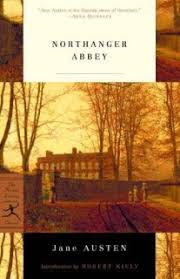
Northanger Abbey, by Jane Austen, 1818

I think Jane Austen is one of our greatest authors. ‘Pride and Prejudice‘ is a masterpiece of controlled writing that has few if any equals, with ‘Emma‘ a close second on any list of classic novels. While ‘Northanger Abbey‘ may not be in the same league, a careful read can uncover many signs of the great author Austen was to become.

Northanger

The central weakness of the novel resides with our heroine, Catherine Morland.

Continue reading
Standard
Book review

The War in the Air, by H G Wells, 1907

I was intending to take a break from Wells, but this novel jumped out at me from the shelves of a second hand bookshop, and as it wasn’t one I had heard of before, let alone read, I thought it worth the £1 investment!war

It is interesting how the reputations of writers and their works evolve over time. In the publisher’s introduction to this 1967 Penguin edition, written much nearer to the time of Well’s death than today – and even slightly nearer to the date the novel was first published than today – Wells’s “chief novels” are listed as “Ann Veronica, (109) Tono-Bungay, (141) The World of William Clissold (4), Brynhild, (3) Dolores (now published as Apropos of Dolores (3)), and The Holy Terror (2)”.

Now be honest, how many of these novels have you heard of, let alone read? This is a Penguin edition remember, not some obscure publisher wanting to promote Wells’ back catalogue. The numbers in brackets are the number of reviews each book has received on Goodreads – by comparison the results for three books not mentioned in this introduction are 8,473 – The Time Machine; 5,726 – War of the Worlds; 4,322 – ‘The Invisible Man’.

Why did Penguin focus on these now largely forgotten novels, and ignore his science fiction – in the introduction to one of his science fiction novels? It is not the case that the more popular novels I have mentioned have only recently become popular – they have been in print since first published, and formed the basis of many films, television programmes, sequels, and of course radio adaptations?  Usually I can offer some speculation on these questions, but this time I am completely stumped? Anyone?

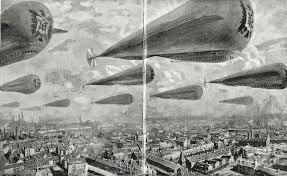
‘The War in the Air’ (66), another invasion novel, is subtitled ‘And particularly how Mr Bert Smallways fared while it lasted’. The novel is Wells’s speculation on how human flight, just taking off (if you will excuse the pun) when written, will affect warfare. The novel is a strange mixture of fairly low comedy – much of it is written as the misadventures of Wells’s everyman character, as sort of English Good Soldier Schweik – and combat scenes. Wells’s predictions are partly wrong – aerial combat did not develop the way he thought it might, largely due to the practical limitations of airships – and partly completely right, in terms of the devastation of global war. The comedy doesn’t really work, and fits uncomfortably with the war scenes, which explains I think why this novel is largely forgotten while others such as ‘War of the Worlds’ continue to grip our collective imagination.

Steampunk aficionados have claimed this text as one of their own but even this community of readers will find it hard to enjoy much in this labouring and poorly constructed novel.

Standard
Book review, First World War, H H Munro, invasion literature, Saki, When William Came

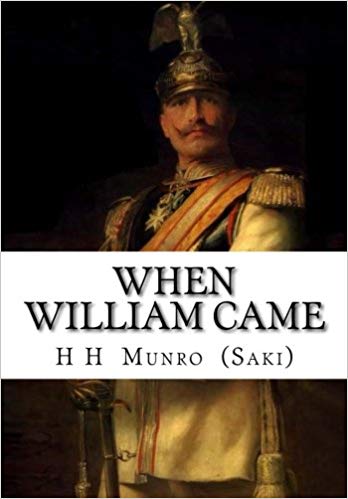
When William Came, by H H Munro (Saki) 1913

More invasion literature, this time a long short story or novella by a writer more traditionally associated with humour, albeit of the more biting kind. I originally read ‘When William Came‘ many years ago, and it is one of those stories that sticks in your head, particularly the final vivid image of resistance and rebellion. when william came

Let me explain. In the years running up to the First World War, there was a common understanding that a global conflict was coming. Initially this was a speculative idea – “what if there is a global war?” –  but after much repetition it become more a question of “When there is a global war…” This idea in other words became part of the political and cultural landscape, accepted as a truism. Novels were written about how the conflict might start and pan out, and a particular focus was on the UK’s lack of preparation. There was also a fashion for novels that saw the country quickly defeated by a technologically and militarily superior alien force (‘War of the Worlds’ for example) with the bulldog spirit emerging at the end to fight back. Other perspectives focussed on the precise nature of our enemies’ preparations – see ‘The Riddle of the Sands’ by Erskine Childers for example.

‘When William Came’ (William, in this context, being Kaiser Wilhelm) opens with the return to the UK of Murray Yeovil, a wandering aristocratic Englishman. He has been very unwell on his travels, and thus isolated from the catastrophic news from home. This provides an opening for a recount of the story of the UK’s recent conquest. A swift and decisive land invasion and an equally destructive naval battle, in which the dispersed British fleet was destroyed by superior German technology, followed by the flight of the royal family and much of the upper classes to imperial India, left the UK defeated and conquered. A few months has passed, and London is slowly accommodating the German victors. Society is divided between those prepared to put up with the demands made by the Germans – new street signs, higher taxes, new currency, German culture, etc – and those who either retreat to the country or emigrate.

Resistance has not entirely faded from the conquered British spirit, and there are several discussions about how the UK could throw off the German oppressor, possibly using the forces of the Empire. These are given short shrift – the German stranglehold on the UK is overwhelming and any resistance by Australia or Canada for example would see their swift defeat in turn. Munro is arguing that there will be no second chances – defeat is the end of the Empire. Yeovil despairs at the decadence of British society that has led to this situation – the novel is a thinly disguised plea for rearmament and the introduction of national service.

Anti-semitism is a feature of far too many novels of this period, and Saki’s portrait of Jewish characters and society in this novel is hard to stomach at times. He goes far beyond the casual anti-semitism of everyday Edwardian language and perpetuates many of the classic anti-semitic tropes that were widely accepted at the time but no less distressing and damaging for all that. I still haven’t worked out whether this damages the novel overall for me sufficiently to detract from the value of Munro’s writing – it is not an integral part of the novel, but it is sufficiently pervasive to be pretty damaging, not something that can be skipped over as ‘just the way people spoke back then’. This is also not a question of Munro giving anti-semitic ideas to a character as part of their portrayal – this is a much more didactic novel than that. I am not a proponent of censorship of novels featuring language or ideas we no longer find acceptable, but there are some novels that should be left to gather dust.

Which is a pity, because ‘When William Came’ is otherwise a powerful portrait of a conquered and cowed Britain, emasculated by defeat. (Yeovil’s wife openly flirts with other men in front of her husband, who seems untroubled by her disloyalty.) The closing scene in which the youth of the country defy the invaders has been criticised (on Goodreads) as being ridiculous or anti-climatic, but I found it powerful and vivid. The fact that Munro went on to die in the imminent Great War gives the novel a greater poignancy.

This is undoubtedly a literary curiosity, and unrepresentative of Saki’s oeuvre, his waspish short stories. It is I think an important representative of the invasion literature genre – one that accepts war as inevitable, and expresses fear for Britain’s preparedness. It is however unlike many other examples in that the war is not described, and avoids any reference to the physical destruction many other novels anticipate (London seems barely touched). I can’t honestly recommend it unless you have a particular interest in these topics and a strong stomach for anti-Semitism.

Standard
Book review, Crime, gothic fiction, Laura Purcell, The Silent Companions

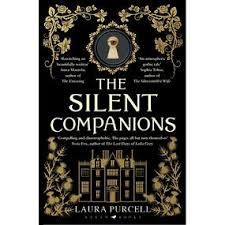
The Silent Companions, by Laura Purcell, 2017

This was a holiday, ‘I need something to read that isn’t too serious’ read, but to be honest it is not the kind of novel I would usually bother with, even notwithstanding the endorsement of the Zoe Ball Book Club. This is one of those novels where the book cover and blurb tell you almost everything you need to know:

purcell
“When newly widowed Elsie is sent to see out her pregnancy at her late husband’s crumbling country estate, The Bridge, what greets her is far from the life of wealth and privilege she was expecting . . .”
I appreciate that sometimes dramatic clichés are hard to avoid. But this novel embraces them with ardour.
In Jane Austen’s satire on this genre, ‘Northanger Abbey’, the heroine Catherine Morland describes why she is not frightened to be visiting the Abbey, despite her romantic fancies:
“Besides, it has never been uninhabited and left deserted for years, and then the family come back to it unawares without giving any notice, as generally happens“.
You have guessed it, this is precisely what happens at the opening of ‘The Silent Companions’, when with her husband dead just weeks after their marriage, Elsie returns to the spooky ancestral home with only her husband’s cousin for company. Or so she thinks. The husband’s cousin has been dispossessed by the marriage and siring of an heir, so one would expect her to be a figure of suspicion when the inevitable mysterious and eerie events start to occur. But of course that never happens.

You have to wonder whether Austen would have thought her satirical observations on the gothic novel would remain relevant 200 years on?
Locked doors, painted wooden figures that bear a striking resemblance to other characters and whose eyes follow you around the room, a moody housekeeper, sullen villagers, mental asylum patients struck dumb with fear, things that almost literally go bump in the night – there really isn’t a cliché left unmined in this gothic horror story. Oh, not forgetting the shop that mysteriously appears and then can’t be found the next day – isn’t that borrowed from ‘Gremlins’?

The author never quite decides if she is writing a crime novel or a supernatural thriller. There is an entirely predictable, common-sense whodunit ending in which we are led to believe that the novel’s events are all wrapped up, but a moment’s consideration reminds the reader that many of those events have in fact not been explained, and could only have had a supernatural explanation, making the attempt to provide a realistic explanation redundant.

It will be clear by now this is not a recommended read. It is lazy generic fiction and a waste of the reader’s time.

Standard
19th Century literature, Book review, George Orwell, H G Wells, science fiction', The Time Machine

The Time Machine by H G Wells,1895

Continuing with my Wells-athon, all of which have been quite short novels, I now turn to the hugely influential ‘The Time Machine’.

Time travel was not a new concept, but Wells’s novel was one of the earliest on this theme, and established some concepts and principles that remain with us. having said that, I found the behaviour of Wells’ s protagonist in many ways puzzling. If you had invented a time machine, what would you do? Where would you go? Would you go back to the nativity, to the Globe in 1605, to assassinate Hitler? Or would you travel 800,000 years into the future, as Wells’ time traveller does, without packing a sandwich, let alone a camera or a weapon? I know that is a ridiculously literal response to a science fiction story, but good science fiction is above all plausible. If I could forward travel in time I would like to know how society reshapes itself in 100 years, what new technology is developed, whether extra-terrestrial life is encountered, so many other things – but 800,000 years?? Given that the existing span of human civilization can be measured in single-figure thousands of years, it seems wildly optimistic to imagine that humans will still be around this far into the future.

I appreciate I am still being too literal – time travel is simply a device to allow Wells to speculate on how human society will evolve, and we need not get too absorbed with the precise date – this is simply the vaguely distant future. In this future humans have evolved into two distinct races, the Eloi and the Morlocks. The Morlocks live underground, and predate upon the simple-minded Eloi. Society is decaying terminally. Into this world the time traveller is pitched, loses his machine, and is forced to confront his slowly dawning realisation that this is no Utopia he had hoped man would have built for himself.

Wells’s conception of time travel is quaint. It doesn’t involve Government-led endeavours and vast resources – an independent inventor working in his shed is able to master the feat after a few years of study. He sets off in an extraordinarily blase fashion, making no preparation whatsover – this is a quick jaunt into the future, not an expedition risking life and limb, back in time for a quick bath and dinner at eight. Victorians were of course great explorers, and often quite eccentric into the bargain, but Wells’ s time traveller takes this to the extreme.

One of the most distinctive features of Wells’ writing is his focus on the personal, the everyday, even when his themes are global or astronomical. As I mentioned in my review of ‘War of the Worlds’, the Martian conflict is constrained within the English Home Counties, and described from the limited perspective of two individual observers. The scenes from ‘The Invisible Man’ are all rooted in suburban and rural England. Kipps and Mr Polly follow the same pattern – his protagonists are everymen. It is no coincidence that the central characters in ‘The War of the Worlds’ and ‘The Time Machine’ are both unnamed. This allows them to act as representatives of their class and time.

However, politically, ‘The Time Machine’ is a difficult book. Wells is commonly considered as a socialist, but his portrait of a future in which the working class has become a cannibalistic underground monster, preying on the weak and enfeebled middle classes, is profoundly pessimistic. It not only expresses “Wells’s horror at the realities of 19th-century class relations, but also his fears about what utopian socialism and communism were offering in their place” (Matthew Taunton). It is hard to travel back from the dystopia of 800,000 to 1895 and find a way to avoid this co-evolution and class war.

It’s been interesting to revisit Wells, but I remain ambivalent about his status as a writer. Influential, without question. I think his social comedies have aged less well than his science fiction. But if I ever am at a loss to put into words my thoughts and feelings about a novel or a writer, there is always one reliable solution, and that is to turn to George Orwell. Try it – he almost always has something sensible and interesting to say about any author of his time or before. Reliably, he puts his finger on this sense of unease. In ‘Wells, Hitler and the World State’, published in Horizon in 1941, he wrote:

Thinking people who were born about the beginning of this century are in some sense Wells’s own creation… I doubt whether anyone who was writing books between 1900 and 1920, at any rate in the English language, influenced the young so much. The minds of all of us, and therefore the physical world, would be perceptibly different if Wells had never existed.”

But he goes on to say

the singleness of mind, the one-sided imagination that made him seem like an inspired prophet in the Edwardian age, make him a shallow, inadequate thinker now…. Back in the nineteen-hundreds it was a wonderful experience for a boy to discover H. G. Wells….But because he belonged to the nineteenth century and to a non-military nation and class, he could not grasp the tremendous strength of the old world… He was, and still is, quite incapable of understanding that nationalism, religious bigotry and feudal loyalty are far more powerful forces than what he himself would describe as sanity. “

Orwell anatomises with extraordinary precision why Wells’s utilitarian version of socialism had not come to pass, even though the scientific advances he anticipated had been realised and indeed exceeded:

Creatures out of the Dark Ages have come marching into the present, and if they are ghosts they are at any rate ghosts which need a strong magic to slay them…Wells is too sane to understand the modern world. The succession of lower-middle-class novels which are his greatest achievement stopped short at the other war and never really began again, and since 1920 he has squandered his talents in slaying paper dragons. But how much it is, after all, to have any talents to squander.”

Creatures out of the Dark Ages have come marching into the present“. Wow.


Standard
Book review, HG Wells, Orson Welles, Second World War, War of the Worlds

Supplementary: Wells and Welles – when Herbert George met Orson

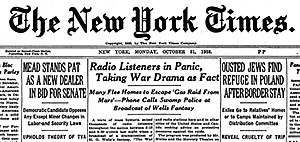
Following on from my post about H G Wells’ ‘War of the Worlds’, I wanted to share with you an anecdote about one of the more interesting aspects of this novel’s “afterlife” and its impact on society. You are probably familiar with the story of Orson Welles’s radio dramatization of the novel, broadcast just before Halloween in 1938, at the height of the events leading up to the Munich agreement. Such was the effectiveness of the dramatic techniques used in the broadcast, it is said, that many Americans believed their country was really under attack. 300px-WOTW-NYT-headline

Continue reading

Standard
Book review, H G Wells, invasion literature, science fiction', War of the Worlds

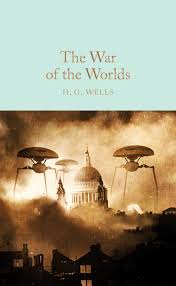
War of the Worlds by H G Wells, 1897

Wotw

“No one would have believed in the last years of the nineteenth century that this world was being watched keenly and closely by intelligences greater than man’s and yet as mortal as his own; that as men busied themselves about their various concerns they were scrutinised and studied, perhaps almost as narrowly as a man with a microscope might scrutinise the transient creatures that swarm and multiply in a drop of water.”

I come from the generation that finds it physically impossible to read that opening paragraph without hearing Richard Burton’s magnificent voice, providing the narration for Jeff Wayne’s album.

I really enjoyed ‘War of the Worlds’. I can’t imagine you don’t know the basic premise, but just in case, here goes: aliens attack Woking, and thence Southern England. Not so much war of the worlds therefore as Martians vs the Home Counties. And of course ‘we’ win, in a way that had allowed Europeans to win so many earlier colonial wars.

Continue reading
Standard
19th Century literature, Book review, H G Wells, science fiction'

The Invisible Man, by H G Wells, 1897

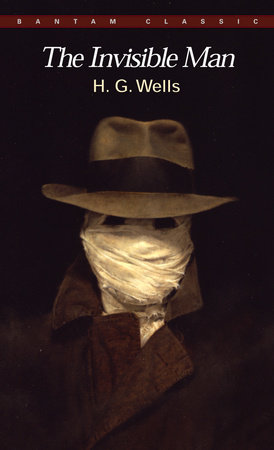
The power to transform the human body using advances in scientific understanding. 9780553213539This was the theme that captured the imagination of many nineteenth century writers, including, among others, Mary Shelley in ‘Frankenstein‘, Robert Louis Stevenson in ‘Dr Jekyll and Mr Hyde‘, and H.G. Wells in ‘The Invisible Man‘. In this late Victorian novella, Wells explores the idea of what would happen if someone, somehow, managed to make themselves invisible. Continue reading
Standard
Book review, China Meiville, Crime, The City and the City, Weird fiction

The City and the City, by China Meiville, 2009

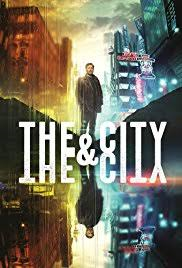
When reading this review, if you do, please remember my policy on spoilers – which is that I will probably use them. I don’t do so deliberately, I just find it hard to write comprehensively about something I have read without writing about the things that other readers might consider spoilers (bearing in mind of course that there is no meivilleuniversally agreed definition of what constitutes a spoiler in the first place). ‘The City and the City‘ is particularly difficult to review without reference to the central concept. If you avoid blurbs, plot summaries, reviews, tv adaptations etc, and read this novel without any preconceptions (I would agree by the way that a ‘pure’ approach to reading any novel is impossible – the reader will be influenced by their knowledge of the author, the cover illustration, etc) you become slowly aware that there is something unusual about the setting.

The central concept in this otherwise orthodox police procedural novel is extraordinary. Inspector Borlú, of the Extreme Crime Squad in the central European country of Besźel, investigates the murder of a foreign student. The victim was involved in debates about the complex relationship between Besźel and its neighbour and rival Ul Qoma. From early on there are some unusual aspects of Borlu’s narration. He talks about ‘unseeing’ a passerby, with no explanation of what this means. Borlu is Beszel born and bred, so his instincts as a native are deeply ingrained – he sees nothing out of the ordinary in what follows. Slowly, the true nature of Beszel and Ul Qoma’s unique relationship is revealed. The cities occupy the same geographical space, but preserve their separation through rigid adherence to ‘unseeing’ – being aware of but refusing to acknowledge the existence of the other – its buildings, vehicles, citizens and so on. This practice is enforced by a sinister entity known as Breach. Separation is assisted by differences between the city and the city – clothing, architecture, even gait. Residents are taught from childhood to recognise things belonging to the other city without actually seeing them. Ignoring the separation, even by accident, is called “breaching” – a serious and swiftly punished crime.

I suspect Meiville drew inspiration for this separate but the same concept from the situation in the former Yugoslavia in the 1980s and 90s, where neighbouring countries fought bitterly over small areas of land. This separation could have arisen from this kind of conflict, although we are told it dates to before recorded European history. Inevitably there are many complications to this way of life. The cities have areas where ownership is unclear, and where people of both cities walk and drive alongside one another. The only way one can legally pass from one city to another is through border control – even though such journeys involve returning to the same physical space one has just left.

Meiville’s construction of this world is thorough – he thinks through all the practical aspects (what if there is a traffic collision between cars from the different cities?) – this is not just a whimsical concept but a fact of everyday life for the citizens of the two cities, which make investigation of cross-border crime a logistical and conceptual nightmare.

Within this world, the murder investigation unfolds, and it is not a criticism to say that in this respect the novel is a traditional police procedural. Suspects are interviewed, other crimes are discovered, hidden forces interfere with the investigation, all in a routine manner. This is not of course a simple murder, even if where it was committed had been a less complex environment. A conventional buddy relationship develops between Borlu and his Ul Qoma partner, and Borlu’s sidekick does what every good sidekick does, providing back-up and insight without stealing the limelight.

In crossing genre boundaries, any author runs the risk of pleasing fans of neither original genre. Meiville does what he can to mitigate this risk, but his weird fiction fans are the most likely to have been disappointed – other than the setting or context, this is a very recognisable world. I really enjoyed it, and while I recognise it is probably not typical of Meiville’s work, I will be interested to see to what extent that is true, or whether my fairly uninformed impressions of this author are correct.

Standard