
I think Jane Austen is one of our greatest authors. ‘Pride and Prejudice‘ is a masterpiece of controlled writing that has few if any equals, with ‘Emma‘ a close second on any list of classic novels. While ‘Northanger Abbey‘ may not be in the same league, a careful read can uncover many signs of the great author Austen was to become.
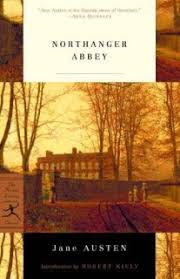
The central weakness of the novel resides with our heroine, Catherine Morland.
When we are introduced to Catherine she is 17, from a large country family, and entering society for the first time. She is naïve and childish. She always tries to do the right and proper thing, and while her judgments are often flawed, they are usually flawed for the right reason. She has an highly active imagination, and often prefers living there more than in the mundane real world. Austen of course put this more succinctly:
“In addition to what has been already said of Catherine Morland’s personal and mental endowments, when about to be launched into all the difficulties and dangers of a six weeks’ residence in Bath, it may be stated… that her heart was affectionate, her disposition cheerful and open, without conceit or affectation of any kind – her manners just removed from the awkwardness and shyness of a girl; her person pleasing, and, when in good looks, pretty – and her mind about as ignorant and uninformed as the female mind at seventeen usually is.”
Catherine’s romantic experiences are mainly confined to the pages of the gothic novels she enjoys. Austen has great fun with the differences between the world as seen through Catherine’s eyes and the world she reveals to the reader. The much more worldly-wise Henry Tilney teases her relentlessly about her romanticism:
“Are you prepared to encounter all the horrors that a building such as ‘what one reads about’ may produce? Have you a stout heart? Nerves fit for sliding panels and tapestry?”
“Oh! yes—I do not think I should be easily frightened, because there would be so many people in the house—and besides, it has never been uninhabited and left deserted for years, and then the family come back to it unawares, without giving any notice, as generally happens.”
“No, certainly. We shall not have to explore our way into a hall dimly lighted by the expiring embers of a wood fire—nor be obliged to spread our beds on the floor of a room without windows, doors, or furniture. But you must be aware that when a young lady is (by whatever means) introduced into a dwelling of this kind, she is always lodged apart from the rest of the family. While they snugly repair to their own end of the house, she is formally conducted by Dorothy, the ancient housekeeper, up a different staircase, and along many gloomy passages, into an apartment never used since some cousin or kin died in it about twenty years before. Can you stand such a ceremony as this? Will not your mind misgive you when you find yourself in this gloomy chamber—too lofty and extensive for you, with only the feeble rays of a single lamp to take in its size—its walls hung with tapestry exhibiting figures as large as life, and the bed, of dark green stuff or purple velvet, presenting even a funereal appearance? Will not your heart sink within you?”
“Oh! But this will not happen to me, I am sure…“Oh! Mr. Tilney, how frightful! This is just like a book!
But this is after all one joke, and while it bears repetition and is given fresh impetus on the visit to the Abbey, it does eventually wear thin.
Being not quite as good as ‘Pride and Prejudice’ is hardly a serious criticism of course. ‘Northanger Abbey‘ is full of Austen’s perceptive wit and wisdom and observations on class, marriage and the role of women in society. There is also much to enjoy in the portraits of the minor characters. The boorish John Thorpe for example talks nonsense constantly, and it is a measure of Catherine’s good judgment that she quickly realises just how unpleasant he is, even though good manners require her to think more highly of him. Here, for example, he greets his sisters:
“On his two younger sisters he then bestowed an equal portion of his fraternal tenderness, for he asked each of them how they did, and observed that they both looked very ugly.”
Thorpe’s rottenness is also exposed by Austen by making him the speaker of the novel’s two anti-Semitic comments, (“Old Allen is as rich as a Jew“, and General Tilney is also “as rich as a Jew“).
I have a confession to make at this point. Normally it is not too difficult to work out what is going to happen in this novel – indeed half the fun derives from the reader knowing, for example, that Isabella is an unscrupulous gold-digger, and will discard Catherine’s brother in a heart beat if and when a better offer comes along. However I misread the General Tilney subplot. The General is the widowed father of Henry, and is at all times polite and considerate towards Catherine. I assumed that his attentiveness was a very formal form of courtship – in other words that he was looking to remarry. While I don’t believe his age is ever specified, large age gaps between men of property and attractive young women were not unusual. I can imagine the scene in which he clumsily proposes, assuming acceptance is a formality, and is puzzled by Catherine’s appalled rejection. Similar proposals happen several times elsewhere in Austen’s work, most memorably Mr Elton’s wooing of Elizabeth Bennet.
The General never of course proposes, and his kindness is instead explained as deriving from his belief that Catherine’s family is very prosperous. If you think about it this would be unlikely – very rich families would make sure they know the financial status of prospective partners well in advance, and certainly would not rely on the views of that renowned speaker of nonsense, John Thorpe. I can’t help wondering if Austen was toying with this heavily signalled plot line, and abandoned it at some point?
The novel’s denouement is undoubtedly hurried. Catherine’s final reunion with Henry Tilney is an interesting example of the narrator deliberately choosing to avert their gaze from the event. The meeting happens while the narrator is with Mrs Morland upstairs, recovering a book of ‘helpful advice’; the subsequent engagement is described in a few simple sentences:
“She was assured of his affection, and that her heart in return was solicited, which, perhaps, they pretty equally know was already entirely his own”.
This doesn’t represent the climax of a long awaited relationship as in the great novels, more a long overdue tidying up of affairs.
‘Northanger Abbey’ is perhaps unrepresentative of Jane Austen’s genius, and if one had to choose only one of her novels for a desert island it would not be this one. Nevertheless everything she wrote should be treasured, and this novel is a wonderful complement to her more substantial works.
(Quick note on the date of publication given above. The consensus is that this novel was written in 1797-8 and subsequently revised once purchased back from a reluctant publisher in 1803. This might explain some of the unevenness in the text and the portrayal of Catherine in particular).


“Being not quite as good as ‘Pride and Prejudice’ is hardly a serious criticism of course.” Haha, so true. I love Northanger Abbey. It’s been a while — I’m due for a reread one of these days — but I actually enjoyed it more than Emma and S&S. You’re probably right that Emma is, structurally, the better novel, but I had the impression that Austen had more fun writing NA. Love reading your thoughts, as always.
LikeLiked by 1 person
Thanks – not tempted to go back to your blog anytime soon?
LikeLiked by 1 person
Haha, never! Well, not never. Once in a while I find myself wishing I had an outlet for some dramatic reaction to a wonderful or terrible book. But I’d been looking forward to shifting to other projects for a while, and I’m happy with that decision.
LikeLiked by 1 person
Pingback: Book review: Sense and Sensibility by Jane Austen, 1811 | The Reading Bug
Pingback: Comment – Charles Dickens, our most consistent novelist? | The Reading Bug