Book review

Hamnet, by Maggie O’Farrell, 2020

It feels as if I am the last book blogger on the planet to get round to reading this magnificent novel. I am more than happy to join in with the praise this wonderful book has been showered with, because it is extraordinarily powerful, easily the best novel I have read this year.

Even if you had managed to avoid any of the publicity about this novel, you would know its subject matter from the title. Described in the Guardian review as the “tragic tale of the Latin tutor’s son” (which cleverly highlights the novel’s way of looking at the story with a fresh pair of eyes) Hamnet is about many things, but at its heart this is a novel about grief. How people process loss, how it impacts us differently (particularly poignant was the scene when Judith, Hamnet’s twin sister, asks her mother what the word is for a bereaved twin – after all we have words for orphans and widows). I have never read a book where the rawness of grief is conveyed so powerfully – I sobbed. Written in the present tense it has an immediacy that gives the scenes of loss such impact, and of course the fact we are now living through another pandemic, gladly one a lot less dangerous than the plague of the middle ages, goes to emphasise the tragedy in an unexpected and dramatic way.

But it’s not just about grief. It is an extraordinarily evocative recreation of late sixteenth century rural Warwickshire (London is also summoned up vividly, but it is not the focus of the novel). The extended Shakespeare and Hathaway families are brought to life – and while this novel sent me back to the internet time after time to check various details of their lives (those we know, of course) I didn’t resent that in the slightest. One of its many strengths is that this book isn’t over-researched – it takes the little we know about Shakespeare’s family background and life, and fills in the gaps imaginatively and convincingly. O’Farrell is happy to take risks and present less popular versions of the story – the idea that Will and Anne met while he was tutoring her step brothers in Latin for example. I loved the way the novel rescues Anne Hathaway from the condescension of history and reinvents her as a wise confident young woman. I also think it was a brave decision to foreground Anne (known here as Agnes, the name her father uses for her in his will, apparently) rather than Shakespeare, who remains unnamed throughout the novel.

The mystery of the relationship between Hamnet and the play in his name written just a few years later (O’Farrell mentions only briefly the fact that Shakespeare is believed to have written some of his best comedies in between the two events) is one that invites speculation. Was Shakespeare simply callous, indifferent to the feelings of his family, or (as O’Farrell compellingly speculates here) using the play to explore his grief for his lost son? Other family relationships and characters – the bullying glove-maker John Shakespeare, or Will’s mysterious brother Edward (here Edmond) are all brought to life vividly.

There are many gaps in what we know about Shakespeare. Why did he live long parts of his life in London and not bring his family to live with him, even when he was financially successful? What impact did these long periods of separation have on his marriage. How did he go from being the son of a glove-maker to a phenomenally successful playwright? Why on earth did he leave his second-best bed to his wife in his will? And most of all, what impact did the loss of his son have on his work? Although this is not Shakespeare’s story, along the way O’Farrell acknowledges these many mysteries and provides thought-provoking answers. Which means you can enjoy this novel if you know all there is to know about Shakespeare, or nothing.

I can’t recommend this novel highly enough. I suspect it will go on to win many more awards than the entirely merited Women’s Prize for Fiction it was awarded earlier this year against stiff opposition.

PS The season finale of series three of Upstart Crow, the David Mitchell/Ben Elton BBC sit-com about Shakespeare featured Hamnet’s death. In this episode Judith falls in first, Shakespeare is sent for from London, and between this message being sent and his arriving home Judith recovers and Hamnet has fallen ill and died, the exact sequence O’Farrell follows here. It’s well done in both versions, but I can’t find any evidence or source for this version other than here. I wonder whether the television programme acted as a spark of inspiration for this part of O’Farrell’s story? The programme ends with this apposite and poignant speech from King John:

Grief fills the room up of my absent child,
Lies in his bed, walks up and down with me,
Puts on his pretty looks, repeats his words,
Remembers me of all his gracious parts,
Stuffs out his vacant garments with his form;
Then, have I reason to be fond of grief?
Fare you well: had you such a loss as I,
I could give better comfort than you do.
I will not keep this form upon my head,
When there is such disorder in my wit.
O Lord! my boy, my Arthur, my fair son!
My life, my joy, my food, my all the world!
My widow-comfort, and my sorrows’ cure!
King John, Act 3 scene 4

Standard
Book review

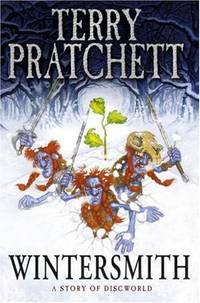
Wintersmith, (Discworld 35) by Sir Terry Pratchett, 2006

Wintersmith (Discworld Novels) by  Sir Terry Pratchett - Paperback - from World of Books Ltd (SKU: GOR001210366)

The Tiffany Aching series of novels gave Discworld a wonderful burst of new life – almost half of the last dozen novels in the series were Tiffany stories. We have followed Tiffany’s story since she was nine, and her training as a witch now sees her placed with Miss Treason, a 113-year old witch renowned for her dark and mysterious powers (which Tiff quickly works out are simply “boffo”, or as Granny Weatherwax would put it, headology. )

Unusually for Pratchett the novel opens with the novel’s climax, and then takes the reader back to the story’s origins. This structure isn’t a problem – it allows the reader to navigate the plot more easily when we know the destination, and is one of the more telling signs that this is a story for younger readers. Tiffany’s problems begin when she goes to observe the traditional “dark morris” dance which welcomes in the winter, Tiffany spontaneously joins the dance, interrupting the passage of the seasons between the two elementals, the Wintersmith and the Summer Lady—the personification of summer. The Wintersmith has never met anyone like Tiffany before, and once the dance is over determines to become a mortal and seek her out, using their spiritual connection forged over Tiff’s silver horse pendant.

This disruption of the natural order of things isn’t going to go well. With the help of the Feegles, and the loving support of Granny Weatherwax and Nanny Ogg, Tiffany has to put things right. It’s not easy when you are being wooed by someone who can make all snowflakes in your image – and icebergs as well! At first Tiff takes refuge in Lancre, and the warm embrace of Nanny Ogg’s cottage, but the elemental Wintersmith is going to track her down.

Like most young adult novels, Wintersmith is really about growing up. Teenage Tiffany has to work through many of the problems and issues young teenagers face. Her fledgling romance with Roland, the Baron’s son (who she rescued in the first novel in the series, The Wee Free Men) is coming along nicely, but she has to battle to keep it private from the feegles and the witches. Speaking of battles, maintaining any sense of privacy from feegles (who take their geas to protect their ‘big wee hag’ very seriously) and witches who can see through her eyes isn’t easy. Later she has to come to terms with the death of an older character. Her place in her peer group is delicately balanced, and she manages to do the right thing and find her place in that hierarchy despite being aware of the subtle manipulations of Granny Weatherwax. Finally, she takes responsibility for her own actions when the temptation to shift the blame or hide behind others is overwhelming. While she may be flawed we are never in any doubt that Tiff will do the right thing and that will bring its own reward:

“It was lonely on the hill, and cold. And all you could do was keep going. You could scream, cry, and stamp your feet, but apart from making you feel warmer, it wouldn’t do any good. You could say it was unfair, and that was true, but the universe didn’t care because it didn’t know what “fair” meant. That was the big problem about being a witch. It was up to you. It was always up to you.”

I love it when Pratchett has the confidence to make such epic characters as Granny Weatherwax and Nanny Ogg minor players in Tiffany’s story. The feegles are an endless delight, and there are some interesting new characters, not least 113 year-old Miss Treason, who wonderfully calls Granny “the girl Weatherwax”. Arguably the novel’s only weak spot is its fairly innocuous ending, but as I always say whoever reads Pratchett for his plots is really missing the point. I don’t think I read these novels with any particular care when they were first published, unwisely seeing them as books for younger readers, (which of course they are) but wrongly concluding there would be little in them for older readers. I am so glad to have got that wrong.

Standard
Book review

The Sea, The Sea, by Iris Murdoch, 1978

I’ve just spent a week in the company of a monster, and I didn’t enjoy it.

I really hated The Sea, The Sea. Or rather I really hated the novel’s protagonist, which on this occasion amounted to the same thing. For a novelist with a reputation for labyrinthine plots, this narrative is fairly straightforward. Theatre director Charles Arrowby the novel’s narrator, retires to the seaside to write his memoirs. Arrowby is utterly self-absorbed. His life has seen a succession of women throwing themselves at him and this pattern continues as he is visited by a series of former lovers, actresses of different degrees of fame, all wanting to resume their relationships. He is not interested, principally because he prefers to steal married women away from their husbands. As soon as each conquest has been mastered he loses interest. His latest obsession is Hartley, a childhood friend who he happens to meet in the village, who he sets about trying to persuade to leave her mild-mannered husband. He even goes to the extreme of kidnapping her, and only releases her once it is obvious she is not going to relent. To justify his obnoxious and criminal behaviour he persuades himself that Hartley is the long lost love of his life, although she clearly sees their friendship in a different light.

Charles’s magnetic attractiveness to women is not however just in his imagination – even at the end of the novel he received letters from a 17 year-old young woman offering him her virginity and to bear his child. But it is mysterious, because he is a bully and a bore. He is always having epiphanies, supposedly profound insights into what is really going on in people’s heads, insights which are invariably wrong. Undeterred he pushes on to the next revelation. When he finds out that his cousin James and his former lover Lizzie have been meeting for coffee occasionally, he throws a tantrum, reacting as if they have been betraying him. Instead of telling him to grow up they indulge his hurt feelings, apologise and withdraw. When he is pushed into the sea and nearly drowns the list of possible suspects is long – I think I would have been tempted!

So we’ve established that Charles is a deluded ego-maniac who is a danger to all around him. Just in case this point needs reinforcing, Murdoch has him see a monster in the choppy waters around his house. This monster is quickly dismissed as a LSD flashback, but later Charles reflects that “I let loose my own demons, not least the sea-monster of jealousy” (528) just in case anyone had missed the heavy-handed symbolism in the preceding 527 pages,

We are supposed to find Charles’s pretentious approach to food amusing. He prepares various mildly eccentric meals for himself and others. At first they are very slightly comic – I stress slightly:
Anchovy paste on hot buttered toast, then baked beans and kidney beans with chopped celery, tomatoes, lemon juice and olive oil… Then bananas and cream with white sugar. (Bananas should be cut, never mashed, and the cream should be thin.) Then hard water-biscuits with New Zealand butter and Wensleydale cheese. Of course I never touch foreign cheeses.

But there’s a relentlessness to this, and we get descriptions of meal after meal:

Lentil soup, followed by chipolata sausages served with boiled onions and apples stewed in tea, then dried apricots and shortcake biscuits… Fresh apricots are best of course, but the dried kind, soaked for twenty-four hours and then well drained, make a heavenly accompaniment for any sort of mildly sweet biscuit or cake. They are especially good with anything made of almonds, and thus consort happily with red wine.

OK, we get the point.

Murdoch is a hugely respected writer, but even her greatest fans seem prepared to acknowledge her flaws. Here the greatest sin is simply repetition – if something is worth saying it is repeated time after time. The scenes where Arrowby tries to persuade Hartley to leave her husband, and she asks to be allowed to leave, go on for page after page with little variation. The conceit that the novel is Arrowby’s memoir is inconsistently maintained – the struggle of having to construct time for him to draft his recollection of the previous events gets tiresome and is quietly dropped. Murdoch’s (alright, Arrowby’s) technique for building suspense is limited:

“Something happened which was so extraordinary and so horrible that I cannot bring myself to describe it” (1)

“Something rather odd and distressing has just occurred”

“I was sitting writing the above late last night in my drawing room when something very disconcerting happened” (74)

“Shortly after this something very disconcerting happened”. (107)

Obviously this is equally a reflection on Charles’s limited ability to express himself, but the end result is wearying.

It should be possible to enjoy and appreciate a novel where the central character is obnoxious or deluded (Pale Fire?) but I didn’t find it so here. Arrowby is a pompous bore who desperately needs to wake up to his own short-comings, but never. Even someone trying to kill him doesn’t make him pause for reflection! There’s no development in Charles’s character – he remains as deluded and ignorant at the end of the story as he was in its beginning. Is it my shortcoming in not being able to enjoy this widely revered novel(ist)?

Standard
Book review

Thud! (Discworld 34) by Sir Terry Pratchett, 2005

I read Thud! when it was first published, and can still remember the slightly puzzling feeling of disappointment. Pratchett’s recent novels – Going Postal and Monstrous Regiment for example – had been imperious, but this was a slight mis-fire. Or so I remembered. But memory can be misleading – would the novel have the same impact some fifteen years on?

Yes and no. On the one hand this is a Watch novel, featuring Sam Vimes and his team. It’s also in many ways an exceptionally well-constructed detective novel, albeit in a fantasy setting featuring dwarves, trolls, vampires and werewolves. Some critics have found the pastiche of The Da Vinci Code a little heavy-handed, but I thought the references were just right, not such that you knew what was coming next, but that you could see the parallels. So what’s not to like? I think partly the problem is that Pratchett had set such high standards in his recent work that something that doesn’t quite reach those levels is likely to disappoint. Because I don’t think Thud! ever quite comes to the boil; there is a lot of time spent setting up a climax that never really arrives.

The plot is more complex than most Discworld stories. A dwarf, Grag Hamcrusher, has been murdered, and a troll is the prime suspect. The radicalisation of the dwarven community that had been suggested in earlier novels has accelerated, and all-out conflict with their eternal enemies, the trolls is imminent. Hamcrusher was a deep-downer, someone who believes dwarves should remain underground and avoid contact with other races. His murder couldn’t come at a worse time for Sam Vimes and the Watch, because it stokes tensions between Ankh-Morpork’s troll and dwarf communities just as the anniversary of the Battle Of Koom Valley approaches. This battle (or series of battles) happened centuries ago, but is still a cause for resentment between trolls and dwarfs, who now come into close daily contact on the streets of Ankh-Morpork. At first it looks like the deep-downers will obstruct the Watch’s enquiries, preferring to deal with it themselves, but Vimes persuades them to accept an investigation by Captain Carrot, human by birth, dwarf by upbringing. Carrot is assisted by the new recruit, Lance-Constable Sally von Humpeding, the Watch’s first vampire, as well as his werewolf partner, Sergeant Angua. Vampires and werewolves are traditionally the fiercest of rivals leading to tension between Angua and Sally.

Elsewhere in the city a painting has been stolen. This is a job for Corporal Nobbs and Sergeant Colon, Ankh-Morpork’s finest. The fifty-foot painting, The Battle of Koom Valley by Methodia Rascal, is believed to hold a clue to the treasure of Koom Valley. (Because as well as being the site of many battles between trolls and dwarves, Koom Valley also hides some lost treasure). Vetinari could not have chosen a worse time to send an auditor, A.E. Pessimal, into the Watch. This is one of the novel’s misfires – Vetenari has shown every evidence previously of having confidence in Vimes and being willing to let him get on with his job, but now with Vimes at the head of a massively expanded Watch he sends in a book-keeper? Vetenari would already know everything he needed to know about the Watch and sending in an auditor would be an admission of failure. Vimes would almost certainly have sent him packing instead of, as he does, meekly accepting his presence. The same applies for Vetenari and Vimes’s acceptance of someone who is obviously a spy into the Watch – they just wouldn’t have done that in previous novels.

And so it goes on – people not behaving quite like the characters Pratchett has spent years developing. Carrot goes missing from the text, with his investigation largely happening off-screen. Angua behaves like a spoiled child and Vimes manages to completely ignore a summons from Vetenari, something that would have been unthinkable previously. There is a supernatural element to the novel – the Summoning Dark – which has strong echoes of the hiver in A Hat Full of Sky but which here seemed superfluous. The novel’s finale falls flat – the happy ever after resolution manages to be both predictable and unconvincing.

A mis-firing Pratchett is still head and shoulders above most novelists, and there is plenty to enjoy here. Sam Vimes’s character development is almost complete – he is now father to young Sam and takes his story-reading duties just a little too seriously. Minor characters, such as Willikins, Sam’s dead-pan butler, are a joy (“My gods, man, you’re covered in blood!’ Sybil burst out. ‘Yes, your ladyship,’ said Willikins smoothly.  ‘May I say in mitigation that it is not, in fact, mine.’) and A E Pessimal the auditor turned blood-thirsty Watch recruit shows promise. Other more familiar characters seem to be on auto-pilot or go missing in action completely, and Tawnee, Nobby’s pole-dancing girlfriend is a mis-judged caricature.

Thud! is much loved by the vast majority of Discworld fans. It’s the only book I have ever seen with 0% one star ratings on both Goodreads and Amazon, which shows how well it is regarded. So who knows, I am probably missing some of the wonders of this novel, one of which is jokes like this variation on the Monty Python “What have the Romans ever given us?” sketch:

“War, Nobby. Huh! What is it good for?”
“Dunno, Sarge. Freeing slaves, maybe?”
“Absol-well okay.”
“Defending yourself against a totalitarian aggressor?”
“All right, I’ll grant you that, but-“
“Saving civilization from a horde of-“
“It doesn’t do any good in the long run is what I’m saying Nobby, if you’d listen for five seconds together.”

Standard
Book review

A Hat Full of Sky, (Discworld 32) by Sir Terry Pratchett, 2004

Books can help us navigate our way through life. People who don’t read can get on well of course, but having books with you along the way can help hugely. I can’t think of a greater challenge in life than the transition to adolescence, and I equally can’t imagine how amazing it would have been to have made that journey with the Tiffany Aching novels by my side. Because this series is about growing up, not in a self-conscious ‘so here’s how to deal with bullies’ way, but by sharing Tiffany’s story.

A Hat Full of Sky is the sequel to the Wee Free Men. Tiffany, now eleven, is leaving family and home to train as an apprentice witch. Leaving her beloved Chalk, the land of her childhood, is hard for her, leaving behind everything that is comfortable and familiar. She goes to live with Miss Level, a witch who has two bodies ( a nice twist on the split personality idea) and a poltergeist named Oswald who cleans the house (another clever inversion).

Tiffany’s powers are such that unknown to her she is being hunted by a dangerous magical creature, a hiver, an ancient parasitical paranormal entity. She is particularly vulnerable when she uses her powers to step outside her body, which she does innocently to look at herself.

Settling in to her new home she meets a group of apprentice witches – far from dying out, witchcraft in this part of the world seems to be thriving. As the new girl she faces the usual struggles of fitting in. The patronising and rude self-appointed leader of the group, Annagramma could be found in any playground in the world. Tiffany represents a potential challenger to her top-dog status, having already met Discworld’s greatest witch, Granny Weatherwax, and been given a hat by her, albeit an invisible one (hence the novel’s title). The other girls don’t believe her, and are mean. Upset by this encounter, Tiffany is vulnerable and is taken over by the hiver. Being possessed by the hiver makes her feel powerful but dangerous, almost like taking drugs?

You can read Tiffany’s struggles with the hiver as a metaphor for depression, anorexia, or any other mental health problem. Young women in particular are vulnerable to doubts about their value, even their identity. That vulnerability can leave them open to ideas or other things that are superficially empowering but nonetheless harmful. Pratchett doesn’t overwork this concept – Tiffany doesn’t self harm for example – but she does struggle internally with the hiver, trying to assert her identity. Her small cries for help aren’t heard by her friends, although the Feegles quickly work out what has happened. Without ever being patronising or spelling things out, I think Pratchett gives his readers some practical ideas on how to deal with these issues in a way that is probably far more helpful than the self-help books that address these issues head-on.

Fortunately, Tiffany has a trump card, the Nac Mac Feegles, wonderful, unruly pictsies, sworn under a geas to defend her from harm. I love the fact that Pratchett is happy to make the geas/geese pun (more than once), even though it is such a terrible dad-joke. Rob Anybody, fearless leader of the Feegles, magically travels into Tiffany’s mind to help her fight the hiver. He works out that smells from her past will allow her to break from the hiver’s control (the scenes where the Feegles collect the items needed – tobacco, alcohol and wool – are a wonderful diversion). Tiffany wrests back control but is left with the memories of the hiver’s previous victims, which she uses to give her strength, drawing on them for support. With the help of Granny Weatherwax, visiting for the Witch Trials, Tiffany comes to understand that the hiver is not something that she needs to defeat but to come to terms with. I think this all works really well as an extended metaphor for how to deal with mental health problems.

I’ve talked a lot about this book being a guide to growing up. But as with all Pratchett’s novels the wisdom it contains is for all ages. I found this paragraph on leaving home quite poignant:

Why do you go away? So that you can come back. So that you can see the place you came from with new eyes and extra colours. And the people there see you differently, too. Coming back to where you started is not the same as never leaving.

And there’s also this advice, which initially appears to be quite witch-specific, but perhaps not:

“Always face what you fear. Have just enough money, never too much, and some string. Even if it’s not your fault, it’s your responsibility. Witches deal with things. Never stand between two mirrors. Never cackle. Do what you must do. Never lie, but you don’t always have to be honest. Never wish. Especially don’t wish upon a star, which is astronomically stupid. Open your eyes, and then open your eyes again”.

Finally, I have written many times about Pratchett’s ability to make me laugh out loud. Once again he managed to achieve this in the scene when Death appears, and is confronted by the pugnacious and profoundly loyal Rob Anybody:

“I WAS NOT EXPECTING A NAC MAC FEEGLE TODAY, said Death. OTHERWISE I WOULD HAVE WORN PROTECTIVE CLOTHING, HA HA.”

Glorious, precious, stuff. It’s easy to overlook the Tiffany Aching Discworld books as just for children, or ‘stories’ rather than novels, and I was probably guilty of this first time round, but now I am coming to appreciate them far more as fully-rounded additions to Sir Terry’s body of work.

Standard
Book review

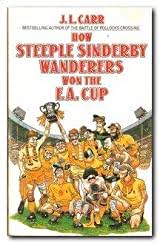
How Steeple Sinderby Wanderers won the FA Cup, by J L Carr, 1975

J L Carr’s A Month in the Country is an under-appreciated masterpiece. The slightly earlier How Steeple Sinderby Wanderers won the FA Cup shows some of the promise seen in full bloom in the later novella, but has a comedic, not to say comic, premise that holds the author back from revealing his full potential.

How Steeple Sinderby Wanderers Won The F. A. Cup by J L Carr

The idea of a small village team winning the FA Cup is drawn directly from the pages of virtually every comic for boys ever written (the whole sub-genre is brilliantly caricatured in Viz’s Billy the Fish). Steeple Sinderby features every cliche from the genre going – the washed up ex-pro, the gifted midfielder with a tragic backstory, the unnaturally talented goalie with prehensile abilities, and the mysterious east European tactical genius.

I read once that J K Rowling hated having to write the scenes in her Harry Potter novels describing Quidditch matches (which explains why they were often called off). Carr may have felt trapped by the same logic of his scenario, because as the story progresses and the club proceed relentlessly to the final, the football games themselves become almost a sideshow. There is some fun with parodies of different commentary and reporting styles (In their primal gladiatorial tourney N. Baddesley jousting on their own bailiwick encountered the full and furious blast of Steeple Sinderby’s New Look Lads spearheaded by Sid Swift, long-lost Shooting Star idol of Brum fans a handful of time ago. The Ringers clocked up eleven strikes and only the inexorable march of time muffled a full peal of twelve), but there’s only so many ways you can describe an imaginary match.

But this really isn’t a football story. There are far more interesting things going on in the margins of the narrative, or perhaps along the touchlines. The narrator, Joe Gidner, having “had this trouble and left theological college”, lives in the village schoolmaster’s house, combining the writing of greetings-card verses and looking after his host’s invalid wife. He is also the club’s secretary, and is chosen to write the first draft of the history of the club’s victory, which this novel purports to be. He is an engaging almost whimsical narrator, and proves a helpful guide to the club’s adventures, the players’ and others’ back-stories, and the less than glamorous mid-1970’s setting in which football supporters’ violence is taken for granted.

Steeple Sinderby itself is a stereotypical English village, with all the charm but also all the flaws. Gidner tells us about its inhabitants, its entry in Pevsner’s Buildings of England and its one notable previous inhabitant, the peasant poet Thomas Dadds. The club’s chairman, Mr Fangfoss, is not interested in football but assumes the role because he is used to running everything. He is a bigot but sympathetically portrayed nonetheless, including his unorthodox marital arrangements.

Despite the team’s inevitable victory in the final, the novel ends in a downbeat manner.

“I often wish I could have known the end at the beginning, so that each detail could have been savored as it happened. But then, life isn’t a gramophone record one can play again and again […] It is Now or Never for most of us, and we haven’t the time.”

Everyone leaves either the club or the village, or both, Joe’s attempts to woo a young lady he is attracted to come to naught, and the club is wound up, in recognition that such heights will never be reached again. Joe’s story is one of missed opportunities, and the subtle whimsy of the story is overlaid with what felt like a somewhat manufactured nostalgia – the 1970’s were the present day when the book was written, village life was not really under threat, and football violence and the bigotry of Enoch Powell and the like with which it was often associated is nothing to be nostalgic about. So I was left unconvinced by this novella despite its many charms.

Standard
Book review

The Elected Member by Bernice Rubens, 1970

This 1970 Booker winner opens with the following quote:

“If patients are disturbed, their families are often very disturbing.”

This really tells you all you need to know about this novel. The central character, Norman Zweck, is mentally ill, and his illness can be traced directly back to his profoundly dysfunctional family.

The Elected Member by Rubens, Bernice Paperback Book The Cheap Fast Free Post

Norman comes from a traditional Jewish family. His father came to London from Lithuania with just a suitcase and a name and address written on a scrap of paper. Despite being forty Norman lives at home (and indeed has never left) with the ghost of his controlling mother and his weak-willed father. His older sister, Bella, still lives at home as well and wears ankle socks every day as a vivid reminder of her frozen adolescence. Younger sister Laura left home and married outside their religion, and has therefore been expelled from the family circle – mention of her name is forbidden.

The primary symptom of Norman’s mental illness is that he sees silverfish crawling everywhere. It’s a horribly and vividly realised psychosis, and it cripples him, leaving him unable to leave his bedroom, work, or sustain a relationship.

We slowly learn the details of the family history through the reminiscences of the characters as they react to Norman’s most recent breakdown. He is addicted to amphetamines, although the precise cocktail of drugs and childhood trauma that leads to his illness is not ever entirely resolved. However his family are unable to cope, so on the advice of the family doctor they have him committed to a psychiatric hospital for treatment. Here he quickly finds someone ready to sell him more amphetamines, meaning any treatment is unlikely to work. Back home his family suffers feelings of guilt that they have not been able to help him. Bella, we eventually find out, had an incestuous relationship with her brother. Laura ran away from a relationship with Norman’s best friend, David, who we are given to understand (without it ever being made explicit) was his lover. Thoughts of and actual suicides haunt the novel, giving it a structure in which we come to see that the mental institution Norman is committed to is very similar to the home he was unable to leave.

The novel’s title is puzzling. One of Norman’s fellow inmates in the hospital has delusions he is in the Cabinet, although he is always referred to as Minister rather than the elected member, or any variation thereof, and in any event is a relatively peripheral character upon which to name the novel. The title could refer to Norman being the chosen one, the golden boy on whom the hopes of his family came to rest – he was gifted with languages, and qualified as a barrister – although the ‘member’ element of the title still escapes me.

Bernice Rubens had a long writing career, and most of her many novels remain in print, so there must be an audience for them somewhere. But whilst I found The Elected Member a largely inoffensive read, it left me with no appetite for following up with anything else by this author.

Standard
Book review

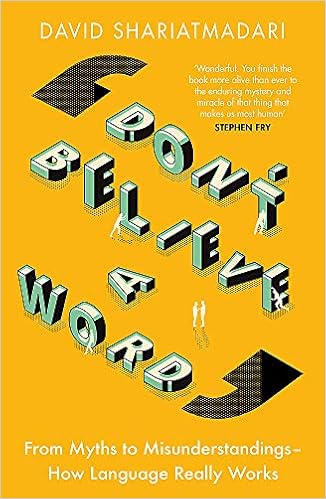
Don’t Believe a Word, by David Shariatmadari, 2019

Don’t Believe a Word is subtitled “From Myths to Misunderstandings – How Language Really Works” which is a pretty bold claim, and one I suspect Shariatmadari would probably disavow. Because this is much more a summary of the current state of research into some of the larger issues around language acquisition and use than anything approaching a comprehensive final set of answers to some of the difficult questions about this issue.

Because language is profoundly mysterious. How we as a species came to uniquely acquire the power of language is endlessly fascinating, and I was hoping for something that attempted to described the processes whereby we went from the simple sounds required to warn of predators or communicate during a hunt to the infinitely more complex process I am using to write these sentences, however inelegantly. Unfortunately the author really only skims these issues for the safer, more familiar ground of why language is not ‘going to the dogs’ or the differences between languages, dialects and ideolects.

The structure for the book is that each chapter is intended to expose a common myth about language. Demonstrating that standards of English are not declining, and never have, is done easily enough, by quoting the same complaint made across the centuries. Older people will always feel alienated from the language of the young who are much more innovative in their use of language, and will use their positions of authority that come with age to define standard English and try to shame younger people into conformity. Which means I can look forward to hopefully one day hearing the incessant use of the word ‘like’ as a meaningless filler to become the ‘correct’ way of expressing oneself, and youngsters chastised for not using it appropriately.

Each generation will think of itself as exceptional, and find reasons why the language they are using is different from that of their predecessors. Much of this is down to the rapid spread of technology which introduces words and ideas simply not required before. I am grateful to the author for bringing to my attention this brilliant summary of the issue from the wonderful Douglas Adams (from The Salmon of Doubt):

1. Anything that is in the world when you’re born is normal and ordinary and is just a natural part of the way the world works.
2. Anything that’s invented between when you’re fifteen and thirty-five is new and exciting and revolutionary and you can probably get a career in it.
3. Anything invented after you’re thirty-five is against the natural order of things.”

Another ‘myth’ Shariatmadari addresses is the idea that foreign languages have untranslatable words. Is that really a language myth that needs to be challenged, or just a bit of fun on the internet that no-one takes particularly seriously? Yes it makes other cultures sound sound quaint or bizarre. and can contribute to the ‘othering’ of foreigners. But other cultures are often profoundly different from our own (not better or worse, just different) so it would be surprising if they didn’t have words for things we use phrases or sentences to describe.

There’s a thoughtful discussion of whether our languages shape how we think, rather than the other way round. Those of us exposed to George Orwell’s thesis (in 1984) that we need a language of nuance and expression to articulate concepts such as democracy will be open to the idea that we need words to explain ideas before those ideas can exist. But mentioning Orwell brings me to a minor quibble with this book. In the chapter on whether language is deteriorating, the author cites Orwell as “clearly wrong when he imagined that language would become decadent and ‘share in the general collapse’ of civilisation unless hard work was done to repair it.” The text Shariatmadari is quoting here is not cited, but the internet being the wonderful thing it is I easily found it in Politics and the English Language. Now you won’t find a better. more powerfully argued essay in favour of clear writing in politics that this. Shariatmadari unfairly dismisses it because Orwell opens with the deliberately contentious argument that:

Most people who bother with the matter at all would admit that the English language is in a bad way, but it is generally assumed that we cannot by conscious action do anything about it. Our civilization is decadent and our language — so the argument runs — must inevitably share in the general collapse.

Orwell, Politics and the English Language, 1946

To break one of Orwell’s prime rules (‘never use a metaphor, simile, or other figure of speech which you are used to seeing in print’) this is throwing the baby out with the bathwater. All Orwell is arguing is that bad writing about politics is often bad for specific reasons: “to make lies sound truthful and murder respectable, and to give an appearance of solidity to pure wind”. Which is surely a more important point than the one he is being discredited with?

Later, Shariatmadari gives a respectful, if sceptical account of Noam Chomsky’s universal grammar theory. The idea that humans are born with an innate language ability far in advance of any other skill or ability in life (compare the struggles we have to walk or feed ourselves) has yet to be proven beyond all doubt, but the alternative, that language is “a medium that is formed as it is used … a road that is paved at the same time as we walk it” seems inadequate when contrasted with the other clumsy abilities we develop as children. If you want a primer on Universal Grammar and the current research on the theory this is not a bad place to start.

Overall this is an entertaining, accessible and well-evidenced summary of the state of linguistics as it is currently understood. As with the book I recently read on genetics, I left this with the impression that there is still a lot of research to be done on this subject, and that our understanding of ‘how language really works’ is as elusive as ever.

Standard