
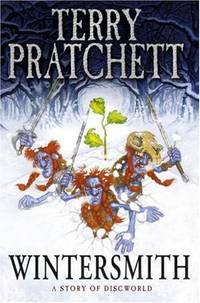
The Tiffany Aching series of novels gave Discworld a wonderful burst of new life – almost half of the last dozen novels in the series were Tiffany stories. We have followed Tiffany’s story since she was nine, and her training as a witch now sees her placed with Miss Treason, a 113-year old witch renowned for her dark and mysterious powers (which Tiff quickly works out are simply “boffo”, or as Granny Weatherwax would put it, headology. )
Unusually for Pratchett the novel opens with the novel’s climax, and then takes the reader back to the story’s origins. This structure isn’t a problem – it allows the reader to navigate the plot more easily when we know the destination, and is one of the more telling signs that this is a story for younger readers. Tiffany’s problems begin when she goes to observe the traditional “dark morris” dance which welcomes in the winter, Tiffany spontaneously joins the dance, interrupting the passage of the seasons between the two elementals, the Wintersmith and the Summer Lady—the personification of summer. The Wintersmith has never met anyone like Tiffany before, and once the dance is over determines to become a mortal and seek her out, using their spiritual connection forged over Tiff’s silver horse pendant.
This disruption of the natural order of things isn’t going to go well. With the help of the Feegles, and the loving support of Granny Weatherwax and Nanny Ogg, Tiffany has to put things right. It’s not easy when you are being wooed by someone who can make all snowflakes in your image – and icebergs as well! At first Tiff takes refuge in Lancre, and the warm embrace of Nanny Ogg’s cottage, but the elemental Wintersmith is going to track her down.
Like most young adult novels, Wintersmith is really about growing up. Teenage Tiffany has to work through many of the problems and issues young teenagers face. Her fledgling romance with Roland, the Baron’s son (who she rescued in the first novel in the series, The Wee Free Men) is coming along nicely, but she has to battle to keep it private from the feegles and the witches. Speaking of battles, maintaining any sense of privacy from feegles (who take their geas to protect their ‘big wee hag’ very seriously) and witches who can see through her eyes isn’t easy. Later she has to come to terms with the death of an older character. Her place in her peer group is delicately balanced, and she manages to do the right thing and find her place in that hierarchy despite being aware of the subtle manipulations of Granny Weatherwax. Finally, she takes responsibility for her own actions when the temptation to shift the blame or hide behind others is overwhelming. While she may be flawed we are never in any doubt that Tiff will do the right thing and that will bring its own reward:
“It was lonely on the hill, and cold. And all you could do was keep going. You could scream, cry, and stamp your feet, but apart from making you feel warmer, it wouldn’t do any good. You could say it was unfair, and that was true, but the universe didn’t care because it didn’t know what “fair” meant. That was the big problem about being a witch. It was up to you. It was always up to you.”
I love it when Pratchett has the confidence to make such epic characters as Granny Weatherwax and Nanny Ogg minor players in Tiffany’s story. The feegles are an endless delight, and there are some interesting new characters, not least 113 year-old Miss Treason, who wonderfully calls Granny “the girl Weatherwax”. Arguably the novel’s only weak spot is its fairly innocuous ending, but as I always say whoever reads Pratchett for his plots is really missing the point. I don’t think I read these novels with any particular care when they were first published, unwisely seeing them as books for younger readers, (which of course they are) but wrongly concluding there would be little in them for older readers. I am so glad to have got that wrong.
 The Reading Bug