Book review

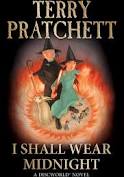
I Shall Wear Midnight (Discworld 38), by Sir Terry Pratchett, 2010

I Shall Wear Midnight is the fourth in the series of Discworld novels that focus on the earlier years of witch in training Tiffany Aching. The wonderfully poetic title of the novel is Tiffany’s defiant statement that she will be her own witch, not conforming to the convention that witches of all ages wear black (i.e. ‘midnight’) and is first referenced in Tiffany’s story at the end of A Hat Full of Sky, when she says “When I’m old I shall wear midnight”.
It is fair to say that each of Tiffany’s novels follow roughly the same pattern, albeit in each new book she is progressively a little older, a little more mature, and a more proficient witch. Here she is almost fully qualified (insofar as witches are ever qualified) and is working on her own as the Chalk’s witch, the Chalk being a sheep-farming area of Discworld somewhere between Lancre and Ankh-Morpork, which is admittedly a very large area. The novel opens at the Scouring Fair, a traditional Chalk celebration which includes maintenance of the massive hillside chalk carving which bears a striking resemblance to the Cerne Abbas giant. If you haven’t heard of the Cerne Abbas giant then a few minutes on Google will be instructive in terms of country folk’s attitudes to fertility and related issues…

But the celebration doesn’t last long because the second chapter opens with one of the most vivid and distressing scenes I can recall in the Discworld series. Thirteen year old Amber Petty has been beaten so badly by her drunken father that she has miscarried. Word has reached drinkers at the local pub, and a group of villagers is coming to exact ‘justice’ on Mr Petty. Here Pratchett references the rural tradition of “rough music” in which a community takes the law into its own hands.

“Rough Music…
o one controls the music, Mr. Pretty – you know that. It just turns up when people have had enough. No one knows where it starts. People look around, and catch on another’s eye, and give each other a little nod, and other people see that. Other people catch their eye and so, very slowly, the music starts and somebody picks up a spoon and bangs it on a plate, and then somebody else bangs a jug on the table and boots starts to stamp on the floor, louder and louder. It is the sound of anger, it is the sound of people who have had enough. Do you want to face the music?

Tiffany drags Mr Petty out of bed and tries to persuade him to run for his life and then takes Amber to be cared by Jeannie, the Kelda (queen) of the Nac Mac Feegles.

The fly-leaf of the hardback edition describes I Shall Wear Midnight as a Discworld book for “young readers”. It is not, not by any measure. It is not even a novel for younger readers, if I have understood the distinction correctly. I reject the meaningfulness of the classification, but any novel that deals so directly with domestic abuse in this honest and open way is not just for young readers. Young readers are perfectly capable of reading about these issues, of course they are, but there’s no sugar coating here, no turning away or euphemisms, unless you count Tiffany’s description of Amber being beaten so hard “that she bled from places where no-one should bleed”.

Shortly later, the local Baron, for whom Tiffany has been caring, dies after a long and painful unspecified illness. Tiff travels by broomstick (accompanied by her bodyguard of Feegles) to Ankh-Morpork to tells his son, Roland. Tiffany and Roland had previously been ‘walking out’ together, and everyone assumes that she is upset that he is now engaged to someone else, but she is actually taking the disappointment in her stride. On the way to the city she has her first encounter with the novel’s protagonist, the Cunning Man, a foul-smelling figure of nightmares who has holes for eyes. The Cunning Man is able to turn people’s minds against witches, which explains why Tiffany’s normally supportive community has started suspecting her of abducting Amber and killing the Baron and stealing from him.

The Feegles cause chaos in the city, but help her find Roland, to whom she breaks her sad news. With the help of Mrs Proust, a local witch who runs the Boffo Novelty and Joke shop, in Tenth Egg Street, ‘the spiritual home for all those who consider that fart powder is the last word in humour’, Tiffany looks for answers as to what the Cunning Man is, and how to defeat him. She meets Eskarina Smith, Discworld’s first and apparently only female wizard, not seen since the events of the third Discworld novel, Equal Rites, who tells her the Cunning Man’s origin story. After a walk-on appearance by some of the Watch’s regulars and an overnight stay in the police cells, Tiffany hurries back to the Chalk to confront the Cunning Man and restore some balance to her community. In doing so she meets two important new allies – Letitia, Roland’s fiancé, who is without realising it a powerful witch, and the charming Preston, one of the Baron’s guards. Back at the Chalk there is time for the Baron’s funeral and the new Baron’s wedding, guest appearances by Nanny Ogg and Granny Weatherwax (the highlight of any Discworld novel!) before the inevitable climatic showdown with the Cunning Man.

This is an important book. As with all Pratchett’s work it is suffused with good sense, compassion and kindness. Tiffany is a good person working tirelessly to make the world just a little bit better. She doesn’t do it for personal gain or glory, just because it needs doing. In a world where there are too many people doing the exact opposite, we could all be a bit more like Tiffany. But that’s not all Pratchett has to say. This is a novel about how people are prepared to believe bad things about outsiders, about ‘others’. The key quote (and it is rare that Discworld novels have just one key quote, but I think this one does) is “Poison goes where poison’s welcome.” In other words the lies told about Tiffany and other witches would not be believed unless people wanted to believe them. In a world in which outsiders and immigrants are demonised we need to realise that the poisonous words spread about them by newspapers, websites and politicians cannot harm us if we do not welcome them in. The people of the Chalk are Tiffany’s friends and relatives, normal hard-working folk, but they are not immune to the harsh words and thoughts spoken about witches or wise-women:

everybody knew, in some mysterious way, that witches ran away with babies and blighted crops, and all the other nonsense. And at the same time, they would come running to the witch when they needed help.”
Standard
Book review

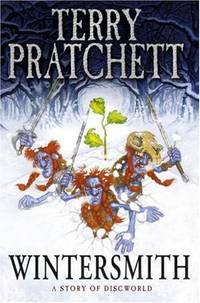
Wintersmith, (Discworld 35) by Sir Terry Pratchett, 2006

Wintersmith (Discworld Novels) by  Sir Terry Pratchett - Paperback - from World of Books Ltd (SKU: GOR001210366)

The Tiffany Aching series of novels gave Discworld a wonderful burst of new life – almost half of the last dozen novels in the series were Tiffany stories. We have followed Tiffany’s story since she was nine, and her training as a witch now sees her placed with Miss Treason, a 113-year old witch renowned for her dark and mysterious powers (which Tiff quickly works out are simply “boffo”, or as Granny Weatherwax would put it, headology. )

Unusually for Pratchett the novel opens with the novel’s climax, and then takes the reader back to the story’s origins. This structure isn’t a problem – it allows the reader to navigate the plot more easily when we know the destination, and is one of the more telling signs that this is a story for younger readers. Tiffany’s problems begin when she goes to observe the traditional “dark morris” dance which welcomes in the winter, Tiffany spontaneously joins the dance, interrupting the passage of the seasons between the two elementals, the Wintersmith and the Summer Lady—the personification of summer. The Wintersmith has never met anyone like Tiffany before, and once the dance is over determines to become a mortal and seek her out, using their spiritual connection forged over Tiff’s silver horse pendant.

This disruption of the natural order of things isn’t going to go well. With the help of the Feegles, and the loving support of Granny Weatherwax and Nanny Ogg, Tiffany has to put things right. It’s not easy when you are being wooed by someone who can make all snowflakes in your image – and icebergs as well! At first Tiff takes refuge in Lancre, and the warm embrace of Nanny Ogg’s cottage, but the elemental Wintersmith is going to track her down.

Like most young adult novels, Wintersmith is really about growing up. Teenage Tiffany has to work through many of the problems and issues young teenagers face. Her fledgling romance with Roland, the Baron’s son (who she rescued in the first novel in the series, The Wee Free Men) is coming along nicely, but she has to battle to keep it private from the feegles and the witches. Speaking of battles, maintaining any sense of privacy from feegles (who take their geas to protect their ‘big wee hag’ very seriously) and witches who can see through her eyes isn’t easy. Later she has to come to terms with the death of an older character. Her place in her peer group is delicately balanced, and she manages to do the right thing and find her place in that hierarchy despite being aware of the subtle manipulations of Granny Weatherwax. Finally, she takes responsibility for her own actions when the temptation to shift the blame or hide behind others is overwhelming. While she may be flawed we are never in any doubt that Tiff will do the right thing and that will bring its own reward:

“It was lonely on the hill, and cold. And all you could do was keep going. You could scream, cry, and stamp your feet, but apart from making you feel warmer, it wouldn’t do any good. You could say it was unfair, and that was true, but the universe didn’t care because it didn’t know what “fair” meant. That was the big problem about being a witch. It was up to you. It was always up to you.”

I love it when Pratchett has the confidence to make such epic characters as Granny Weatherwax and Nanny Ogg minor players in Tiffany’s story. The feegles are an endless delight, and there are some interesting new characters, not least 113 year-old Miss Treason, who wonderfully calls Granny “the girl Weatherwax”. Arguably the novel’s only weak spot is its fairly innocuous ending, but as I always say whoever reads Pratchett for his plots is really missing the point. I don’t think I read these novels with any particular care when they were first published, unwisely seeing them as books for younger readers, (which of course they are) but wrongly concluding there would be little in them for older readers. I am so glad to have got that wrong.

Standard
Book review

A Hat Full of Sky, (Discworld 32) by Sir Terry Pratchett, 2004

Books can help us navigate our way through life. People who don’t read can get on well of course, but having books with you along the way can help hugely. I can’t think of a greater challenge in life than the transition to adolescence, and I equally can’t imagine how amazing it would have been to have made that journey with the Tiffany Aching novels by my side. Because this series is about growing up, not in a self-conscious ‘so here’s how to deal with bullies’ way, but by sharing Tiffany’s story.

A Hat Full of Sky is the sequel to the Wee Free Men. Tiffany, now eleven, is leaving family and home to train as an apprentice witch. Leaving her beloved Chalk, the land of her childhood, is hard for her, leaving behind everything that is comfortable and familiar. She goes to live with Miss Level, a witch who has two bodies ( a nice twist on the split personality idea) and a poltergeist named Oswald who cleans the house (another clever inversion).

Tiffany’s powers are such that unknown to her she is being hunted by a dangerous magical creature, a hiver, an ancient parasitical paranormal entity. She is particularly vulnerable when she uses her powers to step outside her body, which she does innocently to look at herself.

Settling in to her new home she meets a group of apprentice witches – far from dying out, witchcraft in this part of the world seems to be thriving. As the new girl she faces the usual struggles of fitting in. The patronising and rude self-appointed leader of the group, Annagramma could be found in any playground in the world. Tiffany represents a potential challenger to her top-dog status, having already met Discworld’s greatest witch, Granny Weatherwax, and been given a hat by her, albeit an invisible one (hence the novel’s title). The other girls don’t believe her, and are mean. Upset by this encounter, Tiffany is vulnerable and is taken over by the hiver. Being possessed by the hiver makes her feel powerful but dangerous, almost like taking drugs?

You can read Tiffany’s struggles with the hiver as a metaphor for depression, anorexia, or any other mental health problem. Young women in particular are vulnerable to doubts about their value, even their identity. That vulnerability can leave them open to ideas or other things that are superficially empowering but nonetheless harmful. Pratchett doesn’t overwork this concept – Tiffany doesn’t self harm for example – but she does struggle internally with the hiver, trying to assert her identity. Her small cries for help aren’t heard by her friends, although the Feegles quickly work out what has happened. Without ever being patronising or spelling things out, I think Pratchett gives his readers some practical ideas on how to deal with these issues in a way that is probably far more helpful than the self-help books that address these issues head-on.

Fortunately, Tiffany has a trump card, the Nac Mac Feegles, wonderful, unruly pictsies, sworn under a geas to defend her from harm. I love the fact that Pratchett is happy to make the geas/geese pun (more than once), even though it is such a terrible dad-joke. Rob Anybody, fearless leader of the Feegles, magically travels into Tiffany’s mind to help her fight the hiver. He works out that smells from her past will allow her to break from the hiver’s control (the scenes where the Feegles collect the items needed – tobacco, alcohol and wool – are a wonderful diversion). Tiffany wrests back control but is left with the memories of the hiver’s previous victims, which she uses to give her strength, drawing on them for support. With the help of Granny Weatherwax, visiting for the Witch Trials, Tiffany comes to understand that the hiver is not something that she needs to defeat but to come to terms with. I think this all works really well as an extended metaphor for how to deal with mental health problems.

I’ve talked a lot about this book being a guide to growing up. But as with all Pratchett’s novels the wisdom it contains is for all ages. I found this paragraph on leaving home quite poignant:

Why do you go away? So that you can come back. So that you can see the place you came from with new eyes and extra colours. And the people there see you differently, too. Coming back to where you started is not the same as never leaving.

And there’s also this advice, which initially appears to be quite witch-specific, but perhaps not:

“Always face what you fear. Have just enough money, never too much, and some string. Even if it’s not your fault, it’s your responsibility. Witches deal with things. Never stand between two mirrors. Never cackle. Do what you must do. Never lie, but you don’t always have to be honest. Never wish. Especially don’t wish upon a star, which is astronomically stupid. Open your eyes, and then open your eyes again”.

Finally, I have written many times about Pratchett’s ability to make me laugh out loud. Once again he managed to achieve this in the scene when Death appears, and is confronted by the pugnacious and profoundly loyal Rob Anybody:

“I WAS NOT EXPECTING A NAC MAC FEEGLE TODAY, said Death. OTHERWISE I WOULD HAVE WORN PROTECTIVE CLOTHING, HA HA.”

Glorious, precious, stuff. It’s easy to overlook the Tiffany Aching Discworld books as just for children, or ‘stories’ rather than novels, and I was probably guilty of this first time round, but now I am coming to appreciate them far more as fully-rounded additions to Sir Terry’s body of work.

Standard
Book review

The Wee Free Men (Discworld 30) by Sir Terry Pratchett, 2003

Some books are harder to review than others. Sometimes it’s just difficult to find something interesting or original to say, and you don’t want to just summarise the plot and wrap it up with some platitudes about the author’s writing style. But this isn’t that kind of difficult. The Wee Free Men is so full of wonderfulness that it is impossible to capture it all – and to fail would be a disservice to the breadth of Pratchett’s skill as an author. It’s not perfect of course but it’s pretty damn close. For younger readers it is an ideal entry point into Discworld.

Nac Mac Feegle.jpg

The Wee Free Men features the magnificent nine-year old Tiffany Aching. She lives with her farming family, helps out around the farm, and looks after her irritating younger brother Wentworth. Tiffany is special – ferociously intelligent and with a thirst for knowledge and understanding.

I am careful and logical and I look up things I don’t understand! When I hear people use the wrong words, I get edgy! I am good with cheese. I read books fast! I think! And I always have a piece of string! That’s the kind of person I am!

Pratchett’s ability to create fully-rounded female characters always astounds me, and here he does it again, entering imaginatively into the mind of a precocious young girl and getting it pitch perfect. I can’t think of another author of his generation who writes such brilliantly fierce, independent and strong women as Pratchett. They are not just adornments to his novels, they are centralised and given distinctive voices which articulate the reality of their lives. Of course a man can never fully understand what it is to live the life of a woman, but Pratchett does an amazing job of trying. And he defies stereotypes at each turn, not in a self-conscious “I am going to create a gender-fluid character to show how progressive I am” way, but because such characters genuinely interest him.

Although this is a younger reader’s novel, there’s nothing patronising or simplified about the story – it is nuanced, layered, and contains several moments of genuine peril. The bad guys have grim-hounds, dream-stealers and things too scary to describe, and are led by a witch several times scarier than anything in Narnia.

Zoology, eh? That’s a big word, isn’t it?”
“No, actually it isn’t,” said Tiffany. “Patronising is a big word. Zoology is really quite short.

In the previous novels in the series Pratchett created many vividly imagined settings: the sprawling chaos that is Ankh-Morpork; the mountain kingdom of Lancre, the Unseen University, and so on. The Wee Free Men is set in the countryside, a sheep-farming area of grassland known as The Chalk. This small patch of Discworld is vividly evoked and drawn with so much reverence and respect – you have to wonder if Sir Terry grew up somewhere similar to The Chalk.

Anyway, back to the novel. One day while out for a walk with Wentworth, Tiffany sees what the reader knows are Nac Mac feegles, tiny blue kilted men speaking a chaotic and hugely entertaining form of Glaswegian. They warn her of a monster lurking in the river. Using Wentworth as bait, Tiffany bashes the creature with a frying pan. Without mentioning this supernatural experience to any other adult, all of whom are too busy to listen anyway, she seeks out Miss Tick, a visiting witch, who teaches Tiffany some important lessons:

“If you trust in yourself. . .and believe in your dreams. . .and follow your star. . . you’ll still get beaten by people who spent their time working hard and learning things and weren’t so lazy.”

She also tells her all about the Nac Mac Feegle. These riotous pictsies are at the heart of the novel, and are an inspired, vibrant creation. I particularly enjoyed their fear of lawyers – “We’ve got a cheap lawyer an’ we’re not afraid to use him!” In a nod to Tolkien, the Feegles’ swords glow blue in the presence of lawyers. The Feegles believe they are dead – this world is so full of wonders that it must be heaven. When they die therefore there is no cause for grief – you can’t die if you are already dead. That feels seriously profound to me – comforting and at the same time reminding one to appreciate the world as it is.

All of which is a prelude to Wentworth being kidnapped by the Queen of the Fairies, and Tiffany’s rescue mission. She is aided by the Nac Mac Feegles, including Rob Anybody (I confess I only got that joke (that he will steal from anyone) when I read the name out loud; before that I just thought it was a silly name. This might suggest that the novel was written to be read to younger children perhaps?) Big Yan, Daft Wullie, Hamish, the Feegle’s Gonnagle William. The Gonnagle is the Feegle’s battle poet, reciting poetry of Vogon severity that causes enemies to flee. Well I never said the jokes were going to be sophisticated did I?

Tiffany and the Feegles’ adventures in fairyland are scary enough. All through the novel Tiffany remembers her Granny, Granny Aching, an iconic figure of the Chalk who died a few years earlier but remains a crucial figure in her life. This is a touching tribute to the importance of grandparents in children’s lives, and I am sure would be a comfort to any younger reader going through a similar loss.

The novel ends with what is in effect a guest appearance by Granny Weatherwax and Nanny Ogg. In true fairy godmother style, Granny gives Tiffany an imaginary witch’s hat. Tiffany asks

Is it really there?”

“Who knows….It’s virtually a pointy hat. No-one else will know it’s there. It might be a comfort.”

“You mean it just exists in my head?” said Tiffany.

“You’ve got lots of things in your head. That doesn’t mean they aren’t real”.

The Wee Free Men, page 307

Surely it’s not just me who sees this line reappear in Harry Potter and the Deathly Hallows, when Dumbledore says to Harry:

“Of course it is happening inside your head, Harry. But why should that mean that it is not real?”

I’ve only scratched the surface of the wonders of this novel. If you haven’t read it before I am so jealous.

Standard