Book review

Harry Potter and the Deathly Hallows, J K Rowling, 2007

(Last post on Harry Potter for a while – promise!)

And so it all came down to this, the final novel in the series, in which J K Rowling was faced with the monumental task of drawing together the threads of the previous six novels, resolving all the puzzles and storylines and giving everyone an ending, of sorts.

The earlier novels adhered to a format structured around the school year – they start during the summer holidays, Harry has an adventure of some sort before returning to Hogwarts, and then his life is dominated by the demands of lessons, homework, sports and meals in the Great Hall. This is the backdrop against which all his adventures have been set, and it became familiar and comforting – no matter what happened, you knew in a few months/chapters Hagrid would be decorating the school with trees from the forest, Christmas jumpers from Mrs Weasley would arrive, and the clock continue to tick down to the denouement with whichever iteration of Voldemort was in play that year.

So it was quite a shock that Rowling abandoned this structure in Deathly Hallows. I didn’t expect it at all, although in hindsight how Harry could have returned to Hogwarts after the end of Half Blood Prince I am not sure. The opening is one of those rare (and therefore all the more striking) non-Harry scenes I mentioned in my review of Half Blood Prince. Set at Malfoy Manor it sees Voldemort revelling in his return to power, surrounded by sycophantic Death Eaters, killing the Hogwarts Muggle Studies Professor, Charity Burbage and feeding her body to Nagini. If Hogwarts professors are unsafe this is obviously a dangerous world – this is reinforced quickly by the deaths of Hedwig and Mad-Eye Moody. A taste of things to come obviously, but I wonder how younger children would have reacted to the unmitigated bleakness of these chapters? There’s no ambiguity about the choices Rowling made here. She could have written seven children’s stories using the template of Philosopher’s Stone, but instead decided to age the novels with her readers. This was a really innovative approach and had the effect of ensuring that her core readership didn’t grow away from the series, even if it did mean a possible loss of readers at the younger end of the scale.

After a brief moment of relaxation at Bill and Fleur’s wedding, the trio are off hunting the four remaining horcruces (or is it horcruxes?) (two, the diary and the ring, already having been destroyed) with only the barest amount of information to go on. As well as the memories and training provided by Dumbledore, they also have three gifts from their headmaster’s will – his deluminator, the first snitch Harry ever caught, and a copy of the Tales of Beadle the Bard. I am sure Rowling will have explained why Dumbledore didn’t give them as much help as possible, but the reader shares the trios frustration at how difficult he made this task. Remus Lupin offers to help, but Harry sends him back to his new family – for Harry, who never really had one, family is everything. With so little to go on the trio spend a long time aimlessly travelling around the country, and it is in these scenes where the novel lags, although all is forgiven and forgotten when the action accelerates at the end of the novel.

Speculation prior to the novel’s publication focussed on discussing the many clues – and of course red herrings – that were scattered through the previous six novels. I can remember being convinced that one of the horcruxes would be found in Borgin and Burkes, where Voldemort worked after leaving Hogwarts. Wrong, of course. The central mystery of the series, the relationship between Voldemort, Harry, and his scar, was workoutable, but everything else including the location of the remaining horcruxes and the identity of the Deathly Hallows was virtually impossible to guess, which was typical of the way Rowling had structured her puzzles throughout the series.

There is an element of ‘greatest hits’ about some of the scenes in Deathly Hallows – a return to several of the key locations (eg the Shrieking Shack, the Chamber of Secrets, Gringotts) and characters (eg Ollivander, Dobby, Griphook) encountered in previous novels. But there are also new locations, notably Godric’s Hollow, new characters (Aberforth finally emerges from the shadows) and Dumbledore’s extensive back story is explored. The novel’s climax, the long-awaited Battle of Hogwarts, is epic and memorable. Rowling is ruthless in despatching much-loved characters from the series, her justification being ‘this is war, people die’. The political themes of the novels finally emerge unambiguously – Voldemort and the Death Eaters are racists, blood-purists, and have to be beaten no matter the cost.

I know some readers were disappointed with the epilogue set nineteen years after the battle, in which Harry and friends are shown seeing their children off on the Hogwarts Express to continue the story. However this scene matters because it gives the author the chance to quell any doubts about the outcome: “The scar had not pained Harry for nineteen years. All was well.”

The Harry Potter series was a phenomenon, and I suspect we have yet to see the end of it – the Fantastic Beasts films, the stage play The Cursed Child, (which must be turned into a film soon, surely?) and numerous other commercial ventures have all contributed to keeping the revenues rolling in and the franchise alive.

For years now I have been trying to work out why a series that is in many ways so wholly unoriginal had such an impact. It could be that the magic of Harry Potter is actually derived from that lack of originality. I wouldn’t go so far as to say even non-magical Harry is an everyman character, but he is in many ways unexceptional – a point he constantly makes in fact. When he enters the magical world we Muggles go with him, and see the magic with the same renewed sense of wonder, even if we have seen wizards waving wands so many times before. This world is at the same time both extraordinary and everyday, rooted in the things we all have to deal with, combining the fantastical with the ordinary and created something unique. Her decision to make the novels darker and more mature as Harry passes through the school years was also unquestionably a master-stroke. Seven different versions of The Philosopher’s Stone would have been fun eventually quite boring.

Just one last thought – is there a best way to read the Harry Potter novels? As a teenager? As they were published? In audio-book form? Unusually I think there is a right answer to this one, which is: out loud, to a child or children of the right ages. If you are privileged enough to be able to do this you will experience the wonder Rowling weaves through their eyes, as well as being able to appreciate the novels in your own terms.

Standard
Book review

Harry Potter and the Methods of Rationality, Eliezer Yudkowsky

Harry Potter and the Methods of Rationality is free to read online at http://www.hpmor.com/

J K Rowling’s Harry Potter series generated a huge amount of fan-fiction – literally hundreds of thousands of stories were written by fans of the series, set in the wizarding world and featuring the characters Rowling created. Many of these stories were inspired by the phenomenon of ‘shipping’ – imagined relationships between different characters.  Of all the attempts to explore the Potterverse that I have come across Eliezer Yudkowsky’s Harry Potter and the Methods of Rationality is by far and away the most innovative and thoughtful.

The Harry Potter novels can be looked upon as an extended thought experiment – ‘what if magic was real?’ Rowling creates a world that is largely separate from the non-magical world – to avoid persecution wizards have gone underground, and avoid interaction with ‘muggles’ wherever possible. Everyday objects – radios, cars and telephones – are treated as bewilderingly complex and amusing. So the two worlds occupy the same space, but are very distinct. But within a version of our world that is very recognisable, down to using quite routine settings such as Kings Cross station, the magical world has a complex set of rules that govern how magic works. We aren’t encouraged to consider the underlying principles of magic in any detail – how does non-verbal or wandless magic work for example? – but within limits it kind of makes sense. Some magic is used for fairly ordinary purposes, for many of which there are straightforward non-magical alternatives.  A post-it note would usually be more effective than a Remembrall, and how many times would characters in the novels have benefitted from a decent mobile phone! Even some advanced dark magic is no more effective than real-world equivalents, such as a handgun instead of Avada Kedavra. But generally the magical world is one of vast possibilities, which the Hogwarts students really only begin to explore before the series ends.

Methods of Rationality takes this one step further and asks – if magic does exist, how would a rational person, steeped in scientific method and knowledge, explore and interact with that world? How would they come to terms with the fact that everything they thought they knew about the laws of time, space and matter was wrong, that matter can be created from nothing, and that eternal life and time travel are possible? And what would they do with magic given its almost limitless potential?

Yudkowsky imagines that instead of being brought up in the abusive Dursley household, Harry is adopted by his aunt Petunia and her scientist husband Michael Verres-Evans and raised in a loving and positive household where independent thought and learning are encouraged. This version of Harry is a precocious genius. Once faced with the undeniable facts of the wizarding world, Harry reacts in the only way he knows how – he tries to apply the scientific method to magic. Where does it come from? Is it formed by the words of the spell, the gesture of the wand, the wizard’s mental energy or some combination of all three? Is magic in the world really fading as pure-blood fanatics claim? And perhaps most importantly of all how can magic be used to benefit the non-magical world?

In other words, what would have happened in Harry Potter’s first year in Hogwarts, had he (and almost everyone around him) not been so unquestioning? Rowling’s Harry takes everything he is told on trust (recall the scene in his first potions lesson where he simply writes down what Snape tells him) and the reader follows suit – suspension of disbelief means we are not encouraged to ask the difficult questions that Yudkowsky investigates. It is only in later books that we consider issues such as the wizarding government and whether there are magical folk in other countries. Rowling’s Harry is obviously a lot more believable and likeable than this version– most 11 year-olds if told they were wizards would react with a mixture of excitement and disbelief, rather than attempting to pick apart the structures of magical theory. MoR’s Harry is far more adult that Rowling’s, and it is fair to say far less appealing. But his uncompromising personality acts as an explanation for his determination to interrogate the world of magic, asking the difficult questions that may have occurred to older readers of the original series but would not be a problem for the original target audience. If time-travel is possible, why is it only used to help with schoolwork rather than defeating Voldemort? If the Philosopher’s Stone really does granted eternal life, why doesn’t everyone work towards having one, (or at the very least why doesn’t Flamel make more than one?). And what on earth is going on with the rules of Quidditch?!

Not all of the changes in this version of the wizarding world are not purely driven by the ‘methods of rationality’. Professor Quirrell is a dramatic improvement on his original. His Defence Against the Dark Arts lessons are exciting role-playing adventures, in which teams of students battle against one another in the Castle, grounds and forest. Other characters are given additional depth – Draco Malfoy isn’t just the stereotypical bully of the early novels, but more the Draco of Half Blood Prince and Deathly Hallows, trapped by the expectations of his family upbringing, trained to be a death-eater from an early age but capable of change despite the pressures of his caste.

MoR Harry is not always as smart as he thinks he is. At one point he is manipulated into helping break Bellatrix L’Estrange out of Azkaban. There’s no question that having Dementors, dark, irrational monsters that they are, running a prison that leaves most of its prisoners mad “within weeks” and many others dead before the end of their sentence, was an appalling scar on the face of the wizarding world, made even worse by the casual way in which wizards and witches are despatched there without trial or for trivial offences. So attempting to break someone out of it is more than just an intellectual challenge, it is a moral obligation. But choosing Bellatrix as the sole target for escape is hard to justify, particularly as once she is released she is quietly dropped from the story-line.

MoR can’t avoid pointing out some of the more extreme absurdities of the original series – for example the decision to turn the Tri-Wizard tournament trophy into a portkey, meaning that Moody/Crouch has to try to manipulate the outcome of the tournament over the course of a school year, when the alternative, to turn a random object into a portkey and just pass it to Potter, would have achieved the same end far more easily. But this critique is done with a light touch rather than as part of a full-scale demolition of the original series – which would have been pretty impolite in the circumstances.

Yodkowsky makes some interesting choices in developing their version of the wizarding world. Harry and Hermione are sorted into Ravenclaw, where intellect is prized over courage. Harry is entirely uninterested in Quidditch which he dismisses as a waste of time. Ron is portrayed as an unintelligent oaf (canon-Ron may not be as sharp as Harry and Hermione, but he is far from stupid – look at his chess playing abilities for example) and largely disappears from the narrative. Draco Malfoy on the other hand is someone Harry spends a lot of time trying to get to know, even though he is clearly very dangerous . Is Slytherin’s support for the imminent wizarding war really that important?

At time MoR felt a little like a psychology lecture, in which another yet another research paper or experiment in human behaviour or game theory is explained by Harry and applied to the problem in hand. But when these got wearing I felt comfortable with skipping to the next chapter. Overall this was a refreshing version of the wizarding world, a lively consideration of the internal logic of magic which addresses many of the questions older readers of the original series would have considered. It avoids many of the pitfalls fan-fic often falls into and remains largely true to the spirit of the original series. And it’s free to read online!

Standard
Book review

Harry Potter and the Half Blood Prince, 2005

Reading the Harry Potter books as they were published, with two or three year gaps between each (and with the films already being made of the earlier novels as the later novels were being published) was a great, collective experience. I can remember telling my sons on the night Deathly Hallows was published, a night of absurd media over-reaction, that they should savour the moment, because no-one was ever going to be able to read Deathly Hallows for the first time ever again – every subsequent reading of any of the novels would be in a world where the ending of the series was known.

Harry Potter and the Half-Blood Prince - Wikipedia

Speculation prior to the novel being published as to the identity of the Half Blood Prince (once the title had been confirmed, which was a media event all of its own) was rife. The revelation at the novel’s climax shows that Rowling once again set her readers a puzzle that they could not reasonably have been expected to solve – we are never told that Snape is a half blood nor that his mother’s maiden name is Prince, and while both are guessable, that’s not really the way literary puzzles work is it? Similarly futile speculation surrounded the book cover imagery when it was revealed – what are Harry and Dumbledore doing?

When chapters of the Harry Potter series break away from the concentrated focus of the central character, readers know to pay particular attention. These chapters are few and far across the seven novels – arguably there is only one other outside Half Blood Prince, the opening scenes of the Philosopher’s Stone, following Vernon Dudley to work (the opening scenes of Goblet of Fire, in which the caretaker Frank Bryce is murdered, is later shown to be Harry’s dream/vision). So the initial chapters of Half Blood Prince stand out. The first – The Other Minister – is a comic scene which could have been included in almost any one of the preceding novels. The Minister for Magic pays an impromptu visit to the British Prime Minister to brief him on the disturbing developments in the wizarding world. The second chapter is far more significant for the plot arc of the series. Narcissa Malfoy, Draco’s mother, and her sister Bellatrix Lestrange, pay a visit to Spinner’s End, the bleak Northern city which is the out of term home to Severus Snape. (As an aside, I just wanted to say that some of the casting decisions in the films were debatable, but the actor playing Bella, Helena Bonham Carter, was brilliantly cast). Despite Bellatrix’s opposition, Narcissa begs Snape to help Draco in the mysterious task he has been given by Voldemort. Snape is cross-examined by the sceptical Bellatrix, and explains his role as a double agent within Hogwarts and the Order of the Phoenix. Snape makes an Unbreakable Vow, swearing to assist Draco and if necessary complete the task he has been given should he fail. The detailed wording of this Vow was pored over by readers at the end of Half Blood Prince, trying to understand Snape’s true role in the conspiracy against Dumbledore.

Harry’s storyline in the novel opens when Dumbledore arrives at the Dursleys to escort him to the Burrow, home of the Weasley clan. On the way they take a detour to meet Horace Slughorn, a former Potions teacher, where Dumbledore not so subtly uses Harry’s notoriety to persuade Slughorn to return to Hogwarts. Dumbledore also tells Harry that this year he will be giving him private tuition. It is these ‘lessons’ (although they can only be thought of as lessons in the loosest terms) that form the spine of the novel. In them Dumbledore shows Harry a collection of memories he has collected in his research into the life and times of Tom Riddle, starting with a disturbing visit to the Gaunt family home (again notionally a non-Harry chapter, although seen by him in the Pensieve). Outside the Potterverse Dumbledore could have told Harry these anecdotes and explained their significance in an afternoon, but the demands of the narrative require them to be spread out across a whole school year (Harry recaps the scenes to Ron and Hermione fairly quickly after each ‘lesson’ without too many complications.)

There are several other threads to the novel in addition to the slow reveal of Voldemort’s plans. The discovery of an old annotated potions textbook, previously owned by ‘the Half Blood Prince’, allows Harry to excel at potions, taught this year by Slughorn, Snape having finally secured the Defence Against the Dark Arts post. His new-found brilliance at potions allows Harry to win a bottle of Felix Felicis, so called “Liquid Luck”. Another thread is Harry’s strong suspicion that Malfoy is now a death eater and is working on a task set for him by Voldemort. He trails him using the Marauders’ Map, without success. Meanwhile the romantic storylines that have been brewing throughout the series start to come to fruition, with Ron and Hermione growing closer despite Ron’s comically inept romance with Lavender Brown. Harry’s feelings for Ginny are also growing harder to deny.

Finally, the secret that Dumbledore has been edging towards all year is revealed – Voldemort has created six horcruxes, magical objects containing a portion of his soul. Only if these artefacts are destroyed will Voldemort become mortal. We later find out that Dumbledore reveals this information to Harry alone (rather than telling his trusted allies in the Order of the Phoenix) on the tenuous grounds that he wants to ensure Voldemort doesn’t realise his horcruxes are under threat and take steps to protect them. Voldemort’s vanity is his fatal flaw – instead of just using a pebble on a beach, his horcruxes are valueable, significant objects that have a connection to the founders of Hogwarts. Harry and Dumbledore apparate (alone? Why no magical escort, guards, weapons!) to a sinister seaside cave to retrieve a Horcrux. The novel’s sustained climax is well known, but I will avoid pointless spoilers – suffice to say the adventure and excitement in the novel are at a different level from Order of the Phoenix (saving its final chapters in the Department of Mysteries). Schoolwork is relegated to its correct place.

Half Blood Prince is a well constructed adventure story where dark magic takes centre stage. The central and supporting characters are all now very well established, and Rowling’s world-building begins to pay off – we really feel as if we are inhabiting a complete world. New additions to the Potterverse, such as liquid luck, horcruxes, and spells such as sectumsempra are all inspired, and the revelations about Harry and Voldemort’s past begin to throw the earlier novels in the series into a new and darker light. The pieces are now all in place for the series’ astonishing climax. Lucky readers that can now read the whole series without the suspenseful two year waits!

Standard
Book review

Harry Potter and the Order of the Phoenix, 2003

Returning to Harry Potter and the Order of the Phoenix after almost 20 years was an interesting experience. Since reading the novel when it was first published I have seen the film version several times, so it is that version that dominates my memory. Broadly speaking the film is true to the spirit of the book, and many of the cuts made to accommodate the running time are for the better.

Order of the Phoenix is in some ways misnamed (as of course are others in the series – Goblet of Fire is really not about the goblet at all, which makes one brief appearance and plays no functional role in the novel; the deathly hallows are a wild goose chase which bear little relevance to the struggle to track down the horcruxes. But I am getting ahead of myself!). It’s not really about the Order – neither Harry nor his schoolmates are members, and they are excluded from knowing much if anything about its wider membership, activities or purpose. Off-screen the order is no doubt busy recruiting and trying to disrupt the work of the Death Eaters, but we hear very little about this. Sticking firmly to Harry’s point of view, we instead focus for large parts of the novel on the fairly mundane minutiae of boarding school life – lessons and homework (incidentally, I noticed that each lesson follows the same pattern – the teacher sets a task, often by writing magically on the blackboard (no fancy whiteboards for Hogwarts!), the children then complete the task throughout the rest of the lesson either reading or practising a spell. The amount of teaching done is minimal – only Professor Binns, the ghostly History of Magic teacher, delivers lessons in the former of lectures, and these lessons are universally considered deathly dull.)

This is Harry’s year fifth year at Hogwarts in which he is due to sit his first set of exams, and for long periods this becomes a traditional school story in which the pressures of homework, avoiding fights with bullies and the first stirrings of teenage hormones combined to make Harry an extremely grumpy teenager. The point about this being a traditional boarding school story needs to be emphasised, because Rowling sticks rigidly to the conventions of a genre that many of her younger readers will be unaware of – the novels of Angela Brazil, Enid Blyton and others. You see this reflected in what Rowling doesn’t mention as much as what she does – the children never use the bathroom (despite their importance in plot terms within several of the novels) or shower at the start or end of the day; teenage romances are described very hesitantly, and while girls are allowed in the boy’s dormitories we find out in this novel that any boy trying to go up the stairs to the girls’ dorm finds the stairs transform into a slide – a little nod to the slippery-slip in the Faraway Tree?

The food served in the Great Hall is (I suspect) the diet of Rowling’s childhood – sausages and mash, liver and onions, pork chops, Yorkshire puddings and treacle tart. Not a pizza or pasta dish in sight. There’s even one incident where someone uses a dial-phone, which I am certain younger readers around the world would need to have explained to them but would look something like this. 

The opening of the novel is very similar to Deathly Hallows – Harry is collected by a group of Order of the Phoenix members who escort him on broomsticks to a safe location, in this case the Order headquarters in Grimauld Place. I always enjoyed Rowling’s ‘dad’ joke puns like this – Diagon Alley and Knockturn Alley being two other obvious examples – and Grimmauld Place is a fine addition to the Potterverse, the ancestral Black family home, haunted by the screeching portrait of Sirius’s mother and their horribly grumpy house elf, Kreacher. As in The Chamber of Secrets, Harry is accused of breaking wizarding laws by using magic while under-age – (the Ministry’s ability to detect the use of magic to a precise location, but not work out who did it, is one of those discrepancies that younger readers won’t care a damn about). This time the Ministry’s response is a lot less understanding, and the fascistic tendencies of the Wizarding World (we never hear about elections of any kind, for example) come to the fore. Harry is cleared at a full hearing of the Wizengamot, despite the obvious attempts to convict him. The Minister for Magic, Cornelius Fudge, refuses to believe Voldemort has returned to his powers, and is doing everything he can to undermine Harry and Dumbledore.

As part of this campaign Fudge appoints Dolores Umbridge to the role of teacher of Defence Against the Dark Arts. Umbridge is one of children’s literature great monsters, and I found the scenes were she tortures Harry extremely uncomfortable. Harry just accepts his ‘punishment’ in silence. I worry that this sent the wrong message to the millions of young children who saw him as a role model – children should be taught that if an adult hurts them they should tell someone in authority they trust, not just allow the abuser to continue and hurt others. It’s a rare misstep for Rowling who almost always teaches children to do the right thing in these stories. Fred and George’s resistance to Umbridge’s tyranny is one of the highlights of both the novel and the film, and shows that bullies can be stood up to.

Harry is having increasingly troubling dreams in which the connection between him and Voldemort is becoming all the more inescapable. While dreaming he sees the corridors of the Ministry of Magic through Voldemort’s eyes, and comes to realise these are not just dreams when an attack on Mr Weasley occurs in real-life as well as his dreams. Lessons with Snape in Occlumency, to try to close his mind to external intrusion, go disastrously badly, and are abandoned.

Phoenix is often described as the transition novel in the series, when Rowling stopped “writing the stories for children and start writing them for everyone, as Mark Twain did when he moved from Tom Sawyer to Huckleberry Finn and Lewis Carroll did when he moved from Alice in Wonderland to Through the Looking-Glass”. This quote is from the Stephen King review where he describes the “process — mostly subconscious — that began with volume 3 (Azkaban) and hit warp speed in volume 4 (Goblet of Fire). By the time we finish The Order of the Phoenix, with its extraordinary passages of fear and despair, the distinction between “children’s literature” and plain old “literature” has ceased to exist.”

In the same review King memorably described Order of the Phoenix as “The Catcher in the Rye, minus the dirty words and the drinking”. Certainly Harry is at his hormonally grumpiest in this novel, and that, combined with the novel’s length (it is the longest of the series, and that’s saying something) and the absence of any significant action for large parts of the school year, means it drags at some points. This is all forgotten in the novel’s extraordinary climax, in which all the elements Rowling has been putting into place during the slow build up finally pay off. The battle scenes in the Department of Mysteries, sadly truncated in the film version, end in tragedy. In many ways this has been a wasted year – the prophecy is not that important in the wizarding war, certainly not a weapon as it is described at several points, and most readers will wonder what Voldemort has been up to since coming back to life at the end of Goblet. The final scenes of the novel are anti-climatic, with a return to the Dursley’s and a conspicuous absence of any counselling for a clearly traumatised Harry and friends.

It’s important to always remember these are novels written principally for children. Rowling chose – subconsciously or otherwise – to age the novel with her readers and her characters, meaning that at moments there is a tension between her story-writing instincts – to increase the tension and horror in the novel – and the setting. Magic can always be invoked to make any problem disappear (where are the time turners when you need them!) so when magic finally proves futile, and a good shotgun or pistol would be much more effective, the suspension of disbelief comes under increasing pressure. There is much for younger (say 8-12) readers here, moments of slapstick and silliness (Flitwick is often the target of these jokes, and the novel also sees the introduction of the wonderful Luna Lovegood) but the darkness is closing in, and there is worse to come.

Standard
Book review

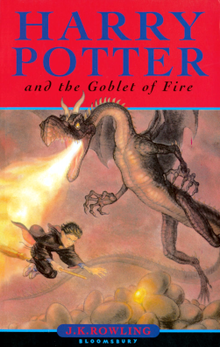
Harry Potter and the Goblet of Fire, by J K Rowling, 2000

Harry Potter and the Goblet of Fire cover.png

In my post on Prisoner of Azkaban I tried to argue that the darkness of that story supported the idea that the novel was the turning point in the series, when they stopped being children’s happy-ever-after tales and became a lot more serious and even disturbing. My evidence rested largely on the role played by Dementors. But the Dementors can be frightened away by a spell; nobody dies in Prisoner, not even Buckbeak, and the only villain present in Hogwarts is a transfigured pet rat. Apart from Pettigrew’s escape and Trelawney’s ominous prediction, everything in Prisoner ends fairly positively. Of course it would have been nicer if everyone had believed in Sirius’s innocence and that Harry could have gone to live with him in Grimmauld Place, but Voldemort still seems a distant, improbable threat.

I was wrong. Goblet of Fire is dramatically darker than any of its predecessors. Real people die in front of our eyes, Voldemort returns to life and to his full powers, together with a band of Death Eaters. Harry seems stripped of the special protection his mother’s sacrifice gave him. The scenes in the Riddle graveyard, when Cedric is brutally and shockingly slaughtered (“kill the spare“), Voldemort rises from the grave and tortures Harry and the Death Eaters return, are difficult to read even now, and only slightly mitigated by Harry’s miraculous escape. This is not a story one would want to read to a young child. Or more specifically these are not chapters one would want to read to a young child – most of the novel is written in the same tone as its predecessors. The level of threat is quite low and Harry is able to master the life-threatening tournament challenges with ease, with lots of people willing to help him.

Obviously another factor is that the novel is significantly longer than the earlier books. This gives Rowling the space to explore and expand upon the magical universe. The international wizarding world is introduced at the Quidditch World Cup, the schools of Beauxbatons and Durmstrang are brought into the narrative, and we learn more about the workings of Hogwarts such as the role of the army of house-elves. While Rowling adheres to her by now very well established story structure spanning the three school terms, this is a year like none other. Here’s a few things I noticed on this read of Goblet of Fire:

SPEW – the Society for the Promotion of Elvish Welfare. What to make of SPEW, Hermione’s campaign to liberate house-elves? The text is unequivocal – with the exception of Dobby, house-elves like being enslaved. They hate the idea of being paid wages, and are horrified by what has happened to Dobby and Winky. There are unsettling echoes of these arguments with the pro-slavery position of the South in America in the nineteenth century – freeing the slaves would be an unkindness, their owners look after them when they are unable to look after themselves, etc. To quote a comment on Reddit “The elves behave like textbook Uncle Toms straight out of Gone with the Wind or Song of the South – the happy servant trope. Other wizards react to their enslavement the same way white people in America reacted to it when people started suggesting it was inhumane: “well, they like being subservient. Serving white people is in their blood.”

Hermione’s campaign is pathetically disorganised and unsuccessful and is perceived by all of her friends, even those closest to her, as an embarrassment. There is very little evidence to indicate her campaign to change attitudes towards the enslavement of house elves has any success. This troubled me because it seems to trivialise the issue for comic purposes, not least in the name of the campaign. Coming from a Muggle family Hermione has a fresh perspective on magical society, and can see the unfairness in the treatment of house-elves than wizarding families are blind to, I just wish her campaign hadn’t been treated as such a joke, an unfunny one at that.

Bertha Jorkins is the witch who plays a pivotal role in the novel (and arguably in the series) but who doesn’t appear in person. She is the Godot of Goblet. I am convinced that she was a late addition to the text, as her only role is to smooth out some of the many wrinkles in the plot. I think the editing process might have gone something like this:

Editor: “OK, love it, great ending, but just a couple of questions. How did Voldemort find out about Barty Crouch Junior having escaped from Azkaban? Also, how did he find out about the Triwizard tournament being staged at Hogwarts this year?

JKR: Good point. I know, I’ll create a character who visits the Crouch family residence, stumbles across Barty Junior hiding there, has her memory modified by Barty Senior so she doesn’t tell anyone that a Ministry of Magic Minister is hiding an escapee from Azkaban, and who then travels to Albania on her holidays, meets Peter Pettigrew, forgets he is supposed to be dead, is lured into a meeting with pre-reincarnated Voldemort who tortures her into revealing Barty Junior’s escape and throws in details of the tournament for good measure. Then he kills her and uses the murder to turn Nagini into a horcrux (as we later learn). There, simples!

The problem with stuffing plot-holes with devices like this (apart from the transparent nature of the process) is that is just opens up more questions. Why wasn’t Bertha’s extended absence in Albania, long-rumoured to be Voldemort’s hiding place, more of a concern for the Ministry? (There are lots of references in the text along the lines of ‘Bertha’s still missing in Albania, goodness I am worried’ but it is never taken that seriously.) Why didn’t Bertha recognise Peter in Albania – not a place one meets many British wizards I assume? It’s all a bit laboured and heavily dependant upon coincidence isn’t it? The film adaptation, forced to make cuts due to the length of the novel, decided to just ignore these problems, cutting out Bertha altogether. No-one bothers to wonder how Voldemort found out about the tournament (it wasn’t exactly a well kept secret, and for that matter there’s no particular reason why it should be) or how he knew Barty Junior had escaped. If he can live in a forest as a disembodied spirit for twelve years he can contact his Death Eaters somehow surely? The film also cuts out two other central characters – Winky, the Crouch family elf, who again is really only there to explain how Harry’s wand is used to conjure the Dark Mark, rather than being a character in his or her own right, and Ludo Bagman, Head of the Department of Magical Games and Sports. Rowling invests a lot of time in building Bagman up as a candidate for Voldemort’s ubiquitous inside man, but Karkaroff does the job perfectly well and Bagman isn’t missed. I don’t think anyone reading Goblet for the first time could have worked out the plot twist re Moody, but few if any would really suspect Bagman either.

The Triwizard Tournament. The tournament is a strange event. It hasn’t been held for a century or more, because it is really dangerous, and student competitors had previously died. So the safety precaution the Ministry introduces (yes, student competitions are governed by the Ministry of Magic) is an age limit? This suggests that previous champions had been younger than seventeen. But if they were chosen by the Goblet it was presumably because they were magically gifted students, most of whom would have been from the senior years anyway. This isn’t much of a precaution, and as it turns out unsurprisingly the tournament is once again lethally dangerous. The other weird thing about the tournament is its duration. It takes all year for just three events, all of which could probably be over in an afternoon and still leave time for tea. Not even a test cricket series takes that long! Rowling seems a prisoner of her school-year format, across which the tournament needs to be stretched irrespective of plausibility.

The challenges themselves are also unusual. The lake-rescue challenge must have been really dull to watch – four champions wade in, nothing happens for an hour, then the champions emerge with their rescued companions. Not exactly an entertaining afternoon down by the lake. There’s some ambiguity about whether the crowd in the Quidditch arena could see what was happening in the maze in the final challenge. People have tried to use trigonometry to work out sightlines by calculating the height of the stands compared to the height of the hedges. But it is fairly obvious they couldn’t see much if anything, because there’s no indication of any reaction when (for example) Krum uses an unforgiveable curse (Crucio) on Cedric, or when Cedric and Harry disappear having touched the trophy. So two out three of the events, with three or four months between them, can’t be watched at all. And why only three challenges? There is time for many more (less dangerous) contests which would have been a lot more entertaining to the audience and allowed the champions to show a full range of magical skills and abilities. A flying for example would have been really fun.

Why is the book called Goblet of Fire? The idea that the “and the” object in each book’s title was an important part of the narrative is pretty obvious, but the goblet of fire only appears briefly to serve as a way of choosing the school champions. It’s a quite unimportant part of the book, but it claims the headline. Perhaps it simply sounded more dramatic than ‘Harry Potter and the Triwizard Tournament‘?

Rita Skeeter. By this point in her writing career Rowling had obviously been on the receiving end of a lot of intrusive press-coverage. Her animosity towards the tabloid press is captured wonderfully in the portrait of the vile Rita Skeeter, and her quick-quotes quill. Rowling’s dislike of the tabloid press is undisguised and vitriolic, and it unbalances the novel slightly – Rita is given a lot more time than she deserves, simply to show her being vile again.

Portkeys. When the Weasley party travels to and from the Quidditch World Cup using a portkey it is clear that they (portkeys) are not simply activated by touch – they travel at specific times. The portkey used to transport Harry and Cedric to the Riddle graveyard is however triggered as soon as it is picked up. Not surprisingly, readers have noticed this apparent anomaly and no doubt drew it to the author’s attention. Subsequently writing on her website, Pottermore, JK explained that there are two different types of Portkey, one pre-programmed, the other triggered on touch. A simple and convincing explanation. Rowling could easily have said “look magic isn’t real so of course it doesn’t follow scientific, rational rules!” but instead she worked really hard to iron out any inconsistencies like these, even long after the series had finished. I suspect this is simply because she enjoys the intellectual challenge.

Goblet of Fire ends on a darkly ominous note – Voldemort is back, and while Dumbledore is going to do all he can to defeat him, he is going to have to do without the Ministry’s support for now.

“Dark times lie ahead of us and there will be a time when we must choose between what is easy and what is right.

Readers would have to wait three long years to find out what was going to happen next to Hv v         v                                      v                             v                                                          v              v         v                                                   v           v                   v                                                       v           arry and his friends.

Standard
Book review

Harry Potter and the Prisoner of Azkaban, by J K Rowling, 1999

I had the huge pleasure of reading Prisoner to my sons a few years back, and it was that experience which finally persuaded me to take J K Rowling seriously as an author.

Harry Potter and the Prisoner of Azkaban.jpg

Philosopher’s Stone and Chamber of Secrets had been fun, with dark moments but plenty of silliness as well, and it seemed the level of peril Harry was going to face was never going to be that serious. He certainly didn’t seem to need the help of adults to face down Voldemort once a year. His plot armour was unbreakable and extended to all his companions. While there is also a strong case to be made for Goblet of Fire being the turning point in the series, where there are key character deaths and the novels begin to grow much longer, I think Prisoner is equally a significant milestone in the series.

First, Prisoner is a much darker novel than its predecessors. Sirius Black has been built up through out the novel as a psychotic and dangerously powerful killer, the only wizard to ever escape from Azkaban (even though his attempts to break into the castle and the Gryffindor common room and bedrooms have not seen anyone killed or even hurt). Having been told relentlessly that he is an extremely dangerous character, we have no reason to believe he is not the novel’s principal villain. After all, who else could it be? In the novel’s climax n the Shrieking Shack the trio are ‘captured’ by Black, Ron is seriously injured, and the only possible help, Professor Lupin, seems to be a traitor. It’s hard to see a way back for them at that point.

The darkness of the novel is underlined by introduction of dementors, a disturbing new element to the narrative. While much of the landscape of Hogwarts is familiar, drawn from traditional stories – ghosts, goblins, giants, unicorns and centaurs – dementors are something new and very scary.

Dementors are among the foulest creatures that walk this earth. They infest the darkest, filthiest places, they glory in decay and despair, they drain peace, hope, and happiness out of the air around them… Get too near a Dementor and every good feeling, every happy memory will be sucked out of you. If it can, the Dementor will feed on you long enough to reduce you to something like itself… soulless and evil. You will be left with nothing but the worst experiences of your life.

What’s worse in many ways is that the dementors are ostensibly on the ‘good’ side – the Ministry employs them to run Azkaban where psychological torture is the state-sanctioned fate of all, to act as security guards around Hogwarts once the threat to Harry from Sirius becomes understood and to execute prisoners without benefit of trial or sentence in the most appallingly cruel fashion, using the Dementor’s Kiss. They are the stuff of nightmares:

Where there should have been eyes, there was only thin, grey, scabbed skin, stretched blankly over empty sockets. But there was a mouth … a gaping, shapeless hole, sucking the air with the sound of a death-rattle.

Fluffy falls asleep when you sing to him, Aragog is Hagrid’s friend, and the basilisk is pecked out of action by Fawkes – but the dementors will eat your soul.

Second, the climax of the novel following Buckbeak’s ‘execution’ is a sustained, extraordinarily breathless series of reveals, twists, and surprises. Reading these chapters (from seventeen to the end of the novel) I found it virtually impossible to find a natural place to find somewhere to pause for the night – each one ends with a cliff-hanger that demands you read on. It’s brilliantly constructed. Prisoner is still an adventure novel for children and young adults, but the shift in tone and quality from the earlier novels is apparent.

Third, complexity. In the course of this novel that Rowling is able to sustain dramatic tension and build a world of depth and complexity, demanding that we look again at the first two novels, re-evaluating references, incidents, and even casual apparently throwaway lines for new importance. You can start to see her cash in some of the investment made in earlier novels. Scabbers, for example, introduced on that first ride on the Hogwarts Express as Ron’s rather pathetic hand-me-down pet, suddenly becomes a much more important character. Equally, the passing reference to Sirius in the opening chapter of Philosopher’s becomes strikingly poignant when it is revealed he is Harry’s godfather. (Incidentally it is surprising that suspicion did not fall on Sirius immediately following the attack at Godric’s Hollow. Dumbledore knew James and Lily were hiding under the protection of a secret-keeper and believed that person to be Sirius – hence his willingness to let Sirius rot in Azkaban for 12 years. But when he hears that Sirius lent Hagrid his motorbike to convey Harry to Privet Drive – no reaction!)

The case against Prisoner revolves mainly around the use of the time-turner as a plot device. It’s a classic deus ex machina, and invites the question why the Ministry allowed a school-girl to casually use such a powerful magical device for relatively trivial purposes. Within the context of the novel however these questions usually don’t occur to the reader, and the time-travel resolution of the plot seems neatly done. Again, if we can suspend our disbelief to allow the existence of magic, magical creatures, and the whole wizarding world, why can’t we allow for time travel as well, and just skate on past any awkward paradoxes?

These elements build into a powerful combination, using the characters, locations and structures that Rowling established in the first two novels, but beginning to explore the wider wizarding world. These are still school-children, struggling with homework, exams, and the awkwardness of teenage friendships (Ron spends a long time sulking when he thinks Crookshanks has eaten Scabbers). Prisoner begins the transition to the darker, more mature themes that dominate the rest of the series.

Standard
Book review

Harry Potter and the Chamber of Secrets, by J K Rowling, 1998

Again, not a review, which would be redundant, but some observations:

  1. The comfort of familiarity. Re-reading Chamber of Secrets I was struck by how similar the story is to Philosopher’s Stone. I am not going to list all the points of comparison here, but (to mention a few) both stories involve:
  • a search for something hidden “miles” beneath the castle
  • a dangerous trip into the Forbidden Forest
  • Hagrid providing clues to the ‘secret’
  • the climax of both novels featuring Harry travelling under the school with his friends, only to be separated from them and having to face You-Know-Who on his own.

The stories are not just similar in terms of their plots. Rowling developed a structure for these novels that was to serve her well and provide a comforting familiarity to her readers. (To be honest it came as a shock when she abandoned that formula in Deathly Hallows). Apart from that one outlier, all the novels start in Privet Drive, feature the journey to Hogwarts, the welcome feast, the three school terms, and culminate conveniently at the end of the summer. Harry’s birthday, lessons, feasts, Quidditch, Halloween, Christmas, Easter and exams are all fixed points of reference in each novel. (It is rare for Rowling to introduce new milestones – so far as I can remember, for example, neither Ron nor Hermione’s birthdays are mentioned or celebrated). This is not an objection, (and I suppose it’s not much of an observation either), but it does mean that each novel was constructed within tightly prescribed parameters, with only limited variations at each outing.

Harry Potter and the Chamber of Secrets By J. K. Rowling

2. Still not sure. Rowling was careful not to assume that readers of Chamber had read Philosopher’s, so provides a detailed if rapid explanation in the opening chapter – Harry is a wizard, he goes to a magic school, he is an orphan, etc. Even the rules of Quidditch get a recap. In later novels Rowling is confident enough to assume that her readers are not joining the series mid-way and dispenses with these summaries, which I suspect were something her editors suggested.

3. Believability. When I first read Chamber I was mildly irritated by some of the plot inconsistencies and absurdities. Would Hagrid really have been carted off to Azkaban just on suspicion of involvement in the opening of the Chamber? Could a massive basilisk have moved freely around the pipes of the school’s medieval plumbing? And why didn’t it eat any of its victims, given how hungry it insists it feels? I could probably explain away these and the many other problematic issues that readers have identified over the years, but I am fairly sure that would be missing the point. This is not a realistic adventure story, and it is wrong to treat it as one. There are ghosts, trolls, centaurs and unicorns for goodness sake, not to mention the giant squid living in the lake! It is a children’s story where suspension of disbelief is required. As the series turns darker a more careful analytical reading can be justified, but for now this is still a bit of a lark.

4. A detective story? One of the pleasures of a re-read of any mystery is spotting the clues one missed the first time round, the misdirection and red herrings. Should I have been able to work out the ending and the plot twists? Most readers assume that the heir of Slytherin is unlikely to be either Malfoy or Harry, following the convention that it is never the more obvious characters ‘whodunnit’. But should I have been able to guess that Ginny was the one opening the Chamber and controlling the basilisk? On a reread the clues are there in plain sight, but the added complication of the diary being haunted by the spirit of Tom Riddle (who mysteriously still has his award for services to the school on display in the trophy room, despite the later difficulty with ahem trying to take over the world) clearly wasn’t guessable, in the same way that Quirrell being the host for You-Know-Who’s disembodied spirit wasn’t work-out-able either. The technique works surprisingly well – Rowling makes us think we should have been able to see the solution while at the same time making it obscurely improbable.

5. Easter Eggs. The other main pleasure of Chamber is seeing some of the skeleton of Half Blood Prince in the bones of the plot. References and objects pop up in passing – the Hand of Glory and the opal necklace from Borgin and Burke’s in Knockturn Alley (one of the many things I still really enjoy from the series are silly little jokes like that), the vanishing cabinet and of course Riddle’s diary.

Chamber isn’t the strongest novel in the series, but there’s still so much to enjoy. The story is told with the wonderful economy that was such a feature of the early novels. The central characters are beginning to come alive and be fully rounded, with the supporting cast also assuming much more depth. New characters such as Dobby are introduced, and the portrait of Lockhart is a wonderfully spiteful sketch. Despite the ghosts and the magic there is a grounded believability about Harry and his friends. They struggle with schoolwork, bullies, unpopularity and peer-pressure – the only thing that no-one seems to suffer from is acne. It’s been a real pleasure to return to Hogwarts, and while I doubt I am going to work my way through the whole series again, I might!

Standard
Book review

The Wee Free Men (Discworld 30) by Sir Terry Pratchett, 2003

Some books are harder to review than others. Sometimes it’s just difficult to find something interesting or original to say, and you don’t want to just summarise the plot and wrap it up with some platitudes about the author’s writing style. But this isn’t that kind of difficult. The Wee Free Men is so full of wonderfulness that it is impossible to capture it all – and to fail would be a disservice to the breadth of Pratchett’s skill as an author. It’s not perfect of course but it’s pretty damn close. For younger readers it is an ideal entry point into Discworld.

Nac Mac Feegle.jpg

The Wee Free Men features the magnificent nine-year old Tiffany Aching. She lives with her farming family, helps out around the farm, and looks after her irritating younger brother Wentworth. Tiffany is special – ferociously intelligent and with a thirst for knowledge and understanding.

I am careful and logical and I look up things I don’t understand! When I hear people use the wrong words, I get edgy! I am good with cheese. I read books fast! I think! And I always have a piece of string! That’s the kind of person I am!

Pratchett’s ability to create fully-rounded female characters always astounds me, and here he does it again, entering imaginatively into the mind of a precocious young girl and getting it pitch perfect. I can’t think of another author of his generation who writes such brilliantly fierce, independent and strong women as Pratchett. They are not just adornments to his novels, they are centralised and given distinctive voices which articulate the reality of their lives. Of course a man can never fully understand what it is to live the life of a woman, but Pratchett does an amazing job of trying. And he defies stereotypes at each turn, not in a self-conscious “I am going to create a gender-fluid character to show how progressive I am” way, but because such characters genuinely interest him.

Although this is a younger reader’s novel, there’s nothing patronising or simplified about the story – it is nuanced, layered, and contains several moments of genuine peril. The bad guys have grim-hounds, dream-stealers and things too scary to describe, and are led by a witch several times scarier than anything in Narnia.

Zoology, eh? That’s a big word, isn’t it?”
“No, actually it isn’t,” said Tiffany. “Patronising is a big word. Zoology is really quite short.

In the previous novels in the series Pratchett created many vividly imagined settings: the sprawling chaos that is Ankh-Morpork; the mountain kingdom of Lancre, the Unseen University, and so on. The Wee Free Men is set in the countryside, a sheep-farming area of grassland known as The Chalk. This small patch of Discworld is vividly evoked and drawn with so much reverence and respect – you have to wonder if Sir Terry grew up somewhere similar to The Chalk.

Anyway, back to the novel. One day while out for a walk with Wentworth, Tiffany sees what the reader knows are Nac Mac feegles, tiny blue kilted men speaking a chaotic and hugely entertaining form of Glaswegian. They warn her of a monster lurking in the river. Using Wentworth as bait, Tiffany bashes the creature with a frying pan. Without mentioning this supernatural experience to any other adult, all of whom are too busy to listen anyway, she seeks out Miss Tick, a visiting witch, who teaches Tiffany some important lessons:

“If you trust in yourself. . .and believe in your dreams. . .and follow your star. . . you’ll still get beaten by people who spent their time working hard and learning things and weren’t so lazy.”

She also tells her all about the Nac Mac Feegle. These riotous pictsies are at the heart of the novel, and are an inspired, vibrant creation. I particularly enjoyed their fear of lawyers – “We’ve got a cheap lawyer an’ we’re not afraid to use him!” In a nod to Tolkien, the Feegles’ swords glow blue in the presence of lawyers. The Feegles believe they are dead – this world is so full of wonders that it must be heaven. When they die therefore there is no cause for grief – you can’t die if you are already dead. That feels seriously profound to me – comforting and at the same time reminding one to appreciate the world as it is.

All of which is a prelude to Wentworth being kidnapped by the Queen of the Fairies, and Tiffany’s rescue mission. She is aided by the Nac Mac Feegles, including Rob Anybody (I confess I only got that joke (that he will steal from anyone) when I read the name out loud; before that I just thought it was a silly name. This might suggest that the novel was written to be read to younger children perhaps?) Big Yan, Daft Wullie, Hamish, the Feegle’s Gonnagle William. The Gonnagle is the Feegle’s battle poet, reciting poetry of Vogon severity that causes enemies to flee. Well I never said the jokes were going to be sophisticated did I?

Tiffany and the Feegles’ adventures in fairyland are scary enough. All through the novel Tiffany remembers her Granny, Granny Aching, an iconic figure of the Chalk who died a few years earlier but remains a crucial figure in her life. This is a touching tribute to the importance of grandparents in children’s lives, and I am sure would be a comfort to any younger reader going through a similar loss.

The novel ends with what is in effect a guest appearance by Granny Weatherwax and Nanny Ogg. In true fairy godmother style, Granny gives Tiffany an imaginary witch’s hat. Tiffany asks

Is it really there?”

“Who knows….It’s virtually a pointy hat. No-one else will know it’s there. It might be a comfort.”

“You mean it just exists in my head?” said Tiffany.

“You’ve got lots of things in your head. That doesn’t mean they aren’t real”.

The Wee Free Men, page 307

Surely it’s not just me who sees this line reappear in Harry Potter and the Deathly Hallows, when Dumbledore says to Harry:

“Of course it is happening inside your head, Harry. But why should that mean that it is not real?”

I’ve only scratched the surface of the wonders of this novel. If you haven’t read it before I am so jealous.

Standard