The Thin Man was Hammett’s last published novel, appearing initially in a magazine in 1934, although he went on to live until 1961. Hammett was a left-wing writer during a period of America’s history where this was very much going against the political grain, eventually finding himself blacklisted after refusing to testify before the House of UnAmerican Activities. Earlier he had gone to prison rather than reveal the names of contributors to a fund he set up to support eleven men appealing their convictions for “criminal conspiracy to teach and advocate the overthrow of the Government by force and violence.” It is fair to assume that it was these experiences which put him off novel writing, although of course he continued writing in other formats.
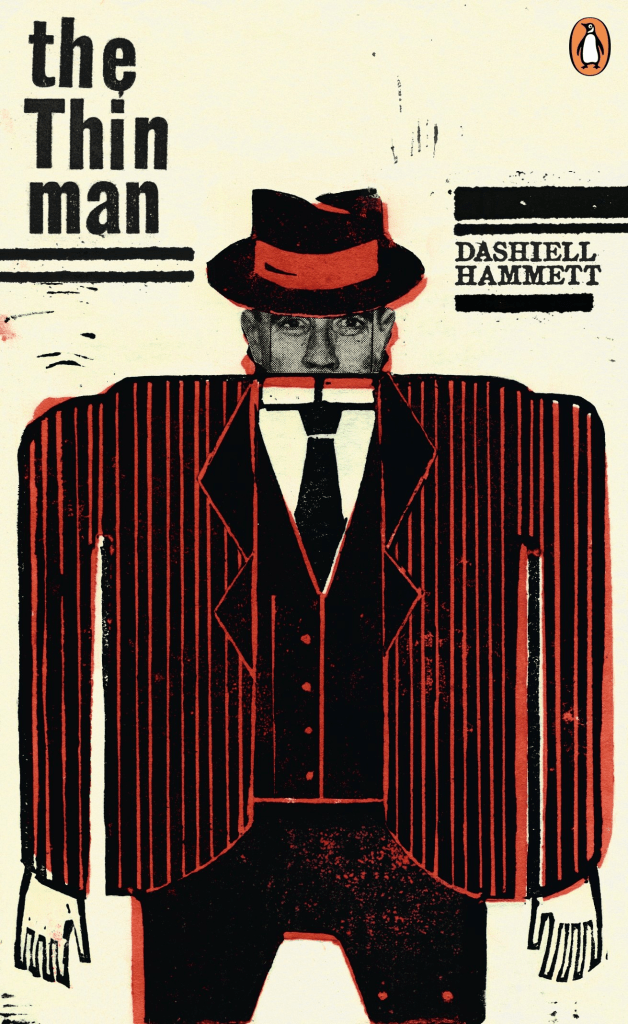
Hammett is widely credited with creating a new form of detective novel, the ‘hard-boiled detective’ genre. This was a world apart from the refined novels of writers such as Agatha Christie and Dorothy L Sayers, Raymond Chandler famously summarised the distinctive element of Hammett’s novels: that he “gave murder back to the kind of people that commit it for reasons, not just to provide a corpse; and with the means at hand, not with hand-wrought duelling pistols, curare, and tropical fish. He took murder out of the Venetian vase and dropped it in the alley“. The Thin Man is a fine example of this genre.
Anyone reading the novel without being aware of the setting will be shocked to find out that the story is set in December 1932 – that is to say in the last days of Prohibition. Given that it remained technically illegal to drink alcohol in the USA, Nick Charles, the novel’s principal character, drinks relentlessly, asking for alcohol at every opportunity like a man dying of thirst. Nick is a former private detective, having retired early following marriage to a wealthy socialite, and is visiting New York with his much younger wife, Nora, to celebrate Christmas and the New Year (and presumably the impending demise of Prohibition). He is reluctantly drawn into investigating a complex murder. A scientist, the titular thin man, has gone missing, and his assistant and former girlfriend is found dead by his ex-wife, on whom suspicion inevitably falls. Their children also act suspiciously and are candidates for the crime, but the police’s focus is on the missing scientist, Clyde Wynant. Together with the local police Nick and Nora drink heavily and talk smart as they try to crack the case.
The focus on drinking throughout the novel is relentless and eventually quite funny:
‘“How do you feel?”
“Terrible. I must’ve gone to bed sober.”’
……….
‘“Don’t you think maybe a drink would help you to sleep?”
“No, thanks.”
“Maybe it would if I took one?”
…….
‘“Why don’t you stay sober today?
We didn’t come to New York to stay sober.”’
The dialogue is the whip-smart wise-cracking we have come to expect from private detectives and their glamourous assistants, but which Hammett seems to have invented:
“She stared at him dully and said: “I don’t like crooks, and even if I did, I wouldn’t like crooks that are stool-pigeons, and if I liked crooks that are stool-pigeons, I still wouldn’t like you.”
Nick in particular has a great line in sarcasm, particularly when he is teasing his wife, who to be fair gives him as good as he gets:
“I’ll give you your Christmas present now if you’ll give me mine.”
I shook my head. “At breakfast.” “But it’s Christmas now.” “Breakfast.”
“Whatever you’re giving me,” she said, “I hope I don’t like it.”
“You’ll have to keep them anyway, because the man at the aquarium said he positively wouldn’t take them back. He said they’d already bitten the tails off the…”
……………
“Nora screwed up her dark eyes at me and asked slowly: “What are you holding out on me?”
“Oh, dear,” I said, ” I was hoping I wouldn’t have to tell you. Dorothy is really my daughter. I didn’t know what I was doing, Nora. It was spring in Venice and I was so young and there was a moon over the…”
The novel is fast-paced – Nick and Nora rarely seem to sleep, and think nothing of setting off at midnight to yet another party. The novel’s resolution seems a little hurried, with everything wrapped up in a few pages once the partying runs out of steam. The novel was very successful and spawned a film, a sequel, and a long-running television series. On its own merits the novel is enjoyable but slight – the reader’s enjoyment is mainly derived from the humour and the wide range of criminal characters, but the plot is almost an after-thought. The same could be said of many of Raymond Chandler’s novels, of course. Hammett was without doubt a profound influence on Chandler, and his style and technique can be found on almost every page of the latter’s work. At the same time I would argue (and I don’t think this is contentious) that Chandler evolved the genre to another level. The principal differences between the two are the latter’s extraordinary turn of phrase (“It was a blonde. A blonde to make a bishop kick a hole in a stained-glass window.”). Marlowe is also a much harder, more violent man than Nick, and the overall body-count in novels such as The Big Sleep is much higher. While Nick can shrug off a bullet wound with a light bandage and another slug of whisky, when Marlowe is beaten up we feel every blow.
P.S. I’ve written more here about the differences between Marlowe and Sam Spade, Hammett’s main character in novels such as the classic The Maltese Falcon.