
“The school at which I was science-master was desirably situated, right in the centre of the town, By walking only a few yards the masters and boys could find themselves in a café or a public-house. I used to frequent a café in the market-place. It was on the first floor, and underneath was a shop where coffee was roasted. A delicious aroma drifted through the maze of market stalls, mingling with the smell of celery, apples and chrysanthemums: you could pick up in the middle of the place and follow it to the source, where, in the shop-window, a magnificent roasting-machine turned with a flash of red enamel and chromium plate.”
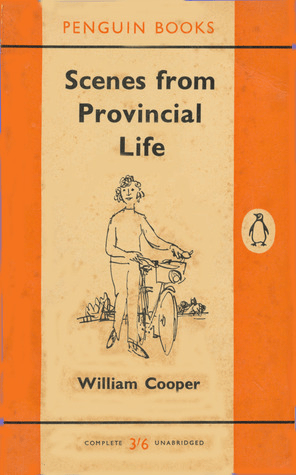
Remarkably it seems that Scenes from Provincial Life, a novel once described as ‘a post-war literary landmark’ by Anthony Burgess and as ‘seminal’ by John Braine, is now out of print. It has received only seven reviews on Goodreads. I first came across the novel in the mid-1980’s in the classic Penguin edition shown here. I remember finding it charming and amusing, but recalled little else about it. You will not be surprised such is the fallibility of memory that returning to the novel I found it much changed!
Scenes from Provincial Life, with a title knowingly looking back to earlier nineteenth century ‘small town’ literature, features as its protagonist a new type of central character, one who came to dominate fiction of the 1950’s: male, (inevitably), but also young, sexually active, educated and (crucially) not financially independent. Unlike so many of the people in (for example) the average Bloomsbury novel, these characters have to work for a living. And their jobs are not things that happen ‘off-screen’ as diversions from the central events of the novel, the love affairs and melodramas, but are actually places they go and things they spend time doing. Kingsley Amis’ Lucky Jim is probably the best known example of this genre, but Scenes, published in 1950, came before it and showed the way. Joe Lunn is a physics teacher in a not very good secondary school in a provincial town (widely acknowledged as being Leicester). He is not a very good teacher, under threat of dismissal for his flagrant disregard for the petty headmaster’s rules and not at all worried about the prospect. He has other things to worry about, not least the fact that this is the spring of 1939 and war seems unavoidable. (Joe thinks the alternative to war, capitulation to Germany, would be even worse). He finds his work boring and pointless. He is not much older than his sixth form students and finds it easier to relate to them than his peers.
Joe’s social circle involves his girlfriend, Myrtle, Tom, an accountant, and Stephen, Tom’s much younger boyfriend. The portrait of an openly gay relationship (open within his social circle, but not out in the modern sense) was highly unusual, not least because it is presented as unexceptional and unproblematic. Stephen and Tom’s relationship is portrayed as slightly hysterical with lots of ups and downs, ultimatums and so on, but Joe never passes judgment on them as a gay couple.
But the central relationship of the novel is that between Joe and Myrtle, which is based on a mutual and enthusiastic sexual attraction. They spend weekends at Joe’s cottage (which it seems he either hires for weekends only or that can afford to rent both this cottage and his room in a boarding house, where overnight guests are forbidden by moralistic landladies). Either way, the cottage is the place where they can enjoy one another’s company without the intrusion of prying eyes. Joe, a few years older than Myrtle, is very keen on having as much sex as possible with her, but is very clear that he is not interested in marriage. In the 1930’s, when the novel is set, and even into the 1950’s when it was published, pre-marital sex obviously happened, but the implied understanding was that it would, sooner or later, lead to marriage, rather than being a fun occupation in its own right. There is even, in chapter two, a very clear but not quite explicit description of oral sex that I think could have been shocking to Cooper’s 1950’s readers, even those who had managed to get their hands on a still-banned copy of Lady Chatterley’s Lover. Sex is fun and uncomplicated in a very 1960’s post pill way. Myrtle does have a pregnancy scare at one point, which she successfully treats with copious amounts of gin.
As the year passes, the international situation deteriorates and it becomes clear that war is coming ever closer. Joe and his friends develop a plan to emigrate to America – Tom in particular is keen to leave, being Jewish. These plans never really get off the ground and I had the feeling that such talk was common in some quarters in 1939, the alternative being too grim to contemplate. J0oe tries to involve Myrtle in this plan, but as he never mentions the ‘m’ word (marriage) she is not interested. Joe and Myrtle’s relationship begins to struggle as he stubbornly refuses to accept her hints about getting engaged and in response she starts to spend time going to parties with other men. If this is intended to make him jealous it succeeds, but not sufficiently to change his mind on the matrimony front. To complicate matters Tom tells Joe that he is planning to ask Myrtle to marry him – other than to make Stephen jealous it is not clear why he is going to do this, and neither Joe nor Myrtle take the offer seriously.
A comedic sports day chapter is entertaining, but as soon as the narrative returns to the love affairs of the cast the novel slows back down. Joe really wants to end his relationship with Myrtle, but she continues to sleep with him, which acts as a serious disincentive to him ending it, but he also does not want to appear caddish, and would rather it be Myrtle herself who ends things. This she finally does. Cooper closes the novel with a quick summary of how the characters fared during and after the war. I was surprised while preparing this post to find out that Cooper published several sequels to this novel, charting the later lives of Joe, Myrtle and friends. I am in two minds as to whether to read these – I am not sure that the characters are sufficiently compelling to justify several follow up novels – but I might! I doubt they are in print however.
I wonder who comes closer to the truth – the novelists and critics of the 1950’s who saw in Scenes from Provincial Life something important and significant, or the modern judgment which is to have largely forgotten the novel? It is possible that both views are right – Scenes was important when first published because it marked a break with the dominant Modernist novel of the interwar years, but that in itself is not enough to preserve its value as a novel in its own right once stripped of its historical and cultural context. I am not entirely convinced it had the cultural impact that some have claimed – after all George Orwell and others were writing novels about young, educated but not very well-off young men looking for new types of relationships that did not involve marriage back in the 1930s. But at the same time this template has proven remarkably resilient and you will find many writers of today writing to this pattern, using these themes. Scenes deserves to be remembered and read, and recognised as an important cultural landmark, even if hindsight now tells us that the turning point it seemed to represent didn’t last that long.

