
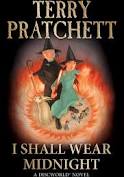
I Shall Wear Midnight is the fourth in the series of Discworld novels that focus on the earlier years of witch in training Tiffany Aching. The wonderfully poetic title of the novel is Tiffany’s defiant statement that she will be her own witch, not conforming to the convention that witches of all ages wear black (i.e. ‘midnight’) and is first referenced in Tiffany’s story at the end of A Hat Full of Sky, when she says “When I’m old I shall wear midnight”.
It is fair to say that each of Tiffany’s novels follow roughly the same pattern, albeit in each new book she is progressively a little older, a little more mature, and a more proficient witch. Here she is almost fully qualified (insofar as witches are ever qualified) and is working on her own as the Chalk’s witch, the Chalk being a sheep-farming area of Discworld somewhere between Lancre and Ankh-Morpork, which is admittedly a very large area. The novel opens at the Scouring Fair, a traditional Chalk celebration which includes maintenance of the massive hillside chalk carving which bears a striking resemblance to the Cerne Abbas giant. If you haven’t heard of the Cerne Abbas giant then a few minutes on Google will be instructive in terms of country folk’s attitudes to fertility and related issues…
But the celebration doesn’t last long because the second chapter opens with one of the most vivid and distressing scenes I can recall in the Discworld series. Thirteen year old Amber Petty has been beaten so badly by her drunken father that she has miscarried. Word has reached drinkers at the local pub, and a group of villagers is coming to exact ‘justice’ on Mr Petty. Here Pratchett references the rural tradition of “rough music” in which a community takes the law into its own hands.
“Rough Music…
o one controls the music, Mr. Pretty – you know that. It just turns up when people have had enough. No one knows where it starts. People look around, and catch on another’s eye, and give each other a little nod, and other people see that. Other people catch their eye and so, very slowly, the music starts and somebody picks up a spoon and bangs it on a plate, and then somebody else bangs a jug on the table and boots starts to stamp on the floor, louder and louder. It is the sound of anger, it is the sound of people who have had enough. Do you want to face the music?
Tiffany drags Mr Petty out of bed and tries to persuade him to run for his life and then takes Amber to be cared by Jeannie, the Kelda (queen) of the Nac Mac Feegles.
The fly-leaf of the hardback edition describes I Shall Wear Midnight as a Discworld book for “young readers”. It is not, not by any measure. It is not even a novel for younger readers, if I have understood the distinction correctly. I reject the meaningfulness of the classification, but any novel that deals so directly with domestic abuse in this honest and open way is not just for young readers. Young readers are perfectly capable of reading about these issues, of course they are, but there’s no sugar coating here, no turning away or euphemisms, unless you count Tiffany’s description of Amber being beaten so hard “that she bled from places where no-one should bleed”.
Shortly later, the local Baron, for whom Tiffany has been caring, dies after a long and painful unspecified illness. Tiff travels by broomstick (accompanied by her bodyguard of Feegles) to Ankh-Morpork to tells his son, Roland. Tiffany and Roland had previously been ‘walking out’ together, and everyone assumes that she is upset that he is now engaged to someone else, but she is actually taking the disappointment in her stride. On the way to the city she has her first encounter with the novel’s protagonist, the Cunning Man, a foul-smelling figure of nightmares who has holes for eyes. The Cunning Man is able to turn people’s minds against witches, which explains why Tiffany’s normally supportive community has started suspecting her of abducting Amber and killing the Baron and stealing from him.
The Feegles cause chaos in the city, but help her find Roland, to whom she breaks her sad news. With the help of Mrs Proust, a local witch who runs the Boffo Novelty and Joke shop, in Tenth Egg Street, ‘the spiritual home for all those who consider that fart powder is the last word in humour’, Tiffany looks for answers as to what the Cunning Man is, and how to defeat him. She meets Eskarina Smith, Discworld’s first and apparently only female wizard, not seen since the events of the third Discworld novel, Equal Rites, who tells her the Cunning Man’s origin story. After a walk-on appearance by some of the Watch’s regulars and an overnight stay in the police cells, Tiffany hurries back to the Chalk to confront the Cunning Man and restore some balance to her community. In doing so she meets two important new allies – Letitia, Roland’s fiancé, who is without realising it a powerful witch, and the charming Preston, one of the Baron’s guards. Back at the Chalk there is time for the Baron’s funeral and the new Baron’s wedding, guest appearances by Nanny Ogg and Granny Weatherwax (the highlight of any Discworld novel!) before the inevitable climatic showdown with the Cunning Man.
This is an important book. As with all Pratchett’s work it is suffused with good sense, compassion and kindness. Tiffany is a good person working tirelessly to make the world just a little bit better. She doesn’t do it for personal gain or glory, just because it needs doing. In a world where there are too many people doing the exact opposite, we could all be a bit more like Tiffany. But that’s not all Pratchett has to say. This is a novel about how people are prepared to believe bad things about outsiders, about ‘others’. The key quote (and it is rare that Discworld novels have just one key quote, but I think this one does) is “Poison goes where poison’s welcome.” In other words the lies told about Tiffany and other witches would not be believed unless people wanted to believe them. In a world in which outsiders and immigrants are demonised we need to realise that the poisonous words spread about them by newspapers, websites and politicians cannot harm us if we do not welcome them in. The people of the Chalk are Tiffany’s friends and relatives, normal hard-working folk, but they are not immune to the harsh words and thoughts spoken about witches or wise-women:
“everybody knew, in some mysterious way, that witches ran away with babies and blighted crops, and all the other nonsense. And at the same time, they would come running to the witch when they needed help.”

