
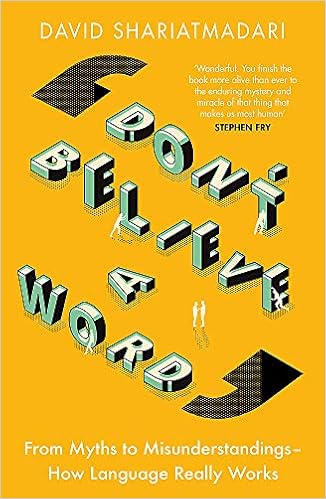
Don’t Believe a Word is subtitled “From Myths to Misunderstandings – How Language Really Works” which is a pretty bold claim, and one I suspect Shariatmadari would probably disavow. Because this is much more a summary of the current state of research into some of the larger issues around language acquisition and use than anything approaching a comprehensive final set of answers to some of the difficult questions about this issue.
Because language is profoundly mysterious. How we as a species came to uniquely acquire the power of language is endlessly fascinating, and I was hoping for something that attempted to described the processes whereby we went from the simple sounds required to warn of predators or communicate during a hunt to the infinitely more complex process I am using to write these sentences, however inelegantly. Unfortunately the author really only skims these issues for the safer, more familiar ground of why language is not ‘going to the dogs’ or the differences between languages, dialects and ideolects.
The structure for the book is that each chapter is intended to expose a common myth about language. Demonstrating that standards of English are not declining, and never have, is done easily enough, by quoting the same complaint made across the centuries. Older people will always feel alienated from the language of the young who are much more innovative in their use of language, and will use their positions of authority that come with age to define standard English and try to shame younger people into conformity. Which means I can look forward to hopefully one day hearing the incessant use of the word ‘like’ as a meaningless filler to become the ‘correct’ way of expressing oneself, and youngsters chastised for not using it appropriately.
Each generation will think of itself as exceptional, and find reasons why the language they are using is different from that of their predecessors. Much of this is down to the rapid spread of technology which introduces words and ideas simply not required before. I am grateful to the author for bringing to my attention this brilliant summary of the issue from the wonderful Douglas Adams (from The Salmon of Doubt):
1. Anything that is in the world when you’re born is normal and ordinary and is just a natural part of the way the world works.
2. Anything that’s invented between when you’re fifteen and thirty-five is new and exciting and revolutionary and you can probably get a career in it.
3. Anything invented after you’re thirty-five is against the natural order of things.”
Another ‘myth’ Shariatmadari addresses is the idea that foreign languages have untranslatable words. Is that really a language myth that needs to be challenged, or just a bit of fun on the internet that no-one takes particularly seriously? Yes it makes other cultures sound sound quaint or bizarre. and can contribute to the ‘othering’ of foreigners. But other cultures are often profoundly different from our own (not better or worse, just different) so it would be surprising if they didn’t have words for things we use phrases or sentences to describe.
There’s a thoughtful discussion of whether our languages shape how we think, rather than the other way round. Those of us exposed to George Orwell’s thesis (in 1984) that we need a language of nuance and expression to articulate concepts such as democracy will be open to the idea that we need words to explain ideas before those ideas can exist. But mentioning Orwell brings me to a minor quibble with this book. In the chapter on whether language is deteriorating, the author cites Orwell as “clearly wrong when he imagined that language would become decadent and ‘share in the general collapse’ of civilisation unless hard work was done to repair it.” The text Shariatmadari is quoting here is not cited, but the internet being the wonderful thing it is I easily found it in Politics and the English Language. Now you won’t find a better. more powerfully argued essay in favour of clear writing in politics that this. Shariatmadari unfairly dismisses it because Orwell opens with the deliberately contentious argument that:
Most people who bother with the matter at all would admit that the English language is in a bad way, but it is generally assumed that we cannot by conscious action do anything about it. Our civilization is decadent and our language — so the argument runs — must inevitably share in the general collapse.
Orwell, Politics and the English Language, 1946
To break one of Orwell’s prime rules (‘never use a metaphor, simile, or other figure of speech which you are used to seeing in print’) this is throwing the baby out with the bathwater. All Orwell is arguing is that bad writing about politics is often bad for specific reasons: “to make lies sound truthful and murder respectable, and to give an appearance of solidity to pure wind”. Which is surely a more important point than the one he is being discredited with?
Later, Shariatmadari gives a respectful, if sceptical account of Noam Chomsky’s universal grammar theory. The idea that humans are born with an innate language ability far in advance of any other skill or ability in life (compare the struggles we have to walk or feed ourselves) has yet to be proven beyond all doubt, but the alternative, that language is “a medium that is formed as it is used … a road that is paved at the same time as we walk it” seems inadequate when contrasted with the other clumsy abilities we develop as children. If you want a primer on Universal Grammar and the current research on the theory this is not a bad place to start.
Overall this is an entertaining, accessible and well-evidenced summary of the state of linguistics as it is currently understood. As with the book I recently read on genetics, I left this with the impression that there is still a lot of research to be done on this subject, and that our understanding of ‘how language really works’ is as elusive as ever.
 The Reading Bug