Book review

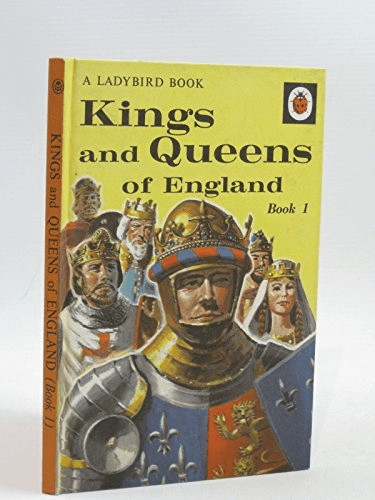
All books are themselves the product of earlier books, however original they may be. I’m not suggesting that all books are copies of earlier works, but they all have dna, texts which have influenced them and without which they couldn’t exist. Some reveal their origins more obviously than others. Unruly makes very little attempt to disguise its sources and influences, which are a fairly straightforward combination of Horrible Histories and the ladybird books that gave you one king per page, with an illustration summarising the one thing you needed to remember about him or her. Add in a little 1066 and All That and a lot of swearing (and I will come back to the swearing), and there you have it.

Which as always begs the inevitable question – why? What made David Mitchell think that writing a book about the queens of England from Anglo-Saxon days to the end of the Tudor period, a pretty long span of history in anyone’s books, was a good idea? Certainly there is a very well established tradition of celebrities writing books. And Mitchell studied history at Cambridge, albeit quite a while ago. My hunch is that this is a lockdown book, something the author filled his hours with when going out or recording game shows wasn’t an option.

There’s not much original research here – none in fact – and anyone with a reasonable grasp of English royal history won’t learn a great deal. A canter through six hundred years of royal history was always going to be somewhat superficial. Even if Mitchell’s reasons for writing the book can be surmised, that in itself doesn’t explain why anyone should read it. There are a few reasons, although whether these justify the whole exercise I am not so sure.

Firstly, there’s the swearing. For someone who has developed a whole comedic persona around being posh, here Mitchell swears freely and extensively. For example, writing about King Stephen and Queen Matilda, he says: “They were both twats. They may not have been able to help being twats – the mores and values of their times and of their class may have made them twats. But they were twats and terrible things happened as a result.” (This is a more family-friendly example). The comedy here derives from the repetition of the word twat rather than its shock value – just in case you hadn’t spotted that. Despite his best efforts not much comedy is wrung from the humour of King Cnut’s name sounding a little like a spelling mistake. But it lightens the tone and makes it clear that Mitchell isn’t taking the exercise all that seriously.

The main interest and where the text really comes alive is in Mitchell’s observations about the nature of monarchy. He argues compellingly that monarchs aren’t in any way special people:

“Ultimately the reverence shown to monarchs is a mockery, a joke. It’s pretending they’re something they are not. This is a bitter and clear reduction of kingship to its essentials: an office accepted only because an unjust hierarchy is preferable to anarchy. Out of the gangsterism of the lawless post-Roman land of Britannia, a few local bigshots emerged, their power gradually coalescing into kingship.” (396).

That’s the book’s thesis in a nutshell – once the Romans left Britain there was a period of lawlessness, local thugs took control of small areas, slowly killed one another and grew in power and influence until the concept of ‘king’ was invented. That power was then cemented with “ceremonial and religious elements giving kingship an aura of legitimacy and sanctity. But it was just made up. At some point someone with a sociopathic dislocation from the truth had to start asserting it, like the first conspiracy theorist who said that 5G masts spread Covid”. All of this is rather brilliantly summarised in the book’s final chapter, Bookends. This final chapter also contains a rather remarkable few paragraphs about Shakespeare. Mitchell writes with passion about Shakespeare’s brilliance, and concludes “He’s where this book has been heading, it turns out…Shakespeare is a good reason to stop writing about kings, because his brilliance makes them seem silly.” I wish he had come to that realisation a few hundred pages earlier and turned his intelligence and learning towards a subject that obviously interests him far more than kings and queens, and one on which has some valuable insights.

The book ends by making it clear that although the exercise could be repeated for the Stuarts, Hanoverians etc, it won’t be. The excuse offered is that kingship had by the end of Elizabeth’s reign become less important and therefore less interesting (tell that to Cromwell). I’m not buying it for an instant. I hope Mitchell’s next book is about a subject he obviously has a real passion for and which according to this book he shares with his wife – if she were to help him out with it all the better!

Unruly, a History of England’s Kings and Queens, by David Mitchell, 2023

Aside
Book review

Hamnet, by Maggie O’Farrell, 2020

It feels as if I am the last book blogger on the planet to get round to reading this magnificent novel. I am more than happy to join in with the praise this wonderful book has been showered with, because it is extraordinarily powerful, easily the best novel I have read this year.

Even if you had managed to avoid any of the publicity about this novel, you would know its subject matter from the title. Described in the Guardian review as the “tragic tale of the Latin tutor’s son” (which cleverly highlights the novel’s way of looking at the story with a fresh pair of eyes) Hamnet is about many things, but at its heart this is a novel about grief. How people process loss, how it impacts us differently (particularly poignant was the scene when Judith, Hamnet’s twin sister, asks her mother what the word is for a bereaved twin – after all we have words for orphans and widows). I have never read a book where the rawness of grief is conveyed so powerfully – I sobbed. Written in the present tense it has an immediacy that gives the scenes of loss such impact, and of course the fact we are now living through another pandemic, gladly one a lot less dangerous than the plague of the middle ages, goes to emphasise the tragedy in an unexpected and dramatic way.

But it’s not just about grief. It is an extraordinarily evocative recreation of late sixteenth century rural Warwickshire (London is also summoned up vividly, but it is not the focus of the novel). The extended Shakespeare and Hathaway families are brought to life – and while this novel sent me back to the internet time after time to check various details of their lives (those we know, of course) I didn’t resent that in the slightest. One of its many strengths is that this book isn’t over-researched – it takes the little we know about Shakespeare’s family background and life, and fills in the gaps imaginatively and convincingly. O’Farrell is happy to take risks and present less popular versions of the story – the idea that Will and Anne met while he was tutoring her step brothers in Latin for example. I loved the way the novel rescues Anne Hathaway from the condescension of history and reinvents her as a wise confident young woman. I also think it was a brave decision to foreground Anne (known here as Agnes, the name her father uses for her in his will, apparently) rather than Shakespeare, who remains unnamed throughout the novel.

The mystery of the relationship between Hamnet and the play in his name written just a few years later (O’Farrell mentions only briefly the fact that Shakespeare is believed to have written some of his best comedies in between the two events) is one that invites speculation. Was Shakespeare simply callous, indifferent to the feelings of his family, or (as O’Farrell compellingly speculates here) using the play to explore his grief for his lost son? Other family relationships and characters – the bullying glove-maker John Shakespeare, or Will’s mysterious brother Edward (here Edmond) are all brought to life vividly.

There are many gaps in what we know about Shakespeare. Why did he live long parts of his life in London and not bring his family to live with him, even when he was financially successful? What impact did these long periods of separation have on his marriage. How did he go from being the son of a glove-maker to a phenomenally successful playwright? Why on earth did he leave his second-best bed to his wife in his will? And most of all, what impact did the loss of his son have on his work? Although this is not Shakespeare’s story, along the way O’Farrell acknowledges these many mysteries and provides thought-provoking answers. Which means you can enjoy this novel if you know all there is to know about Shakespeare, or nothing.

I can’t recommend this novel highly enough. I suspect it will go on to win many more awards than the entirely merited Women’s Prize for Fiction it was awarded earlier this year against stiff opposition.

PS The season finale of series three of Upstart Crow, the David Mitchell/Ben Elton BBC sit-com about Shakespeare featured Hamnet’s death. In this episode Judith falls in first, Shakespeare is sent for from London, and between this message being sent and his arriving home Judith recovers and Hamnet has fallen ill and died, the exact sequence O’Farrell follows here. It’s well done in both versions, but I can’t find any evidence or source for this version other than here. I wonder whether the television programme acted as a spark of inspiration for this part of O’Farrell’s story? The programme ends with this apposite and poignant speech from King John:

Grief fills the room up of my absent child,
Lies in his bed, walks up and down with me,
Puts on his pretty looks, repeats his words,
Remembers me of all his gracious parts,
Stuffs out his vacant garments with his form;
Then, have I reason to be fond of grief?
Fare you well: had you such a loss as I,
I could give better comfort than you do.
I will not keep this form upon my head,
When there is such disorder in my wit.
O Lord! my boy, my Arthur, my fair son!
My life, my joy, my food, my all the world!
My widow-comfort, and my sorrows’ cure!

King John, Act 3 scene 4

Standard
Book review

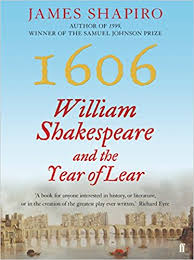
1606 William Shakespeare and the Year of Lear by James Shapiro

I am coming late to the Shapiro party, and that is only in part because I got stuck halfway through this actually very readable account of  England in 1606 and the plays Shakespeare wrote in this year. (Quite rightly Shapiro cheats a little and also spends some time in 1605, looking in detail in particular at the events of the Gunpowder Plot.)1606

Dating Shakespeare’s plays is never easy. The exercise assumes that the plays were written at a specific time, whereas there is plenty of evidence that once written and performed the plays continued to be revised for different performances (for example a shorter version of the play might be required for a court performance). But the overwhelming consensus is that King Lear, Macbeth, and Antony and Cleopatra were written in 1606, and were first performed in that year. So Year of Lear is slightly misleading, but more concise than Year of Lear, Macbeth and so on.

I make no claims to expertise on these issues, so the extent to which Shapiro’s analysis is reliable or otherwise is beyond me. Certainly it sounds authoritative; there is also a wealth of footnotes and bibliography supporting the text. In dating Lear, Macbeth and Antony and Cleopatra to 1606, Shapiro inevitably upset the Oxfordian lobby, that remarkable group of people who are convinced that Shakespeare’s plays were written by the Earl of Oxford. In order for this group’s theories to “work” they need Lear and the others to have been written much earlier, before James 1 came to the throne in 1603. So they felt/feel compelled to attack Shapiro’s central concept – that the events of the time can be seen reflected in the plays of the time – even though Macbeth in particular seems profoundly influenced by James’s interest/obsession with witches, and the pursuit of Jesuits in England following the Gunpowder Plot.

Anyone writing about Shakespeare in the context of the times in which he lived has to exercise a lot of care. These are without question not autobiographical plays, and any attempt to link events in Shakespeare’s personal life to his plays is bound to fail. At the same time we know a lot more about the major political events that happened in England at the time Shakespeare lived, so it is only reasonable to ask to what extent these events informed his plays, both in their original conception and their subsequent evolution. It is hard to imagine that it is a coincidence that Shakespeare wrote a play – Lear – showing the dangers of a disunited kingdom while at the same time James was arguing with Parliament for union between his two thrones, England and Scotland, or that a play showing the consequences of regicide – Macbeth – should just accidentally have turned up on stage as the consequences of the attempted regicide of the Gunpowder Plotters still reverberated around the country.

While undoubtedly very scholarly, Shapiro’s book is not an academic tome. It is accessible and relatively easy to read. The chapters on the Gunpowder Plot and its aftershock are quite thrilling, if not also rather gruesome. One gets a vivid picture of Jacobean London and England, the world in which Shakespeare was living and working. Some of the content was not new to me – it must be extraordinarily hard to find new things to say about Shakespeare, rather than just presenting content in new ways. But there were certainly snippets of new insight – new to me, anyway – such as the fact that Shakespeare’s daughter was a recusant (i.e she refused Anglican communion) or that his landlady in St Olave’s parish in London almost certainly died of the plague. I had never noticed before Shapiro pointed it out that the plague, such a dominant feature of life in England at the time, never really plays anything other than a peripheral part in Shakespeare’s works.

If this is a topic that interests you, and it really should, Shapiro’s 1606 is highly recommended. He wrote a similar book on 1599, and also what looks like a pretty definitive guide to the ‘authorship’ debate, which I have to admit I have added to my Amazon wish list!

Standard