Book review

Guilty by Definition, by Susie Dent, 2024

If you had to guess what a novel by tv’s lexicographer Susie Dent would be about I think most people would assume that it would be a) in the cosy crime genre, b) feature a main character who is a lexicographer, or a related profession, and c) involve word puzzles and clues that lead to the resolution of the mystery. And the author obviously hates to disappoint her audience, because that is exactly what she has produced. I was expecting the novel to be a lazy, genre-driven cash-in on the author’s public persona (of which there are many out there at the moment) but I am delighted to say it was so much better than that. There are still some predictable elements, of course, including the loving descriptions of academic Oxford, the word puzzles, and the short chapters that keep the pages turning. But these are more than compensated for by the high quality writing and the well constructed plot.
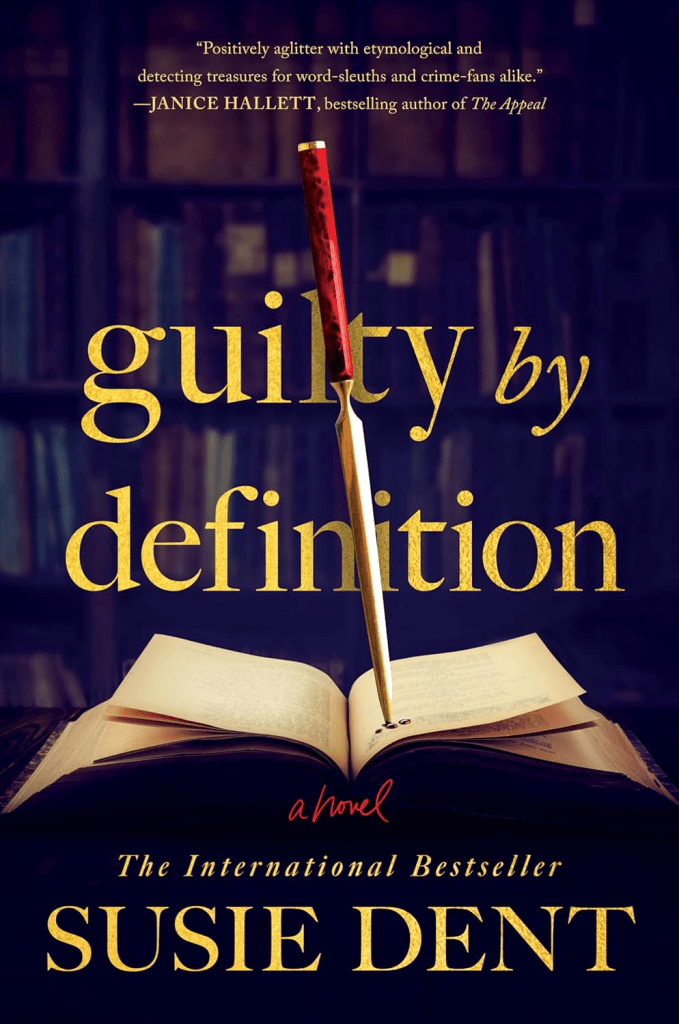
Set in Oxford and featuring a team of lexicographers working for the Clarendon English Dictionary, the setting and structure of Guilty by Definition also provides the author with plenty of opportunities to weave into the text anecdotes about the origins of words and phrases, keeping the fans of Countdown and Dictionary Corner satisfied. These word-related anecdotes are sometimes rather obviously shoe-horned into the narrative (often something about a word or phrase will just occur to the narrator and have to be explained) but I think Dent just about keeps on the right side of this not being irritating or distracting.

The plot follows Martha Thornhill, senior editor of the Clarendon English Dictionary. She and her team seems to have gloriously relaxed jobs tracing the origins of words and phrases. Also working for the CED but not part of Martha’s team is Jonathan Overton, a Shakespeare expert who has published widely on the bard’s coinages and who is a minor media celebrity. One day they receive a letter from an anonymous correspondent who signs themself ‘Chorus’. This letter contains a word puzzle, which when solves leads to the answer 2010, which is the year that Martha’s sister, Charlie, went missing. Thus begins a reopening of the investigation into Charlie’s disappearance. This moves along at a fair pace, with new developments and discoveries about Charlie’s past every few pages. Further letters and puzzles from Chorus move the action along every time the investigation begins to lose focus. It is revealed that Charlie was on the trail of a literary discovery, which as well as being hugely valuable would rewrite much of what we know about Shakespeare’s invention of new words. In lexicography terms this could be up there with the Rosetta Stone or the double helix structure of DNA.

Guilty by Definition is well plotted and well written. The final reveal of what happened to Charlie and what she had discovered hits exactly the right balance between not being too obvious but at the same time not too obscure. I was able to work out ‘whodunnit’ fairly early on, the list of possible suspects being quite small, but this didn’t spoilt the read for me in any way. The novel has lots of independent women characters who are not defined by their appearance or sexuality and who are not traditional stereotypes, which was a refreshing change from much genre fiction. The three main lexicographers, Safi, Martha and Alex form a strong team that would translate very well onto the television screen (with Oxford as a photogenic background) and I would be astonished if they do not reappear in further word-based mystery sequels. I look forward to them.
Guilty by Definition, by Susie Dent, 2024

Aside
Book review

1606 William Shakespeare and the Year of Lear by James Shapiro

I am coming late to the Shapiro party, and that is only in part because I got stuck halfway through this actually very readable account of  England in 1606 and the plays Shakespeare wrote in this year. (Quite rightly Shapiro cheats a little and also spends some time in 1605, looking in detail in particular at the events of the Gunpowder Plot.)1606

Dating Shakespeare’s plays is never easy. The exercise assumes that the plays were written at a specific time, whereas there is plenty of evidence that once written and performed the plays continued to be revised for different performances (for example a shorter version of the play might be required for a court performance). But the overwhelming consensus is that King Lear, Macbeth, and Antony and Cleopatra were written in 1606, and were first performed in that year. So Year of Lear is slightly misleading, but more concise than Year of Lear, Macbeth and so on.

I make no claims to expertise on these issues, so the extent to which Shapiro’s analysis is reliable or otherwise is beyond me. Certainly it sounds authoritative; there is also a wealth of footnotes and bibliography supporting the text. In dating Lear, Macbeth and Antony and Cleopatra to 1606, Shapiro inevitably upset the Oxfordian lobby, that remarkable group of people who are convinced that Shakespeare’s plays were written by the Earl of Oxford. In order for this group’s theories to “work” they need Lear and the others to have been written much earlier, before James 1 came to the throne in 1603. So they felt/feel compelled to attack Shapiro’s central concept – that the events of the time can be seen reflected in the plays of the time – even though Macbeth in particular seems profoundly influenced by James’s interest/obsession with witches, and the pursuit of Jesuits in England following the Gunpowder Plot.

Anyone writing about Shakespeare in the context of the times in which he lived has to exercise a lot of care. These are without question not autobiographical plays, and any attempt to link events in Shakespeare’s personal life to his plays is bound to fail. At the same time we know a lot more about the major political events that happened in England at the time Shakespeare lived, so it is only reasonable to ask to what extent these events informed his plays, both in their original conception and their subsequent evolution. It is hard to imagine that it is a coincidence that Shakespeare wrote a play – Lear – showing the dangers of a disunited kingdom while at the same time James was arguing with Parliament for union between his two thrones, England and Scotland, or that a play showing the consequences of regicide – Macbeth – should just accidentally have turned up on stage as the consequences of the attempted regicide of the Gunpowder Plotters still reverberated around the country.

While undoubtedly very scholarly, Shapiro’s book is not an academic tome. It is accessible and relatively easy to read. The chapters on the Gunpowder Plot and its aftershock are quite thrilling, if not also rather gruesome. One gets a vivid picture of Jacobean London and England, the world in which Shakespeare was living and working. Some of the content was not new to me – it must be extraordinarily hard to find new things to say about Shakespeare, rather than just presenting content in new ways. But there were certainly snippets of new insight – new to me, anyway – such as the fact that Shakespeare’s daughter was a recusant (i.e she refused Anglican communion) or that his landlady in St Olave’s parish in London almost certainly died of the plague. I had never noticed before Shapiro pointed it out that the plague, such a dominant feature of life in England at the time, never really plays anything other than a peripheral part in Shakespeare’s works.

If this is a topic that interests you, and it really should, Shapiro’s 1606 is highly recommended. He wrote a similar book on 1599, and also what looks like a pretty definitive guide to the ‘authorship’ debate, which I have to admit I have added to my Amazon wish list!

Standard