
Guilty by Definition, by Susie Dent, 2024
If you had to guess what a novel by tv’s lexicographer Susie Dent would be about I think most people would assume that it would be a) in the cosy crime genre, b) feature a main character who is a lexicographer, or a related profession, and c) involve word puzzles and clues that lead to the resolution of the mystery. And the author obviously hates to disappoint her audience, because that is exactly what she has produced. I was expecting the novel to be a lazy, genre-driven cash-in on the author’s public persona (of which there are many out there at the moment) but I am delighted to say it was so much better than that. There are still some predictable elements, of course, including the loving descriptions of academic Oxford, the word puzzles, and the short chapters that keep the pages turning. But these are more than compensated for by the high quality writing and the well constructed plot.
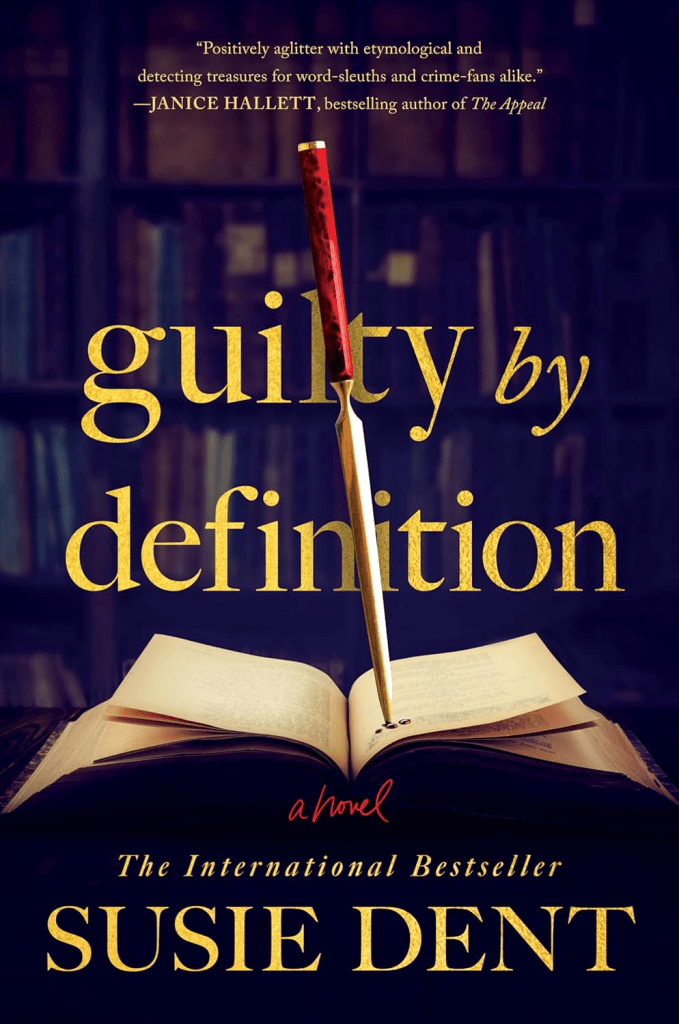
Set in Oxford and featuring a team of lexicographers working for the Clarendon English Dictionary, the setting and structure of Guilty by Definition also provides the author with plenty of opportunities to weave into the text anecdotes about the origins of words and phrases, keeping the fans of Countdown and Dictionary Corner satisfied. These word-related anecdotes are sometimes rather obviously shoe-horned into the narrative (often something about a word or phrase will just occur to the narrator and have to be explained) but I think Dent just about keeps on the right side of this not being irritating or distracting.
The plot follows Martha Thornhill, senior editor of the Clarendon English Dictionary. She and her team seems to have gloriously relaxed jobs tracing the origins of words and phrases. Also working for the CED but not part of Martha’s team is Jonathan Overton, a Shakespeare expert who has published widely on the bard’s coinages and who is a minor media celebrity. One day they receive a letter from an anonymous correspondent who signs themself ‘Chorus’. This letter contains a word puzzle, which when solves leads to the answer 2010, which is the year that Martha’s sister, Charlie, went missing. Thus begins a reopening of the investigation into Charlie’s disappearance. This moves along at a fair pace, with new developments and discoveries about Charlie’s past every few pages. Further letters and puzzles from Chorus move the action along every time the investigation begins to lose focus. It is revealed that Charlie was on the trail of a literary discovery, which as well as being hugely valuable would rewrite much of what we know about Shakespeare’s invention of new words. In lexicography terms this could be up there with the Rosetta Stone or the double helix structure of DNA.
Guilty by Definition is well plotted and well written. The final reveal of what happened to Charlie and what she had discovered hits exactly the right balance between not being too obvious but at the same time not too obscure. I was able to work out ‘whodunnit’ fairly early on, the list of possible suspects being quite small, but this didn’t spoilt the read for me in any way. The novel has lots of independent women characters who are not defined by their appearance or sexuality and who are not traditional stereotypes, which was a refreshing change from much genre fiction. The three main lexicographers, Safi, Martha and Alex form a strong team that would translate very well onto the television screen (with Oxford as a photogenic background) and I would be astonished if they do not reappear in further word-based mystery sequels. I look forward to them.

