
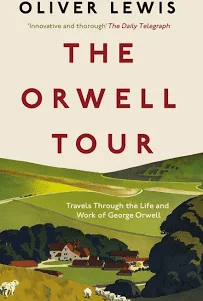
The Orwell Tour, by Oliver Lewis, 2023
I must admit I am a little jealous of Oliver Lewis. I have pointed out in previous reviews of Orwell biographies that he was relentlessly nomadic, never living in the same place for more than a handful of years. I’ve also been to several of the places he lived – Marrakesh, Southwold, Paris, London, and nearby Wallington in Hertfordshire – but with the exception of the last location I have never made the effort to seek out the blue plaques recording where Orwell lived, however briefly. (Wallington is an exception to that rule, because apart from the Stores, Orwell’s house there, and the prototypes of Manor Farm, there is very little in the village at all). Lewis had the inspired idea of visiting as many of Orwell’s homes as possible, with the thought that they might individually or collectively tell us something about the man, his background, influences and experiences. I wish I had had the same idea.
Knowing where to draw the line in terms of the places Orwell ‘lived’ is not always straightforward. For example, did he ever live in Stockton-on-Tees? We know his wife Eileen’s family owned a house there and she and Richard (their adopted son) decamped there after they were bombed out of their London flat. But did Orwell visit or stay for any length of time? There are so far as I am aware no letters from him to anyone carrying this address. D J Taylor, author of one of the best biographies of Orwell, (Orwell, the New Life) says (page 432)
“The first of the V1 flying bombs, known as ‘doodlebugs’, had been launched across the channel on 13 June, a week after the Normandy landings. On 28 June one of them fell on Mortimer Crescent; no one was hurt, but the house was uninhabitable and would remain so for some time. Orwell and Eileen’s whereabouts for the next few months are far from certain. One temporary landlady may have been Inez Holden, at her new flat in George Street, Marylebone, although a note in Inez’s diary records their going to stay with the Dakins in Bristol. If so, this could only have been a short-term arrangement as Orwell was needed three days a week at Tribune. Eileen and Richard certainly spent some time at Greystone, the O’Shaughnessy family home twenty-five miles south of Newcastle, and there were short visits to Wallington…but the likelihood is that Orwell himself joined the vast floating population of displaced wartime Londoners with no fixed abode, moving on from one spare room or camp bed to another as the opportunity arose”.
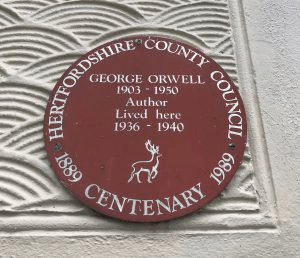
I have quoted this at length to illustrate the point that the question of where Orwell ‘lived’ is often far from straightforward and until such times as letters from or to Orwell, or any other evidence emerges, will remain unclear. There is a similar issue with Orwell’s residence at the Stores in Wallington. He held the lease to this cottage from 1936 to 1947, but the plaque on the wall states he lived there from 1936 to 1940. Even during that period he spent six months in Spain, as recorded in Homage to Catalonia, six far less interesting months in a sanatorium in Kent and a further six months recuperating in Marrakesh. After 1940 he lived in various addresses in London and in 1946 he moved to Jura. The Stores were (from what I can tell) sub-let at various points, but the record also indicates he and Eileen, occasionally joined by friends, would spend some weekends at Wallington during the war. Does this mean he lived there then? (If so, the plaque would be far more complicated!) Probably not, but again the point is that the question of where this ultra-nomad lived at any one time is not straightforward, and eventually requires us to make judgment calls about these issues.
There are a few omissions from what is otherwise a comprehensive review of the many places Orwell lived. He attended Wellington College for a single term before going to Eton. St Cyprian’s School in Eastbourne, East Sussex where Orwell went to prep school for five years as a boarder, is mentioned but not visited, possibly because the building in which it was housed has since burned down, so there would be little to see. Having said that these were key formative years for Orwell, recorded in his essay Such, Such Were the Joys (which is a grimly ironic quote from Blake). Freys College, where he taught for a term in 1933, is also mentioned but not visited. Orwell seems to have spent quite a lot of time at his wife’s brother’s family home in Greenwich, which might have been worth visiting, and was certainly close enough. Any attempt to visit every location ever associated with Orwell is probably futile, but these all seemed easy enough locations to tick off and may have been worthwhile additions to this account.
There are a few errors here as well which are less forgivable. The chapter on the Blair’s early years back in the UK after India is entitled Henley-on-Thames, Berkshire, whereas Henley-on-Thames is in Oxfordshire, as the text makes clear. The error is important because it makes more sense of Orwell’s decision to be buried in Sutton Courtenay, Oxfordshire – otherwise he had no particular association with this County, rather than it being the place of his early childhood. The description of Southwold as being “a small port clinging to the extremity of the East Anglian coastline” is technically correct, but misleading. Southwold is predominantly a Suffolk seaside town, pier and all, and the fact that as with all ports and seaside towns it is on the coast means the description of it ‘clinging’ to the coastline (rather than sloping gently down to the sea) is redundant.
I don’t think there is any doubt that we can learn more about an author by visiting the places where they lived. Orwell’s lack of interest in home comforts is summed-up vividly by the dilapidated cottage in Wallington, even if over the years it has been vastly improved, not least by the addition of a thatched roof and indoor plumbing and heating. Manor Farm just a short walk away conjures up images of the revolutionary animals of Animal Farm. I am sure the conditions in Burma could tell us a lot about Orwell’s time in the military police there. The wildness of Jura doesn’t seem to have changed a great deal since his time there in the 1940’s – anyone seeking out that remoteness and isolation must have wanted to escape something and will have paid little regard once again to the lack of home comforts.
Lewis makes some small but fascinating discoveries in the course of his journey: gravestones from the Limouzin family, Orwell’s mother’s side of the family, are found in a half-abandoned church in Burma; his measurements can still be seen in his tailor’s records in Southwold from when he ordered a suit almost 100 years ago; his name is still to be found in the visitors book in his neighbour’s house on Jura. Orwell left footprints everywhere, but at the same time he is elusive – famously, there is no known recording of his voice, which is extraordinary given that he worked in broadcasting for two years in the the 1940’s – and there are many small mysteries about his life which researchers are diligently chipping away at.
Lewis makes it clear in his introduction that this is not another biography, of which there are plenty, but it is not simply a travelogue either. It is a different way of looking at a remarkable life, and therefore a valuable contribution to the growing scholarship about the great man.

