Book review

Essays by George Orwell

My deep dive into Orwell continues with the Penguin Modern Classics collection of his essays, edited by Bernard Crick, one of Orwell’s earlier biographers.

In the extremely unlikely event that someone asked me to edit a collection of the great man’s essays, the first task I would set myself would be to understand what is an essay? Which of the many articles Orwell wrote would qualify for inclusion, and which would be excluded? There is a simple textbook definition of the term ‘essay’, ‘a short piece of writing on a particular subject’ but that isn’t particularly helpful – a letter of complaint to the council would fit that bill. He published different collections during his lifetime, and since then they have been republished in multiple different formats. Some collections of Orwell’s essays have over 240 items (for example the Everyman’s Library Contemporary Classics edition – to get to this high a number they must have included the weekly columns that Orwell wrote for Tribune from 1943 to 1947). This Penguin Modern Classics edition has 41 essays, which tallies with the count in Orwell’s bibliography on Wikipedia.

The next thing I would do is try to decide how to group the essays? Would I present them chronologically? That would have the benefit of showing Orwell’s progression as a writer, although some of the essays were published long after they were written, such as his account of his days at his prep school, St Cyprians, Such, Such Were the Joys, which was considered so libellous that publication had to wait until the 1950’s when everyone mentioned was safely dead. I think I would instead group the essays thematically. Memoirs such as A Hanging, Shooting an Elephant, Marrakesh, Bookshop Memories and so on would form one category. Another would be literary analysis – Dickens, Kipling, Cervantes, etc. A third would be popular culture including Boy’s Weeklies and The Art of Donald McGill – and finally a politics section.

When Orwell initially wrote these essays they were published in a wide variety of magazines including: Tribune (which is still in print) where he was literary editor after he left the BBC, Horizon, a magazine edited by his old schoolfriend Cyril Connolly, the Evening Standard, for years the principal London evening paper, as well as a number of more obscure and short-lived publications, such as Polemic, which only managed eight issues and Gangrel which only ran to four, but published his seminal essay “Why I Write”. It is fairly obvious from this wide spread of magazines and papers that Orwell wasn’t enormously fussy (or couldn’t afford to be fussy) about where his work was published – although of course he would have had red lines in terms of pro-Communist and pro-fascist publications.

The reason why I have made this point at such length is that I have no idea why this collection was printed in this particular order. It’s not chronological, thematic, alphabetical, or any other structure or design that I can discern. Perhaps I am missing something but the random nature of the collection, if intentional, did not work at all. The changes in tone from whimsical to academically serious were often jarring. The editing of the text did not help either because the date of publication of each essay was only included as an endnote. The date of publication matters – something written in 1942 about what the world might look like after the end of the war lands completely differently from the same topic written in 1946. But you have to check the end of the essay to find this out, even though it is information needed up front. Crick’s introduction to the selection is also really rather strange. At times it seems that he doesn’t particularly like Orwell’s work. At one point he comes close to calling Orwell dishonest, claiming “One can tell lies or spin stories in monosyllables and simple sentences.” and later “Orwell himself seemed to believe that it is more difficult to lie in monosyllables than in polysyllables, but like many people he confused meaning with truth”. This is leading up to his suggestion that A Hanging and Shooting an Elephant are stories rather than essays, and therefore do not belong in this collection. Which begs the simple question, if Crick did not think these are essays, why include them?

Which is all a pity, because the essays themselves are (of course) outstanding. I have some personal favourites. The Burma essays, A Hanging (1931) and Shooting an Elephant (1936), are comparatively early but exceptional, very concise masterpieces that speak to the human condition and the impact of imperialism. In many ways they would be more impressive if they were entirely fictional. The Art of Donald McGill introduced me to the idea that popular culture (in this case, comedic holiday postcards) can be looked at seriously and tell us something about society. His essay Boys’ Weeklies had the same impact (criminally, this edition does not include the response to Orwell’s theory that the author of the Greyfriars stories must be a collective identity, which explained why the stories themselves were so heavily stylised; Frank Richards’ reply to Orwell can be found here, and it is a serious oversight that it was not included in this collection.) Orwell the man always shines through in his work but never more so when he is writing about the simple but very English pleasures of life such as what makes a great pub, how to make a cup of tea (neither of which are included in this collection) or his thoughts on the common toad. And of course Orwell’s political insight and perspective are a guide to both the politics of the period but more importantly provide us with tools to navigate our own troubled times.

This isn’t a book to be read from beginning to end straight through (although you could) but rather it is to be dipped into and referred back to as occasion demands.

Essays, by George Orwell

Aside
Book review

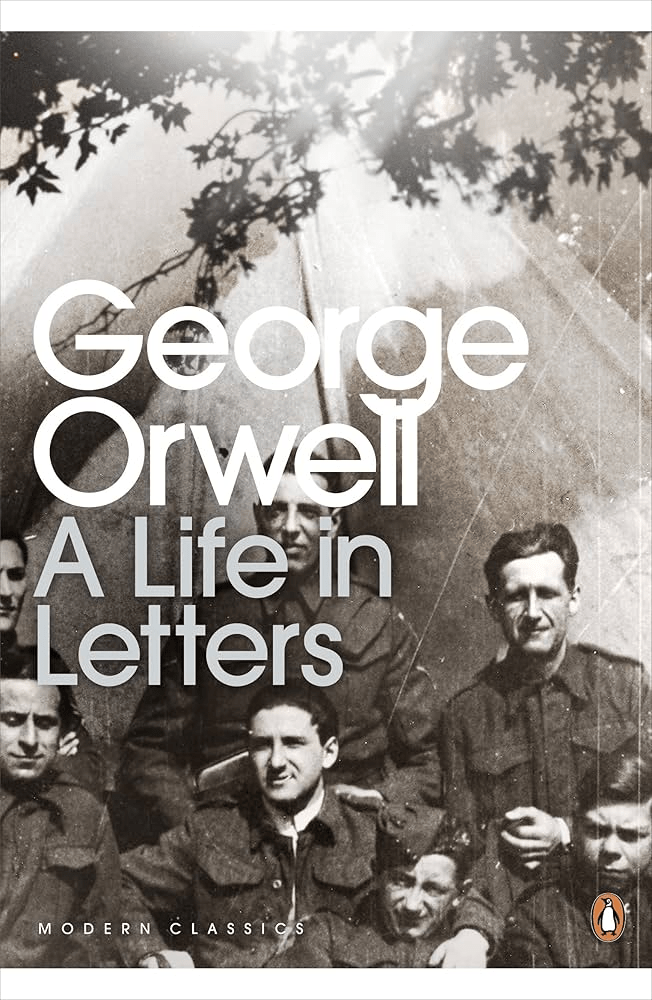
George Orwell, A Life in Letters, edited by Peter Davison, 2010

A Life in Letters is a fascinating collection that took me an inordinately long time to read, simply because of the multiple ‘side quests’ it sent me on. A great example of this is Orwell’s exchange with Anne Popham (pages 293, 307 & 321). Anne was Orwell’s downstairs neighbour in Canonbury Square, and one of the many young women that Orwell propositioned after his wife’s death. (“I wonder if you were angry or surprised when I sort of made advances to you that night before you went away“) According to Anne there was nothing ‘sort of’ about it. In an interview in the Guardian on her 100th birthday she recalled the incident as follows:

“In his flat there was a table, the baby, and its nurse. We had strong Indian tea, with brown bread and treacle. After tea, he told the nurse to take the baby away, and then he said, ‘Come and sit on the bed’. So I went and sat on the bed in the corner, and he came and sat beside me.” She laughs in disbelief at the memory. “In no time at all, his arms were round me, and he was kissing me. I was shocked. I said, ‘What are you up to ?’ and I pushed him away. Later on, I decided this must be how Old Etonians got on with girls, as if no one could resist them. He said, ‘I’m sorry’ and asked about my work, and I said, ‘I’m governing Germany’.”

Anne had an extraordinary life (the interview in the Guardian linked above is a good start) of which the encounter with Orwell played a minor part, but it does tell us a lot about his state of mind following the death of his wife the previous year. It is in this exchange (Orwell’s letter 18th April 1946) in which he makes the claim that “What I am really asking you is whether you would like to be the widow of a literary man?” One can never be completely certain of the extent to which this is being said seriously or is simply a ‘line’, but I am reasonably sure that Orwell himself would not have been able to answer that honestly either – he knew his health was poor and he was looking for a mother for Richard, his adopted son, but at the same time he was making plans for the future and did not have a terminal diagnosis. As a sexually frustrated bachelor in his early forties he would hardly be the first man to chance his arm with a young women with a tragic sob story, on the basis that sooner or later he might be lucky. It is in this same letter that Orwell claims that he did not suffer from jealousy: “I don’t much care who sleeps with whom. It seems to me what matters is being faithful in an emotional and intellectual sense. I was sometimes unfaithful to Eileen and I also treated her very badly, and I think she treated me badly too at times.”

This collection would make a superb companion text to any biography of Orwell. It can be read on its own of course, but combining it with a biography would work really well, with Orwell’s own words accompanying narrative about the events of his life. It would reveal his tendency to downplay things in a very British stiff-upper-lip way, such as his health problems, his distress at the death of his wife (“I don’t know whether you will have heard from anyone else the very bad news. Eileen is dead” opens a letter to Lydia Jackson, one of Eileen’s close friends, dated 1 April 1945, Eileen having died two days earlier. This isn’t Orwell being uncaring or brutal, it is him trying to cope with his grief and carry on doing the right thing.) and his pride in the success of his later books.

Another thing that shines out of the pages of this collection is Orwell’s entirely unsentimental love of the countryside. Very few personal letters go by without lines on the progress of his garden, how many pounds of potatoes have been harvested, how many eggs the hens have laid, and so on. This was more than a hobby, it was a part of his life and he clearly found the loss of gardening when he was laid up in various hospitals and sanitoriums (or away in Spain or Morocco) highly frustrating. It does make me think that the short period he was on Jura, enjoying living off the land, was one of the happiest of his life, even though it was tinged with sadness as he was having to make this home without Eileen, who seemed to have shared his dream of escape to the Hebrides.

Over half of the letters in this collection date from 1945 or later, that is to say the last five full years of his life (he died in January 1950). In part this must be a reflection of the fact that by 1945 Orwell was increasingly well known, so recipients of his letters were much more likely to have kept them. He may have also kept copies himself, certainly of business letters. I don’t have access to the 20-volume Complete Orwell that Davison edited, so I can’t be sure, but this edition doesn’t contain any letters from Orwell’s five years in Burma, which suggests either that he didn’t send any, which is profoundly unlikely, that none of the letters from that time have been found, (quite possible) or that none of them have anything particularly interesting to say. Whatever the reason it does mean that this aspect of his life is unrecorded in this collection, which is a gap. If I am being pedantic I would also say that this collection contained just a few too many letters from Orwell to his literary agent arranging details of publication, distribution, translation and so on – this aspect of his life as an author could have been illustrated just as clearly with fewer examples. But the scholarship of this collection is formidable, with detailed and clear footnotes to every letter, an extensive set of biographical notes of the main recipients of Orwell’s letters, every typo that was Orwell’s not the editor’s marked clearly and of course a detailed index. Even though I have read all the biographies of Orwell I still learnt a lot about his life and work from this collection. Just to offer one example, I previously thought of Jura as a remote and wild place, which it was, but assumed it was madness to decamp there with Orwell’s health so precarious and it being so hard to reach. But he only summered there, spending winters in the Canonbury Square flat in London that he retained the tenancy of (often letting others stay there) and the island had a mild climate. It also seems they ate better there than on the still rationed mainland, with access to fish, lobsters and crabs from the sea, rabbits and venison from the land, eggs and meat from the chickens they kept, and vegetables from the garden. It was also easier to keep warm on Jura compared to London, because there was plenty of natural fuel – peat and wood – available, compared to the capital where everything was scarce and rationed. It does seem rather idyllic and it is not surprising they had so many visitors, at one stage having to set up a tent in the garden to accommodate the overflow.

Davison enriches this collection enormously by interspersing letters from Orwell with those from others such as his childhood sweetheart Jacintha Buddicom. Most revealing are those from Eileen to her friend Norah. These letters are full of impish humour and provocation and were the basis of the 2023 book Wifedom. The author of Wifedom took everything Eileen says in these letters as gospel, when it is plain as anything that she is invariably joking, usually by way of comic exaggeration. Letters between Eileen and Orwell are few and far between. Obviously that is because husband and wife tend not need to write to another. Eileen’s last unsent letter to her husband (29/3/45) is heartbreakingly sad. She was a much more interesting and lively correspondent than Orwell, and the fact that her letters are often interrupted and written over several days, if not longer (instead of throwing away a mislaid draft she would resume writing with an apology for the delay) adds to their charm. The exercise of compiling a complete edition of Orwell’s letters is one that may never end – very recently more letters were discovered by relatives of his correspondents. Last year Darcy Moore, a great Orwell scholar, discovered another lost letter from 1942. I doubt it will be the last.

Sadly the editor of this collection, Peter Davison, who was also the editor of the twenty volume complete Orwell, died in 2022 – I do hope that the Orwell Society or his literary agents appoint someone to continue Davison’s work. The Society has introduced a Peter Davison award for Orwell scholarship, which I suppose goes some way towards this aim. While mentioning the Orwell Society I should also recommend this excellent review of the Collected Letters on their site.

The final year of Orwell’s life was spent a sanatorium and then a hospital where he seemed to have received little by way of actual medical treatment, spending the time just resting, surrounded by growing piles of books. Resting for Orwell still meant undertaking a lot of correspondence, as well as a little journalism and book reviewing. He obviously knew he was very seriously ill but at the same time held out hope for a recovery that might give him a few more years. He had lots of visitors, many of them members literary aristocracy and was clearly much loved – many people expressed concern for his health and the need to ‘do something’ to save him. Forty-six is a ridiculously early age to die, especially for a writer who in Animal Farm and 1984 had fully discovered their own voice. These two novels alone have sold over forty-one million copies. This achievement is not the end of the story. Earlier this month I was watching the television show Countdown. Someone used the word “unperson” without reference to Orwell even though he coined the word in 1984. This to me just emphasises (albeit in a very minor, incidental way), the extent to which Orwell’s thoughts and ideas have permeated Western culture and language; they are just now part of the way we think rather than something that needs to be referenced or explained. Sales of 1984 spike every time world events seem particularly Orwellian such as when Trump’s press spokesperson coined the phrase ‘alternative facts‘. That more than anything else was his contribution.

George Orwell, A Life in Letters, edited by Peter Davison, 2010

Aside
Book review

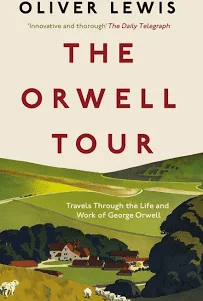
The Orwell Tour, by Oliver Lewis, 2023

I must admit I am a little jealous of Oliver Lewis. I have pointed out in previous reviews of Orwell biographies that he was relentlessly nomadic, never living in the same place for more than a handful of years. I’ve also been to several of the places he lived – Marrakesh, Southwold, Paris, London, and nearby Wallington in Hertfordshire – but with the exception of the last location I have never made the effort to seek out the blue plaques recording where Orwell lived, however briefly. (Wallington is an exception to that rule, because apart from the Stores, Orwell’s house there, and the prototypes of Manor Farm, there is very little in the village at all). Lewis had the inspired idea of visiting as many of Orwell’s homes as possible, with the thought that they might individually or collectively tell us something about the man, his background, influences and experiences. I wish I had had the same idea.

Knowing where to draw the line in terms of the places Orwell ‘lived’ is not always straightforward. For example, did he ever live in Stockton-on-Tees? We know his wife Eileen’s family owned a house there and she and Richard (their adopted son) decamped there after they were bombed out of their London flat. But did Orwell visit or stay for any length of time? There are so far as I am aware no letters from him to anyone carrying this address. D J Taylor, author of one of the best biographies of Orwell, (Orwell, the New Life) says (page 432)

The first of the V1 flying bombs, known as ‘doodlebugs’, had been launched across the channel on 13 June, a week after the Normandy landings. On 28 June one of them fell on Mortimer Crescent; no one was hurt, but the house was uninhabitable and would remain so for some time. Orwell and Eileen’s whereabouts for the next few months are far from certain. One temporary landlady may have been Inez Holden, at her new flat in George Street, Marylebone, although a note in Inez’s diary records their going to stay with the Dakins in Bristol. If so, this could only have been a short-term arrangement as Orwell was needed three days a week at Tribune. Eileen and Richard certainly spent some time at Greystone, the O’Shaughnessy family home twenty-five miles south of Newcastle, and there were short visits to Wallington…but the likelihood is that Orwell himself joined the vast floating population of displaced wartime Londoners with no fixed abode, moving on from one spare room or camp bed to another as the opportunity arose”.

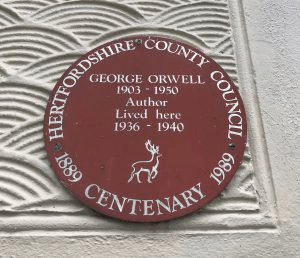
I have quoted this at length to illustrate the point that the question of where Orwell ‘lived’ is often far from straightforward and until such times as letters from or to Orwell, or any other evidence emerges, will remain unclear. There is a similar issue with Orwell’s residence at the Stores in Wallington. He held the lease to this cottage from 1936 to 1947, but the plaque on the wall states he lived there from 1936 to 1940. Even during that period he spent six months in Spain, as recorded in Homage to Catalonia, six far less interesting months in a sanatorium in Kent and a further six months recuperating in Marrakesh. After 1940 he lived in various addresses in London and in 1946 he moved to Jura. The Stores were (from what I can tell) sub-let at various points, but the record also indicates he and Eileen, occasionally joined by friends, would spend some weekends at Wallington during the war. Does this mean he lived there then? (If so, the plaque would be far more complicated!) Probably not, but again the point is that the question of where this ultra-nomad lived at any one time is not straightforward, and eventually requires us to make judgment calls about these issues.

There are a few omissions from what is otherwise a comprehensive review of the many places Orwell lived. He attended Wellington College for a single term before going to Eton. St Cyprian’s School in Eastbourne, East Sussex where Orwell went to prep school for five years as a boarder, is mentioned but not visited, possibly because the building in which it was housed has since burned down, so there would be little to see. Having said that these were key formative years for Orwell, recorded in his essay Such, Such Were the Joys (which is a grimly ironic quote from Blake). Freys College, where he taught for a term in 1933, is also mentioned but not visited. Orwell seems to have spent quite a lot of time at his wife’s brother’s family home in Greenwich, which might have been worth visiting, and was certainly close enough. Any attempt to visit every location ever associated with Orwell is probably futile, but these all seemed easy enough locations to tick off and may have been worthwhile additions to this account.

There are a few errors here as well which are less forgivable. The chapter on the Blair’s early years back in the UK after India is entitled Henley-on-Thames, Berkshire, whereas Henley-on-Thames is in Oxfordshire, as the text makes clear. The error is important because it makes more sense of Orwell’s decision to be buried in Sutton Courtenay, Oxfordshire – otherwise he had no particular association with this County, rather than it being the place of his early childhood. The description of Southwold as being “a small port clinging to the extremity of the East Anglian coastline” is technically correct, but misleading. Southwold is predominantly a Suffolk seaside town, pier and all, and the fact that as with all ports and seaside towns it is on the coast means the description of it ‘clinging’ to the coastline (rather than sloping gently down to the sea) is redundant.

I don’t think there is any doubt that we can learn more about an author by visiting the places where they lived. Orwell’s lack of interest in home comforts is summed-up vividly by the dilapidated cottage in Wallington, even if over the years it has been vastly improved, not least by the addition of a thatched roof and indoor plumbing and heating. Manor Farm just a short walk away conjures up images of the revolutionary animals of Animal Farm. I am sure the conditions in Burma could tell us a lot about Orwell’s time in the military police there. The wildness of Jura doesn’t seem to have changed a great deal since his time there in the 1940’s – anyone seeking out that remoteness and isolation must have wanted to escape something and will have paid little regard once again to the lack of home comforts.

Lewis makes some small but fascinating discoveries in the course of his journey: gravestones from the Limouzin family, Orwell’s mother’s side of the family, are found in a half-abandoned church in Burma; his measurements can still be seen in his tailor’s records in Southwold from when he ordered a suit almost 100 years ago; his name is still to be found in the visitors book in his neighbour’s house on Jura. Orwell left footprints everywhere, but at the same time he is elusive – famously, there is no known recording of his voice, which is extraordinary given that he worked in broadcasting for two years in the the 1940’s – and there are many small mysteries about his life which researchers are diligently chipping away at.

Lewis makes it clear in his introduction that this is not another biography, of which there are plenty, but it is not simply a travelogue either. It is a different way of looking at a remarkable life, and therefore a valuable contribution to the growing scholarship about the great man.

The Orwell Tour, by Oliver Lewis, 2023

Aside
Book review

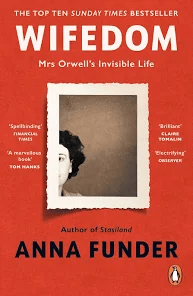
Wifedom by Anna Funder, 2023

I started Anna Funder’s Wifedom, her 2023 book about George Orwell’s first wife, Eileen, with a considerable sense of unease. I had read reviews of the book when it came out which raised some concerns about the methodology used and the conclusions reached; the book’s blurb heightened the sense that I was likely to be reading a hit-job on one of my favourite authors. At the same time I wanted to try and keep an open mind – after all I knew that Orwell was hardly a saint, and if the author had something new to say about his life, his relationships and his work, then I wanted to learn.

The first puzzle to unpick was – what kind of book is this? It’s not a biography – it seemed obvious to me that Funder had originally been working on a conventional biography of Eileen, but that her fox had been thoroughly shot by the publication in 2020 of Sylvia Topp’s Eileen – the Making of George Orwell. Wifedom is also not a novel, although at one point Funder claims she considered making it one. It’s not a memoir, but there are several points at which the author discusses her own personal circumstances, her memories, her status as a wife and mother and her dissatisfaction with the sharing of household tasks within her marriage. In fact the book is all of the above, and more. Helpfully Funder uses the term ‘counterfiction’ to describe the text. The internet defines counterfiction as “a story or narrative that challenges dominant views, mainstream beliefs, or official accounts by presenting an alternative, often marginalized, perspective, aiming to disrupt established realities or norms through fictionalized elements”. This concept was key to me understanding what Funder was trying to achieve. The fictionalised elements in Wifedom are Funder’s attempts to ventriloquise her subject, creating diary entries for Eileen as she drafts the letters to Norah Myles that serve as the author’s inspiration for this account.

Initially this approach – essentially ‘making things up’ – only served to exacerbate my unease. But I quickly realised that was the point – the author wants to challenge the reader and the recreated internal monologues, the streams of consciousness that record Eileen’s private thoughts and ideas as she goes about her day and writes her letters are acts of imagination, attempts to construct Eileen and George’s married life in the absence of more direct, first-hand evidence. As long as the reader remembers that – this is just Funder’s best efforts at imagining what Eileen might have thought – then the intention is successfully achieved. A conventional biography would rarely be so bold as to creatively reconstruct a subject’s thoughts and feelings, but Funder is not constrained by such conventionalities. If these exercises help us see the hidden Eileen more clearly, then the job is done.

The question then is whether this is the case – whether the Eileen and George created by the author here is plausible and convincing? There is of course plenty of evidence that tells us about this couple’s married life. Letters, diaries, and a whole catalogue of personal memoirs by the people who knew them. These accounts are fairly unanimous – this was an unconventional but surprisingly happy marriage. Both George and Eileen said as much over and over again and despite various infidelities, suspected and actual, there is no suggestion they ever considered separation – and of course they adopted a baby in 1944, a signal of the strength of their bond.

Funder presents a very different account of their marriage. Her evidence rests heavily on two primary sources – the accounts of Eileen’s friend, Lydia Jackson, who it would be fair to say never looked kindly on Orwell (she once told an interviewer “I was always sorry that Orwell married Eileen”) and the ‘Norah’ letters. These six letters written from Eileen to a university friend, Norah Myles, who so far as I can tell never met Orwell, and whose replies did not survive, were not “newly discovered” as claimed in the paperback edition of the book’s blurb (I recognise that the author almost certainly did not write the blurb, and may not even have approved the text, but they are part of the book nonetheless.) In fact these letters were ‘discovered’ in 2005, almost 20 years before Wifedom was published, and appear in Peter Davison’s supplement to his collected works, The Lost Orwell. As a number of critical reviews have pointed out, Funder notices every time the passive voice is used to erase Eileen’s contribution to Orwell’s work, but uses it here to imply or suggest that the discovery of Eileen’s letters was by herself. At one point she actually uses the phrase “I found the letters” – from the context the reader will be unclear whether this is the original discovery or whether she simply means “I came across…”.

But to return to the question I posed earlier, is Funder’s recreation of Eileen’s life and marriage plausible and convincing? To consider that question let’s look at the first letter to Norah, written during a visit to Orwell’s parent’s home in Southwold, a rather lovely coastal town in Suffolk, six months after the couple married in 1936. In it appears the following now rather famous line:

“I lost my habit of punctual correspondence during the first few weeks of marriage because we quarrelled so continuously and really bitterly that I thought I’d save time and just write one letter to everyone when the murder or separation had been accomplished”. (My emphasis)

Most critics take that comment to be a joke. To me that’s so obvious as to not need stating. It’s a pointed joke, of course, but unquestionably an attempt at humour. In her biography of Eileen, Sylvia Topp calls it ‘banter’. Richard Blair, George and Eileen’s adopted son, thought it was “obviously tongue in cheek”. Funder is not so sure – for her this comment is to be taken seriously, a sign of the immense distress Eileen must have been experiencing, her letter a cry for help. And as a result the version of Eileen Funder imagines regrets her decision to marry, resents the burden of domestic work, and is constantly irritated by George. I think the reader can decide for themself which is the more plausible interpretation.

Funder’s overall thesis, summed up in the book’s subtitle, Mrs Orwell’s Invisible Life, is that Eileen’s contribution to Orwell’s life and work has been erased by the patriarchy and in particular by Orwell himself and his cabal of all-male biographers. Her task therefore is to bring Eileen back into the light and if some imaginative reconstruction of what probably happened is required to achieve that result, then so be it.

As an example of this erasure, the “wicked magic trick” by which Eileen has been made to disappear, Funder takes a careful look through Orwell’s memoir of his time in Spain during the Civil War, Homage to Catalonia. She starts with the surprising statement that

I had read Homage twice and never registered that Eileen was in Spain. No-one I have ever asked remembers her.”

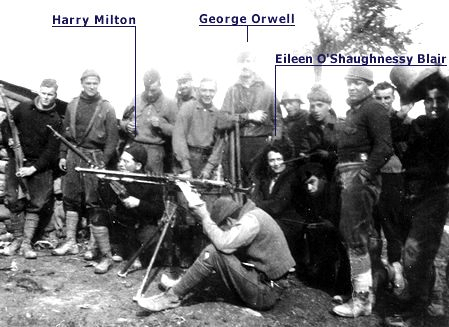
To which the only possible response to this confession is “Really!!??” Given the centrality of Eileen’s role in the key events of Homage (she even visited him at the front, an event captured on camera (see below)) and the multiple references to ‘my wife’ throughout the text, this is surprising. If Orwell was genuinely trying to avoid letting people know that Eileen was in Barcelona for most of the time that he was in Spain, he did a poor job of doing so. Granted, he does not refer to her by name, for reasons that could be as banal as it being conventional not to do so, or the more serious security reasons some suggest, but as Eileen typed the manuscript (and according to Funder, and others, contributed extensive editorial suggestions) it would have been a job of moments to have added or reinserted her name. Later, attempting to explain why she never noticed Eileen was in Spain, Funder claims (with traces of bitterness?) that the word “wife” is a “job description” (181) rather than a way of describing a relationship. Eileen is “in this story only in a way no one will ever see, like scaffolding, or a skeleton, something disappeared or covered over in the end result”. It reflects poorly on Funder as an Orwell scholar and more broadly as a reader that she did not notice (on either reading) the multiple references to Eileen in Homage – the scene when her hotel room is being searched and she hides documents under her bed, avoiding them being found because the Spanish soldiers were being overly polite towards her, is tragically comic, and one of many very memorable scenes from the book.

The phenomenon of women’s erasure from history is undeniable and there is a convincing case to be made that Eileen suffered from just such an experience. She has been a shadowy, lightly-sketched figure in many Orwell biographies. Sylvia Topp’s work was an important start at correcting that failure. But was the erasure of Eileen a mass conspiracy instigated by Orwell and supported by his biographers and the patriarchy? Perhaps Eileen is not a clear example of this phenomenon, or perhaps Funder’s counter-fictional approach is not the best way of revealing Eileen’s role in Orwell’s life and work.

As an aside, I found the author’s use of unnumbered endnotes, referenced only by page number, really frustrating, particularly when they were used for important content such as her thoughts on the Topp biography. An endnote is simply a list of additional notes on the text, mainly sources, listed by page number. When reading Wifedom you cannot tell whether the author has included a source or comment on the text without constantly checking the endnotes, which of course you quickly stop doing. Why she chose this approach I found baffling.

After finishing Wifedom, but before putting pen to paper to record my thoughts, I read some reviews of the book online. Most of the reviews in the broadsheets were broadly positive. The Guardian called it “a brilliant reckoning with George Orwell to change the way you read”. The review on the Orwell Society website asks more serious questions. But then I came across (‘discovered’) Matthew Clayfield’s cleverly titled ‘She Can’t Tell Norah That’ which makes a compelling case that Funder’s methodology and central thesis is flawed. He argues that the ‘recently discovered’ letters to university friend Norah, although relied on by Funder as a springboard for the text’s speculative counterfiction episodes, do not support any of her conclusions. Funder’s explanation for this is that the letters have to be read creatively, looking for the things Eileen wanted to say but could not. In other words, she could not ‘tell Norah that’. The obvious alternative explanation is that she doesn’t tell Norah things in these otherwise frank and revealing letters is because she didn’t believe them or they didn’t happen. I commend this analysis to anyone interested in reading more about the issues with Wifedom. It is so comprehensive that I was tempted to abdicate any attempt to review the book and just leave the link here, but I don’t think in all honesty I can do that. Crucially, this article also contains in postscripts details of emails from the son of Georges Kopp (Orwell’s commander in Spain, a long term friend of the couple, and according to many biographers, Eileen’s lover) and from Richard Blair himself (George and Eileen’s adopted son) expressing serious concerns about the accuracy and intentions of the author (Funder). Richard writes to Clayfield about Funder’s “(deliberate) misplaced understanding of the dynamic between Eileen and George.”

Another finely detailed critical review can be found here.

Why the hostility towards Wifedom from this group of reviewers? I think the answer is simple, and no it is not ‘the patriarchy’! It is that the Orwell Funder presents us is never given the benefit of the doubt. If there is any explanation of his behaviour offered, any interpretation of his work or his actions, it is always the most critical, the most damning. Orwell emerges as a crude monster, an attempted rapist who abuses his wife, constantly and callously betrays her, takes her ideas and contributions to his work without giving her any credit, contributes if not causes her early death, and avoids every responsibility in their marriage. He is totally unrecognisable from the man that emerges from his novels, letters, essays and journalism. At every turn Funder sits in judgment waiting for Orwell to do something horrible or unthinking. Any love or affection in their marriage is ignored. Rather than the complex, flawed man many of us respect and admire, we are left with a travesty which not only diminishes Orwell but also Eileen as well.

Or to quote one final review which again makes the point far more cogently that I ever could:

“Wifedom is more intent on condemnation than comprehension. With no interest in Eileen’s life before Orwell, the book focuses on Eileen solely as an example of “how a woman can be buried first by domesticity and then by history.” Funder enlists her to buttress her assertion that there “is not one place on the planet where women as a group have the same power, freedom, leisure or money as their male partners.” That may well be true, but the uniqueness of Eileen O’Shaughnessy Blair disappears amid the abstraction of “wifedom.” Appropriating her merely as an exhibit in a polemic against patriarchy is the same as erasing her.”

Wifedom by Anna Funder, 2023

Aside
Book review

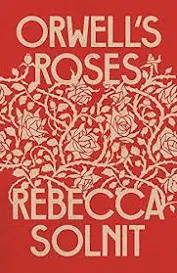
Orwell’s Roses, by Rebecca Solnit, 2021

There is a scene is Stella Gibbons’s near-perfect Cold Comfort Farm where the heroine, Flora, meets the appalling Mr Mybug in a tea shop. She tries to avoid him but he is unshakeable and tries to impress her by talking about his latest project. He is convinced Branwell Bronte wrote Wuthering Heights and in his research has found three letters from him to an aunt in Ireland. These letters are “little masterpieces of repressed passion.  They are full of tender little questions… he asks her how is her rheumatism…has her cat, Toby, ‘recovered from the fever?’ … what is the weather like at Derrydownderry…?’” This portrait, of a pseudo-intellectual taking an obscure fact from the life of an author and blowing it up into a profound insight into their life and work, cannot be bettered, but in Orwell’s Roses, Rebecca Solnit gives it a good go.

In the mid-1930’s Orwell rented a small cottage in Wallington, Hertfordshire. He ran the local shop from the front room of the cottage and tended the small garden, planting fruit trees, vegetables, and roses. Those roses may or may not be still flowering in the cottage garden, although this seems both improbable and unimportant. In the course of the many thousands of articles, reviews, essays and letters he wrote he inevitably also referenced roses from time to time. But the idea that this scant piece of information can tell us anything significant about Orwell, either as a man or as a writer, is ludicrous. Although sceptical I was genuinely prepared to be persuaded I was wrong. I expected Solnit to have dug up some long-forgotten essay or letter in which Orwell wrote about the significance of roses to his world view, perhaps using their connection to England’s heritage as a metaphor for, well, anything. But of course he didn’t write any such thing and this left the author struggling mightily to make any kind of case. Chapters are devoted to the commercial rose growing industry in Columbia for example, in which unsurprisingly workers rights are undermined and working conditions are tough (although it is hardly a dark satanic mill situation). The author draws clumsy parallels between these hot greenhouses full of roses with Orwell’s exploration of the British mining industry in the 1930’s, but almost any third-world factory or sweatshop would have delivered the same set of comparisons.

A few years ago, shortly after lockdown, I was browsing in my local bookshop with one of my sons. Knowing my admiration for all things Orwell, he pointed this book out. My initial reaction probably seemed a little churlish (I do hope not, but fear it might have been) – that this felt like the scraping of a barrel. All of Orwell’s primary influences – Empire, class, the BBC, literature, politics etc – have been documented and investigated at length, so here was someone writing about his love of gardening. Gardening might have made it into the top ten of a list of Orwell’s interests, perhaps, but did it tell us anything we didn’t already know about the author, his works and his politics? I hazarded that the answer was no, and decided not to invest the £20 or so that the hardback would have cost me. A second-hand bookshop bargain made the decision a lot easier more recently, but my initial judgment – that this was a really tenuous thesis that it would be hard to sustain – was vindicated. There’s no questioning that the author makes a strong effort in arguing that there was some significant connection between Orwell and floristry, but effort doesn’t equal success in this case. See here for example:

“He (Orwell) went on to classify flowers among hobbies, and hobbies among the characteristics of people who valued liberty and private life, but he had opened a door for a room he hadn’t gone into, or perhaps a door onto something much larger than a room. If you do go through this door marked aesthetics and Orwell, you wander toward the very center of his life’s pursuits. (188).

No you don’t. And even if you do, roses are entirely peripheral to that room/area of interest.

Solnit writes at length about the significance of flowers to our lives. There are times where she seems to forget that the book is supposed to be about Orwell, only dragging him back into the text unconvincingly in chapter-ending summaries. But when she does write about Orwell, particularly in the book’s final chapters looking at the extraordinary productivity at the end of his life, she writes well. It is rewarding to spend time revisiting this period of his life, when he took the bizarre decision to move to Jura with his very young son, shortly after his wife Eileen had died, but carried on writing ferociously. The text ends with a chapter on Orwell’s significance today and she rightly points out that the word Orwellian has a resonance in these times that even words like Shakespearean or Dickensian do not. I was expecting the text’s final peroration to see roses drawn back into the discussion, but I was really pleased to see that in the end this didn’t (and probably couldn’t) happen. Solnit writes so much more interestingly about Orwell when she isn’t struggling to tie his work to her poorly-conceived theme.

Orwell’s Roses, by Rebecca Solnit, 2021

Aside
Book review

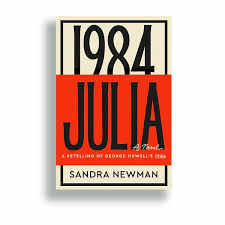
Julia, by Sandra Newman, 2023

My first review of 2025 is of Sandra Newman’s compelling Julia, a retelling of the events of George Orwell’s 1984 from the perspective of Winston Smith’s young lover, whom he betrays in the novel’s bitter climax in Room 101 “‘Do it to Julia! Do it to Julia! Not me! Julia! I don’t care what you do to her. Tear her face off, strip her to the bones. Not me! Julia! Not me!'”

Which poses the very simple question as to whether 1984 needs to be retold from Julia’s perspective. The source novel is told from Winston’s point of view. Through Winston (and bearing in mind his relationship with her is quite short and comprises a few snatched moments and afternoons) we learn a little about her background and childhood, her life as a mechanic in the Fiction Department of the Ministry of Truth, and her living arrangements, sharing a hostel room with thirty other young women.

Julia sent me back to 1984 to try and ascertain how much was the author’s creation, filling in the gaps left by Orwell’s account, and how much was based on the source material. I was surprised at how much the original novel does actually tell us about Julia – she certainly isn’t the two dimensional character some critics would have you believe, and I don’t think she necessarily needed to be re-imagined by this novel to be made more believeable or rounded. Of course the original novel doesn’t contain her full life story or her internal monologue – Winston’s point of view narration precludes this. More honestly, Winston isn’t that interested in Julia’s background or history. Their relationship is not simply one of an older man being sexually attracted to a younger, more independent woman – Winston is genuinely interested in Julia’s ideas and is guided by her in acts of rebellion other than ‘sex-crime’ – “In some ways she was far more acute than Winston, and far less susceptible to Party propaganda. Once when he happened in some connexion to mention the war against Eurasia, she startled him by saying casually that in her opinion the war was not happening. The rocket bombs which fell daily on London were probably fired by the Government of Oceania itself, ‘just to keep people frightened’. This was an idea that had literally never occurred to him. She also stirred a sort of envy in him by telling him that during the Two Minutes Hate her great difficulty was to avoid bursting out laughing.”

A lot of the critical commentary on Julia is based on the assumption or claim that the original novel is in some way unfair to her. The Guardian put it this way: “This ambitious retelling from Julia’s point of view gives Winston Smith’s lover the agency she lacked. ” Is this fair? Did Orwell have a ‘women problem’? And does 1984 underplay Julia’s role, reducing her to a sexual partner and victim, requiring this attempt to rehabilitate her? Certainly women play only minor roles in most of his earlier novels, and the one exception, Dorothy in A Clergyman’s Daughter, is a largely unconvincing portrait used principally as an avatar for Orwell to recycle some of his journalism. But I think there is a case to made for Julia being one of his most fully-rounded female characters. She is independent, brave, forthright, and kind. The Julia we are introduced to in Newman’s novel is very closely modelled on Orwell’s original – Newman has been very respectful to the source material, and only made one significant change. Fairly early in in the novel Julia is recruited into the Thought Police, and in addition to her relationship with Winston she is instructed to seduce a number of other Outer Party members and encourage them to commit thought- and sex-crimes.

The idea that Orwell’s version of Julia lacks agency is unfair and wrong – it is Julia who initiates the affair with Winston, finds them somewhere to go to have sex, and has previously had many other lovers. She is a strong woman who knows what she wants and is perfectly willing to take calculated risks. Newman’s Julia is not significantly more independent than Orwell’s – arguably her early recruitment into the Thought Police actually reduces her agency. From that point she is compelled to follow their instructions and cannot freely pursue her own choices.

Day to day life in Airstrip One is vividly described in 1984. These descriptions would have been painfully familiar to Orwell’s original audience in a Britain only slowly emerging from the hardships of the Second World War. Newman builds upon this portrait, giving more detail on the petty humiliations that young women have to face. She describes the Party’s ArtSem (artificial insemination) programme which is used as cover when women fall pregnant outside of marriage and other aspects of women’s lives which the original novel did not describe or consider. Overall the Airstrip One she describes is vividly recognisable and very faithful to Orwell’s portrait.

As long as Julia remains safely within the guide rails of the source material, the novel remains on track, but the text fails to convince as soon as it goes beyond the undeniably bleak ending of 1984. Newman understandably chooses to omit Orwell’s suggestion that Julia has been lobotomised during her torture and goes on to suggest that the end of Big Brother’s rein of terror is imminent. This is nowhere suggested in the source text – quite the opposite, Orwell suggests that Big Brother is unbeatable (although the appendix on Newspeak implies that one day IngSoc’s rule comes to an end).

Orwell’s handling of Winston’s torture, and in particular the climax of this process in Room 101, is a very hard read. Newman takes this several steps further – the descriptions of Julia’s abuse is really hard to stomach. Orwell would not have been allowed by his publishers to be this explicit, but sometimes less is more. Newman doesn’t blink and follows through with the implication that the ultimate torture conceived for Winston is applied instead to Julia. The horror of this is undermined by the deus ex machina resolution Newman applies, which is that Julia survives the torture because the time each victim has in Room 101 is limited to fifteen minutes, because of the sheer volume of torture candidates. This is a serious misstep – I understand why Newman wanted to show the horrific consequences of Winston’s betrayal and at the same time keep Julia alive, but this resolution is deeply improbable in a world of bitterly realistic situations.

Novels based on and inspired by well-known original texts need to overcome some high hurdles to avoid being dismissed as mere fan-fiction. They need to be respectful to the source material – in most respects Newman does this, with some important exceptions. They need to have a clear reason for returning to the source material, and I think Newman ticks that box as well, giving a clear and recognisable voice to a character who often appears enigmatic in the source text, and exploring what life on Airstrip One would be like for women, a subject Orwell is largely silent on. The tightrope between simply being an attempted impersonation of Orwell’s voice and being faithful to his creation is an awfully difficult line to tread and I think for the most part, with one or two significant exceptions, Newman achieves this. It often felt like I was reading an authentic description of life under Big Brother, chapters that Orwell would have not disowned. For these good reasons alone Julia is definitely worth reading. I did have just one minor complaint – the cover design is awfully drab. It tries to suggest the relationship between the novel and the source text but I am sure there must be better ways of doing it.

Julia, by Sandra Newman, 2023

Aside
Book review

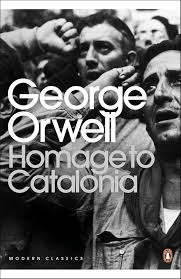
Homage to Catalonia, by George Orwell, 1938

Homage to Catalonia is Orwell’s memoir of his time fighting in the Spanish Civil War. Covering the period between December 1936 and June 1937, he tells how he stumbled into the war having originally intended to observe the conflict and ‘write newspaper articles’, but then quickly got caught up in the revolutionary atmosphere in Barcelona and signed up to fight. After some rudimentary training he describes his uneventful but miserable time on the front lines in Aragon and then his involvement in the May Days conflict in Barcelona. Although he returned to the front line after this short break, his time in Spain was brought to a sudden end when he was shot through the throat. A further close shave followed quickly when the political group he was serving in, the POUM, was declared an illegal organisation causing Orwell and his wife to flee for their lives, following closely by the police. The memoir elements of the book are interspersed with Orwell’s commentary on the war and the May Days conflict, in which he is heavily critical of the actions of the Government forces.

This analysis of the May Days conflict is central to this narrative and all subsequent commentary on the book. Orwell saw the May Days as a microcosm of the struggle between revolutionary socialism and communism. This isn’t some obscure metaphorical parallel but a real time playing out of the conflict between Trotskyism and Stalinism , fatally undermining the ability of countries such as Spain to resist fascism. Orwell comes down firmly and unambiguously on the side of revolutionary socialism and against Communism as represented by the Soviet Union and its counterparts in Spain and elsewhere. You could argue that as an almost accidental member of the POUM militia (he joined because it was aligned with the Independent Labour Party) it would have been impossible to imagine him taking any other position – who cheers on the people who are trying to arrest you and who are killing your friends and comrades. all the while telling the world that you are a fascist collaborator?

A common accusation levelled against Orwell’s non-fiction is that it is to a greater or lesser extent made up. He didn’t shoot an elephant, witness a hanging, etc. This accusation is almost never expressed as simple dishonesty – instead critics talk about things being ’embroidered’ and of ‘journalistic licence’ – but that’s what they mean. Homage to Catalonia was attacked on this basis from the moment it was published – instead of being an honest eye-witness account of the six-month period Orwell was in Spain, it is alleged that it is a carefully edited and at times simply untrue portrait of the war, most contentiously the street fighting in Barcelona. One critic who takes this position on HtC is Paul Preston, an academic at the London School of Economics. His Light and Shadows in George Orwell’s Homage to Catalonia dissects HtC in meticulous detail and gives credit for the book’s vivid descriptions of the conflict, but is assiduous in picking up on contentious issues in the account. To take one fairly minor example, early on in the book Orwell contrasts the food shortages being experienced by the ordinary citizens of Barcelona with the food being wasted in the barracks. Preston observes

If Orwell’s POUM unit could really afford to waste food, it must have been a rarity among the Republican forces.

To support this rather snide comment (it is implied that Orwell is lying, but not directly stated), Preston refers an extremely hostile essay on HtC by Bill Alexander called George Orwell and Spain. This essay was part of a collection of critical attacks on Orwell published in 1984 called Inside the Myth (see what they did there?) Why Alexander’s account is considered reliable and Orwell’s dishonest is not explained. But if Orwell was lying about the food shortage situation, Preston implies, his other observations might also be untrue or unreliable.

There’s fundamental category error in many of Preston’s cricitisms of HtC. For example he claims

Orwell’s eye-witness testimony guarantees the inclusion of Homage to Catalonia in any list of important books on the war. However, it would certainly not be there as a reliable analysis of the broader politics of the war and particularly of its international determinants.

Whereas of course it never claims to be a reliable analysis of the broader politics of the war, as a few minutes spent reading it will clearly demonstrate. Orwell goes out of his way to stress the partisan and incomplete nature of his account:

In case I have not said this somewhere earlier in the book I will say it now: beware of my partisanship, my mistakes of fact, and the distortion inevitably caused by my having seen only one corner of events. And beware of exactly the same things when you read any other book on this period of the Spanish war. (HtC)

Another accusation repeated by both Preston and Alexander is that Orwell was some kind of literary tourist, travelling to Spain simply to collect content and material for future books and articles and was not really interested in the Spanish or their struggles.

“Orwell had no understanding of the world wide significance of the struggle in Spain, he knew little of the national efforts of the Popular Front government to achieve a united front against fascism, he had never seen the Republican flag, he did not agree with the actions of the POUM – he took the rifle in the role of an outsider, a journalist looking for different experiences to figure in a future book.” (George Orwell and Spain, Bill Alexander, 1984).

Again Orwell anticipated this criticism. Initially it was the case that he had gone to Spain to write, but the sincerity of his subsequent conviction – he returned to the fighting despite the betrayal (as he saw it) of the May Days, was shot in the throat and came very close to death – is hard to doubt. In fact Orwell wrote very little about his time in Spain outside of HtC, and the book struggled to find a publisher and was famously a commercial and literary failure. You can question the accuracy of some of his writing, but surely the authenticity of his convictions cannot be questioned.

Some of the other claims made against Orwell, crafted solely to undermine his analysis of the war, are petty in the extreme. For example Preston casts doubt on the record of events at the end of the book when he is at risk of being arrested for his association with the POUM, claiming he (Orwell) couldn’t speak Spanish. There is however unambiguous eye-witness evidence that contradicts this allegation. It is also not disputed that Orwell commanded a group of young Spanish volunteers who presumably had little English. Orwell was a bright man and a quick learner and surrounded by Spanish speakers I can easily imagine he learnt the basics of the language quickly. The alternative – that he did not learn any significant amounts of Spanish during his months there and subsequently invented conversations to fit in with his anti-Government narrative – is surely far less likely?

I don’t want to spend to much time on the case for the defence, because frankly Homage to Catalonia doesn’t need it. It is superbly written and an important snapshot of pre-war European politics. It explains very clearly why Orwell become a convinced socialist and I would argue that it adds significantly to any reading of 1984 in its portrait of Stalinism. I challenge anyone to read his description of revolutionary Barcelona and not be moved, even if you accept that in doing so Orwell was overlooking the bloodshed of the early days of the conflict:

It was the first time that I had ever been in a town where the working class was in the saddle. Practically every building of any size had been seized by the workers and was draped with red flags or with the red and black flag of the Anarchists; every wall was scrawled with the hammer and sickle and with the initials of the revolutionary parties; almost every church had been gutted and its images burnt. Churches here and there were being systematically demolished by gangs of workmen. Every shop and café had an inscription saying that it had been collectivized; even the bootblacks had been collectivized and their boxes painted red and black. […] And it was the aspect of the crowds that was the queerest thing of all. In outward appearance it was a town in which the wealthy classes had practically ceased to exist. Except for a small number of women and foreigners there were no ‘well-dressed’ people at all. Practically everyone wore rough working-class clothes, or blue overalls, or some variant of the militia uniform. All this was queer and moving. There was much in it that
I did not understand, in some ways I did not even like it, but I recognized it immediately as a state of affairs worth fighting for.

The book ends with this wonderful and profoundly prophetic description of returning to England, an experience any English tourist will recognise:

“And then England—southern England, probably the sleekest landscape in the world. It is difficult when you pass that way, especially when you are peacefully recovering from seasickness with the plush cushions of a boat-train carriage underneath you, to believe that anything is really happening anywhere. Earthquakes in Japan, famines in China, revolutions in Mexico? Don’t worry, the milk will be on the doorstep tomorrow morning, the New Statesman will come out on Friday. The industrial towns were far away, a smudge of smoke and misery hidden by the curve of the earth’s surface. Down here it was still the England I had known in my childhood: the railway-cuttings smothered in wild flowers, the deep meadows where the great shining horses browse and meditate, the slow-moving streams bordered by willows, the green bosoms of the elms, the larkspurs in the cottage gardens; and then the huge peaceful wilderness of outer London, the barges on the miry river, the familiar streets, the posters telling of cricket matches and Royal weddings, the men in bowler hats, the pigeons in Trafalgar Square, the red buses, the blue policemen—all sleeping the deep, deep sleep of England, from which I sometimes fear that we shall never wake till we are jerked out of it by the roar of bombs.”

Homage to Catalonia, by George Orwell, 1938

Aside
Book review

Why Orwell Matters by Christopher Hitchens, 2002

This extended essay on the continuing significance of Orwell as a writer and thinker is a tour de force of analytical writing by the late, great, Christopher Hitchens. Orwell has been seconded to a wide range of causes over the years, by cold warriors, reactionaries and revolutionaries, but I don’t think anyone has written as clearly nor as intelligently about his work as Hitchens does here.

There’s an immense but loosely worn scholarliness about this analysis. Hitchens has not only read and remembered virtually everything Orwell ever wrote, (and in case I haven’t mentioned it before that was an enormous, prodigious amount), but he seems also to have read everything written about Orwell. What is wonderful is that this isn’t an account bogged down in footnotes and irrelevant detail. Heavyweight critics of Orwell from left and right are batted away with ease. If I found some of the debates about Orwell’s legacy hard to follow at points, due to the arcane academic language used by some critics, (in complete contrast to Orwell’s one writing of course) I nevertheless felt in safe hands in Hitchens company.

A lesser critic would have been tempted to call this text ‘Why Orwell was Right’ but Hitchens is a far subtler writer than that. He appreciates that the idea of Orwell having a fixed set of ideas that never changed throughout his life and which can be tested by later critics as either correct or otherwise is facile – Orwell changed his mind constantly, as any human being will, particularly as he lived through the political turbulence of the 1930’s and 40’s. Orwell was at heart a journalist, and he frequently opened his articles with provocative statements intended to engage the reader rather than as statement of positions he genuinely felt. Orwell’s early anti-Semitism and later attempts to address the issue within himself is charted fairly here, as is his more troubling and apparently life-long homophobia. Orwell the flawed but ultimately heroic author and man emerges more clearly from these pages than from most of his biographies.

Hitchens is very good on Orwell’s novels, and their relationship to the rest of his work. The earlier works before Animal Farm are considered fairly but also I think accurately as a minor contribution to his work. He describes (page 186) Coming Up for Air, A Clergyman’s Daughter, Keep the Aspidistra Flying and Burmese Days wonderfully thus: “These four pre-war efforts constitute a sort of amateur throat clearing” which is exactly how I have always thought of them – like an orchestra warming up discordantly before the symphony begins. Hitchens writes of Orwell’s final masterpiece (page 190) 1984It is the first and only time that his efforts as a novelist rise to the level of his essays”. That might be , in fact almost certainly is, hyperbole, and is totally unfair with regard to Animal Farm, but the essays are much under-appreciated, beyond one or two pieces such as Shooting an Elephant and A Hanging which are still taught in schools.

Despite this very positive reaction I still found something to disagree with on almost every page. That’s going to happen with polemical writing and is part of the fun! Some points of fact were I think missed (for example Hitchens claims Orwell was right to deduce (in his essay, Boys’ Weeklies, published on Horizon) that the Greyfriars/Billy Bunter stories were written by more than one person, whereas Frank Richards’s wonderful response to Orwell’s essay is rightly cherished and to my knowledge never disproven) but equally Hitchens invites disagreement and I suspect would have relished it. Perhaps he was not being deliberately controversial, but it is clear he never backed down from a fight either.

For Orwell enthusiasts this is a must-read. For anyone looking for an introduction to Orwell this might be quite advanced – it assumes a fairly extensive knowledge of Orwell’s life and works – but there are many far worse places to start.

Why Orwell Matters by Christopher Hitchens, 2002

Aside
Book review

Orwell, A Man of our Time, by Richard Bradford, 2020

I can’t remember ever having so passionately agreed with the central premise of a book before – yet also found myself profoundly disagreeing with many of the conclusions the author draws. I know that might sound like a slightly artificial opinion adopted to make a good opening line to a blog post, but I mean it. (I’d rather be honest than interesting, although ideally I’d like to be both of course!).

Bradford’s thesis is summed up in the book’s subtitle – Orwell is a Man of Our Time. In other words his work has an immediate relevance to the 2020’s – to the era of Trump, Brexit, social media and the ever intrusive state. And that’s utterly unarguable – of course he does. Orwell has in many ways shaped the way we see the world. That’s why the media manages to find a dozen things a day ‘Orwellian’, from facial recognition software to social media cancel culture. So here’s the first problem – this thesis has already been written. In 2002 Christopher Hitchens wrote Why Orwell Matters adopting the same format as Bradford, or rather anticipating it, demonstrating vividly Orwell’s continuing relevance. Although Bradford has written in more detail than Hitchens, and obviously included more recent material, fundamentally the point has already been made, far more convincingly. (If you prefer there is a short YouTube video of a speech Hitchens made that covers his key points. I disagree with much of what he says – he argues that Orwell died of poverty, which is simply nonsense, and he has nothing to say about Orwell’s defining characteristic, his Englishness, but he is entertaining and persuasive).

There’s a second equally obvious problem with the biographical structure that Bradford adopts. He goes through Orwell’s life in the manner of a traditional biography and gives equal space to his childhood and early novels compared to for example his final great works. If you are trying to trace the origins of (say) Animal Farm in Orwell’s time at the village store in Wallington, fair enough, but that immediately begins to stray from the declared intention of the book, to demonstrate Orwell’s continuing relevance. I would argue (as Orwell himself does, in Why I Write) that his work really only begins to be distinctively in his voice after the Spanish Civil War. Almost everything before that is of minor interest only (I would exclude the Down a Mine section of Wigan Pier). Putting it another way, if that sniper’s bullet that bisected his throat in 1937 had been centimetres to the left or right, we would never have heard the term “Orwellian”. The biographical structure of this book therefore means that we spend a long time waiting for the main event, the major two novels and the classic political essays of the 1940’s, and that some earlier parts of the text feel like ‘filler’.

(Just a quick aside on the term Orwellian. It seems to me it is used in three distinct ways nowadays. Increasingly the first application has come to predominate – to describe totalitarian behaviour by the state or the agents of the state, particularly through the use of technology. Facebook’s algorithms are Orwellian, automatic number plate recognition is Orwellian, etc. The second use is in the ironic commentary on official language, referencing the slogans of Oceania – appointing a Minister for Brexit Benefits was quintessentially Orwellian. Finally, and this is more rare nowadays, is the use of the term to describe writing in Orwell’s distinctive style – as he famously put it in the essay just referenced, “Good prose is like a windowpane”. )

Bradford often strays from his original concept. Instead of demonstrating Orwell’s relevance to contemporary events, (‘our time’) he instead finds parallels between incidents in Orwell’s life and things that happened later. Oswald Mosley is compared to Nigel Farage, for example, a perfectly fair comparison but nothing to do with Orwell. Conditions in mines in the 1930’s were hard, as recorded in The Road to Wigan Pier, but in the 1980’s miners in the UK went on strike to save their jobs – again hard to argue with, although the two things are barely connected with one another let alone Orwell. Where Bradford’s argument nears breaking point is in his apparently preposterous claim that Orwell’s ‘foresaw Brexit‘. That might seem ridiculous given that the EU didn’t exist before Orwell died in 1950, but surprisingly Bradford does a good job of defending this point. Orwell thought a lot about what the world would look like after the end of the second world war and in a world dominated by nuclear weapons. He lived just long enough to see the beginning of the end of Empire and new post-war political and military structures emerge, one of which was likely to be a form of united Europe. IN the event such a body was created, Britain’s role in it would be uncertain. It is not much of a leap to imagine Orwell’s understanding of colonialism, imperialism and nationalism all coming together to predict Brexit. In England Your England (1941) for example, Orwell wrote about “the famous ‘insularity’ and ‘xenophobia’ of the English, and in 1947 recorded anti-Polish sentiment very similar to the prejudices that drove Brexit. Orwell also foresaw that it would be in America’s commercial interests to weaken a centralised United States of Europe.

Unfortunately, for every worthwhile observation there are far too many misses, irrelevancies or demonstrations of the author’s own prejudices. The television cook Hugh Fearnley Whittingstall is bizarrely attacked for no apparent reason than he went to Eton. Anti-Semitism within the Labour Party is bafflingly compared to the two-minute hate in 1984. Jacques Derrida’s syntax is attacked as overly complex, and claimed to be an example of something Orwellian, I am not quite sure what given that Newspeak was defined by its lack of complexity. The book’s analysis ends with a scattergun critique of Boris Johnson, Trump, Jeremy Corbyn’s Labour, political correctness, wokeism, cancel culture in universities, deconstructionism, and last but not least Islam.

There are some errors in this text, or at least things that I found debateable, although I make no pretence of authority on the issue. First, Bradford says that Orwell spent a year at Wellington college before going on to Eton (page 17) – Taylor’s far more authoritative work says he was there for just nine weeks (page 60). In his discussion on homelessness as presented in Orwell’s work Bradford appears to believe that anyone using the ‘tuppenny hangovers’ (the cheapest place to sleep, resting over a rope) were at risk from arrest under the Vagrancy Act because they were outside, which is simply incorrect. He later describes Orwell’s voice as indicating “irredeemable boredom and monotony” without acknowledging that no recordings of Orwell’s voice can be found. To give one final example Bradford criticises China’s one-child policy, citing it as an unexplained example of the state attempting to control the private lives of the citizenry (and being therefore Orwellian) without giving a moment’s thought to the famine in China less than a decade earlier which lead to the deaths by starvation of millions of people (https://en.wikipedia.org/wiki/Great_Chinese_Famine).

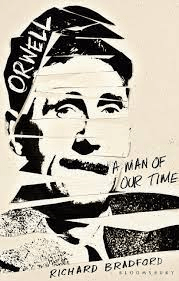
This might be a bit clumsy, but I found this edition’s front cover strangely apposite. It is illustrated (see above) with a print of Orwell’s head and shoulders, cut into segments then partially reassembled, leaving his face crooked and askew. In a way that is what Bradford has done with Orwell’s life work – he has broken them down into different constituent parts and then poorly reassembled them.

Orwell, A Man of Our Time, by Richard Bradford, 2020

Aside
Book review

Orwell – the New Life by D J Taylor, 2023

It was a real pleasure to spend some more time getting to know the genial, flawed and very human genius that was George Orwell. I was broadly familiar with the structure of Orwell’s life – India, prep school, Eton, Burma and so on – but Taylor draws these events together into a coherent whole. So when I say this, it needs to be seen in that context: Orwell remains as much a mystery to me now as he ever was. This edition quotes John Sutherland on the dust-jacket as saying “He (Taylor) presents the ‘living’ Orwell as well as anyone will be able to”. That may be the case, but to me Orwell remains enigmatic, hidden, and incomplete. I’ll try and explain why.

There are so many aspects of Orwell’s life that remain puzzling to me. Some of the things we don’t really know about him include:

Why didn’t he go to university?

Why did he leave his post in the Burmese Imperial police, after more than five years of service?

Why didn’t he get a conventional job and write in his spare time?

What did he do for money – was he living off his parents, figures who also don’t really emerge into the light in this book.

Almost everything about his relationship with his first wife, Eileen

Let’s take those in order. The traditional explanation of his decision to join the Burmese Imperial Police instead of going to university is that his grades at Eton weren’t good enough. Certainly he wasn’t a star pupil and financial pressures to get a proper job, one following in the family traditions of Imperial service, would have been compelling. But that’s just speculation – we don’t really know for certain what led him to this decision. Having made it he stuck at the job for several years (five and a half) – this wasn’t just the equivalent of a brief period of national service – but on returning to the UK he made the key decision in his life – to become a writer. Where did that decision come from? Were there any signs prior to this that Orwell aspired to the life of an author? Had he been writing out in Burma? If so there’s no record of it. And what a strange way to start the life of a writer – instead of using the five years of experience in Burma (which he was later to use of course) he instead decides almost out of the blue to go tramping? Why? Even in the context of going ‘undercover in the under-classes’, something earlier writers had done, this still seems such a sudden and mysterious choice. Collecting material is something some writers feel compelled to do, but there seems few less promising areas to mine for content for a novel than tramps. Orwell did of course use this content, both in essays and in A Clergyman’s Daughter, but it still seems a very random choice.

When asked later in life about his decision to quit the Burmese police Orwell always cited his opposition to imperialism, and texts such as A Hanging and Shooting an Elephant certainly support that idea. I can’t suppress the suspicion that this was a simplification of his reasons (which is fair enough, most life decisions are complex and when explaining them to other people we often reduce them to one or two elements).

Orwell did have conventional jobs, lots of them. He worked in Parisian kitchens and hotels, he sold books, he was a tutor, briefly a headmaster (in a private school with a teaching staff of two, where his CV as an Old Etonian would have helped) and during the war he worked for the BBC. I think he never stayed in a job for much more than two years. Was this because he couldn’t settle at a job for any length of time, getting bored and disenchanted with the value of his work very quickly, or was it because work was always supplementary to his writing, something that paid the rent and kept the bailiffs away, always secondary to his ‘real’ work? Once again we simply don’t have any definitive evidence that explains this nomadic lifestyle which was reflected in his relentless moving from address to address, never staying in the same place for more than a year or two – a full list of Orwell’s residences would fill an address book.

Despite making a reasonable income from his journalism, his publishing, and his various jobs, I suspect Orwell often relied on his parents and wealthier friends for financial support. I admittedly have no real evidence for this, just another suspicion – he did keep going back to his parents’ house in Southwold when he first started out as a writer. Certainly he had that middle class carelessness with money, putting up with considerable hardship when necessary and always assuming that something would come up to help out. You really can only live that life if you know there is always some support available as a last resort – Orwell was never going to find himself homeless.

And finally there is the closed book that is his relationship with Eileen. They married in 1936 after a relatively brief courtship (their very modest wedding was held in Wallington, the hamlet where Orwell ran the village stores), she went with him to Spain to support him in the civil war, and she died in 1945 just after the end of the war in Europe, and very shortly after having adopted their son, Richard. Taylor speculates the marriage was reasonably happy although hints at affairs on both sides – other biographers have been much more categorical about their infidelities, and certainly Orwell left some deeply incriminating letters. Lots of people who knew the couple wrote about them, but none seem to have understood the real dynamic of the relationship, what attracted one to the other, what made them tick as a couple. Why did Eileen put up with being a junior partner in the relationship despite her many talents, indeed why did she put up with living in the cottage in Wallington for so long with its outdoor privy, no heating and cramped rooms.

What is all the more extraordinary about this mysteriousness of the real Orwell is that he was a journalist, was famous after Animal Farm, was interviewed many times and had many writers as friends who left memoirs. A surprising number of people he wrote to preserved his letters, even when he asked them not to. Yet no recording of his voice exists, and I believe there is no film of him either, despite his working for a year and half at the BBC!

Another point that comes across vividly in this text is the tragedy of Orwell’s early death. He published his first novel, Burmese Days, in 1934, and was dead less than sixteen years later. In that time he did an extraordinary amount of work, and living, for a man in such poor health. He published six novels and three full-length pieces of non-fiction, got married, fought in the Spanish Civil War, worked at the BBC, served in the Home Guard, wrote a prodigious amount of journalism, reviews, diaries and journals, essays, opinion pieces, and letters, finding the time somehow to adopt a child and then remarry in the final weeks of his life. Dying aged 46, it is striking just how incredibly truncated his life was – cramming all those novels and experiences into little more than a decade dominated by the rise of fascism and the second world war.

If you are not a fan of Orwell you probably won’t become one on reading this biography. Taylor is honest about Orwell’s shortcomings and flaws. What doesn’t emerge clearly from these pages is Orwell the politician. There’s no real account of Orwell’s personal political journey from Old Etonian and imperial policeman to avowed socialist. The Spanish Civil War was obviously a turning point, but the transition was much more complex than just changing his views after being shot at (and of course, shot). His membership of the Independent Labour Party, a left-wing off-shoot of the Labour Party, is barely mentioned, and although his friendships and acquaintances within the Attlee Government are referred to there is no sense of Orwell the political animal, which was such a central part of his identity.

The chronological narrative is broken up from time to time with short thematic chapters – Orwell on faces, rats, anti-Semitism, homophobia, and so on. These essays felt like a way of using left-over material (and many of them did appear in the original version of this biography) and felt strangely out of place. If I was editing this book I would have put a line through all of them and suggested they be sent to the Orwell Society for publication.

The attempt early on to draw comparisons with St Cyprians, Orwell’s prep school (a private, fee-paying school where the middle classes sent their children to prepare them for public school examinations) and Oceania are absurd. Similar ill-thought through comparisons could have easily been made between Oceania and the BBC or Eton or the Burmese Imperial Police Force – the idea that an author’s literary ideas must all have their origins in childhood experiences or institutions is as ridiculous as it is demeaning, undermining the ability of an author to – you know – make things up.

There were a couple of other things that bugged me about this book and should really be fixed in the next edition:

a) Eileen’s war-time job. See if you can spot why this paragraph irked me? Chapter 20 ‘The Melting Iceberg’ describes Orwell’s account to find a role in the overall war effort. On page 366 Taylor, quoting a letter from Orwell to his literary agent, tells us that

“The letter to Moore notes ‘my wife has already got a job in a government office’ as if Eileen’s rapid deployment were the most natural thing in the world. But it might be wondered just exactly how, in the paranoiac conditions that prevailed in Whitehall corridors circa 1939, the wife of a writer regarded as an ‘extremist’ by the India Office, suspected of importing contraband material and already on MI5’s radar, could have fetched up in such a sensitive part of the wartime bureaucracy”.

I reread this sentence several times thinking “What sensitive part of the wartime bureaucracy”? What was her job, and why was it such a matter of surprise that she was given it. It’s not until page 375 that we learn what it was – she worked in the Censorship Department. An editor should have caught this omission and made the minor changes required for the narrative to make sense. A similar thing happens in:

b) Chapter 26 ‘Pain in Side Very Bad’ is prefaced by two quotes dated 1948. The text itself then starts with this sentence:

“The Blair party left for Jura on the afternoon of 10 April, went by overnight train to Glasgow, and then flew on to Islay. By the evening of 11 April they were back in Barnhill.”

What year is this? We are in the closing years of Orwell’s life – every year matters. The previous chapter is one of the rather irritating filler essays – this one is on Orwell and anti-Semitism – so the reader can be forgiven for not knowing or remembering that Taylor is picking up where he left off the preceding chapter. It’s just unnecessary and irritating, when a year after the first reference to April would make everything clear.

These are minor, fixable points.

I opened this review with a comment on one of the observations from critics quoted on the book’s dust-jacket, so I am going to close with one as well. Hilary Spurling from the Daily Telegraph apparently wrote

“A persuasive and profoundly moving exploration of the ways in which Orwell’s work was constructed from the stones of a ruined life”.

I know he had health issues, died early, and lost his first wife, but despite all that I never thought of Orwell’s life as ruined. There are sad moments in his story but it is not a tragedy – he lived, wrote and achieved more in his 46 years than many of us manage in 70. And while his early works draw upon his life experiences, the idea that Animal Farm and 1984 are in any way autobiographical (or ‘constructed from the stones’ of his life) is preposterous. This instinct, to try and find the seeds of a writer’s creativity in their life stories, actually ends up diminishing their ability to tell stories and work with ideas. That’s one reason why Orwell was so dismissive of his early novels in later life, to the extent of not allowing them to be republished on the back of the popularity of Animal Farm in particular. What led to that late blooming of creativity and inventiveness remains yet another mystery about this extraordinary author.

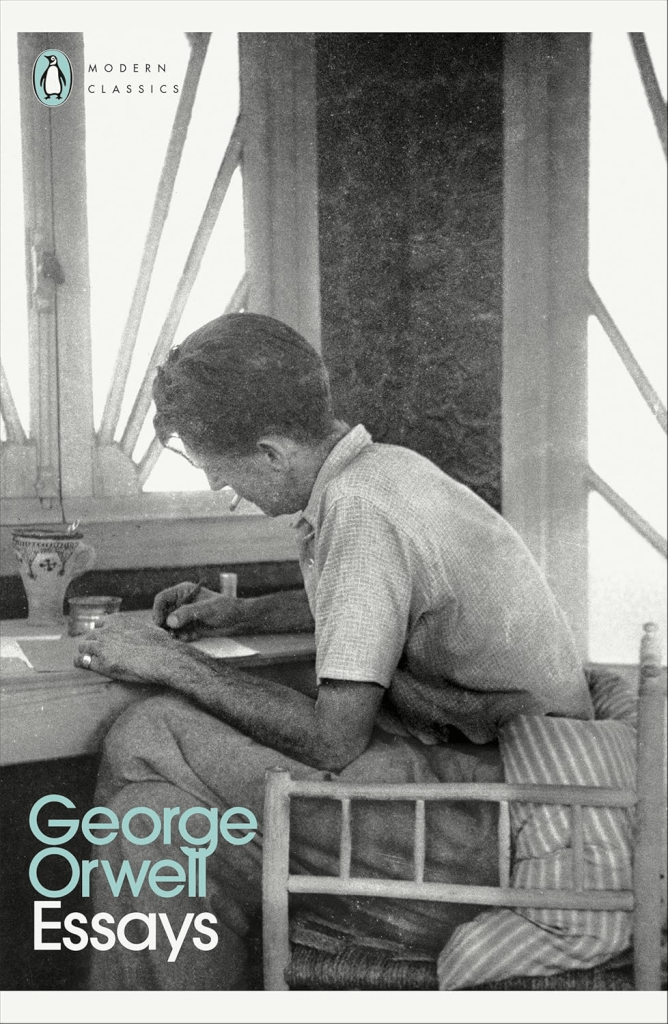
Orwell – the New Life by D J Taylor, 2023

Aside