Book review

Down and Out in Paris and London, George Orwell, 1933

Down and Out in Paris and London was Orwell’s first full-length book. It is written in the form of a memoir, describing the time Orwell spent living on or near the breadline in London and Paris. I’ve not been able to ascertain whether this pairing of the two capital cities was a deliberate nod towards Dickens’s Tale of Two Cities, or whether the symmetry is a simple consequence of Orwell’s time spent in both capitals. The book is also about two cities in another sense – that of the prosperous middle and upper classes and that of the working and underclass. So the symmetry works really well, even if it was accidental!

The first part of the book is Orwell’s account of his time working in hotel and restaurant kitchens in Paris. This was the original core of the book, to which the second, London-based half was later added. It covers a period of around ten weeks. You wouldn’t know it from this account, but Orwell lived in Paris for approximately two years, from the time he quit his job in the Imperial police force in Burma. Why Paris? By this point in his life Orwell was completely committed to being a full-time writer, and Paris had the attraction of a) being a cheap place to live, compared to London, and b) the home of a thriving artistic community, including a large Russian émigré community. Basically it was a lot more exciting than London.

At present I do not feel that I have seen more than the fringe of poverty. Still, I can point to one or two things I have definitely learned by being hard up. I shall never again think that all tramps are drunken scoundrels, nor expect a beggar to be grateful when I give him a penny, nor be surprised if men out of work lack energy, nor subscribe to the Salvation Army, nor pawn my clothes, nor refuse a handbill, nor enjoy a meal at a smart restaurant. That is a beginning.

I can probably guess how Orwell spent most of his time in Paris, but in March 1929 he had most of his money stolen, forcing him into seeking a job. He had the option of reaching out to family or friends – or anyone else in the English community in Paris, (none of whom are even mentioned – taken at face value this book suggests that Orwell was the only Englishman in Paris in the 1920s!) but instead he took a job as a dishwasher in a very posh hotel and then latterly in a small bistro. His experiences in these establishments and his thoughts on the social structures that underpin them form the bulk of the first half of the book, and for some time were the only part of the book – it wasn’t until after several rejections by publishers that Orwell had the idea of welding his English down and out experiences to the text, immeasurably strengthening the overall structure.

Orwell left Paris in December 1929 and returned to his parents’ house in Suffolk. While waiting for a job as a private tutor to begin he went ‘tramping’, not for the first time (as the book implies). That is to say he put on some dirty clothes, left most if not all of his money behind, and set off on the road to live among the down and out. His experiences in ‘spikes’ are vividly recorded. Spikes were temporary hostels for the homeless, often constructed as part of the workhouses which still existed in pre-war England. In 1905 a Royal Commission had recommended that specialised institutions for different classes of the poor and homeless be established, and spikes, where you were only allowed to stay one day per month, were a result. The rules of the spikes were punitive and humiliating, and Orwell captures the misery of them perfectly.

The history of the publication of the book is quite interesting. Following rejections from several publishers Orwell effectively abandoned the typescript at the home of a family friend. Proving the adage that it’s not what you know, but who, this friend showed the text to a literary agent, who in turn offered it to Gollancz, who offered to publish it subject to the excision of some curse words and a few other changes to make them less likely to be sued. The title went through various iterations – Confessions of a Down and Outer, Confessions of a DishwasherThe Lady Poverty, In Praise of Poverty, only settling on Down and Out in Paris and London at the last. This was the first time Orwell used his pseudonym, again having toyed with various alternatives. It seems the pseudonym was used to save his respectable family any potential embarrassment given the slightly sordid subject matter.

It did not occur to me when I first read Down and Out to question how accurate it was. Perhaps I more sceptical nowadays – certainly I wonder to what extent Orwell embroidered his account? He made several differing comments on this question, leaving the issue unclear. I think the honest truth is that he omitted some detail and reordered others, but the essential truth of the memoir is unavoidable – there’s nothing here that is over the top, unbelievable or cause for any doubt. The events of the book are almost bland in their plainness. But somehow this fairly uneventful narrative has had an impact far beyond the sum of its parts. Perhaps this is because we know it is the first major work by an author who was going to go on to write in a few short years 1984, Animal Farm and so much more. You can quite easily see many of the essential principles of Orwell’s writing technique in Down and Out – the lack of over-ornamentation, use of plain English, and a willingness to say the unsayable (the f-bomb is dropped casually in a later chapter about the language of the streets.)

I’ve mentioned this in previous reviews of some of Orwell’s books, but his views on Jewish and gay people haven’t aged well. He is casually anti-Semitic in the way he writes about Jewish people, and expresses similarly dismissive attitudes towards gay people. There are worse examples elsewhere in his journalism, letters and diaries, but I wouldn’t want to dismiss the examples that appear despite this.

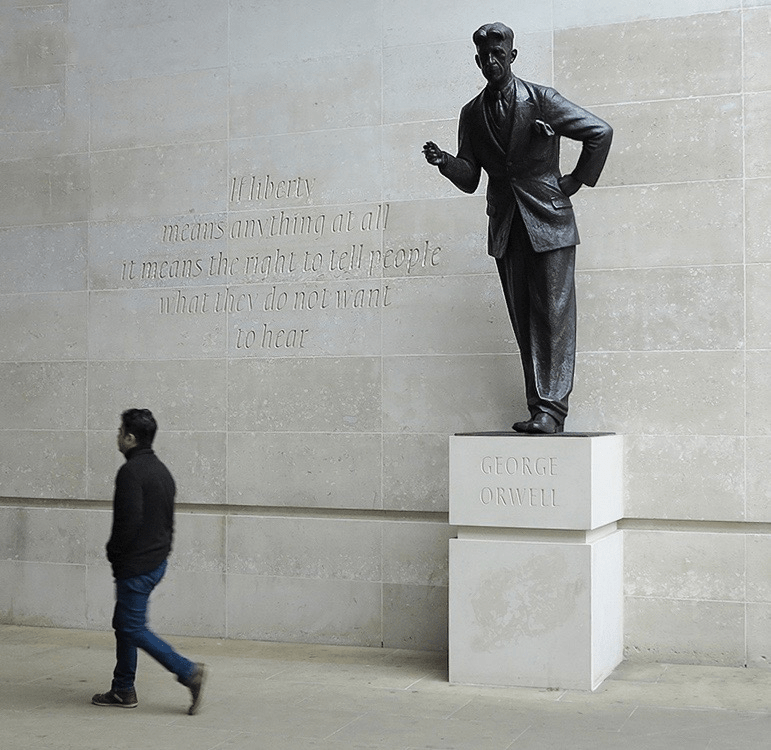
Orwell has been in the UK media a lot in recent days because of the dispute between one of the BBC’s presenters and the organisation itself on the question of freedom of speech. Lots of commentators have pointed out the irony of the BBC trying to censor Gary Lineker for his comments on Government immigration policy all the while ignoring this quote from Orwell which is on the wall of its main entrance:

Well said, as always. Apparently the quote comes from a draft preface to Animal farm which was never used. Just one more irony to go alongside the fact that at the time he worked at the BBC in the early 1940’s, Orwell was effectively a propogandist for the UK Government!

Down and Out in Paris and London, George Orwell, 1933

Aside
Book review

The Road to Wigan Pier, by George Orwell, 1937

The opening sentence to chapter eight of this book explains that ‘the road from Mandalay to Wigan is a long one and the reasons for taking it are not immediately clear. ‘

This would have been a wonderful introduction to The Road to Wigan Pier. Orwell’s decision to go to Burma for a post in the Indian Imperial Police straight from Eton (rather than taking the road more often travelled to university) was obviously a turning point in his life. The next stage of his personal odyssey, from Burma to Wigan in early 1936, would have made a fascinating story, and it is one he obviously wants to tell. He can’t completely remove himself from the narrative –

I was born into what you might describe as the lower-upper-middle class. The upper-middle class, which had its heyday in the eighties and nineties, with Kipling as its poet laureate, was a sort of mound of wreckage left behind when the tide of Victorian prosperity receded

I am a degenerate modern semi-intellectual who would die if I did not get my early morning cup of tea and my New Statesman every Friday”

and he regularly mentions how tall he is in comparison with the people of northern England. But we only get intermittent glimpses of this story. Orwell had been commissioned by the newly established Left Book Club to write about the living conditions of the unemployed in the north of England and from time to time he makes a genuine effort to stick to this brief. So there is a tension throughout the book – at points it is about the subject he was supposed to be writing about and at others autobiographical elements intrude.

I have to wonder whether Orwell delivered what he had been commissioned to write? Certainly he found what he expected to find – widespread poverty, appalling housing conditions, and little sign of organisation within the working class to improve things. A benevolent middle class intervention to help the struggling poor was Orwell’s inevitable diagnosis. But so much of the text is not on the subject Orwell was supposed to be writing about – the standards of living of the unemployed in the North. He wanders off topic for large sections of the book, and then in the second section abandons it altogether.

The opening chapter in part one describes life in a cheap boarding house. We are not told where this house is nor why Orwell is staying there (the book has no real introduction at all, other than the contentious opening by Victor Gollancz, the commissioning editor and promoter of the Left Book Club, which argues with several of Orwell’s conclusions). An un-emptied chamber pot left in the boarding house’s dining room causes Orwell to quit his shared room and get on a train to the North. This chapter includes the famous description of a view from the train:

The train bore me away, through the monstrous scenery of slag-heaps, chimneys, piled scrap-iron, foul canals, paths of cindery mud criss-crossed by the prints of clogs. This was March, but the weather had been horribly cold and everywhere there were mounds of blackened snow. As we moved slowly through the outskirts of the town we passed row after row of little grey slum houses running at right angles to the-embankment. At the back of one of the houses a young woman was kneeling on the stones, poking a stick up the leaden waste-pipe which ran from the sink inside and which I suppose was blocked. I had time to see everything about her – her sacking apron, her clumsy clogs, her arms reddened by the cold. She looked up as the train passed, and I was almost near enough to catch her eye. She had a round pale face, the usual exhausted face of the slum girl who is twenty-five and looks forty, thanks to miscarriages and drudgery; and it wore, for the second in which I saw it, the most desolate, hopeless expression I have ever-seen. It struck me then that we are mistaken when we say that’ It isn’t the same for them as it would be for us,’ and that people bred in the slums can imagine nothing but the slums. For what I saw in her face was not the ignorant suffering of an animal. She knew well enough what was happening to her – understood as well as I did how dreadful a destiny it was to be kneeling there in the bitter cold, on the slimy stones of a slum backyard, poking a stick up a foul drain-pipe.

You will note that in this paragraph Orwell talks about ‘we’ – himself and the implied reader, the Left Book Club subscriber who has someone else to unblock their drains. He does this elsewhere in the text, assuming that his reader will be middle class and Southern like himself, viewing the industrial northern working class as an alien race that needs to be introduced and explained by Orwell, the traveller into a strange land. The second chapter, later printed as a standalone essay in Inside the Whale, describes the lives of miners and their working conditions down a coal mine. This chapter vividly captures the horrors of mine working. I don’t want to over-emphasise this element of the text but it is impossible to avoid the homo-eroticism of Orwell’s descriptions of the miners:

“They really do look like iron hammered iron statues–under the smooth coat of coal dust which clings to them from head to foot. It is only when you see miners down the mine and naked that you realize what splendid men, they are. Most of them are small (big men are at a disadvantage in that job) but nearly all of them have the most noble bodies; wide shoulders tapering to slender supple waists, and small pronounced buttocks and sinewy thighs, with not an ounce of waste flesh anywhere. In the hotter mines they wear only a pair of thin drawers, clogs and knee-pads; in the hottest mines of all, only the clogs and knee-pads.”

(He later writes in similar terms about the attractiveness of Burmese men compared to Englishmen, in particular himself). The following chapters describe the housing and economic position of the average miner. Orwell agonises over the housing shortage in the north without being able to identify the obvious solution of a mass state sponsored house building programme. Eventually in chapter 5 he reaches the issue of unemployment, but this is a cold statistical analysis rather than a personal record of life without paid work. Orwell makes some good points about how hard to is to eat well or sensibly on poverty income levels – an issue that remains pertinent to this day.

The second part of the book is almost entirely comment, sometimes wandering quite some distance from the original point of the commission. He struggles to answer the question of why socialism has not been embraced by the working class in the UK, given the self evident argument that it would address all the problems outlined in the first section of the text. Orwell is honest about his social origins, his class prejudices and his efforts to overcome them. He is quite dismissive of socialists in the UK, finding them largely detached from the working classes whose lives they are planning to improve. This is largely polemic, based upon the stark contrast between his experiences as an intellectual in London and the South East and his weeks in the North. These chapters are characterised by muddled logic, prejudice and contradiction. Often you get the impression Orwell is more interested in crafting a quotable phrase than developing a line of argument. Certainly he is never afraid of hyperbole:

“Looking back upon that period (post-war) I seem to have spent half the time in denouncing the capitalist system and the other half in raging over the insolence of bus conductors”;

or

There is probably no-one capable of thinking and feeling who has not occasionally looked at a gas-pipe chair and reflected that the machine is the enemy of life.”

He argues that mechanisation is effectively synonymous with socialism, as if that is simply self-evident rather than something contentious that he has to demonstrate (“This, then, is the case against the machine. Whether is is sound or unsound case hardly matters“) then goes on to bemoan at significant length the damage machines have done to the quality of life in the UK and to his life in particular.

“As you can see by looking at any greengrocer’s shop, what the majority of English people mean by an apple is a lump of highly-coloured cotton wool from America or Australia; they will devour these things, apparently with pleasure, and let the English apples rot under the trees. It is the shiny, standardized, machine-made look of the American apple that appeals to them; the superior taste of the English apple is something they simply do not notice. Or look at the factory-made, foil-wrapped cheese and ’blended’ butter in any grocer’s; look at the hideous rows of tins which usurp more and more of the space in any food-shop, even a dairy; look at a sixpenny Swiss roll or a twopenny ice-cream; look at the filthy chemical by-product that people will pour down their throats under the name of beer. Wherever you look you will see some slick machine-made article triumphing over the old-fashioned article that still tastes of something other than sawdust.

Coming up for Air is tainted by the same pervading sense of nostalgia, a dim awareness that things were better when Orwell was a young man. It was this strand of conservatism (even when he was trying to develop an argument for socialism) that led him to being quoted approvingly by John Major. Orwell can recognise that industrialisation and mechanisation have brought benefits in terms of living standards and improvements to the world of work. But his apples have a machine-made look and it is our fault anyway for preferring American apples to the innately superior English varieties. We’ve all heard similar complaints from old people (Orwell was only in his thirties at this point, but sounds a lot older) about how things were better in the old days, and the claim rings as hollow today as it did then.

And then we come to the difficult passages where Orwell makes the argument that working class people smell. Quite why he felt the need to be so disrespectful to the people who had welcomed him into their homes, shared their food and shown him every hospitality, is beyond me. He was never afraid of being controversial, sometimes actively seeking out controversy, and I am sure he genuinely believed this to be the case, but he could have chosen to point out any number of other aspects of poverty-line daily life – badly made clothes, rotten teeth, untreated medical ailments, shoes with no soles, etc. Instead, as always it seems for Orwell, it is the ‘scent narrative’ (as John Sutherland puts it in his book on this very specific topic, Orwell’s Nose, A Pathological Biography)

The real secret of class distinctions in the West–the real reason why a European of bourgeois upbringing, even when he calls himself a Communist, cannot without a hard effort think of a working man as his equal. It is summed up in four frightful words which people nowadays are chary of uttering, but which were bandied about quite freely in my childhood. The words were: The lower classes smell. That was what we were taught–the lower classes smell. And here, obviously, you are at an impassable barrier. For no feeling of like or dislike is quite so fundamental as a physical feeling.

He tells himself that it is wrong to feel this way, but he can’t ever fully overcome this instinctual sense of repugnance at the working classes.

Class prejudice is accompanied by casual homophobia, anti-Semitism and other prejudices that shouldn’t be brushed away too casually:

It would help enormously if the smell (smell again!) of crankishness which still clings to the Socialist movement could be dispelled. If only the sandals and the pistachio-coloured shorts could be put in a pile and burnt, and every vegetarian, teetotaller and creeping Jesus sent home to Welwyn Garden City to do his yoga exercises”.

“In order that Hitler may march the goose-step, that the Pope may denounce Bolshevism, that the cricket crowds may assemble at lord’s, that the Nancy poets may scratch one another’s backs, coal has got to be forthcoming.

We have reached a stage when the very word ’Socialism’ calls up, on the one hand, a picture of aeroplanes, tractors, and huge glittering factories of glass and concrete; on the other, a picture of vegetarians with wilting beards, of Bolshevik commissars (half gangster, half gramophone), of earnest ladies in sandals, shock-headed Marxists chewing polysyllables, escaped Quakers, birth-control fanatics, and Labour Party backstairscrawlers.

While The Road to Wigan Pier doesn’t cover in any detail the subject it was commissioned to address and exposes a lot of Orwell’s prejudices, at the same time it is an important text. I originally read it over forty years ago, and while books I read last year have already started to fade from my memory, Wigan Pier still resonates, however wrong-headed and muddled it may be. This is in part because of Orwell’s legendary uncomplicated prose, in part because even when completely wrong he is always interesting, and mostly because no-one wrote about the state of pre-war Britain in the way he did. It ends with a slightly forced rallying call for class solidarity between the proletariat and the white collared middle classes and with an awful joke: “We have nothing to lose but our aitches“.

The Road to Wigan Pier, by George Orwell, 1937

Aside
Book review

Orwell dismissed A Clergyman’s Daughter as “tripe” and more bluntly as “bollocks”, and prevented it from being reprinted during his lifetime. He thought it even worse than Keep the Aspidistra Flying, as “it was written simply as an exercise and I oughtn’t to have published it, but I was desperate for money”.

Is it really that bad, or was this simply false modesty?

Dorothy Hare, 28 years old and single, works tirelessly as an unpaid curate (vicar’s assistant) to her father, the rector of Knype Hill, a small town based (it is believed) on Southwold in Suffolk, where Orwell’s parents lived after they retired from service in India. Dorothy is run ragged by the responsibilities of the parish and her household. Her father is feckless and totally unsympathetic, so she takes the weight of the whole parish on her shoulders, from running the girl guides and Mothers’ Union, to typing up his sermons and visiting the sick. One day, following a particularly challenging day’s work, she is sexually assaulted by Mr Warburton, an aging lothario who casually attempts to seduce her (as he sees it). This assault triggers an episode of amnesia for Dorothy, who wakes up several days later in the Old Kent Road wearing a new set of clothes. How she got to London from Suffolk is never explained. Knype Hill society assumes she has eloped with Warburton, who has conveniently gone on a long European trip at exactly the same time.

Dazed, confused and extremely vulnerable, Dorothy joins a group travelling to Kent for the hop-picking season. Slowly her memory returns and she writes to her father explaining her situation and asking for help. When no reply comes she assumes she is persona non-grata and at the end of the hop season she travels back to London. Once her money runs out she ends up living on the street joining a group of tramps in Trafalgar Square. The chapter describing the night spent sleeping rough in Trafalgar Square is written experimentally, with a nod to Ulysses, in play format. As the cold worsens and lack of sleep leads to exhaustion, Dorothy enters an almost dream-like state which only ends when she is arrested and imprisoned for vagrancy.

Dorothy’s father meanwhile, has reached out to his well-to-do cousin, Sir Thomas Hare, to try and find Dorothy and help her. Bringing her home seems out the question, the implication being that the rector believes the rumours that she has eloped, despite her reassurances to the contrary. Sir Thomas has an efficient man-servant who quickly tracks Dorothy down – easily enough as she is in custody – and finds a job for her in a small private school run by the monstrous Mrs Creevy. At first Dorothy enjoys attempting to awaken her students’ dormant interest in learning, but these attempts are quickly quashed when parents protest about the lack of focus on practical learning, writing and mathematics. The children rebel, understandably, but the issue quickly becomes moot when Mrs Creevy dismisses her without notice when she finds a replacement.

There is just time for Mr Warburton to appear out of the blue as Dorothy’s unlikely saviour and to take her back to Knype Hill. Here she quickly resumes her old routine. Although she has now lost her faith she still retains a belief in the value of service to others and this is where the novel closes.

A key element of the plot of A Clergyman’s Daughter is Dorothy’s loss of memory. Orwell uses this plot device to send her on a journey round his old haunts – hop-picking in Kent, dossing down in Trafalgar Square, and teaching in private schools in the suburbs. We are invited to believe that exhaustion combined with her distress at Mr Warburton’s sexual assault triggers this amnesia. There’s no attempt to explain how she finds herself in London in a new set of clothes, or anything that happens to her in the meantime. What we do now know is that in an earlier draft of the novel Warburton’s attack is more explicitly described as an attempted rape. I think we would today see the surviving description as such an event anyway, but the point is that to an 1930’s audience the description could more easily be dismissed as a clumsy attempt at seduction.

This sentence jumped from chapter Chapter 5 (page 285 in the Penguin classic edition):

It was one of those bright cold days which are spring or winter according as you are indoors or out.”

Ring any bells? Here’s the first line from 1984:

It was a bright cold day in April, and the clocks were striking thirteen.”

The re-use of content from Orwell’s journalism is blatant. Reportage from Down and Out in Paris and London and Orwell’s hop-picking diaries are shoe-horned into the novel on only the flimsiest of pretexts. The later chapter on Dorothy’s time as a school-teacher is also largely autobiographical. Orwell certainly wasn’t the first writer to re-purpose some of his journalism into novel format – Raymond Chandler for example welded his shorter stories written for magazine publication into novels such as The Big Sleep – but this is clumsily done.

There are also some horribly out-dated attitudes on display in this novel. Of course there is always the defence that these are his characters’ views not the novelists, but that defence feels weak in a novel which relies so heavily on reportage, and where the same attitudes are reflected elsewhere in both his novels and his journalism. For example here is the narrator’s description of the travellers at the hop farm:

Quite half the pickers in the set were gypsies—there were not less than two hundred of them in the camp. Diddykies, the other pickers called them. They were not a bad sort of people, friendly enough, and they flattered you grossly when they wanted to get anything out of you; yet they were sly, with the impenetrable slyness of savages. In their oafish, Oriental faces there was a look as of some wild but sluggish animal—a look of dense stupidity existing side by side with untameable cunning. 118

Another troubling aspect of the novel is the views expressed on the working class. There is plenty of evidence here and elsewhere in his work to suggest that lower-upper-middle-class, privately educated, Old Etonian Eric Blair thought that working class people smell – not least because he tells us more than once that he did. This is a contentious view, I appreciate, and there has been a surprising amount written on either side of the issue. It was already a debate while Orwell was still alive and writing, used by his political opponents to undermine his arguments. But for someone who didn’t really think the working classes smell there’s an awful lot of references to the smelliness of the working class.

In The Road to Wigan Pier Orwell defined the attitude of his class towards the working class as “an attitude of sniggering superiority, punctuated by bursts of vicious hatred.” At times some of that approach emerges, perhaps subconsciously, in his work.

Consider this description from the first chapter of A Clergyman’s Daughter, while Dorothy does her parochial visits:

Dorothy knocked at the Pithers’ badly fitting door, from beneath which a melancholy smell of boiled cabbage and dish-water was oozing. From long experience she knew and could taste in advance the individual smell of every cottage on her rounds. Some of their smells were peculiar in the extreme. For instance, there was the salty, feral smell that haunted the cottage of old Mr Tombs, an aged retired bookseller who lay in bed all day in a darkened room…. In nearly all the cottages there was a basic smell of old overcoats and dish-water upon which the other, individual smells were superimposed; the cesspool smell, the cabbage smell, the smell of children, the strong, bacon-like reek of corduroys impregnated with the sweat of a decade.

Orwell addresses this issue face on elsewhere in The Road to Wigan Pier:

Here you come to the real secret of class distinctions in the West–the real reason why a European of bourgeois upbringing, even when he calls himself a Communist, cannot without a hard effort think of a working man as his equal. It is summed up in four frightful words which people nowadays are chary of uttering, but which were bandied about quite freely in my childhood. The words were: The lower classes smell.

…..in my childhood we were brought up to believe that they were dirty. Very early in life you acquired the idea that there was something subtly repulsive about a working-class body; you would not get nearer to it than you could help. You watched a great sweaty navvy walking down the road with his pick over his shoulder; you looked at his discoloured shirt and his corduroy trousers stiff with the dirt of a decade; you thought of those nests and layers of greasy rags below, and, under all, the unwashed body, brown all over (that was how I used to imagine it), with its strong, bacon-like reek. “

You’ll notice the language from Wigan Pier, which was published in 1937, echoes much of that in the earlier passage from Clergyman’s – ‘bacon-like’, ‘sweat/dirt of a decade’ etc.

A Clergyman’s Daughter isn’t really a bad novel. But it shows every sign of being quickly thrown together: the characters are two-dimensional, the plot is a mess and the discussion on faith which closes the text is perfunctory at best, tacked on to give some much needed but unconvincing depth. Another one for Orwell completists only.

A Clergyman’s Daughter by George Orwell, 1935

Aside
Book review

Anti-semitism in Britain, by George Orwell, 1945

George Orwell was a boyhood hero of mine. Here was someone prepared to say unpopular things, to go against the flow of public opinion and to speak truth to power. The major novels, 1984 and Animal Farm led me to his earlier work including Keep the Aspidistra Flying and Coming Up for Air, and then on to his journalism and essays, all written in that distinctive, clear, very personal voice that seemed to know the answers to all of the important questions. If Orwell thought something was wrong, it probably was, and adopting his position on an issue was a useful guide to being on the right side of the argument. So his thoughts on anti-Semitism in this article, written early in 1945, must surely be worth reading?

It’s not clear what research, if any, Orwell did before writing this essay, nor indeed what specifically prompted him to write it in the first place. He starts his article by reporting a series of anti-Semitic comments overheard on the tube and in shops. Perhaps one of these comments was the trigger? The issue of anti-Semitism itself was unavoidable given the ongoing Holocaust in Europe. The essay was written in February and published in April 1945, just as the war in Europe was ending. It conceivable that this was before the full horror of the Holocaust was widely understood, although Hitler’s determination to exterminate the Jewish people from Europe was hardly a secret (see here for example  https://www.jewishvirtuallibrary.org/allied-declaration-on-persecution-of-the-jews.)

The overall tone of the essay is almost conversational, along the lines of Orwell saying ‘here are a few interesting thoughts I would like to share about a topic that has caught my attention’. Rather than simply condemning anti-Semitism, Orwell claims to attempt to understand it, and even goes so far as to acknowledge some anti-Semitic ideas and beliefs within himself. He tentatively identifies the origins of the prejudice in nationalism:

It seems to me a safe assumption that the disease loosely called nationalism is now almost universal. Antisemitism is only one manifestation of nationalism, and not everyone will have the disease in that particular form.

And concludes that to defeat anti-Semitism we will have to defeat nationalism. For an author famed for the clarity of his expression, the point where Orwell concludes his article on the issue is convoluted to say the least:

“…antisemitism will be definitively cured, without curing the larger disease of nationalism, I do not believe.”

What he doesn’t do is identify any specific features of anti-Jewish prejudice that makes it so insidious and harmful. Equally there is little research in the article, and personal anecdotes only go so far to explore the topic. Much as it pains me to accept it, throughout his previous writings Orwell occasionally expressed anti-Semitic ideas and used anti-Semitic tropes. I am not going to repeat them here – the internet will help you find them easily enough if you are interested. They make painful reading, much like his homophobic comments – casually dismissive and hurtful towards people who are different from him. But while many people go through their lives holding on to their prejudices, Orwell at least had the willingness to confront his own. He recognises his anti-Semitism, and tries to understand its origins and place it in context:

Thirty years ago it was accepted more or less as a law of nature that a Jew was a figure of fun and – though superior in intelligence – slightly deficient in ‘character’. In theory a Jew suffered from no legal disabilities, but in effect he was debarred from certain professions. He would probably not have been accepted as an officer in the navy, for instance, nor in what is called a ‘smart’ regiment in the army. A Jewish boy at a public school almost invariably had a bad time. He could, of course, live down his Jewishness if he was exceptionally charming or athletic, but it was an initial disability comparable to a stammer or a birthmark. Wealthy Jews tended to disguise themselves under aristocratic English or Scottish names, and to the average person it seemed quite natural that they should do this, just as it seems natural for a criminal to change his identity if possible. About twenty years ago, in Rangoon, I was getting into a taxi with a friend when a small ragged boy of fair complexion rushed up to us and began a complicated story about having arrived from Colombo on a ship and wanting money to get back. His manner and appearance were difficult to ‘place’, and I said to him:

‘You speak very good English. What nationality are you?’

He answered eagerly in his chi-chi accent: ‘I am a Joo, sir!’

And I remember turning to my companion and saying, only partly in joke, ‘He admits it openly.’

Later he poses the question this way:

(We should not ask) Why does this obviously irrational belief appeal to other people?’ but ‘Why does antisemitism appeal to me? What is there about it that I feel to be true?’ If one asks this question one at least discovers one’s own rationalizations, and it may be possible to find out what lies beneath them. 

It’s an interesting starting point – asking people with anti-Semitic ideas and values to help with understanding the origins of those ideas and values. I’m not convinced Orwell was able to complete the exploration he proposes here – while he retained many Jewish friends for the remainder of his short life, he never acknowledged the pain and harm his thoughtless comments caused, and allowed his diaries to survive for publication with the comments intact (I recognise that may not have been a deliberate plan of course). I accept that he was hardly unique among British writers and intellectuals of the period in having these views, but that is only very partial mitigation. It’s hard to imagine someone writing this piece today when I think we have a better understanding of the causes of racial prejudice in all its forms. Orwell was a product of his time and class as we all are, and passing historical judgment on his views really only takes us so far. It’s also ridiculous to consider his views as monolithic and unchanging over time, when he went to such extraordinary lengths to challenge the ideas and prejudices that he was brought up with. Christopher Hitchens’ fantastic and highly readable essay on Orwell’s progression from bigoted public schoolboy to class-ally is in this context a must-read.

It is sad and hard to process each time one of our childhood heroes is shown to be less than heroic, but there’s no point in trying to ignore their failings either. That doesn’t make Orwell a bad writer, or his ideas less interesting, but the process of seeing him and others as flawed, fallible human beings can be painful.

Standard
Book review

Inside the Whale and other essays, by George Orwell

Inside the Whale and other essays was first published in this format in 1957, but the individuals essays are drawn from across Orwell’s most productive journalistic years, 1936 to 1947. There are nine essays in this collection – first date of publication shown in brackets:

Inside the Whale (1940) starts as a discussion of Henry Miller’s Tropic of Cancer, but uses this topic as a springboard to roam far and wide across the literature of the first half of the twentieth century;

Down the Mine (1937) originally formed a chapter in The Road to Wigan Pier and is what is says it is, a description of the physical hardships involved in working down a coal mine;

England Your England (1941) is a discussion of nationalism in the context of the early years of the second World War;

Shooting an Elephant (1936) – in this well-known essay Orwell describes the possibly fictional experience of shooting an elephant while serving in Burma in the Indian Imperial Police, where he went immediately after Eton instead of the more traditional route of university;

Lear, Tolstoy and the Fool (1947) is a discussion of Tolstoy’s essay on Shakespeare;

Politics in Literature (1946) is an extended review of Jonathan Swift’s Gulliver’s Travels;

Politics and the English Language (1946) is a surprisingly conservative discussion of how debased the English language has become due to the declining political situation;

The Prevention of Literature (1945) works well as a companion piece to the previous essay as it discusses the impact of totalitarianism on literature;

Boys’ Weeklies (1940) which is a more light-hearted review of the comics published for boys in the first decades of the twentieth century.

Each essay had previously been published elsewhere and had also been collected in different formats. They work well together in this collection, completing one another and giving a examples of some of Orwell’s best journalism of this his defining period.

Taking these essays as a whole, my first impression was how incredibly interesting Orwell must have been as a person to speak to. His mind jumps across so many different topics and he always has a contentious, well-framed position. He never sits on the fence. Some of the positions he sets out here, such as his arguments about the use of plain English in political writing, have stayed with me since I first read them in the 1970’s. You might not agree with what he says – and sometimes I think he is just adopting a position to be controversial for its own sake – but it’s always interesting. It’s also possible to open a page at random and find dozens of thoughtful comments on an important issues. Here are some examples – but the book is absolutely full of them, and choosing some representative examples was incredibly difficult:

It was an age of eagles and of crumpets, facile despairs, backyard Hamlets, cheap return tickets to the end of the night. Inside the Whale

He (Henry Miller) is fiddling While Rome is burning, and, unlike the enormous majority of people who do this, is fiddling with his face towards the flames“. Inside the Whale

“As I write, highly civilized human beings are flying overhead, trying to kill me.
They do not feel any enmity against me as an individual, nor I against them. They are ‘only doing their duty’, as the saying goes. Most of them, I have no doubt, are kind-hearted law-abiding men who would never dream of committing murder in private life. On the other hand, if one of them succeeds in blowing me to pieces with a well-placed bomb, he will never sleep any the worse for it. He is serving his country, which has the power to absolve him from evil.”
England Your England

(On the impact of imperialism on the ‘white man with his gun’) “He wears a mask and his face grows to fit it” Shooting an Elephant.

These essays are very specific to the time and place from which they were published – the end of Empire and the outbreak of the second World War; the rise of the dictators and for a while what looked like it might be the end of civilisation as we knew it. They are dominated by the oppressive political climate in which internationally things looked very bleak, the war loomed and then broke, and progressive ideas struggled to survive.

“While I have been writing this essay another European war has broken out. It will either last several years and tear Western civilisation to pieces, or it will end inconclusively and prepare the way for yet another war which will do the job once and for all.Inside the Whale.

It is interesting how little Orwell seemed to have celebrated or been inspired by the election of the radical Labour Government at the end of the war. Although he obviously wrote about these events none of his great journalism touches upon the creation of the NHS, the nationalisation of swathes of British industry, and the introduction of the modern welfare state, even though these steps were an attempt to address many of the social injustices he had written about in, for example, The Road to Wigan Pier. His focus by then was the international situation, and in particular the spread of Soviet Communism. The extent to which Orwell was rehearsing themes that would come to dominate his last two great novels, Animal Farm (1945) and 1984 (1950) comes across very strongly in these essays. For example in The Prevention of Literature he speculates on what kinds of reading matter would survive in a rigidly totalitarian society. “Perhaps some kind of low-grade sensational fiction will survive, produced by a sort of conveyor belt process that reduces human initiative to the minimum? It would not be beyond human ingenuity to write books by machinery.” This theme was brought more vividly to life in 1984 with the creation of the ‘ficdep’ and ‘pornosec’ departments. That’s one of the great strengths of these two masterpieces – they bring together complex political ideas that Orwell had been writing about for some time, and express them in a wonderfully clear way.

I think it’s appropriate that the collection ends with Boys’ Weeklies. This is a class based analysis of boys’ comics, with particular reference to the Billy Bunter Greyfriars stories. It was originally published in the monthly literary magazine Horizon, and argues that the rigid structure these stories employ was needed because “a series lasting thirty years could hardly be the work of the same person every week. Consequently they have to be written in a style that is easily imitated — an extraordinary, artificial, repetitive style, quite different from anything else now existing in English literature.” While Orwell was unquestionably right about the repetitive style the stories used, he was completely wrong in his speculation that the author – Frank Richards – was a pseudonym used by a series of writers. The following month Horizon published one of the most devastating ripostes to an essay I have ever seen which includes a line by line reply to virtually every point made, plus this magnificently understated take down:

“Mr Orwell finds it difficult to believe that a series running for thirty years can possibly have been written by one and the same person. In the presence of such authority I speak with diffidence: and can only say that, to the best of my knowledge and belief, I am only one person, and have never been two or three people”

I highly recommend reading Richards’ reply in full (to be fair it was included in Orwell’s collected essays letters and journalism when they published by Penguin in four volumes a few years/decades back) as an example of how to write a dignified demolition of what to be fair was just an attempt to write something interesting about a light-hearted subject.

Finally, I wanted to close on Down a Mine. Orwell has rightly been condemned in recent times for his casual homophobia – he often used homophobic language to describe gay men in particular. But even he was not immune to the attractions of the male form:

“It is only when you see miners down the mine and naked that you realize what splendid men, they are. Most of them are small (big men are at a disadvantage in that job) but nearly all of them have the most noble bodies; wide shoulders tapering to slender supple waists, and small pronounced buttocks and sinewy thighs, with not an ounce of waste flesh anywhere. In the hotter mines they wear only a pair of thin drawers, clogs and knee-pads; in the hottest mines of all, only the clogs and knee-pads.Down a Mine.

Standard
Book review

Keep the Aspidistra Flying, by George Orwell, 1936

Gordon Comstock, anti-hero of Keep the Aspidistra Flying, is a failed poet, struggling with a premature mid-life crisis, and what we would now characterise as depression. He expresses his feelings as resentment at demands placed upon him by family and friends, and rages against the need to work for a living. OrwellRejecting a well-paid job in advertising, which he feels is beneath him, he instead works in a bookshop, spending long sad weeks struggling to make sure he can afford the next cigarette or pint of beer. He obsesses over the cost of everything. At first this is slightly comic, but the intensity of this obsession soon becomes wearisome. He is a misanthropic, grumpy figure who doesn’t deserve the friendship and love of those around him who care for him and look out for him, even though he goes out of his way to reject their help.

He lives a mean life in a dingy bedsit in Hampstead, working in a bookshop and in his spare time picking away at his magnum opus ‘London Pleasures’. His fantasy of himself as a poet is fed by the earlier publication of a slim volume of poetry – ‘Mice’ – which sold only 153 copies despite positive reviews. His obsession with money poisons his relationship with his girlfriend Rosemary. They have nowhere to go to be together, and Gordon’s pride means he wont allow her to pay for even a cup of coffee. Rosemary suggest a day in the countryside , with a hint that this might be the long awaited opportunity to finally consummate their relationship (Orwell was to return to this idea – of a couple travelling out into the countryside to find somewhere private to have sex – in 1984).

The day doesn’t go well – in an attempt to impress Rosemary, he wastes most of his money on lunch at a fancy hotel. Later when they are about to have sex en plein air it doesn’t happen because Gordon has forgotten to bring any contraception. Like a spoilt child he is angry with her:

“Money again, you see! … You say you ‘can’t’ have a baby. … You mean you daren’t; because you’d lose your job and I’ve got no money and all of us would starve.”

When some money does finally come his way, in the form of payment for a poem sent speculatively to an American magazine, Gordon wastes it on a fancy dinner and ostentatious tips. He gets completely out-of-control drunk, leading to a night in the cells and the sack from his job the next morning. I am not sure if Orwell intended this episode to be comic, but it is quite the opposite, not least in the assault on Rosemary.

After “sponging” for a while off Ravelston, a more prosperous literary friend, Gordon secures a post in another book shop/lending library. Determined to sink to the lowest level of society but afraid of sleeping on the street, Gordon takes an even seedier bed-sit in Lambeth, (to have fallen so low!) and isolates himself from family and friends. There is no question at this point that Gordon is clinically depressed, and he is hugely lucky to be loved by some of the most patient people on the planet. In desperation Rosemary has sex with him, and while this doesn’t jolt him from his depression, the result of this and thereby the conclusion to the novel is predictable.

Keep the Aspidistra Flying has a strong, semi-biographical flavour. It was written in 1934 and 1935 when Orwell was living in London, and clearly draws on his experiences in this period. There are numerous points of comparison between the life of the novel’s protagonist and his own. Orwell had written for The Adelphi, a left-wing literary journal edited by Sir Richard Rees, an obvious model for Ravelston, Comstock’s upper-class publisher and friend. Orwell had also worked in a second-hand bookshop in Hampstead, lived in squalid bedsits and struggled to find female companionship while attempting to write.

The novel has not aged well. Many of the social attitudes here will be uncomfortable to a modern reader. Comstock is homophobic, referring to a customer as a “nancy”. Orwell gives this character an affected lisp, and used similar language in correspondence and articles, so it is a reasonable assumption that he is here reflecting the everyday prejudice against homosexuality that was common in the 1930’s. Comstock also has disrespectful attitudes towards women, seeming only interested in them for sex:

This woman business! What a bore it is! What a pity we can’t cut it right out, or at least be like the animals—minutes of ferocious lust and months of icy chastity. Take a cock pheasant, for example. He jumps up on the hen’s backs without so much as a with your leave or by your leave. And no sooner is it over than the whole subject is out of his mind. He hardly even notices his hens any longer; he ignores them, or simply pecks them if they come too near his food.

Equally there is a horrible disdain for the working class in this novel that only someone born in the middle-class (and having been to Eton) could display. Of course one needs to be careful to not ascribe the character’s views to the author too easily, but the disgust with which the working classes – not least their terrible smelliness – seems authentic, and is on a par with some of Orwell’s other work. Take this description of a pub for example:

“A foul yet coldish air enveloped them. It was a filthy, smoky room, low-ceilinged, with a sawdusted floor and plain deal tables ringed by generations of beer pots. In the corner were four monstrous women with breasts the size of melons.” 

Comstock explores the underworld of the very poor, as Orwell himself did when Down and Out in Paris and London, but is always an outsider looking in, with the safety net of the £4 a week job waiting for him whenever he wants it. There’s a cursory discussion of socialist ideas which could help Comstock escape the money he feels trapped by, but Orwell’s heart doesn’t seem in it. Gordon’s conversations with Ravelston never progress beyond the level of point facile scoring:

Every intelligent boy of sixteen is a Socialist. At that age one does not see the hook sticking out of the rather stodgy bait.

Whatever its aspirations this isn’t a novel of ideas. It is at best part of the tapestry of 20th century literature. The portrait of the profoundly grumpy, sexist poet with a flair for getting extremely drunk may have been an inspiration for Kingsley Amis’s Lucky Jim, although there equally are some clear signs of borrowing from Sinclair Lewis’s 1922 novel Babbitt about a another individual’s struggle against the pressures of capitalism. “Keep the aspidistra flying!” is also the final line of Henry Miller’s novel Nexus (1959), and last but least it provided the title (if little else by way of inspiration) for Nancy Mitford’s 1949 “Love in a Cold Climate“.

Orwell wrote Keep the Aspidistra as a source of relatively easy income, and it shows. In a 1946 letter to a friend he wrote that this novel was one of the two or three books of which he was ashamed, saying that it was “written simply as an exercise; I oughtn’t to have published it, but I was desperate for money [-] At that time I simply hadn’t a book in me, but I was half starved and had to turn out something to bring in £100 or so.” It wasn’t until towards the end of his life, after the second world war, that he was to find his authentic voice as an  author of novels. Much of his best writing is to be found elsewhere, in his journalism, his essays and book reviews. 

Post script 2026 – I just came across this American edition of KAF on the internet, and thought I would share it as it is so marvellous:

May be an image of text that says "KEEP THE "The most powerful 35c novel he (0rwell) ASPIDISTRA has produced" LOS ANGELES TIMES FLYING GEORGE ORWELL Complete and Unabridged AN EXCITING AND MEMORABLE NOVEL THE THEWORI WOR AMOUS AUTHOR OF "1984" AND "BURMESE DAYS"

Standard
Book review

Animal Farm by George Orwell, 1945

Why reread ‘Animal Farm‘? I could spin you a line that the novel has a new importance in our post-Brexit world, but the honest answer is that my list of reviews looks a bit sparse without this novel. I can’t really claim to have read extensively across the great novels written in English without including ‘Animal Farm’ can I?AF

At the same time I was interested to see how it had changed. To be clear, I don’t mean the words on the page will have changed, of course. But all literature exists in a specific cultural context, and as that context has changed dramatically since ‘Animal Farm’ was first published, and even since I first read it (in the 70’s, I guess) the novel is bound to be different. Continue reading

Standard