
Orwell’s Roses, by Rebecca Solnit, 2021
There is a scene is Stella Gibbons’s near-perfect Cold Comfort Farm where the heroine, Flora, meets the appalling Mr Mybug in a tea shop. She tries to avoid him but he is unshakeable and tries to impress her by talking about his latest project. He is convinced Branwell Bronte wrote Wuthering Heights and in his research has found three letters from him to an aunt in Ireland. These letters are “little masterpieces of repressed passion. They are full of tender little questions… he asks her how is her rheumatism…has her cat, Toby, ‘recovered from the fever?’ … what is the weather like at Derrydownderry…?’” This portrait, of a pseudo-intellectual taking an obscure fact from the life of an author and blowing it up into a profound insight into their life and work, cannot be bettered, but in Orwell’s Roses, Rebecca Solnit gives it a good go.
In the mid-1930’s Orwell rented a small cottage in Wallington, Hertfordshire. He ran the local shop from the front room of the cottage and tended the small garden, planting fruit trees, vegetables, and roses. Those roses may or may not be still flowering in the cottage garden, although this seems both improbable and unimportant. In the course of the many thousands of articles, reviews, essays and letters he wrote he inevitably also referenced roses from time to time. But the idea that this scant piece of information can tell us anything significant about Orwell, either as a man or as a writer, is ludicrous. Although sceptical I was genuinely prepared to be persuaded I was wrong. I expected Solnit to have dug up some long-forgotten essay or letter in which Orwell wrote about the significance of roses to his world view, perhaps using their connection to England’s heritage as a metaphor for, well, anything. But of course he didn’t write any such thing and this left the author struggling mightily to make any kind of case. Chapters are devoted to the commercial rose growing industry in Columbia for example, in which unsurprisingly workers rights are undermined and working conditions are tough (although it is hardly a dark satanic mill situation). The author draws clumsy parallels between these hot greenhouses full of roses with Orwell’s exploration of the British mining industry in the 1930’s, but almost any third-world factory or sweatshop would have delivered the same set of comparisons.
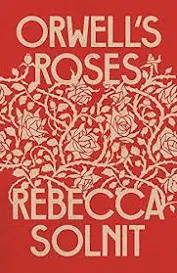
A few years ago, shortly after lockdown, I was browsing in my local bookshop with one of my sons. Knowing my admiration for all things Orwell, he pointed this book out. My initial reaction probably seemed a little churlish (I do hope not, but fear it might have been) – that this felt like the scraping of a barrel. All of Orwell’s primary influences – Empire, class, the BBC, literature, politics etc – have been documented and investigated at length, so here was someone writing about his love of gardening. Gardening might have made it into the top ten of a list of Orwell’s interests, perhaps, but did it tell us anything we didn’t already know about the author, his works and his politics? I hazarded that the answer was no, and decided not to invest the £20 or so that the hardback would have cost me. A second-hand bookshop bargain made the decision a lot easier more recently, but my initial judgment – that this was a really tenuous thesis that it would be hard to sustain – was vindicated. There’s no questioning that the author makes a strong effort in arguing that there was some significant connection between Orwell and floristry, but effort doesn’t equal success in this case. See here for example:
“He (Orwell) went on to classify flowers among hobbies, and hobbies among the characteristics of people who valued liberty and private life, but he had opened a door for a room he hadn’t gone into, or perhaps a door onto something much larger than a room. If you do go through this door marked aesthetics and Orwell, you wander toward the very center of his life’s pursuits. (188).
No you don’t. And even if you do, roses are entirely peripheral to that room/area of interest.
Solnit writes at length about the significance of flowers to our lives. There are times where she seems to forget that the book is supposed to be about Orwell, only dragging him back into the text unconvincingly in chapter-ending summaries. But when she does write about Orwell, particularly in the book’s final chapters looking at the extraordinary productivity at the end of his life, she writes well. It is rewarding to spend time revisiting this period of his life, when he took the bizarre decision to move to Jura with his very young son, shortly after his wife Eileen had died, but carried on writing ferociously. The text ends with a chapter on Orwell’s significance today and she rightly points out that the word Orwellian has a resonance in these times that even words like Shakespearean or Dickensian do not. I was expecting the text’s final peroration to see roses drawn back into the discussion, but I was really pleased to see that in the end this didn’t (and probably couldn’t) happen. Solnit writes so much more interestingly about Orwell when she isn’t struggling to tie his work to her poorly-conceived theme.

