Rosencrantz and Guildenstern are Dead was the answer to a question on University Challenge last month – and that was enough of a reminder that I absolutely loved this play and that I ought to revisit it, especially as I had promised myself that I would read more plays this year. I warmed up by first watching the 1990 Stoppard written and directed version of the play on YouTube. This production took some liberties with the script, but no harm done and I returned to the text looking forward to Stoppard’s wordplay, wit, and intelligence. And I am pleased to say I was not disappointed.
What is that I love about this play so much? First and foremost it’s the simple brilliance of the whole conceit. Telling the story of two minor characters who feature in Hamlet with not much more than walk-on parts, trying to understand their motivation, to explain how they come to betray their childhood friend, as well as providing a drama in its own right throws new light on Hamlet itself. We see key sections of the play in a totally fresh way. Take for example the scene where R&G are trying to work out why Hamlet is so out of sorts. In asking for their help Claudius says
“Something have you heard Of Hamlet’s transformation, so call it, Sith nor th’exterior nor inward man Resembles that it was. What it should be, More than his father’s death, that thus hath put him, So much from th’understanding of himself, I cannot dream of.”
R&G chew this over and come to the following conclusion:
ROS: “To sum up: your father, whom you love, dies, you are his heir, you come back to find that hardly was the corpse cold before his young brother popped on to his throne and into his sheets, thereby offending both legal and natural practice. Now, why exactly you behaving in this extraordinary manner?”
Hamlet is such an extraordinarily strong play that it can survive being carved apart like this and still emerge the stronger. You don’t need an intimate knowledge of Hamlet to appreciate R&G though. Some of the humour and in particular the clowning in the play is brilliantly, effortlessly, done.
“What’s the first thing you remember?”
“No, it’s no good, it’s gone.”
I haven’t indicated in the quote above who says what line because the confusion between the characters’ identities – which is Rosencrantz and which Guildenstern – is one of the many running gaps through the play, picking up on hints in the original text that this was Shakespeare’s intention. Of course the characters are differentiated – Rosencrantz is consistently the more stupid and innocent of the two – but their often muddled identities underlines the point that their lives are of such little value to Hamlet, to Claudius, and to Shakespeare.
The play obviously owes a debt to Waiting for Godot – two characters on an almost bare stage passing time waiting for something to happen. Beckett breaks the tension with the arrival of Pozzo and Lucky; Stoppard achieves the same effect with the larger scale arrival of the players. These are another set of characters with small (but critical) parts in Hamlet given expanded roles here. Stoppard speculates on the lives of itinerant players struggling through hard times and hints at their having to resort to prostitution. It’s never said explicitly but these scenes always make me think that Stoppard was commenting on Shakespeare’s life as a player prior to his writing taking off, especially during the plague years when the company would need to go on the road to stay in business. Stoppard sees this as a hard life, which no doubt it was. Despite these hardships the players retain a dignity and pride in their performances.
Between their brief appearances in the main play, off-stage as it were, Rosencrantz and Guildenstern find ways to pass the time. When the play opens they are playing heads or tail. Guildenstern tosses a coin; Rosencrantz wins if it is heads, which it is every time:
GUIL spins. ROS studies coin. ROS: Heads. (He picks it up and puts it in his money bag. The process is repeated.) Heads. (Again.) ROS: Heads. (Again.) Heads. (Again.) Heads. GUIL (flipping a coin): There is an art to the building up of suspense.
(This is one of many artful breaches of the fourth wall that greatly add to the humour of the play).
As the run of heads continues improbably into three figures, Rosencrantz is simply delighted with his run of good luck, but Guildenstern becomes increasingly troubled by the implications of what is happening. It becomes an existential threat to his existence and sense of self:
GUIL: It must be indicative of something, besides the redistribution of wealth. (He muses.) List of possible explanations. One: I’m willing it. Inside where nothing shows, I’m the essence of a man spinning double-headed coins, and betting against himself in private atonement for an unremembered past. (He spins a coin at ROS.) ROS: Heads. GUIL: Two: time has stopped dead, and a single experience of one coin being spun once has been repeated ninety times… (He flips a coin, looks at it, tosses it to ROS.) On the whole, doubtful. Three: divine intervention, that is to say, a good turn from above concerning him, cf. children of Israel, or retribution from above concerning me, cf. Lot’s wife. Four: a spectacular vindication of the principle that each individual coin spun individually (he spins one) is as likely to come down heads as tails and therefore should cause no surprise that each individual time it does. (It does. He tosses it to ROS.)
This scene is a tour de force of writing, a spectacular piece of craftsmanship which it must be a delight to perform. Stoppard is playing lightly with ideas of determinism and fate. This combination of light comedic touches with the discussion of philosophical ideas – why are we here, is there some force determining our fate or is the world just random? – is an incredibly difficult tightrope to walk, but Stoppard pulls it off with apparent ease.
“A weaker man might be moved to re-examine his faith, if in nothing else at least in the law of probability”
I recognise this has become more of an appreciation than a review, but this is a great play that remains fresh and vibrant. It doesn’t really need a ‘what happens’ review because the clue is in the title! Stoppard went on to write plays that were more successful and more critically lauded, but I don’t think he wrote anything better.
The Old Man and the Sea is the story of an epic struggle between an old fisherman and a huge marlin. Thus starts every review ever written of The Old Man and the Sea and who am I to break with tradition. The novella is short and because it has been seen as a representative sample of Hemingway’s prose, the text is commonly taught in schools and is therefore arguably his best known work. Partly for this reason, and partly because of Hemingway’s status as one of America’s most important novelists, the book comes weighted down with a burden of analysis long before the reader opens the pages. Every detail and nuance is overloaded with interpretation to the extent that the merits of the story itself can be lost.
Which would be a pity because at its heart this is the simplest of stories. Santiago, a Cuban fisherman, is suffering a run of bad luck and is not catching any fish. Things are so bad that the parents of his apprentice Manolin have made him leave the old man and go to work in another boat. The relationship between the old man and the boy is touching and gentle, with Manolin caring for the old man while at the same time allowing him to retain his self-respect. He admires his wisdom and his indefatigability. They share an interest in American baseball which allows them to bond outside the daily struggle for subsistence.
The heart of the story focusses on the day Santiago’s luck turns, when he catches a massive fish. The detail of the catch consumes more than half of the narrative, with the struggle to land the fish being described in intimate and totally believable, immersive detail. The reader shares the old man’s fight with the marlin, confident that his wisdom and experience will help him win. And eventually he does, killing the marlin with a harpoon after a three day battle. But this is where his problems come into focus, because the fish is so huge that he cannot bring it aboard his small fishing boat. He is three days away from the shore, with very few resources, and very little chance of bringing his catch home. It would be worth a lot of money were he to be able to get it into harbour, but the boost to his reputation as a fisherman is just as important. He ties the fish to the side of his boat and heads for home.
Inevitably the blood trail in the water attracts sharks. A series of attacks follow and while Santiago does his best to fight them off, the end result is unavoidable, and the fish is all but lost, with only the skeleton, head, and tail remaining. Santiago finally makes it back to the shore and stumbles back to his shack. His catch, or what remains of it, causes amazement among the fishermen when they arrive for work in the morning. The scale of the fish is obvious and Santiago’s reputation is restored. The novel ends with the old man being cared for by his young, newly-returned apprentice.
This is a simple and engrossing story which assumes the symbolic weight of its narrative effortlessly. Hemingway doesn’t have to point out that this is a tale about the struggles we face in life and how to overcome them, nor the pointlessness of it all at the end of the day, but it is the struggle itself which is worthwhile. His admiration for the fishermen of this community is self-evident, the way they work together, respect one another and value the experience that comes with old age. The story played a significant part in Hemingway being awarded the 1954 Nobel prize for Literature, and rightly so. The citation said he was being given the award “for his mastery of the art of narrative, most recently demonstrated in The Old Man and the Sea, and for the influence that he has exerted on contemporary style”. This is a reference to that fact that Hemingway was feted for his bare, stripped down narrative style. While this is certainly a feature of this novella, it does not dominate the text – one doesn’t read the story looking for all the missing adverbs and descriptions, marvelling at the economy of the prose. The novella’s ending is never really in any doubt – we know Santiago’s luck will change, but also that it will not be as simple as ‘old man catches fish’. I read quite a bit of Hemingway in years gone past (prior to the blog) and I am not sure this was enough to take me back to the longer works, given how many unread novels there are out there – but this novella fully deserves its reputation as one of the great American short stories.
“After dinner I sat and waited for Pyle in my room over the rue Catinat; he had said “I’ll be with you at latest by ten”, and when midnight struck I couldn’t stay quiet any longer and went down into the street.”
Over the years, in recognition of his reputation as one of England’s greatest novelists, I have read several novels by Graham Greene – Our Man in Havana, Brighton Rock; The End of the Affair; The Third Man; and Dr Fischer of Geneva – with the aim of finding out for myself what entitled him to that status. All are impressive in their own way. Brighton Rock is a chilling portrait of a psychopath; The Third Man is an outstanding detective story, and so on – but none of them have struck me as being anywhere nearly as impressive (while still being very distinctively by Greene) as The Quiet American.
The short (less than 180 pages) novel is set in mid-1950’s Vietnam. At this time the origins of the Vietnam War were developing, with the French colonial rulers struggling to impose order upon a growing Communist insurgency and their American allies slowly being dragged into the conflict. The narrative contains an account of the domino theory which came to dominate American foreign policy for decades. If you are not familiar with this theory it argues that one country ‘lost’ to communism would lead to others in the region falling to communism like a row of toppling dominos.
“They want enough rice, I said. They don’t want to be shot at. They want one day to be much the same as another. They don’t want our white skins around telling them what they want.”
“If Indo-China goes…”
“I know the record. Siam goes. Malaya goes. Indonesia goes.”
Narrated in the first person by the cynical and aging English journalist Thomas Fowler, The QuietAmerican tells the story of a love triangle between Fowler, his much younger Vietnamese mistress Phuong, and a naive American ‘economic attaché’, Alden Pyle. Through this story Greene challenges the American involvement in Vietnam and eerily predicts the future course of the conflict. Greene’s was a war correspondent for The Times and Le Figaro in French Indochina 1951–1954 and the novel is clearly based on this experience, with his point of view being closely identified with his narrator, Fowler. The novel is told in flashback, with Fowler recalling his brief relationship with Pyle before the latter is murdered by insurgents.
It becomes clear very early on in the novel that Pyle is a CIA agent organising support for a local right-wing militia, seen by the American as a useful third force in opposition to the communists.
Fowler has a live-in lover, Phuong, who is only 20 years old and was previously an exotic dancer. Phuong has an ambitious sister who intend to arrange a marriage for Phuong to a Westerner. She originally thought that Fowler might marry Phuong, but he is already married. His wife back in the UK is a staunch Catholic unprepared to consider divorce, despite his record of infidelity. Pyle falls immediately in love with Phuong and asks Fowler to give her up, promising he will give her everything he, Fowler, cannot. At the same time Fowler’s editor asks him to return to England, offering him a promotion. Despite the American offering much more than Fowler can, Phuong chooses to stay with the Englishman. Pyle, always attempting to be ‘honourable’ withdraws and tries to make himself scarce. But he and Fowler are thrown together once again when they end up in a guard tower outside Saigon under attack from the insurgents. Pyle saves Fowler’s life much to his irritation. Back in Saigon, injured but recovering, Fowler lies to Phuong that his wife has agreed to a divorce. When this lie is exposed Phuong moves out an in with Pyle, realising that Fowler is never going to marry her.
The novel’s climax comes when the evidence pointing to Pyle’s involvement in a attack killing civilians becomes undeniable. Pyle attempts to justify his support for General Thé, commander of the ‘third force’ behind these attacks, explaining his theories about what is best for the Vietnamese. As a journalist, Fowler has some trusted contacts with the Viet Minh, predecesors of the Viet Cong, one of whom approach him asking for his tacit help in ending Pyle’s support for General Thé. He realises, but does not admit to himself, that this most likely means Pyle will be murdered. He goes through with the arrangement, and the result is already known. Despite his involvement, even culpability, Fowler manages to be angry at Pyle’s death, telling the American Economic Attache “They killed him because he was too innocent to live. He was young and ignorant and silly and he got involved. He had no more of a notion than any of you what the whole affair’s about, and you gave him money and York Harding’s books on the East and said “Go ahead. Win the East for Democracy”.
This was a devastating portrait of American involvement in Vietnam, extraordinarily prescient, predicting the whole course of the war. No wonder the book was seen as anti-American – it certainly isn’t sympathetic to the US. Greene obviously wrote from bitter experience. As a political statement the novel is powerful, but it succeeds on a number of other levels. The description of how women are treated in 1950’s Saigon is depressing. Phuong’s relationship with Fowler is predominantly commercial – he looks after her financially, with the implied promise of future support, and she is return allows him access to her body. She is a step above the prostitutes working the streets of Saigon or at the House of the Five Hundred Girls, shown fighting desperately for ‘business’ – but she is treated little better by the Americans. Granger, the obnoxious journalist working as part of the press corps in Vietnam, asks of Fowler’s relationship with Phuong:
“Where’d he find her? You got to be careful in this town.” He added gloomily “Thank God for penicillin”. Later he describes her as “a piece of tail”, even though it is clear that her relationship with Fowler is more than that of client and prostitute. Fowler’s narration portrays Phuong as docile and interested only in gossip about the British Royal family. He sees other Vietnamese women purely as sex objects:
“Up the street came the lovely flat figures – the white silk trousers, the long tight jackets in pink and mauve patterns slit up the thigh.”
The Quiet American is taut, precise, atmospheric, and chillingly prescient. In Fowler, Greene has created a complex, flawed, and in many ways unpleasant anti-hero with whom the reader cannot help but identify, despite his culpability in Pyle’s murder. Highly recommended.
“Yes, of course, if it’s fine tomorrow,” said Mrs. Ramsay. “But you’ll have to be up with the lark,” she added.”
The narrative style of To the Lighthouse is usually described as ‘stream of consciousness’. While there is no strict definition of this term, it struck me while reading the novel that this term is not quite right. Stream of consciousness, as demonstrated by Molly Bloom at the end of Ulysses for example, is a direct representation of the thoughts of the character in the first person. (“Yes, I said yes, I will, yes” etc). Whereas To the Lighthouse has an omniscient narrator who sits on the shoulders of Woolf’s characters and transcribes their thoughts in the third person. Normally this transcription is unfiltered and may as well be in the first person, but very occasionally the narrator interprets or passes comment on the character’s thoughts and feelings. The representation of consciousness is one of the most striking features of this novel – thoughts are chaotic, easily interrupted or distracted, and sometimes include intrusive or unwelcome. But the narrator is always there, inserting a slight distance between the character and the narrative. Take for example the opening paragraph of chapter 12. The narrator is watching Mrs Ramsay and her husband, and describes what they do as well as what they think:
“She folded the green shawl about her shoulders. She took his arm. His beauty was so great, she said, beginning to speak of Kennedy the gardener, at once he was so awfully handsome, that she couldn’t dismiss him. There was a ladder against the greenhouse, and little lumps of putty stuck about, for they were beginning to mend the greenhouse. Yes, but as she strolled along with her husband, she felt that that particular source of worry had been placed. She had it on the tip of her tongue to say, as they strolled, “It’ll cost fifty pounds,” but instead, for her heart failed her about money, she talked about Jasper shooting birds, and he said, at once, soothing her instantly, that it was natural in a boy, and he trusted he would find better ways of amusing himself before long. Her husband was so sensible, so just. And so she said, “Yes; all children go through stages,” and began considering the dahlias in the big bed, and wondering what about next year’s flowers, and had he heard the children’s nickname for Charles Tansley, she asked. The atheist, they called him, the little atheist. “
It is Mrs Ramsay who thinks her husband is sensible and just, not the narrator, but the slim distance between the two perspectives is important. Crucially it allows the point of view to flit between characters, so within a few lines of this paragraph the narrative is assumed by Mr Ramsay, a much more introspective, internally focussed point of view. What the narrator does not do is step away from the characters’ thoughts and provide any exposition. We are thrown into the middle of the Ramsay family holiday without being told who the family members are, who are their guests and servants, their occupations, or indeed anything to provide us with context. Who are these people? Slowly, through the narration and the conversation the reader is able to piece together an overview of the setting. The Ramsays are a large middle-class family on holiday in the Isle of Skye in Scotland. As well as their eight children they have several house-guests and a number of domestic servants. The house is on the coast and overlooks a bay where a large lighthouse is situated. Some of the children want to take a boat-trip out to the lighthouse the following day, but it is a long and rough journey and cannot happen unless the weather is fine, which it usually isn’t. Mr. Ramsay—a professor of philosophy—harshly tells the children the trip will be impossible.
In the first, longest section of the novel, the Ramsays are hosting a diverse group of intellectuals and artists at their holiday home. The narrative focuses on a single day during which Mrs Ramsay match-makes between her guests, reads her youngest son, James, a story, flatters the ego of her grumpy husband, and floats around the house noticing things. In the evening a grand dinner is served (more on which below) and the day ends with Mr and Mrs Ramsay reading alongside one another but failing to connect or communicate. The sketch is predominantly autobiographical – Mrs Ramsay is thinly-disguised a portrait of Woolf’s mother who died when Woolf was only 11, and was obviously deeply missed. To the Lighthouse is in many ways Woolf’s way of exorcising her grief at the loss of her mother.
The second, much shorter section of the novel, “Time Passes” was described by Woolf as a corridor between the The Window, set before the first World War, and The Lighthouse, the third section of the novel set some ten years later. The holiday home is viewed through the eyes of the domestic servant employed by the family to act as a caretaker for the house, and when they eventually decide to come back to renovate and clean it. Time Passes is a quite literal description of what happens. In the intervening decade Mrs Ramsay and two of her children die, and the house deteriorates badly in apparent sympathy with the family:
For now had come that moment, that hesitation when dawn trembles and night pauses, when if a feather alight in the scale it will be weighed down. One feather, and the house, sinking, falling, would have turned and pitched downwards to the depths of darkness. In the ruined room, picnickers would have lit their kettles; lovers sought shelter there, lying on the bare boards; and the shepherd stored his dinner on the bricks, and the tramp slept with his coat round him to ward off the cold. Then the roof would have fallen; briars and hemlocks would have blotted out path, step and window; would have grown, unequally but lustily over the mound, until some trespasser, losing his way, could have told only by a red-hot poker among the nettles, or a scrap of china in the hemlock, that here once some one had lived; there had been a house.
Here the abandoned home symbolises the state of the nation, damaged to the point of destruction by World War I. In casual, almost brutal parenthesis, the deaths of Mrs Ramsay and two of her children are announced. Alongside so much death in the Great War, in which almost no town, village or family was untouched, these announcements act as reminders of the everyday losses that the country suffered.
[A shell exploded. Twenty or thirty young men were blown up in France, among them Andrew Ramsay, whose death, mercifully, was instantaneous.]
In the final section of the novel, some of the surviving family members and a few former guests return to the reopened summer home. A grieving Mr Ramsay insists that the family must finally complete the long-delayed boat trip to the lighthouse and forces his now-teenage children, James and Cam, to join him. The teenagers deeply resent their father’s tyrannical, mourning behaviour and form a silent pact of resistance against him. The trip to the lighthouse is both an attempt to recover the lost pre-War days which in hindsight seemed so peaceful and to reconnect with his children, who as moody teenagers no longer respect their mourning father. Much of this section of the novel is told from the perspective of Lily Briscoe, one of the original house guests, a painter who sets up her easel in the exact spot she did a decade earlier. Remembering her earlier visit she also mourns for Mrs Ramsay. The novel ends as the fishing boat reaches the lighthouse and they disembark. The lighthouse is a multi-faceted symbol that works in a number of ways during the course of the novel, but here for me represents death or the end of life’s journey.
I wanted to take a closer look at some of the minor characters in To the Lighthouse, more specifically the domestic servants. The cook, Muriel, is first mentioned in chapter 10. Mrs Ramsay is wondering whether some of her house guests have returned from their walk, so she asks one of her children (Cam) to “ask Mildred if Andrew, Miss Doyle, and Mr. Rayley have come back?” She wonders “What message would Cam give the cook?” which tells us, indirectly that Muriel is not a family member or guest but a member of staff, and specifically the cook. Cam returns to tell her “that there was an old woman in the kitchen with very red cheeks, drinking soup out of a basin” whose message is that “”No, they haven’t, and I’ve told Ellen to clear away tea.” Ellen is another servant who is part of the support team that the household relies on but takes for granted. Chapter 10 ends with Mrs Ramsay finishing her reading of a story to James, and “In a moment he would ask her, “Are we going to the Lighthouse?” And she would have to say, “No: not tomorrow; your father says not.” Happily, Mildred came in to fetch them, and the bustle distracted them. But he kept looking back over his shoulder as Mildred carried him out, and she was certain that he was thinking, we are not going to the Lighthouse tomorrow; and she thought, he will remember that all his life.” James is six at this point, a bit old for being carried out by an old woman I would have thought, but this does suggest that Mildred is not just a cook but has child-caring responsibilities as well.
Mildred is next referred to during dinner preparations, where the main dish, a boeuf en daube, is described as “Mildred’s masterpiece”. When this dish is finally served (and there is strong suggestion that the cook has exaggerated its complexity to Mrs Ramsay – it is just a slow cooked stew) Mrs Ramsay accepts her guests praise for the dish without acknowledging Mildred’s hard work:
“an exquisite scent of olives and oil and juice rose from the great brown dish as Marthe (another anonymous servant), with a little flourish, took the cover off. The cook had spent three days over that dish. And she must take great care, Mrs. Ramsay thought, diving into the soft mass, to choose a specially tender piece for William Bankes. And she peered into the dish, with its shiny walls and its confusion of savoury brown and yellow meats and its bay leaves and its wine, and thought, This will celebrate the occasion–a curious sense rising in her, at once freakish and tender, of celebrating a festival, as if two emotions were called up in her, one profound–for what could be more serious than the love of man for woman, what more commanding, more impressive, bearing in its bosom the seeds of death; at the same time these lovers, these people entering into illusion glittering eyed, must be danced round with mockery, decorated with garlands.
“It is a triumph,” said Mr. Bankes, laying his knife down for a moment. He had eaten attentively. It was rich; it was tender. It was perfectly cooked. How did she manage these things in the depths of the country? he asked her. She was a wonderful woman. All his love, all his reverence, had returned; and she knew it.“It is a French recipe of my grandmother’s,” said Mrs. Ramsay, speaking with a ring of great pleasure in her voice.“
Later, after dinner, Mrs Ramsay wanders ethereally away from her guests to go and check on the children.
“She turned the handle, firmly, lest it should squeak, and went in, pursing her lips slightly, as if to remind herself that she must not speak aloud. But directly she came in she saw, with annoyance, that the precaution was not needed. The children were not asleep. It was most annoying. Mildred should be more careful. There was James wide awake and Cam sitting bolt upright, and Mildred out of bed in her bare feet, and it was almost eleven and they were all talking. What was the matter? It was that horrid skull again. She had told Mildred to move it, but Mildred, of course, had forgotten, and now there was Cam wide awake, and James wide awake quarreling when they ought to have been asleep hours ago. What had possessed Edward to send them this horrid skull? She had been so foolish as to let them nail it up there. It was nailed fast, Mildred said, and Cam couldn’t go to sleep with it in the room, and James screamed if she touched it.”
Cam is the youngest Ramsay daughter, at seven only a year older than her brother James. In this home (at least) they share a bedroom. Mrs Ramsay is annoyed with Mildred “out of bed and in her bare feet” because the children are not asleep. So as well as being the family cook, we can infer that Mildred is directly responsible for putting the children to bed. I doubt she sleeps in the same room as them, so the fact she is ‘out of bed’ suggests she has heard the children arguing and has got up to try and calm them down, when Mrs Ramsay walks in and blames her for the children’s misbehaviour and arguing. This reveals a contemptuous attitude towards a senior member of staff, which is compounded by the comment that Mildred “of course” had forgotten to move the skull. The ‘of course’ suggests Mrs Ramsay expects to be disappointed by her servants, as if Mildred hasn’t been busy cooking a stew for three days! Later in this paragraph Mildred explains that the skull is nailed fast, making it clear that she had not forgotten about it all, just that she was unable to move it. Of course, no apology is even considered. Servants are there to do as they are told.
The domestic female staff of the Ramsay household are ignored, neglected, taken for granted, disrespected, and under-valued. So what we have to try and work out is whether this is a subtly drawn portrait by Woolf of entitled middle-class people treating their servants – their employees – with a lack of respect, or whether this is a reflection of the way Woolf herself took her family servants for granted. It is a difficult call to make – we have to read the text closely to work out who the servants are (as opposed to the eight children and the various house guests) and Mrs Ramsay’s inner monologue doesn’t really help us. But there is another portrait of a servant in the novel that throws light on this issue. In Time Passes, we are introduced to Mrs McNab. Although she is the family’s housekeeper, she does not merit a mention in The Window. The portrait of her in Time Passes is largely unsympathetic. She walks with a lurch, rolling like a ship at sea. The narrator doesn’t explain why she walks this way, but it could have been caused by rickets, a common condition for working people at the time (particularly Hebridean people with limit access to some foodstuffs) caused by a calcium deficiency. What Woolf’s narrator is noticing is that old servants walk in a ‘funny’ way without considering why. She also ‘leers’ instead of looking directly at things, which we are told is because she is ‘witless’. And as working class people often do (when written by middle-class authors) she sings to herself:
“As she lurched (for she rolled like a ship at sea) and leered (for her eyes fell on nothing directly, but with a sidelong glance that deprecated the scorn and anger of the world–she was witless, she knew it), as she clutched the banisters and hauled herself upstairs and rolled from room to room, she sang.,,, a sound issued from her lips–something that had been gay twenty years before on the stage perhaps, had been hummed and danced to, but now, coming from the toothless, bonneted, care-taking woman, was robbed of meaning, was like the voice of witlessness, humour, persistency itself, trodden down but springing up again, so that as she lurched, dusting, wiping, she seemed to say how it was one long sorrow and trouble, how it was getting up and going to bed again, and bringing things out and putting them away again.”
Not satisfied with patronising and caricaturing this hard-working housekeeper, Woolf continue to denigrate her. She is “bowed down … with weariness…. creaking and groaning on her knees”. Her “sidelong leer which slipped and turned aside even from her own face, and her own sorrows, stood and gaped in the glass, aimlessly smiling”. The narrator attempts to capture Mrs McNab’s thoughts, but for once the attempt falls flat:
“Visions of joy there must have been at the wash-tub, say with her children (yet two had been base-born and one had deserted her), at the public-house, drinking; turning over scraps in her drawers. Some cleavage of the dark there must have been, some channel in the depths of obscurity through which light enough issued to twist her face grinning in the glass and make her, turning to her job again, mumble out the old music hall song….Mrs. McNab continued to drink and gossip as before.”
Even the washer-woman, the narrator speculates, must have some fond memories of her children, even though two of them were illegitimate. A kind interpretation would be that Woolf is here acknowledging that even working class woman, condemned to a life of drudgery and child-bearing, have an internal life, hopes and dreams – but I am not convinced, and that final dismissive summary – “Mrs McNab continued to drink and gossip as before” – makes me wonder whether Woolf really thought of her servants as authentic, valuable human beings. There is evidence to suggest her relationships with her own servants were troubled – see Alison Light’s account in Mrs Woolf and the Servants for example.
I appreciate this aspect of the novel is simply one part and should not be given overdue emphasis. It certainly didn’t spoil the novel for me. But equally I did not want to ignore it, when the more obvious aspects of the novel – the Modernist exploration of consciousness, the complex narrative point of view, and the abundant use of symbolism – have been so thoroughly explored elsewhere. To be fair to Woolf she does not ignore her servant characters completely, as was often the case in earlier novels (see this post for more on the invisibility of servants in nineteenth century novels), they are given names and thoughts, but they are marginalised and disrespected, which is not much better.
After Me Comes the Flood was Sarah Perry’s promising first novel, published two years before her breakthrough work, The Essex Serpent. After Me tells a deceptively simple story: five weeks into a heatwave, the novel’s central character, John Cole, shuts his customer-less London bookshop and sets out to visit his brother on the Norfolk coast. When his car breaks down somewhere in Norfolk, he leaves his car and wanders into a wood where he stumbles upon a large house. Knocking with the intent of asking for help, he is welcomed by the members of the household – strangely it seems he is expected and is welcomed by name. They mystery is quickly explained – this is a group of friends who previously lived together in a mental health clinic nearby and who now look after one another. A new group member with a very similar name to John’s was due to arrive, although has been delayed and John is mistaken for him. He sustains the idea that he is the other John Cole, although there is every indication that the household would have welcomed him if he explained the misunderstanding.
There is a mysterious gothic quality to John’s stay at this house. The residents are introduced slowly, telling how they came to live in this unusual sanctuary. Hester is in her sixties and is the matriarch of the house. John consistently describes her as ugly, saying she appears “poorly assembled, as though she had been put together from left over pieces” (which is a bit mean!). Eve is a pianist; Elijah a former preacher who has lost his faith; Claire and Alex, brother and sister, are childish and childlike (John initially mistakes Claire for a young girl) and finally there’s Walker, an accountant who met the others at the hospital but who was not a patient there. Near the house is a reservoir and Alex is frightened that the bank holding it in place might at some point burst, and that the house will be swept away in the ensuing biblical flood. This threat looms over the rest of the novel increasing the sense of menace.
It would be fair to say that After Me is definitely an atmospheric and character-driven novel, but at the same time not very much happens. The events of the novel, such as they are, are spread over one week, with each chapter representing a day. John gets to know the residents, and slowly gets comfortable with his deceit, reminding himself daily to either tell them the truth or leave, but never quite getting round to doing either. One day the household takes a trip to the coast and Alex briefly goes missing with a young boy he had befriended while playing innocently on the beach. The suspicion cast on him by the boy’s mother throws a shadow over the day and upsets Alex more than the others realise. This is probably the nearest the novel comes to anything that could be described as incident.
Perry’s subsequent novels rest heavily on supernatural themes. Here such things are hinted at but there are naturalistic explanations for all the strangeness John initially encounters. There is also an under-developed theme running through the novel relating to the short Anglo-Saxon poem Wulf and Eadwacer which is never really resolved. We find out who has been sending the poison-pen letters to Alex which have caused him so much distress, but the reasons for the obscure classic illusion remain unclear.
I do have a issue with the novel’s ending. The threatening reservoir looms over the novel like the sword of Damocles and it would have been a shock had it not played a central role in the novel’s resolution. It is hard to resist the impression that having assembled her characters, drawn all the lines between them, and placed them in a moderately interesting setting, Perry was at a loss as to what to do with them all next. The novel’s ending felt far too convenient and obvious, a simple way to bring matters to a close.
I am conscious that I haven’t found anything interesting to say about After Me, which I am disappointed about. But I can’t help wondering whether the problem is mine as a reviewer or the author’s as a novelist. This is after all a novel in which not much happens, the characters are not really engaging and where the ending is very predictable. The prose is perfectly adequate, but I don’t think I can recall a single line or phrase that jumped out and asked to be remembered. If I appeal to the jury of the internet to decide where the problem lies I think it is revealing that on Goodreads this novel has an average reader score of 2.78, by far the lowest score for any of her subsequent novels, and has twice as many one-star reviews as five-star.. Many of those one-stars will have been by disappointed readers of The Essex Serpent looking for more of the same, which is of course a bit unfair. If you have read After Me and found more in it than I managed to find, I would love to hear from you in comments. What am I missing?
This autobiography focuses on Greene’s early life, the years up to the point he married, by which point he had published his three novels. The memoir ends in 1932 when he achieved his first major success as a novelist with Stamboul Train. Most of A Life of Sorts focusses on his in some ways idyllic Edwardian childhood, growing up the son of a headmaster and one of six children in leafy Berkhamstead. This was a life of considerable privilege – at one point Greene reels off a list of servants (although his family were perceived as the poor relations compared to another clan of Greene’s living at the nearby hall). They even had an orchid house! This start in life gave Greene a privileged education, psychotherapy in Harley Street when he threatened to run away from school, private tutors and entrance to Oxford without any of the nonsense about qualifications or suitability (he twice failed to win a scholarship but ‘we still lived in a world of influential friends,’ and the history tutor at Balliol who admitted him was ‘an old pupil and disciple of my father’s’).
At times the narrative is reduced to a simple list of Greene’s likes and dislikes: his childhood hobbies, the qualities most admired in men, favourite pastimes and favourite holiday resorts are all described in detail, without telling us much about the author other than he seemed to have lived an life of luxury. His enormous family are sketched with vivid pen-portraits of the principal characters and Greene takes the opportunity to name-drop the many distinguished and famous people that were a part of or acquainted with his extended family. Like many Edwardians of the upper-middle class Greene could trace his family money back to the Caribbean sugar plantations, which were run on slave labour for centuries. His paternal great-grandfather, Benjamin Greene, was a prominent West India merchant who owned extensive plantations in the Caribbean and held hundreds of enslaved people. He passionately opposed the abolition of slavery in the 1830s and later received substantial government compensation when it was outlawed. Greene never acknowledges the source of this blood money.
Boarding school, even though it was in the same village as his family home, was a dreadful and traumatising experience for Greene. He writes of the indignities and filth of this deeply unhappy period in his life which haunted him into adulthood. The psychological distress is vivid to him forty years later and an obvious trigger for several clumsy suicide attempts. His life of advantage continued after university (where he describes being drunk from morning to night – great training for his chosen career in journalism). A job as a subeditor on the Times falls into his lap with minimum effort. His novels are published without the years of rejection faced by many writers, although Greene is dismissive of the literary merit of his early work.
As well as descriptions of Greene’s childhood, this account contains some ‘teasers’ – glimpses of his future career in espionage. There are some significant omissions from this account as well. His wife is mentioned in passing of the “by this time I had decided to get married” variety. Equally his conversion to Catholicism, which was to play such a significant part in his adult life, is presented almost as administrative decision rather than anything to do with his faith: “I cannot be bothered to remember—I accept. With the approach of death I care less and less about religious truth. One hasn’t long to wait for revelation or darkness.” Despite this Greene still manages to mention a conversation about the supposedly heretical nature of his books with a very tolerant Pope.
I wouldn’t call it a matter of policy, but generally I tend to avoid reading autobiographies. They rarely give a fair portrait of the author, who inevitably presents a partial or distorted view of their life, not necessarily in an attempt to deceive (although that definitely happens) but because they don’t have the necessary distance or perspective. Biographies often give a very different account of the events recorded in autobiographies. To give one obvious example, in this first volume of Greene’s memoirs, his experience of playing Russian roulette features prominently. Greene describes these attempts in detail, suggesting they derived from an attempt to relieve his existential boredom with life: “I remember an extraordinary sense of jubilation, as if carnival lights had been switched on in a dark drab street. My heart knocked in its cage, and life contained an infinite number of possibilities.” But his most recent biographer, Richard Greene (apparently no relation) concluded that “There is no evidence, apart from Graham’s word, that he ever tried to kill himself by playing Russian roulette…it was merely part of Graham’s self-created daredevil myth. His brother, with whom he shared a bedroom, said the revolver had no bullets. Most likely, Graham played the potentially fatal game with blanks or empty chambers.” In other words Greene invented these events, probably as part of the self-mythologising that we all do to a greater or lesser extent. I am sure he genuinely believed that these things happened – his accounts suggests no doubt or ambiguity when it comes to this part of his childhood, although other memories are qualified or even in some cases directly contradicted when he quotes, in footnotes, the clearer memories of others. But it seems equally certain that his memories of these incidents were wrong. Their inclusion in this memoir gives us an insight into how Greene perceived himself – even in his sixties he still nursed his self-image as a wounded survivor.
England, 1939. Grace Allingham, a young, affluent Englishwoman is engaged to be married to Hughie. But when she meets Charles-Edouard de Valhubert, a French Air Force officer, she is swept off her feet, Hughie is dumped unceremoniously and Grace and Charles-Edouard quickly marry. After a brief honeymoon he returns to the war, leaving Grace pregnant but content to wait out the months and years of war for his return. Seven years pass, and when he finally returns to England it is to collect his wife, son and the family nanny and take them back to France, to finally begin married life.
Life in France is not without its challenges. The principal characters of the novel, with the exception of the nannies who look after the children before they are sent off to boarding school, are all upper class if not aristocratic, independently wealthy, who don’t have to work, have multiple houses, staff and spend their summers in Italy. But their relationships are a mess. The comedy of the novel derives largely from stereotypes about English and French aristocrats and their very different lifestyles. The main difference between the countries is their attitude towards infidelity. The French have a ‘laissez-faire’ approach, where affairs are seen as a private matter rather than a moral failure, and even accepted as part of long-term relationships. Charles-Edouard’s problem is that he is a enthusiastic adulterer who seems untroubled by being caught in the act. Eventually Grace realises he is never going to change. She returns to England and divorces him. He is remarkably untroubled by this, continuing with his long-term affairs, confident that his wife will sooner or later see sense and return to him.
As Charles-Edouard is a man-child driven by his libido above all else, it is hardly surprising that his son, Sigi, easily outwits him. Sigi likes his parents being separated – it means that all the potential new husbands and wives in their lives have to seek his approval, and approval means treats. He is spoilt rotten and frustrates Charles-Edouard’s lacklustre attempts to woo his wife into returning to France by simply not delivering his messages. Potential suitors for his mother’s newly available hand are equally easily disposed of given Sigi’s veto over their selection. Balls are attended, afternoon tea is drunk, French properties left unlooted by the Nazis are toured, and of course assignations are conducted more or less in the open. The comedy is dated, and I suspect it felt so even in the early 1950’s when the novel was first published, being more suited to the carefree times of the 20’s and 30’s. I even wonder whether this might have been a returned-to manuscript from the 30’s, updated with scant details of the slightly longer second world war?
The only indication we are in post-war Europe is a short discussion on homosexuality. Dexter, an obnoxious American, (it is almost a given that Americans in novels of this kind are obnoxious) is ranting about the link between homosexuality, which he calls ‘perversion’, and communism. Hughie, who by this point in the novel has overcome his break-up with Grace and is courting Albertine, who is one of Charles-Edouard’s mistresses. replies “But, old thing, they’re not sick. They just happen to like boys better than girls. You can’t blame them for that, it’s awfully inconvenient, and they’d give anything to be different if they could…I probably know more about them than you, having been at Eton and Oxford“. The revelation towards the end of the novel, that Dexter was a Russian spy and life-long communist, further undermines his credibility as a judge of public morality. Other than this brief defence of ‘perversion’ the social attitudes prevalent throughout the novel are those of earlier decades, when the Mitford’s had some relevance beyond historians of English class identities.
I have finally finished this year’s Dickens, Little Dorrit, with what I am embarrassed to admit was a sense of relief! It took me around two months to complete it. As will be obvious, at no point in the nine hundred pages did the novel ever really engage me. There were some characters who were more interesting, but their stories frequently fizzled out and were incomplete. I found the main plot line mechanical and dull, and most of the peripheral characters were two-dimensional. There were one or two elements of the novel that were unexpected, which I will expand upon below, but despite this I found it flawed and disappointing. As is probably too often the case, I am going to devote the bulk of this review to working out why I found it so.
Taking a step back for a moment, why do we read Dickens? It can’t really be for his plots – they are drawn out, driven by the demands of publication by instalment. They usually include hackneyed and repetitive plot devices: profoundly unlikely coincidences, long lost relatives reappearing after decades, lost wills, hidden identities and sudden reversal of fortunes. Little Dorrit has all these tropes and more, assembled in a slightly random order. When the myriad plot lines are resolved at the end of the novel the explanation given is baffling complex and improbable – the reader could never in a million years have worked out what was really going on behind all the subterfuge. Nor, frankly, would they have cared. The events of Little Dorrit pivot (we eventually find out) on a codicil to a will that passes through many hands before ending in those of a blackmailer, but by the time the intentions of the deceased are revealed it has long since ceased to matter.
Or do we read Dickens for his characters? Here the case is stronger – many of his creations live on in popular culture: Fagin, the Artful Dodger, Sam Weller, Mr Micawber and so on. But I would struggle to make this claim for any of the characters in Little Dorrit. The heroine, Amy Dorrit, is a kind and loving daughter, but her relationship with Arthur Clennam, the novel’s hero, if he can be called such, is one of Dickens many rather creepy much older man/young woman relationships which are so problematic in the light of the author’s personal life. Throughout the novel Clennam refers to Amy as ‘my child’, ‘my daughter’, or variations on this idea, and even though their eventual marriage is one of the least surprising events of the novel, it still feels uncomfortable. Of the novel’s other principal characters, the villain, Rigaud, is an appalling caricature, with his satanic smirk and twirling moustache. He is introduced to the reader from the outset as a cynical murderer and he never once shows any redeeming features nor any sign that he is going to defy the role he is cast in. He flits in and out of the narrative occasionally without ever progressing the plot, only to finally re-emerge to meet a grisly if fitting end.
Some of the novel’s minor characters showed more promise. John, the lovelorn junior warden of the Marshalsea pines away for Amy Dorrit with surprising dignity. Daniel Doyce is an entrepreneur who invents a mechanism – we ever never told anything more about it than it is potentially very useful – which is throttled by the bureaucracy of the Circumlocution Office. (In his essay on Dickens, to which I return every time I read anything by the latter, Orwell says “Nothing is queerer than the vagueness with which he speaks of Doyce’s “invention” in Little Dorrit. It is represented as something extremely ingenious and revolutionary, “of great importance to his country and his fellow-creatures”, and it is also an important minor link in the book; yet we are never told what the “invention” is!) Dickens is making a somewhat clumsy point about the dead hand of the Government service upon the spirit of industry and the absence of any effective intellectual property legislation. As the UK was at the height of the industrial revolution at this time, driven by innovation and enterprise, the satire barely lands a blow, despite the effort Dickens put into the portrait. Doyce eventually travels abroad – to Russia no less, which in the 1820’s (the novel’s setting) was not particularly problematic, but in the 1850’s the UK was at war with Russia in the Crimea – to find more rewarding work. There he prospers, only to finally return to London at the novel’s conclusion. We never really find out what happens to him, what his patent was for, whether it was granted, nor whether his new business succeeds (we can infer that it does).
Perhaps my favourite minor character was Flora Finching. Many years earlier she was engaged to be married to Arthur Clennam. His return from working in the far East finds her a widow. She cares for a truculent aunt of her late husband, nurtures a hope that her relationship with Arthur might be rekindled and speaks in a stream of consciousness that is one of the joys of the novel:
My Goodness Arthur! cried Flora, rising to give him a cordial reception, ‘Doyce and Clennam what a start and a surprise for though not far from the machinery and foundry business and surely might be taken sometimes if at no other time about midday when a glass of sherry and a humble sandwich of whatever cold meat in the larder might not come amiss nor taste the worse for being friendly for you know you buy it somewhere and wherever bought a profit must be made or they would never keep a place it stands to reason without a motive still never seen and learnt now not to be expected for as Mr F himself said if seeing is believing not seeing is believing too and when you don’t see you may fully believe you’re not remembered not that I expect you Arthur Doyce and Clennam to remember me why should I for the days are gone but bring another teacup here directly and tell her fresh toast and pray sit near the fire.”
Many reviewers accept that Little Dorrit is a sprawling mess, populated by thinly sketched characters and with a plot that manages to be both predictable and full of improbable coincidences. But “look at the social commentary” we are told. So let’s. The two main targets Dickens takes aim at in the novel are Government bureaucracy, in the form of the Circumlocution Office, and the practice of imprisoning people for debt, in this case in the very personal description of the Marshalsea debtor’s prison (Dickens’ father had served time in the Marshalsea and it clearly had a significant impact on Charles’s childhood. He was forced to leave school at the age of 12 to earn his keep).
The Circumlocution Office, Dickens’s attack on Government bureaucracy, is introduced in Chapter 10, ‘Containing the Whole Science of Government”:
“The Circumlocution Office was (as everybody knows without being told) the most important Department under Government. No public business of any kind could possibly be done at any time without the acquiescence of the Circumlocution Office. Its finger was in the largest public pie, and in the smallest public tart. It was equally impossible to do the plainest right and to undo the plainest wrong without the express authority of the Circumlocution Office. If another Gunpowder Plot had been discovered half an hour before the lighting of the match, nobody would have been justified in saving the parliament until there had been half a score of boards, half a bushel of minutes, several sacks of official memoranda, and a family-vault full of ungrammatical correspondence, on the part of the Circumlocution Office.”
This is just a small part of the description of the operation of the Office – Dickens writes at considerable length about the inefficiency and bloody-mindedness of the people who run the Office purely as a means of lining their own pockets without any consideration for the wider interests of the country. Nepotism is the key driver of this form of government. Reading the descriptions and Clennam’s relentless efforts to navigate the system, first to find a way to have Mr Dorrit released from debtor’s prison, and subsequently to secure a patent for Doyce’s mysterious invention, no-one who has ever struggled with bureaucracy, who has ever been put on hold for hours on end, or who has written countless letters in pursuit of a simple reply, could fail to empathise with the frustration described. Dickens was pushing at an open door here. The Northcote-Trevelyan Report into the operation of Government business had been published in February 1854 and to this day remains the founding document of the British Civil Service, enshrining it with “core values of integrity, propriety, objectivity and appointment on merit, able to transfer its loyalty and expertise from one elected government to the next”. The report accepted that the administration of Government was being crippled “both in internal efficiency and in public estimation”. I am not convinced this is effective satire. It’s taking a swipe at an easy target where the problem has already been recognised and was being addressed. It’s powerfully done, more with a steamroller than a scalpel.
Imprisonment for debt is portrayed as an everyday part of life in Victorian England. You fall into debt, you suffer the consequences. For some that included a lifestyle better than that enjoyed outside the walls of the prison. The reader is left to decide for themselves whether this is a sensible method of collecting money from people who don’t have any. (It is not widely known that while the 1869 Debtors’ Act largely abolished prison as a sanction for non-payment of debt in the UK, the Judgment Summons procedure still exists and includes imprisonment as a possible if little used sanction available to the Court:
” A judgment summons is an application by a creditor under s 5 of the Debtors Act 1869 requiring the debtor to attend court in circumstances where payment is due under an outstanding debt. If the creditor can prove to the satisfaction of the court, beyond reasonable doubt, that (a) the debtor either has or has had since the date of the original order or judgment the means to pay the sum owing under the original order or judgment and (b) has refused or neglected to pay, or refuses or neglects to pay, the debtor may be committed to prison for a period of up to six weeks or until payment of the sum which is owing.”)
Did Dickens’ portrait of the Marshalsea lead to the passage of the Debtors Act (which largely removed imprisonment as a sanction for debt)? I think we take it for granted that the answer to the question is largely yes, even if the impact of Little Dorrit was more to create a general perception that debtors’ prisons were cruel and ineffective, rather than leading directly to the reform legislation itself. It’s worth noting incidentally that the Marshalsea had closed in 1842, long before Little Dorrit was published (as Dickens explicitly acknowledges). I think this might be worth a deep dive one day, because I fear the truth might be more complicated. We know Dickens hated debtors’ prisons, because of what happened to his family and the impact it had on the trajectory of his own life. But if you take that out of the equation, is the portrait of the Marshalsea that harsh? Is being locked up there as bad as being in a criminal prison? To be honest, life in the Marshalsea actually seems quite comfortable. The warders are polite to the prisoners and happy to run them errands, rather than brutalising them. Perhaps this needs a separate post – were Victorian debtors prisons really that bad? (And if they were, why does Dickens make them sounds so bearable?)
It is usually fairly obvious in what overall direction Dickens’ novels are heading. But I got one thing seriously wrong in my anticipation of the plot of Little Dorrit. At the end of the first book, Mr Dorrit, having been locked away in the Marshalsea for decades, is, through the efforts of Clennam and Mr Pancks, discovered to be heir to a large fortune. We are told no more about it than that – he is going to inherit lots of money. I thought at this point that fate would intervene to prevent him from ever receiving his inheritance – most likely that he would die just before the will passes Probate, delayed by the incompetence or malevolence of the Circumlocution Office. But surprisingly no, it all goes completely smoothly and he leaves the Marshalsea with his head held high, spending most of the rest of the novel with his family and a vast entourage in Venice and Rome, trying all the while to bury his ignominious past. He is haunted by any suggestion that he was once a debtor, and takes offence at the slightest imaginary suggestion of his former life. He is accepted into this new strata of society without hesitation – his money is as good as anyone’s. Dickens seems to suggest that a life of wealth has parallels with the Dorrit’s former life of poverty, constrained as both were by society’s expectations. I am not so sure this point lands – spending one’s life on holiday without any restrictions on what one can buy or do seems pretty nice compared to the Marshalsea of Bleeding Heart Yard.
The novel’s meandering predictable plot, its unlovable or unbelievable characters, its ineffective satire and loose threads, illuminated only occasionally by flashes of humour, probably explain why Little Dorrit ranks below many of Dickens great novels. At least in my totally unscientific ranking system anyway!
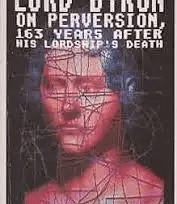
Conversations with Lord Byron on perversion 163 years after his Lordship’s death by Amanda Prantera, 1987
This novel is very much a curiosity. With only three Goodreads reviews and now out of print, you may struggle to get hold of a copy. The reference to perversion in the title is misleading – there are no discussions about any form of sexual deviancy, unless homosexuality was considered such in 1987, (which it wasn’t) and it feels as if it was included as a cynical effort to increase sales. But the main interest of the novel is its very early but also quite advanced discussion of what we now term Artificial Intelligence.
Lord Byron was an interesting figure. His in part self-created reputation as a legendary seducer of women caused him to be a scandalous figure in early nineteenth century English society. Inoculated to an extent from the full consequences of his actions by his aristocratic status, he nevertheless broke a lot of taboos, and eventually had to leave the country. His poetry was arguably less successful than his seduction technique and his readership nowadays is largely restricted to university syllabuses. But he is an excellent choice for the central character of a novel about AI. Prantera imagines a computer programme in which every known piece of information about Byron’s life and works is entered into a database to create a simulation of his Lordship’s consciousness. The research team set up to develop the program then go on to interrogate it, hoping it will connect its fragments of information in new ways, thereby providing answers to academic puzzles about Byron’s life – particularly his romantic life – such as whether he wrote his love poems “To Thyrza” to his Cambridge friend John Edleston.
Predictably the program develops a consciousness close to Byron’s own, Its interior monologue forms much of the second part of the novel, its voice imitating Byron’s memoirs and letters. His time at Cambridge is the focus of this ‘memory’, and a potential explanation of his enigmatic relationship with Edleston is developed. Edleston is initially presented to the reader as an angelic voiced young chorister, who falls in love with the older (but still young, only 17) more experienced Byron. Tempted, Byron resists any sexual contact with Edleston seemingly repulsed by the idea of homosexual sex. Finally he can resist no longer and it is at this point that the novel’s ‘big’ secret is revealed – like many attractive young men in fiction before him (for example virtually all of Shakespeare’s comedies) Edleston is a young woman disguised as a boy! As the novel hints at several points that Edleston has a secret which would relieve Byron of his homosexual hesitation, this comes as no surprise whatsoever. The opportunity to write about a trans or bisexual character is thrown away – this is simply a disguise used by a privileged aristocrat/minor royal in order to have fun at an all-male university, nothing to do with sexual identity. Byron had no reason to worry about his sexual orientation – he was only attracted to Edleston because (s)he was a girl all along, not because he was in any way sexually confused. This of course does a disservice to same-sex attracted people and in particular to the transgressive Byron himself.
What of the novel’s discussion of artificial intelligence? Surprisingly it was quite accurate in its fundamental concepts – load the computer with as much data as possible and then leave it to start making connections itself. The computer used in the research programme has an algorithm which learns through its interactions with the operators, finding patterns to simulate a characterisation of Byron’s intelligence and personality. The layering of different personality traits and characteristics for the programme is strongly reminiscent of the neural networks used today in AI in which layers of “neurons” are used for complex tasks such as image and speech recognition. It also has a Natural Language Processing facility which allows it to understand and generate human language, very much in the way that chatbots and voice assistants work today. The only dated aspect of this portrait of a very early AI is the fact that every output from the programme needs to be printed out and photocopied in order to be studied by the researchers. But apart from that this was a very interesting insight into how AI was seen in the 1980’s and how little, surprisingly, it has progressed since then, even if it has moved from the pages of fiction into the real world. When compared to the almost unfailing inaccuracy of the typical prediction of the development of technology from this period, which anticipated we would all be travelling in flying cars and eating our meals in pill form, it feels spot on.
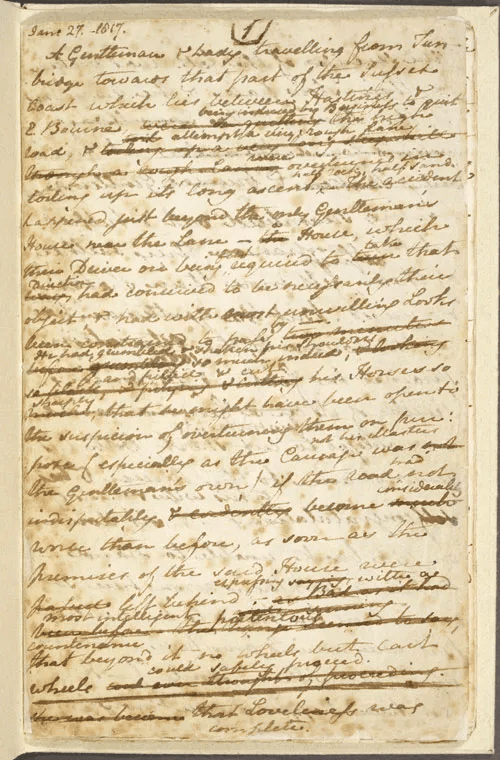
The third of the Austen novel fragments I have been reading recently is her last, incomplete work, Sanditon, written in the months prior to her tragically early death in 1817. As with the other fragments (The Watsonsand Lady Susan) the interest of the text lies more in its composition than its status as a story. As such we have the advantage of the original draft (see below) with all its revisions and hesitations. You can see the manuscript online here. Someone has kindly transcribed the manuscript amendments and all, showing every change Austen made. We can see the creative process at work. Only twelve chapters long, the manuscript shows that Austen edited as she wrote – rather than writing the full text then going back to the beginning and editing, she has made substantial changes to each page. This would have meant that once complete the manuscript would have been largely ready for type-setting and publication.
The novel fragment focuses on Charlotte Heywood, one of the daughters of the Heywood family from Willingden, Sussex. The narrative opens in uncharacteristically dramatic fashion when the carriage of Mr and Mrs Parker of Sanditon crashes near the Heywood home. Mr Parker is slightly injured in the crash, and very kindly the Heywoods offer hospitality to the Parkers for two weeks until his ankle is healed. Mr Parker is what we would now think of as a property developer – he has ambitious plans to transform Sanditon, a fishing village, into a fashionable seaside resort. Once his foot is healed the Parkers return to Sanditon, taking Charlotte with them as their guest. This is in part a return of the hospitality shown them by the Heywoods, but it is also possible Mr Parker wants to show off Sanditon to as many people as possible.
The residents of Sanditon are introduced in familiar slightly breathless Austen fashion. Lady Denham, a twice-widowed woman who received a fortune from her first husband and a title from her second, lives here with her niece Clara Brereton, as does Sir Edward Denham and his sister Esther, nephew and niece to Lady Denham by her second husband. The Parkers are joined by two of Mr Parker’s sisters, his younger brother, Arthur, and finally his middle brother Sidney. There are indications that Austen planned to call this novel ‘The Brothers’ which some critics have interpreted as a potential shift of focus to a more male perspective. We will never know if that was going to be the case, but the extant chapters are all firmly written through Charlotte’s eyes as she meets this dazzling array of new characters. The whole Parker family appears to be part of the enterprise to develop Sanditon. News of a wealthy family from the Caribbean arriving shortly in the town and a girls school intending to relocate to the coast causes a stir, although it soon becomes apparent that these two parties are one and the same. The new arrivals consist of Miss Lambe, a teenaged Antiguan-English heiress, whom Austen describes as ‘half-mulatto’ and the two Miss Beauforts, English girls just arrived from the West Indies.
It is striking how complex this cast of characters is in so few chapters. Relationships between the eligible young people both planned and actual are suggested and as with the other fragmentary novels it is possible to speculate with some confidence the direction the novel was heading.
In addition to the speculation about the extent to which the novel’s original title was to be its focus, critics have also pointed to several other departures from Austen’s standard template. Sanditon, a speculative property development, is clearly going to be the novel’s primary location, and there is little to compare it to in the rest of the canon. It’s not a stately home (c.f. Mansfield Park, Northanger Abbey) but a commercial enterprise. The ambitious Parker family, looking to profit from the sea-bathing enthusiasm of Regency Britain, don’t really have any parallels in Austen’s other stories. And the introduction of a mixed race character is also a departure for Austen. We see very little of Miss Lambe in the novel, but she is intriguing:
“Mrs. Griffiths … supported herself by receiving such great girls and young ladies as wanted either masters for finishing their education or a home for beginning their displays. She had several more under her care than the three who were now come to Sanditon, but the others all happened to be absent. Of these three, and indeed of all, Miss Lambe was beyond comparison the most important and precious, as she paid in proportion to her fortune. She was about seventeen, half mulatto, chilly and tender, had a maid of her own, was to have the best room in the lodgings, and was always of the first consequence in every plan of Mrs. Griffiths.”
Miss Lambe’s mixed race is clearly no objection to acceptance into Georgian society, and Lady Denham immediately starts to plan her engagement to her nephew by marriage, Sir Edward. It would have been fascinating to see how Austen handled this sensitive issue.
Austen was an extraordinary, subtle and skilful novelist, with a profound understanding of human nature and a wonderful sense of humour. There are plenty of flashes of her brilliance in this fragment. She has a lot of mischievous fun in describing the self-identified invalid Arthur Parker for example. It is in paragraphs such as this that we see glimpses of the author’s authentic voice. It opens with Arthur describing his health:
“I am very nervous. To say the truth, nerves are the worst part of my complaints in my opinion. My sisters think me bilious, but I doubt it.”
“You are quite in the right to doubt it as long as you possibly can, I am sure.”
“If I were bilious,” he continued, “you know, wine would disagree with me, but it always does me good. The more wine I drink in moderation the better I am. I am always best of an evening. If you had seen me today before dinner, you would have thought me a very poor creature.”
Charlotte could believe it. She kept her countenance, however, and said, “As far as I can understand what nervous complaints are, I have a great idea of the efficacy of air and exercise for them—daily, regular exercise—and I should recommend rather more of it to you than I suspect you are in the habit of taking.”
“Oh, I am very fond of exercise myself,” he replied, “and I mean to walk a great deal while I am here, if the weather is temperate. I shall be out every morning before breakfast and take several turns upon the Terrace, and you will often see me at Trafalgar House.”
“But you do not call a walk to Trafalgar House much exercise?”
“Not as to mere distance, but the hill is so steep! Walking up that hill, in the middle of the day, would throw me into such a perspiration! You would see me all in a bath by the time I got there! I am very subject to perspiration, and there cannot be a surer sign of nervousness.”
They were now advancing so deep in physics, that Charlotte viewed the entrance of the servant with the tea things as a very fortunate interruption.