Book review

The British Museum is Falling Down by David Lodge 

This novella is a comic pastiche of James Joyce’s Ulysses. That makes it sound more substantial than it actually is. Lodge was flexing his literary muscles as a professor of English literature here, and he did so by inserting throughout the novel a series of literary references. Ten distinct sections of the novel are written in the style of a range of authors including Conrad, Woolf and Kafka. I would argue that these actually add little to the novel overall. In other words there’s an element of showing off here, where the reader might be vaguely aware that the novel’s style has shifted and that they should be getting the joke, (the Kafka and the Joyce sections are unmissable; the others less so) but uncomfortably aware that they are failing the test being set by the much cleverer than them author.
Strip away the contrived literary references and this is simply a straightforward mid-sixties comic novel on that most sixties of themes, sex. Adam Appleby, a father of three and a student of English literature spends a single day failing to do any work at the British Museum (not) researching his thesis “The Structure of Long Sentences in Three Modern English Novels”. Instead he gets into a series of what it is hard to avoid calling ‘scrapes’ familiar to anyone who watched British sitcoms (especially those, ironically, from the 1970s) – he accidentally calls the fire brigade out to a non-existent fire at the museum, he is the subject of an attempted seduction by a frustrated seventeen year-old virgin (a common experience for the male subjects of English post-war comic novels), he gets drunk at a cocktail party, and his scooter bursts into flames. The scene where he tries to buy some condoms but can’t do so because his priest enters the medical appliances shop at precisely the wrong moment is appallingly cliched. Throughout the novel Appleby, a thinly disguised avatar for the author, is haunted by the fear that his wife is pregnant with their fourth child, because being Roman Catholics and this being before the widespread availability of the pill, they are forbidden from using any but the most unreliable methods of contraception. This leaves Appleby permanently frustrated and at the same time petrified that their personal complicated game of Vatican Roulette has been lost once again.

As well as the explicit references to other authors, there are some strong echoes of Kingsley Amis here. The ‘seduction’ scenes is an obvious example. Appleby’s persistent worries about money and the way these are resolved by the intervention of a wealthy American at the end of the novel was strongly reminiscent of the way Amis concludes Lucky Jim. The getting inappropriately drunk at a party scene, the ‘seduction’ scene, and the many petty minor frustrations of academic life, all echo the earlier Amis novel. So yes, in a nutshell, this is heavily derivative, so much so that by the end their is no attempt to disguise Lodge’s borrowing, and it is simply chalked up as pastiche.

In many ways this is a very typical mid-Sixties comic novel, but what sets it apart are Lodge’s literary pretentions. And in case you were wondering, no, the title doesn’t make sense – Lodge explains in an afterword written for a 1980 reprinting that he had originally wanted to call the novel “The British Museum Had Lost Its Charm” but as this is a quote from a Gershwin song and he couldn’t get permission to use it, the alternative title had to be used. There is a clearly late addition to the text to explain the alternative title he ended up using, with its reference to London Bridge, which Lodge may have got away with if he hadn’t written about the original title in the afterword.
The British Museum is Falling Down, by David Lodge, 1965

Aside
Book review

Changing Places, by David Lodge, 1975

Although Changing Places was written in 1975, it is set in 1969, and those six years are significant. The events of the novel take place in parallel on campuses in England and America, and the spirit of the sixties is abroad in both. Protest and counter-culture are in the air. By 1975 Nixon was out of the White House, the Vietnam War was coming to an ignominious end, the Beatles had split up and flower power was a distant memory.

To an extent this made Changing Places anachronistic even when it was published. It was looking back nostalgically at a period in time which was very close but also gone for good. That anachronism has inevitably widened over time. Professors sleeping with their students and one another’s wives may have been the height of liberation in the sixties – today it just looks creepy.

The novel is a classic trading places situation comedy. Two English professors, mild-mannered Philip Swallow, and charismatic American Morris Zapp, swap roles in their respective universities, thinly disguised versions of Birmingham, UK and Berkeley, California. They find themselves in very unfamiliar territory both academically and socially and much of the novel’s humour derives from their struggles in their new environments in traditional fish out of water manner. Both men almost inevitably have affairs while on their academic sabbaticals; more surprising is their involvement in the student protests that sweep their campuses. While Swallow finds himself accidentally involved in the demonstrations, Zapp is well-suited to his role as mediator between students and faculty.

Lodge has fun with the format of the novel, at one point continuing the narrative through news headlines and stories and later using a screenplay format. This serves to keep the story fresh and moves it along at pace. A significant time jump two thirds of the way through, moving quickly past some of the events that had been sign-posted and are now seen in hindsight, adds to the sense of pace. The novel ends with the two couples convened in a New York hotel room trying to decide their fates. The author has fun with the idea first articulated in Northanger Abbey that the reader knows the novel is coming to a close (and therefore a resolution of any outstanding plot points) by the “tell-tale compression of the pages” but chooses instead to leave issued unresolved – until the sequel of course.

The acid test for any comic novel has to be ‘is it funny?’. The quote on the front cover of the edition I read (shown above) has a comparison to Lucky Jim, a novel that I think has largely fallen out of fashion in recent years and is now equally anachronistic. There was a time when the Kingsley Amis novel would have been in my top ten novels list, but it hasn’t aged well. I think a more interesting comparison would be with Malcolm Bradbury’s The History Man which was published in the same year as Changing Places and which takes a much more unblinking, less affectionate look at British academic life. Is Changing Places funny? It’s mildly amusing, nothing more; the satire is so gentle as to be hardly noticeable. I now need to decide whether to read the sequel, with a nagging suspicion that it might simply be more of the same. Only one way to find out I suppose.

Changing Places, by David Lodge, 1975

Aside
Book review

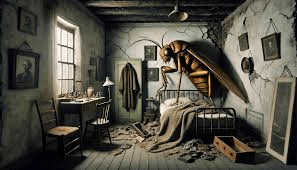
The Metamorphosis by Franz Kafka, 1915

Is there a better, more striking opening to a novel than this?

One morning, when Gregor Samsa woke from troubled dreams, he found himself transformed in his bed into a horrible vermin*. He lay on his armour-like back, and if he lifted his head a little he could see his brown belly, slightly domed and divided by arches into stiff sections. The bedding was hardly able to cover it and seemed ready to slide off any moment. His many legs, pitifully thin compared with the size of the rest of him, waved about helplessly as he looked.

The Metamorphosis is wonderfully enigmatic. Of course the reader is invited to consider the story as an allegory about difference, but everyone will see it from their own perspective. For some it will be about how we treat the disabled, for others about race, gender, sexuality or religion. Its ambiguity is its strength, leaving the reader to interpret and reinterpret it without the constraints of simplistic X = Y parallels.

This is a powerful story in which not a word is wasted. Consider that opening line and the reference to waking from ‘troubled dreams‘ – did Gregor’s transformation cause the troubled dreams, or were the dreams the origins of his transformation?

Gregor Samsa is a travelling textile salesman, bullied by his boss and unable to leave his miserable job because of debts owed by his parents, with whom he lives. We know very little about Gregor other than at one point he was in the army – “On the wall exactly opposite there was photograph of Gregor when he was a lieutenant in the army, his sword in his hand and a carefree smile on his face as he called forth respect for his uniform and bearing“, which is obviously a dramatic contrast with his life as a travelling salesman, and even more so after his metamorphosis. He has made a sad attempt to brighten his room up by cutting a picture from a magazine and framing it: “It showed a lady fitted out with a fur hat and fur boa who sat upright, raising a heavy fur muff that covered the whole of her lower arm towards the viewer.” Perhaps this is being fanciful, but could it be that the three-fold repetition of the word ‘fur’ suggests this woman has undergone her own transformation? Change, metamorphosis, isn’t always a bad thing, it implies. We also see this idea at the end of the novel (novel not being the completely correct term – The Metamorphosis is barely fifty pages long) when after Gregor’s death, Grete, his younger sister, begins her own metamorphosis:

All the time, Grete was becoming livelier. With all the worry they had been having of late her cheeks had become pale, but, while they were talking, Mr. and Mrs. Samsa were struck, almost simultaneously, with the thought of how their daughter was blossoming into a well built and beautiful young lady. They became quieter. Just from each other’s glance and almost without knowing it they agreed that it would soon be time to find a good man for her. And, as if in confirmation of their new dreams and good intentions, as soon as they reached their destination Grete was the first to get up and stretch out her young body.

Gregor’s father is also transformed by the end of the novel, changing from the redundant aging tyrant of the opening chapters to something far more respectable and impressive:

He was standing up straight enough now; dressed in a smart blue uniform with gold buttons, the sort worn by the employees at the banking institute; above the high, stiff collar of the coat his strong double-chin emerged; under the bushy eyebrows, his piercing, dark eyes looked out fresh and alert; his normally unkempt white hair was combed down painfully close to his scalp. He took his cap, with its gold monogram from, probably, some bank, and threw it in an arc right across the room onto the sofa, put his hands in his trouser pockets, pushing back the bottom of his long uniform coat, and, with look of determination, walked towards Gregor.

The point of view of the narrator in this paragraph is interesting. The fact that the narrator recognises Mr Samsa senior’s uniform as coming from “probably, some bank” suggests this is Gregor’s perspective – an omniscient narrator would know which bank the uniform is from. This is not the consistent viewpoint, but often we see things through Gregor’s eyes.

His initial reaction to his metamorphosis is quite phlegmatic – he decides to go back to sleep and (despite the fact we have just been told his transformation is not a dream) thinks to himself “How about if I sleep a little bit longer and forget all this nonsense” The dawning realisation that this is not nonsense at all, this is happening, is not narrated in the text – the reader is left to work gradually through that process themselves. We wait page after page for some explanation of Gregor’s situation, but it never comes. Instead we read in vivid detail about what it would be like to be a monstrous insect:

Hardly aware of what he was doing other than a slight feeling of shame, he hurried under the couch. It pressed down on his back a little, and he was no longer able to lift his head, but he nonetheless felt immediately at ease and his only regret was that his body was too broad to get it all underneath. He spent the whole night there. Some of the time he passed in a light sleep, although he frequently woke from it in alarm because of his hunger, and some of the time was spent in worries and vague hopes which, however, always led to the same conclusion: for the time being he must remain calm, he must show patience and the greatest consideration so that his family could bear the unpleasantness that he, in his present condition, was forced to impose on them.

Always thinking about his family, he gradually comes to terms with the changed world he is confronted by:

Out of consideration for his parents, Gregor wanted to avoid being seen at the window during the day, the few square metres of the floor did not give him much room to crawl about, it was hard to just lie quietly through the night, his food soon stopped giving him any pleasure at all, and so, to entertain himself, he got into the habit of crawling up and down the walls and ceiling.

The Metamorphosis is a powerful, disturbing book. it is available free online and can be read in little more than an hour. It’s also a great introduction to the dark, troubling world of Franz Kafka, who I think is rightly regarded as one of the twentieth century’s greatest writers.

*This translation – ‘horrible vermin‘ – is a bit literal for my tastes. Other translations are available. Wikipedia tells me that the phrase “ungeheuren Ungeziefer”, describing the creature into which Gregor metamorphoses, has been translated many different ways. These include:

  • gigantic insect
  • monstrous kind of vermin
  • monstrous vermin
  • giant bug
  • monstrous insect
  • enormous bug
  • gargantuan pest
  • monstrous cockroach
  • monstrous verminous bug
  • a vile insect, one of gigantic proportions
  • some kind of monstrous vermin
  • some sort of monstrous insect
  • some kind of monstrous bedbug
  • huge verminous insect
  • a kind of giant bug

The Metamorphosis by Franz Kafka, 1915

Aside
Book review

Short stories by Robert Louis Stevenson: The Body-Snatcher, A Lodging for the Night, Markheim, Thrawn Janet & The Misadventures of John Nicholson

These stories were included in the Vintage edition of Dr Jekyll and Mr Hyde (and other stories), which I finally got round to reading several years after the event. (That is, I read the short stories long after having read Dr Jekyll). To what extent they were ‘padding’ to make the original novella into a fuller length text, or were stories worth republishing in their own right, is something I will consider in this review.

The website devoted to all aspects of Stevenson’s life and works, (‘The RLS website) says

“Stevenson has an important place in the history of the short story in the British Isles: the form had been elaborated and developed in America, France and Russia from the mid-19th century, but it was Stevenson who initiated the British tradition.”

Which is a bold claim when you think about the short stories and novellas Dickens wrote, to give just one example. The site also claims that many of his stories:

“have an affinity with the Strange Case of Dr Jekyll and Mr Hyde in their setting in the labyrinthine modern city, and the subject matter of crimes and guilty secrets involving respectable members of society.” 

The Body-Snatcher is definitely one such dark, gothic tale. The title tells you almost all you need to know – it is set in Edinburgh at the time of the Burke and Hare murders when corpses were in such demand for dissection by medical students that grave robbing become common-place and eventually led to murder to provide more bodies. The story is told from the perspective of a laboratory assistant who unwittingly becomes embroiled in the cadaver trade. The story’s climax comes on a ubiquitously dark and stormy night when a corpse is robbed from a remote country churchyard and supernatural events intervene. It’s a classic horror story that must have chilled Stevenson’s Victorian audience and would make a highly atmospheric radio play.

A Lodging for the Night, subtitled A Story of Francis Villon is another gothic morality tale. Rather far-fetched claims have been made by some critics that this story can be precisely identified as the first modern version of the genre – I have to say that sounds implausible. There’s nothing dramatically original about the form or content. The story opens with the narrator describing a snow-covered Parisian night in 1456. Francis Villon, a poet is drinking and gambling in a small cabin in the grounds of a cemetery with a few friends. While Villon tries to compose a poem, the gambling turns sour and one of the participants is stabbed and murdered. His corpse is robbed and although Villon apparently had no part in the murder he takes his share of the robbery. He flees into the night, but not before his purse is stolen, leaving him destitute. He eventually seeks refuge in a stranger’s home. The remainder of the story is a protracted exchange between the amoral Villon and his host, a former knight who lives by a strict code of conduct. When Villon finally leaves he appears to have learnt nothing from his host.

Markheim is set in a pawn shop. The titular character visits to buy a gift but when the opportunity arises he murders the pawnbroker with a view to stealing from him. While he tries to decide what to do next, someone enters the house, looks briefly into the room Markheim and the body are in, “looked at him, nodded and smiled as if in friendly recognition, and withdrew again.” Markheim cries out, and the stranger returns, asking “Did you call me?”. Again the rest of the story is an exchange between this other-worldly visitor and the murderer. The visitor offers to tell Markheim where the pawnbroker’s money can be found. It soon becomes clear that he knows all about Markheim’s descent into criminality, and has no faith in his ability to change the course of his life. He even offers to help him escape when the pawnbroker’s maid returns home unexpectedly early. But there is wonderful twist in the tale which I won’t spoil for you. This is a genuinely innovative story that subverts the readers expectations without a hint of sentimentality. It’s the gem of the collection.

Thrawn Janet is written in a broad Scottish dialect, and I have to admit at times I struggled with the language. It is not that it is impenetrable. In sentences such as “There was Janet … wi’ her neck thrawn … like a body that has been hangit, and a girn on her face like an unstreakit corp. ” most of the language is conventional English words, and others are simply transliteration of other everyday terms – “hangit” for “hanged”, “corp” for “corpse”, and so on. There are occasional words that need to be looked up – thrawn means twisted for example – but usually the sense is clear. (There is incidentally a version of the story available on the internet ‘translated’ into English, which seems a bit unnecessary!). Janet is housekeeper to a young Scottish preacher. The local people suspect her of being a witch. When they try to prove it by dunking her in the local pond, the preacher intervenes and makes her publicly swear she is not in league with the devil. From that point, Janet’s appearance is changed – twisted neck like someone who has been hanged. Later, after meeting a strange “black man” (the implication being this is the devil), the preacher finds Janet hanging dead in her room. As with Markheim, the supernatural is portrayed as being a tangible and real presence in people’s lives.

The collection ends with what is conventionally known as a shaggy dog story, although I can’t be sure it was conceived as such. The Misadventures of John Nicholson has the eponymous central character go through a series of mishaps, but always ends up on his feet, able to rely on either dumb luck or his family to bail him out. Even though his implicated in at least two series robberies and a murder, he walks away without any series consequences. It’s a weak ending to the collection with no gothic elements, a loose narrative structure and not much point.

So were these stories just padding, or are they worth reading in their own right? Yes and no. Dr Jekyll is such a powerful story because it has something to say about the nature of humanity, civilisation, and the duality of good and evil. It’s also a genuinely interesting story. Some of these shorter stories have interesting insights into similar issues. Clearly none have the same impact as Dr Jekyll, and some are disappointingly predictable, others, particularly Markheim with its clever subversion of the reader’s expectations, are definitely worth reading in their own right rather than simply as companion texts.

Short stories by Robert Louis Stevenson

Aside
Book review

Orwell, A Man of our Time, by Richard Bradford, 2020

I can’t remember ever having so passionately agreed with the central premise of a book before – yet also found myself profoundly disagreeing with many of the conclusions the author draws. I know that might sound like a slightly artificial opinion adopted to make a good opening line to a blog post, but I mean it. (I’d rather be honest than interesting, although ideally I’d like to be both of course!).

Bradford’s thesis is summed up in the book’s subtitle – Orwell is a Man of Our Time. In other words his work has an immediate relevance to the 2020’s – to the era of Trump, Brexit, social media and the ever intrusive state. And that’s utterly unarguable – of course he does. Orwell has in many ways shaped the way we see the world. That’s why the media manages to find a dozen things a day ‘Orwellian’, from facial recognition software to social media cancel culture. So here’s the first problem – this thesis has already been written. In 2002 Christopher Hitchens wrote Why Orwell Matters adopting the same format as Bradford, or rather anticipating it, demonstrating vividly Orwell’s continuing relevance. Although Bradford has written in more detail than Hitchens, and obviously included more recent material, fundamentally the point has already been made, far more convincingly. (If you prefer there is a short YouTube video of a speech Hitchens made that covers his key points. I disagree with much of what he says – he argues that Orwell died of poverty, which is simply nonsense, and he has nothing to say about Orwell’s defining characteristic, his Englishness, but he is entertaining and persuasive).

There’s a second equally obvious problem with the biographical structure that Bradford adopts. He goes through Orwell’s life in the manner of a traditional biography and gives equal space to his childhood and early novels compared to for example his final great works. If you are trying to trace the origins of (say) Animal Farm in Orwell’s time at the village store in Wallington, fair enough, but that immediately begins to stray from the declared intention of the book, to demonstrate Orwell’s continuing relevance. I would argue (as Orwell himself does, in Why I Write) that his work really only begins to be distinctively in his voice after the Spanish Civil War. Almost everything before that is of minor interest only (I would exclude the Down a Mine section of Wigan Pier). Putting it another way, if that sniper’s bullet that bisected his throat in 1937 had been centimetres to the left or right, we would never have heard the term “Orwellian”. The biographical structure of this book therefore means that we spend a long time waiting for the main event, the major two novels and the classic political essays of the 1940’s, and that some earlier parts of the text feel like ‘filler’.

(Just a quick aside on the term Orwellian. It seems to me it is used in three distinct ways nowadays. Increasingly the first application has come to predominate – to describe totalitarian behaviour by the state or the agents of the state, particularly through the use of technology. Facebook’s algorithms are Orwellian, automatic number plate recognition is Orwellian, etc. The second use is in the ironic commentary on official language, referencing the slogans of Oceania – appointing a Minister for Brexit Benefits was quintessentially Orwellian. Finally, and this is more rare nowadays, is the use of the term to describe writing in Orwell’s distinctive style – as he famously put it in the essay just referenced, “Good prose is like a windowpane”. )

Bradford often strays from his original concept. Instead of demonstrating Orwell’s relevance to contemporary events, (‘our time’) he instead finds parallels between incidents in Orwell’s life and things that happened later. Oswald Mosley is compared to Nigel Farage, for example, a perfectly fair comparison but nothing to do with Orwell. Conditions in mines in the 1930’s were hard, as recorded in The Road to Wigan Pier, but in the 1980’s miners in the UK went on strike to save their jobs – again hard to argue with, although the two things are barely connected with one another let alone Orwell. Where Bradford’s argument nears breaking point is in his apparently preposterous claim that Orwell’s ‘foresaw Brexit‘. That might seem ridiculous given that the EU didn’t exist before Orwell died in 1950, but surprisingly Bradford does a good job of defending this point. Orwell thought a lot about what the world would look like after the end of the second world war and in a world dominated by nuclear weapons. He lived just long enough to see the beginning of the end of Empire and new post-war political and military structures emerge, one of which was likely to be a form of united Europe. IN the event such a body was created, Britain’s role in it would be uncertain. It is not much of a leap to imagine Orwell’s understanding of colonialism, imperialism and nationalism all coming together to predict Brexit. In England Your England (1941) for example, Orwell wrote about “the famous ‘insularity’ and ‘xenophobia’ of the English, and in 1947 recorded anti-Polish sentiment very similar to the prejudices that drove Brexit. Orwell also foresaw that it would be in America’s commercial interests to weaken a centralised United States of Europe.

Unfortunately, for every worthwhile observation there are far too many misses, irrelevancies or demonstrations of the author’s own prejudices. The television cook Hugh Fearnley Whittingstall is bizarrely attacked for no apparent reason than he went to Eton. Anti-Semitism within the Labour Party is bafflingly compared to the two-minute hate in 1984. Jacques Derrida’s syntax is attacked as overly complex, and claimed to be an example of something Orwellian, I am not quite sure what given that Newspeak was defined by its lack of complexity. The book’s analysis ends with a scattergun critique of Boris Johnson, Trump, Jeremy Corbyn’s Labour, political correctness, wokeism, cancel culture in universities, deconstructionism, and last but not least Islam.

There are some errors in this text, or at least things that I found debateable, although I make no pretence of authority on the issue. First, Bradford says that Orwell spent a year at Wellington college before going on to Eton (page 17) – Taylor’s far more authoritative work says he was there for just nine weeks (page 60). In his discussion on homelessness as presented in Orwell’s work Bradford appears to believe that anyone using the ‘tuppenny hangovers’ (the cheapest place to sleep, resting over a rope) were at risk from arrest under the Vagrancy Act because they were outside, which is simply incorrect. He later describes Orwell’s voice as indicating “irredeemable boredom and monotony” without acknowledging that no recordings of Orwell’s voice can be found. To give one final example Bradford criticises China’s one-child policy, citing it as an unexplained example of the state attempting to control the private lives of the citizenry (and being therefore Orwellian) without giving a moment’s thought to the famine in China less than a decade earlier which lead to the deaths by starvation of millions of people (https://en.wikipedia.org/wiki/Great_Chinese_Famine).

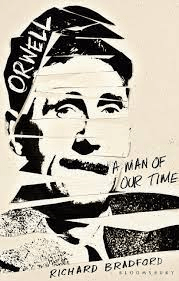
This might be a bit clumsy, but I found this edition’s front cover strangely apposite. It is illustrated (see above) with a print of Orwell’s head and shoulders, cut into segments then partially reassembled, leaving his face crooked and askew. In a way that is what Bradford has done with Orwell’s life work – he has broken them down into different constituent parts and then poorly reassembled them.

Orwell, A Man of Our Time, by Richard Bradford, 2020

Aside