
Changing Places, by David Lodge, 1975
Although Changing Places was written in 1975, it is set in 1969, and those six years are significant. The events of the novel take place in parallel on campuses in England and America, and the spirit of the sixties is abroad in both. Protest and counter-culture are in the air. By 1975 Nixon was out of the White House, the Vietnam War was coming to an ignominious end, the Beatles had split up and flower power was a distant memory.
To an extent this made Changing Places anachronistic even when it was published. It was looking back nostalgically at a period in time which was very close but also gone for good. That anachronism has inevitably widened over time. Professors sleeping with their students and one another’s wives may have been the height of liberation in the sixties – today it just looks creepy.
The novel is a classic trading places situation comedy. Two English professors, mild-mannered Philip Swallow, and charismatic American Morris Zapp, swap roles in their respective universities, thinly disguised versions of Birmingham, UK and Berkeley, California. They find themselves in very unfamiliar territory both academically and socially and much of the novel’s humour derives from their struggles in their new environments in traditional fish out of water manner. Both men almost inevitably have affairs while on their academic sabbaticals; more surprising is their involvement in the student protests that sweep their campuses. While Swallow finds himself accidentally involved in the demonstrations, Zapp is well-suited to his role as mediator between students and faculty.
Lodge has fun with the format of the novel, at one point continuing the narrative through news headlines and stories and later using a screenplay format. This serves to keep the story fresh and moves it along at pace. A significant time jump two thirds of the way through, moving quickly past some of the events that had been sign-posted and are now seen in hindsight, adds to the sense of pace. The novel ends with the two couples convened in a New York hotel room trying to decide their fates. The author has fun with the idea first articulated in Northanger Abbey that the reader knows the novel is coming to a close (and therefore a resolution of any outstanding plot points) by the “tell-tale compression of the pages” but chooses instead to leave issued unresolved – until the sequel of course.
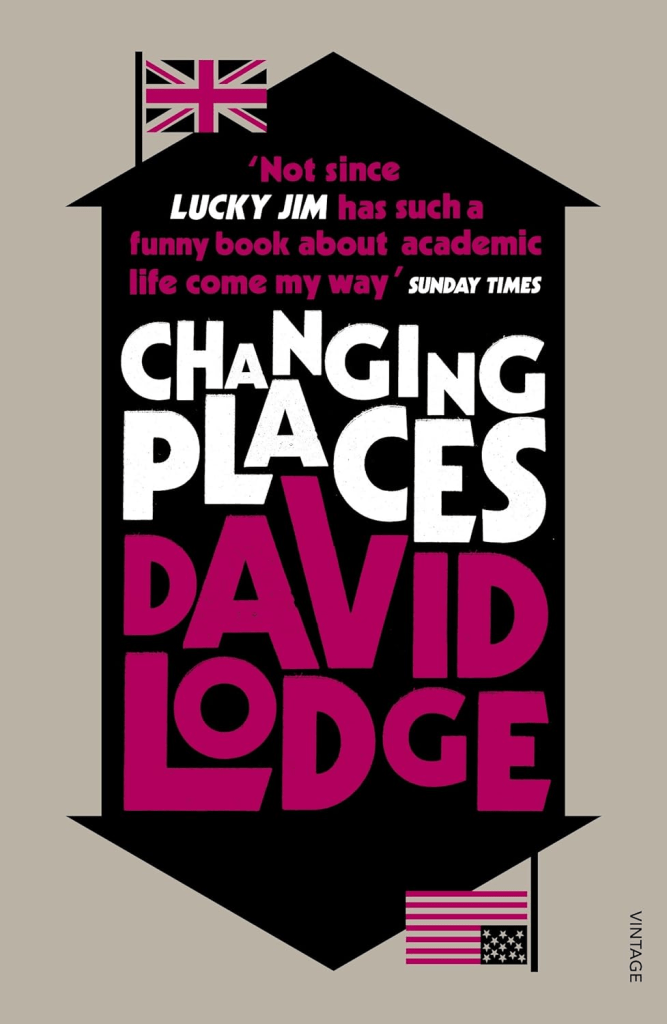
The acid test for any comic novel has to be ‘is it funny?’. The quote on the front cover of the edition I read (shown above) has a comparison to Lucky Jim, a novel that I think has largely fallen out of fashion in recent years and is now equally anachronistic. There was a time when the Kingsley Amis novel would have been in my top ten novels list, but it hasn’t aged well. I think a more interesting comparison would be with Malcolm Bradbury’s The History Man which was published in the same year as Changing Places and which takes a much more unblinking, less affectionate look at British academic life. Is Changing Places funny? It’s mildly amusing, nothing more; the satire is so gentle as to be hardly noticeable. I now need to decide whether to read the sequel, with a nagging suspicion that it might simply be more of the same. Only one way to find out I suppose.

