
A Life of Sorts, by Graham Greene, 1971
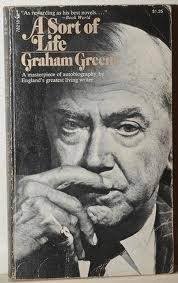
This autobiography focuses on Greene’s early life, the years up to the point he married, by which point he had published his three novels. The memoir ends in 1932 when he achieved his first major success as a novelist with Stamboul Train. Most of A Life of Sorts focusses on his in some ways idyllic Edwardian childhood, growing up the son of a headmaster and one of six children in leafy Berkhamstead. This was a life of considerable privilege – at one point Greene reels off a list of servants (although his family were perceived as the poor relations compared to another clan of Greene’s living at the nearby hall). They even had an orchid house! This start in life gave Greene a privileged education, psychotherapy in Harley Street when he threatened to run away from school, private tutors and entrance to Oxford without any of the nonsense about qualifications or suitability (he twice failed to win a scholarship but ‘we still lived in a world of influential friends,’ and the history tutor at Balliol who admitted him was ‘an old pupil and disciple of my father’s’).
At times the narrative is reduced to a simple list of Greene’s likes and dislikes: his childhood hobbies, the qualities most admired in men, favourite pastimes and favourite holiday resorts are all described in detail, without telling us much about the author other than he seemed to have lived an life of luxury. His enormous family are sketched with vivid pen-portraits of the principal characters and Greene takes the opportunity to name-drop the many distinguished and famous people that were a part of or acquainted with his extended family. Like many Edwardians of the upper-middle class Greene could trace his family money back to the Caribbean sugar plantations, which were run on slave labour for centuries. His paternal great-grandfather, Benjamin Greene, was a prominent West India merchant who owned extensive plantations in the Caribbean and held hundreds of enslaved people. He passionately opposed the abolition of slavery in the 1830s and later received substantial government compensation when it was outlawed. Greene never acknowledges the source of this blood money.
Boarding school, even though it was in the same village as his family home, was a dreadful and traumatising experience for Greene. He writes of the indignities and filth of this deeply unhappy period in his life which haunted him into adulthood. The psychological distress is vivid to him forty years later and an obvious trigger for several clumsy suicide attempts. His life of advantage continued after university (where he describes being drunk from morning to night – great training for his chosen career in journalism). A job as a subeditor on the Times falls into his lap with minimum effort. His novels are published without the years of rejection faced by many writers, although Greene is dismissive of the literary merit of his early work.
As well as descriptions of Greene’s childhood, this account contains some ‘teasers’ – glimpses of his future career in espionage. There are some significant omissions from this account as well. His wife is mentioned in passing of the “by this time I had decided to get married” variety. Equally his conversion to Catholicism, which was to play such a significant part in his adult life, is presented almost as administrative decision rather than anything to do with his faith: “I cannot be bothered to remember—I accept. With the approach of death I care less and less about religious truth. One hasn’t long to wait for revelation or darkness.” Despite this Greene still manages to mention a conversation about the supposedly heretical nature of his books with a very tolerant Pope.
I wouldn’t call it a matter of policy, but generally I tend to avoid reading autobiographies. They rarely give a fair portrait of the author, who inevitably presents a partial or distorted view of their life, not necessarily in an attempt to deceive (although that definitely happens) but because they don’t have the necessary distance or perspective. Biographies often give a very different account of the events recorded in autobiographies. To give one obvious example, in this first volume of Greene’s memoirs, his experience of playing Russian roulette features prominently. Greene describes these attempts in detail, suggesting they derived from an attempt to relieve his existential boredom with life: “I remember an extraordinary sense of jubilation, as if carnival lights had been switched on in a dark drab street. My heart knocked in its cage, and life contained an infinite number of possibilities.” But his most recent biographer, Richard Greene (apparently no relation) concluded that “There is no evidence, apart from Graham’s word, that he ever tried to kill himself by playing Russian roulette…it was merely part of Graham’s self-created daredevil myth. His brother, with whom he shared a bedroom, said the revolver had no bullets. Most likely, Graham played the potentially fatal game with blanks or empty chambers.” In other words Greene invented these events, probably as part of the self-mythologising that we all do to a greater or lesser extent. I am sure he genuinely believed that these things happened – his accounts suggests no doubt or ambiguity when it comes to this part of his childhood, although other memories are qualified or even in some cases directly contradicted when he quotes, in footnotes, the clearer memories of others. But it seems equally certain that his memories of these incidents were wrong. Their inclusion in this memoir gives us an insight into how Greene perceived himself – even in his sixties he still nursed his self-image as a wounded survivor.

