
Conversations with Lord Byron on perversion 163 years after his Lordship’s death by Amanda Prantera, 1987
This novel is very much a curiosity. With only three Goodreads reviews and now out of print, you may struggle to get hold of a copy. The reference to perversion in the title is misleading – there are no discussions about any form of sexual deviancy, unless homosexuality was considered such in 1987, (which it wasn’t) and it feels as if it was included as a cynical effort to increase sales. But the main interest of the novel is its very early but also quite advanced discussion of what we now term Artificial Intelligence.
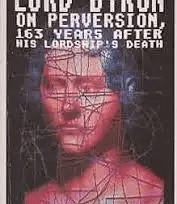
Lord Byron was an interesting figure. His in part self-created reputation as a legendary seducer of women caused him to be a scandalous figure in early nineteenth century English society. Inoculated to an extent from the full consequences of his actions by his aristocratic status, he nevertheless broke a lot of taboos, and eventually had to leave the country. His poetry was arguably less successful than his seduction technique and his readership nowadays is largely restricted to university syllabuses. But he is an excellent choice for the central character of a novel about AI. Prantera imagines a computer programme in which every known piece of information about Byron’s life and works is entered into a database to create a simulation of his Lordship’s consciousness. The research team set up to develop the program then go on to interrogate it, hoping it will connect its fragments of information in new ways, thereby providing answers to academic puzzles about Byron’s life – particularly his romantic life – such as whether he wrote his love poems “To Thyrza” to his Cambridge friend John Edleston.
Predictably the program develops a consciousness close to Byron’s own, Its interior monologue forms much of the second part of the novel, its voice imitating Byron’s memoirs and letters. His time at Cambridge is the focus of this ‘memory’, and a potential explanation of his enigmatic relationship with Edleston is developed. Edleston is initially presented to the reader as an angelic voiced young chorister, who falls in love with the older (but still young, only 17) more experienced Byron. Tempted, Byron resists any sexual contact with Edleston seemingly repulsed by the idea of homosexual sex. Finally he can resist no longer and it is at this point that the novel’s ‘big’ secret is revealed – like many attractive young men in fiction before him (for example virtually all of Shakespeare’s comedies) Edleston is a young woman disguised as a boy! As the novel hints at several points that Edleston has a secret which would relieve Byron of his homosexual hesitation, this comes as no surprise whatsoever. The opportunity to write about a trans or bisexual character is thrown away – this is simply a disguise used by a privileged aristocrat/minor royal in order to have fun at an all-male university, nothing to do with sexual identity. Byron had no reason to worry about his sexual orientation – he was only attracted to Edleston because (s)he was a girl all along, not because he was in any way sexually confused. This of course does a disservice to same-sex attracted people and in particular to the transgressive Byron himself.
What of the novel’s discussion of artificial intelligence? Surprisingly it was quite accurate in its fundamental concepts – load the computer with as much data as possible and then leave it to start making connections itself. The computer used in the research programme has an algorithm which learns through its interactions with the operators, finding patterns to simulate a characterisation of Byron’s intelligence and personality. The layering of different personality traits and characteristics for the programme is strongly reminiscent of the neural networks used today in AI in which layers of “neurons” are used for complex tasks such as image and speech recognition. It also has a Natural Language Processing facility which allows it to understand and generate human language, very much in the way that chatbots and voice assistants work today. The only dated aspect of this portrait of a very early AI is the fact that every output from the programme needs to be printed out and photocopied in order to be studied by the researchers. But apart from that this was a very interesting insight into how AI was seen in the 1980’s and how little, surprisingly, it has progressed since then, even if it has moved from the pages of fiction into the real world. When compared to the almost unfailing inaccuracy of the typical prediction of the development of technology from this period, which anticipated we would all be travelling in flying cars and eating our meals in pill form, it feels spot on.

