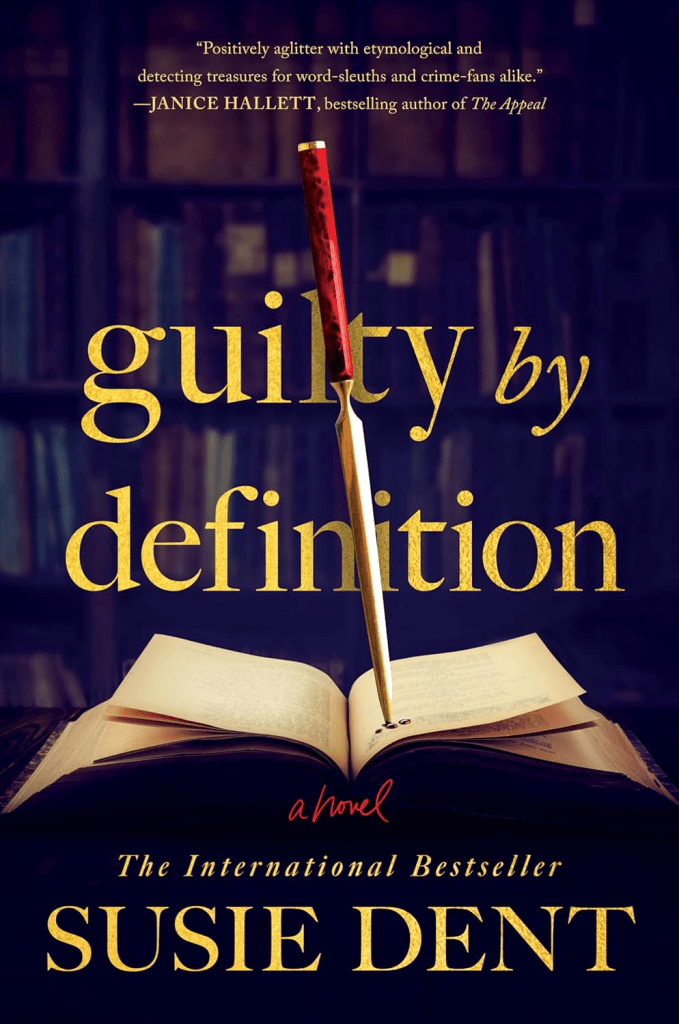
If you had to guess what a novel by tv’s lexicographer Susie Dent would be about I think most people would assume that it would be a) in the cosy crime genre, b) feature a main character who is a lexicographer, or a related profession, and c) involve word puzzles and clues that lead to the resolution of the mystery. And the author obviously hates to disappoint her audience, because that is exactly what she has produced. I was expecting the novel to be a lazy, genre-driven cash-in on the author’s public persona (of which there are many out there at the moment) but I am delighted to say it was so much better than that. There are still some predictable elements, of course, including the loving descriptions of academic Oxford, the word puzzles, and the short chapters that keep the pages turning. But these are more than compensated for by the high quality writing and the well constructed plot.
Set in Oxford and featuring a team of lexicographers working for the Clarendon English Dictionary, the setting and structure of Guilty by Definition also provides the author with plenty of opportunities to weave into the text anecdotes about the origins of words and phrases, keeping the fans of Countdown and Dictionary Corner satisfied. These word-related anecdotes are sometimes rather obviously shoe-horned into the narrative (often something about a word or phrase will just occur to the narrator and have to be explained) but I think Dent just about keeps on the right side of this not being irritating or distracting.
The plot follows Martha Thornhill, senior editor of the Clarendon English Dictionary. She and her team seems to have gloriously relaxed jobs tracing the origins of words and phrases. Also working for the CED but not part of Martha’s team is Jonathan Overton, a Shakespeare expert who has published widely on the bard’s coinages and who is a minor media celebrity. One day they receive a letter from an anonymous correspondent who signs themself ‘Chorus’. This letter contains a word puzzle, which when solves leads to the answer 2010, which is the year that Martha’s sister, Charlie, went missing. Thus begins a reopening of the investigation into Charlie’s disappearance. This moves along at a fair pace, with new developments and discoveries about Charlie’s past every few pages. Further letters and puzzles from Chorus move the action along every time the investigation begins to lose focus. It is revealed that Charlie was on the trail of a literary discovery, which as well as being hugely valuable would rewrite much of what we know about Shakespeare’s invention of new words. In lexicography terms this could be up there with the Rosetta Stone or the double helix structure of DNA.
Guilty by Definition is well plotted and well written. The final reveal of what happened to Charlie and what she had discovered hits exactly the right balance between not being too obvious but at the same time not too obscure. I was able to work out ‘whodunnit’ fairly early on, the list of possible suspects being quite small, but this didn’t spoilt the read for me in any way. The novel has lots of independent women characters who are not defined by their appearance or sexuality and who are not traditional stereotypes, which was a refreshing change from much genre fiction. The three main lexicographers, Safi, Martha and Alex form a strong team that would translate very well onto the television screen (with Oxford as a photogenic background) and I would be astonished if they do not reappear in further word-based mystery sequels. I look forward to them.
(NB I’ve tried to avoid spoilers in this review but I am not sure I have succeeded, so if you are planning to read The Bullet that Missed and want to have a spoiler-free experience, best not to read on.)
Any author setting out to construct a crime novel will need to decide fairly early on in the process the amount of peril they want to include. Are the characters going to be at serious risk of harm or death, or will they be able to slip away from danger effortlessly? Authors writing for children will usually avoid anything where their characters come to ‘real’ harm, and any deaths are usually ‘off-screen’ or reversed very quickly – I know I have said this before, but I have a theory that you can work out the age group a film is targeted out by the number of seconds between the moment a character ‘dies’ and then suddenly coming back to life. When J K Rowling kills one of her characters in front of us – Cedric Diggory of course – and he doesn’t come back to life, we know she is now writing for a new, more mature audience, even if it is the same one that initially read Philosopher’s Stone three years earlier.
Richard Osman seems to have made a different choice and gone in the opposite direction, ratcheting up the ‘cosy’ element of the Thursday Murder Club series and removing all sense of peril whatsoever. At no point are his senior citizen investigators under any more threat than the Jigsaw Club. Highly skilled assassins can be persuaded not to go through with their threats over a cup of tea, a chocolate biscuit and a nice little chat with someone telling them they really didn’t want to kill anyone, did they? A hardened gang-leader in prison for murder can be persuaded to help the gang investigate the current crime simply through being asked nicely. Another lonely gangland crime boss trades secrets for another game of snooker.
Which makes it hard to take the novel at all seriously. Osman introduces several new characters in this latest incarnation of the Thursday Murder Club, which it goes without saying will sell in its millions. There’s a Swedish crypto-billionaire money launderer who tries to do his own easily-foiled assassinations (even though he has a crew to conduct kidnappings for him). He shows Elizabeth, retired spy, around his baronial lair in Staffordshire (why Staffordshire – is it home to many Swedish crypto-currency billionaires?) and the only thing missing is a white cat being slowly stroked for the Bond villain caricature to be complete. Victor is the ubiquitous retired Russian KGB colonel who always turns up in this kind of novel and would be played by Brian Cox (the actor, not the astronomer) in the inevitable film adaptation. He is also a complete sweetie and wants to join the gang, moving into the retirement community from his lonely luxury apartment in a tower block with it’s own suspended swimming pool.
The novel’s whodunnit puzzle – the gang are investigating a mysterious death of a reporter ten years earlier – is not that interesting. The red herrings are capitalised, in bold, and underlined to remove the risk of them being missed, and the resolution is, unusually for this series, a bit messily handled. The clues include some clunky anagrams which are hard to avoid – because arch-criminals obviously disguise their bank accounts anagrammatically, don’t they?
The element of pathos in the novel, the recognition that these are the last years of the characters’ lives and that death and infirmity come for us all, remains a theme, but is kept firmly in the background. Stephen, Elizabeth’s husband, is suffering from rapidly deteriorating dementia, but remains lucid enough most of the time to be able to assist with the investigation. Overall old-age is presented as rather pleasant golden years rather than those of infirmity, poverty and loneliness.
That’s the negative aspects of the novel – the cosiness is dialled past 11 and any sense of peril is entirely absent. Joyce, Elizabeth, Ron and Ibrahim (and Victor?) are going to all live to 100 and run out of cases before they run out of time. But the 400+ pages pass by pleasantly enough nonetheless. Joyce remains the star of the show, navigating her way through the complexities of the modern world including Instagram and losing her savings by investing them in BitCoin and Etherium. Her murder mystery story, submitted to the local paper as a competition entry and included in full as a bonus item in the Waterstones edition of the novel (but I am sure available online) is hilarious and shows just how hard it is for crime-writers to avoid cliché. The humour in the novel is cleverly done. I particularly enjoyed the observation that “he eats salmon and broccoli now. He eats so much broccoli he can spell it without looking it up” given how hard it usually is to get this one right. Jokes about technology also land well – one character admits “I got so desperate I even used Bing, but the results were the same, if a bit slower.” There are plenty of quotable nuggets of wisdom scattered through the text – Victor in particular is wise in the manner of most Russian spies in this genre:
“It’s the people, in the end, isn’t it?” says Viktor. “It’s always the people. You can move halfway around the world to find your perfect life, move to Australia if you like, but it always comes down to the people you meet.”
There are enough points of entertainment to keep the pages turning and one’s interest engaged. The extra-large font the novel is printed in tells you everything you could want to know about Osman’s target readership, if that was ever in any doubt! I just wonder if perhaps Osman is losing focus and interest, and whether diminishing returns are beginning to set in? Eventually all long-running series run the risk of self-parody (a risk Osman explicitly acknowledges in the short story Joyce writes). He will need to find a new element or character in the inevitable Thursday Murder Club 4 due out this autumn this series becoming oppressively comfortable and we all doze off. This is a book to listen to while doing an uncomplicated jigsaw. There is a place in the world for that kind of book and I am sure I will read TMC4 when it comes out – but I can’t avoid thinking that Osman could do better than this.
I was disappointed with The Twyford Code, Hallett’s second novel, so was planning to give The Appeal, her first, a miss – but a pristine second hand copy for £1 proved hard to resist. Without wanting to sound mean, I am glad I didn’t pay full price, because it was equally unsatisfying. Just as a heads up – I find it hard to review mystery novels without spoilers, so if you are planning to read this probably best to move on.
The novel takes an unusual form. A barrister sends two of his pupils (junior or trainee lawyers) a collection of emails and messages about a case. These messages constitute the bulk of the novel. He gives them no other information about the files other than they relate to a case he is concerned with. But enigmatically this isn’t a case file: no indication is given of the crime, or crimes involved, nor any other background. He asks them to read the messages and try to spot the relevant or important information hidden within them. The fact that they don’t know what they are looking for is deemed essential – is some way it will make their insights, when they come, all the more significant and unpolluted by preconceptions about the case. Of course it actually just makes the case more confusing whereas a one page summary would have helped enormously! This is a contrivance of course which allows the author to set the reader puzzles that would otherwise be obvious. If you are OK with such contrivances then you won’t might this otherwise frustrating structure.
The novel opens with the planning of a production of Arthur Miller’s All My Sons. An ambitious challenge for the Fairway Players, a small amateur company who have just completed their short run of Blithe Spirit. The company’s characters are revealed through the messages they share while discussing the casting and production of the play. Issy, a local nurse, introduces two new members, friends from work: Sarah and Kel Greenwood. Tensions between characters emerge: who likes who, who tolerates who etc. There are large number of characters to keep track of, and the author helpfully gives us a list of names and relationships/roles. Some characters are given a lot of coverage – others lurk in the shadows. In particular the Greenwoods, having moved back to the UK from Africa recently following some unpleasantness regarding abuse by fellow charity workers, only appear in the messages of others.
The cosiness of the setting is disrupted when Poppy, granddaughter of the Haywards, owners of ‘The Grange’ (it’s never entirely clear if The Grange is a hotel, golf course, both or something similar, not that it hugely matters: it’s a large building with high running and maintenance costs) and principal movers of the company, is diagnosed with a brain tumour. The community immediately swings into action, fundraising for an experimental American treatment not available on the NHS, and costing hundreds of thousands of pounds. This is immediately suspicious – such experimental treatments are usually options of last resort once all other treatments have been exhausted, not something rushed into shortly after diagnosis. Suspicions about the appeal (and credit has to be given to Hallett for the title with its double meaning) quickly mount – there is never an accurate record of how much is raised, despite their apparent wealth the Haywards don’t contribute and even charge the appeal £20k for use of their venue at a fundraising event, and £80k goes missing to an alleged fraudster. The fact that the Haywards are embezzling their own charity fund couldn’t be clearer, and the obvious corollary, that the rudely healthy Poppy has not got any form of cancer, is unavoidable. Most readers will arrive at these conclusions fairly quickly, and other mysteries within the novel are equally transparent.
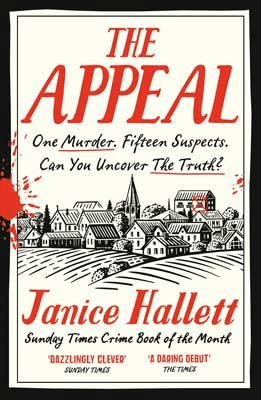
The novel’s cover (at least in the paperback edition) explicitly sets out the challenge to readers: “One murder, fifteen suspects. Can you uncover the truth?” To which the inevitable answer is no, because on the basis of what the reader is told there are multiple potential murderers (probably 15 although I didn’t count) and any one of them could be guilty because of some unrevealed information that only emerges in the closing pages. Spotting the many other crimes and misdemeanours along the way – virtually no-one is entirely well-meaning and innocent – is straightforward enough, but the final resolution, the big reveal as to ‘whodunnit’ was deeply disappointing and unconvincing, requiring as it does someone to take the blame for the crime, then quickly change their mind about doing while at the same time refusing to tell anyone who actually was the murderer. A lot of effort goes into making this plausible behaviour for the character involved, but I wasn’t convinced.
Another mystery within the novel relates to the character of Helen Hayward. We never hear from Helen directly, but we eventually learn that she was responsible for the death of her five year old child when she lived in America, long before meeting her present husband. She moved to the UK to avoid the scandal of a trial in which she was accused of infanticide. The novel becomes muddled on this point, because it suggests that Poppy’s illness is another example of Helen’s child abuse. In fact Poppy isn’t ill at all, and her ‘brain tumour’ is simply a way of scamming money from the community. Helen isn’t Poppy’s carer, and the opportunity for her to induce illness in the child would be limited. So the history of child medical abuse is simply not relevant, and the suggestion that this revelation is in some way an insight into the solution of the mystery (or this particular mystery) is misleading. The novel is full of similar false red herrings which don’t really stand up to much scrutiny. This invites a superficial reading of the text – mysteries are clearly flagged, solutions presented, but scrutiny or careful consideration best avoided. Which presents an inevitable tension with the whole premise of the novel itself in which a careful reading is encouraged to work out the ‘solution’ to the murder.
Having said that this is in other ways a clever novel. Its observations of the British class structure – “they’re an insular bunch. Repressed, judgmental—and they don’t like strangers” – is spot on, and the small-mindedness of many of them is well sketched (if this doesn’t put people off amateur dramatics nothing will). The structure of texts, Whatsapp messages and emails breaks the narrative down into very digestible chunks which keep the pages turning. There is also a contemporary feel to some of the storylines, such as those featuring Fabricated or Induced Illness Syndrome (formerly Munchausen’s Syndrome by Proxy) and the overseas charity sexual exploitation scandal. But ultimately novels like this stand or fall on their conclusion, and the fact that this was so unconvincing and arbitrary was a real disappointment given the effort taken to get us to that point. The author has another mystery novel coming out in the new year (The Mysterious Case of the Alperton Angels – “another labyrinthine, twist-laden mystery focusing on a true-crime writer investigating the historic case of a disturbing cult) which sounds like it will be more of the same. Unless another £1 bargain presents itself, I’ll pass.