
I was disappointed with The Twyford Code, Hallett’s second novel, so was planning to give The Appeal, her first, a miss – but a pristine second hand copy for £1 proved hard to resist. Without wanting to sound mean, I am glad I didn’t pay full price, because it was equally unsatisfying. Just as a heads up – I find it hard to review mystery novels without spoilers, so if you are planning to read this probably best to move on.
The novel takes an unusual form. A barrister sends two of his pupils (junior or trainee lawyers) a collection of emails and messages about a case. These messages constitute the bulk of the novel. He gives them no other information about the files other than they relate to a case he is concerned with. But enigmatically this isn’t a case file: no indication is given of the crime, or crimes involved, nor any other background. He asks them to read the messages and try to spot the relevant or important information hidden within them. The fact that they don’t know what they are looking for is deemed essential – is some way it will make their insights, when they come, all the more significant and unpolluted by preconceptions about the case. Of course it actually just makes the case more confusing whereas a one page summary would have helped enormously! This is a contrivance of course which allows the author to set the reader puzzles that would otherwise be obvious. If you are OK with such contrivances then you won’t might this otherwise frustrating structure.
The novel opens with the planning of a production of Arthur Miller’s All My Sons. An ambitious challenge for the Fairway Players, a small amateur company who have just completed their short run of Blithe Spirit. The company’s characters are revealed through the messages they share while discussing the casting and production of the play. Issy, a local nurse, introduces two new members, friends from work: Sarah and Kel Greenwood. Tensions between characters emerge: who likes who, who tolerates who etc. There are large number of characters to keep track of, and the author helpfully gives us a list of names and relationships/roles. Some characters are given a lot of coverage – others lurk in the shadows. In particular the Greenwoods, having moved back to the UK from Africa recently following some unpleasantness regarding abuse by fellow charity workers, only appear in the messages of others.
The cosiness of the setting is disrupted when Poppy, granddaughter of the Haywards, owners of ‘The Grange’ (it’s never entirely clear if The Grange is a hotel, golf course, both or something similar, not that it hugely matters: it’s a large building with high running and maintenance costs) and principal movers of the company, is diagnosed with a brain tumour. The community immediately swings into action, fundraising for an experimental American treatment not available on the NHS, and costing hundreds of thousands of pounds. This is immediately suspicious – such experimental treatments are usually options of last resort once all other treatments have been exhausted, not something rushed into shortly after diagnosis. Suspicions about the appeal (and credit has to be given to Hallett for the title with its double meaning) quickly mount – there is never an accurate record of how much is raised, despite their apparent wealth the Haywards don’t contribute and even charge the appeal £20k for use of their venue at a fundraising event, and £80k goes missing to an alleged fraudster. The fact that the Haywards are embezzling their own charity fund couldn’t be clearer, and the obvious corollary, that the rudely healthy Poppy has not got any form of cancer, is unavoidable. Most readers will arrive at these conclusions fairly quickly, and other mysteries within the novel are equally transparent.
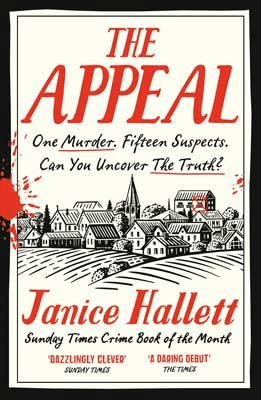
The novel’s cover (at least in the paperback edition) explicitly sets out the challenge to readers: “One murder, fifteen suspects. Can you uncover the truth?” To which the inevitable answer is no, because on the basis of what the reader is told there are multiple potential murderers (probably 15 although I didn’t count) and any one of them could be guilty because of some unrevealed information that only emerges in the closing pages. Spotting the many other crimes and misdemeanours along the way – virtually no-one is entirely well-meaning and innocent – is straightforward enough, but the final resolution, the big reveal as to ‘whodunnit’ was deeply disappointing and unconvincing, requiring as it does someone to take the blame for the crime, then quickly change their mind about doing while at the same time refusing to tell anyone who actually was the murderer. A lot of effort goes into making this plausible behaviour for the character involved, but I wasn’t convinced.
Another mystery within the novel relates to the character of Helen Hayward. We never hear from Helen directly, but we eventually learn that she was responsible for the death of her five year old child when she lived in America, long before meeting her present husband. She moved to the UK to avoid the scandal of a trial in which she was accused of infanticide. The novel becomes muddled on this point, because it suggests that Poppy’s illness is another example of Helen’s child abuse. In fact Poppy isn’t ill at all, and her ‘brain tumour’ is simply a way of scamming money from the community. Helen isn’t Poppy’s carer, and the opportunity for her to induce illness in the child would be limited. So the history of child medical abuse is simply not relevant, and the suggestion that this revelation is in some way an insight into the solution of the mystery (or this particular mystery) is misleading. The novel is full of similar false red herrings which don’t really stand up to much scrutiny. This invites a superficial reading of the text – mysteries are clearly flagged, solutions presented, but scrutiny or careful consideration best avoided. Which presents an inevitable tension with the whole premise of the novel itself in which a careful reading is encouraged to work out the ‘solution’ to the murder.
Having said that this is in other ways a clever novel. Its observations of the British class structure – “they’re an insular bunch. Repressed, judgmental—and they don’t like strangers” – is spot on, and the small-mindedness of many of them is well sketched (if this doesn’t put people off amateur dramatics nothing will). The structure of texts, Whatsapp messages and emails breaks the narrative down into very digestible chunks which keep the pages turning. There is also a contemporary feel to some of the storylines, such as those featuring Fabricated or Induced Illness Syndrome (formerly Munchausen’s Syndrome by Proxy) and the overseas charity sexual exploitation scandal. But ultimately novels like this stand or fall on their conclusion, and the fact that this was so unconvincing and arbitrary was a real disappointment given the effort taken to get us to that point. The author has another mystery novel coming out in the new year (The Mysterious Case of the Alperton Angels – “another labyrinthine, twist-laden mystery focusing on a true-crime writer investigating the historic case of a disturbing cult) which sounds like it will be more of the same. Unless another £1 bargain presents itself, I’ll pass.

