Book review

The Mysterious Case of the Alperton Angels is Hallett’s third (substantial) novel to be published in the last two years, following 2021’s The Appeal, and 2022’s The Twyford Code. A fourth novel is already in the works. She is a busy writer!
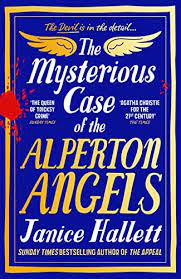
The distinctive feature of all three novels is their format – they are modern versions of epistolary novels in which the narrative is told not by a narrator but through texts, WhatsApp messages, diary notes and in the case of Alperton a host of other primary sources, including extracts from a screenplay and two novels. This can make the narrative quite fragmented – there is no guiding consciousness to explain what is going on, the reader has to do a lot more of the work – but it is refreshingly different, and allows multiple voices and perspectives to be heard, as well as telling the story in lots of different ways. Together they tell the contemporary story of the eponymous Alperton Angels, a millennial cult that ended in a bloodbath eighteen years earlier. A baby that survived the killings is due to come of age, and Amanda Bailey, a crime writer, is commissioned to write a book about the case. The book is part of a crime series re-examining previous murders, and there are lots of references to real-life cases (Fred West etc). Her editor impresses on her that the key to making the book a success is finding and interviewing the rescued baby. And so it begins.

It quickly becomes apparent that there is more to the ‘mysterious case’ than originally appears. Some basic information about the three – or is it four? – deaths is missing. What appears to be a very well known and researched case melts away on closer examination, and none of the key witnesses can be found or are willing to talk. Alarmingly people Amanda tries to interview start to die off in unexplained circumstances. A fellow crime writer, Oliver Menzies, is also working on the story, and when their investigations overlap their publishers suggest they work together, trying to find fresh perspectives on the case. The novel’s approach to narration means information is slowly eked out and there’s limited reflection by the characters. Amanda’s transcription assistant, Ellie, provides a useful sounding board for her to bounce ideas off, but her relationship with Oliver is constrained by more than professional competitiveness – they have a history dating back to when they first entered the profession.

I had some reservations about Hallett’s earlier novels – yes, they were satisfyingly easy reads in which the pages kept turning quite briskly, but the mystery elements of the stories simply weren’t strong enough. The outcome of the various puzzles often depended on people behaving irrationally and sometimes just didn’t add up. With this novel at first it looked as if using a crime where irrational behaviour was a fundamental part of the case might have resolved some of these issues – if ever a participant did something unbelievable or bizarre it could be written off as symptomatic of the power of the cult. And Amanda seems very professional in her approach to her investigation – she has a sensible and very systematic working pattern which is set out clearly for the reader. She also has extensive contacts in the crime world (police and social services in particular) and is prepared to bend a few rules in the interests of getting the story. Oliver on the other hand is less impressive and acts as a drag on the investigation.

But suspension of disbelief can only get you so far. And so will being spoiler-free. So from this point in this review expect spoilers and stop reading if you haven’t yet read The Mysterious Case and intend to do so.

Firstly, I wasn’t convinced at all that Oliver would become a believer in the arrival on earth of the antichrist on the basis of a fifteen minute interview with the charismatic cult-leader, who we are told is just a common everyday kidnapper. Amanda impersonates a friendly spiritual adviser who leads Oliver further down the path but it’s still a long way before you decide to kill a minor royal on the off-chance they are the daughter of Satan. This was just one of many comically implausible features of the plot. Amanda’s decision to rush down to try and stop him (rather than say just phoning the police) made no sense at all. And while her investigation is presented as being very thorough there are some sources she ignores – the autopsies of the bodies or the transcripts of the trial proceedings for example, where the number of victims would be easily resolved and original witness evidence would be recorded. We are also invited to believe that not only would the police beat to death a suspect who had been seen walking through the front door of the local police station that evening, but they would then opportunistically add the body to the cult suicide crime scene (which incidentally wasn’t a cult crime scene at all, but the assassination of some underworld kidnappers) as a convenient way of disposing of it. That just makes no sense whatsoever – a beaten body looks very different from someone shot and ritualistically disfigured. And if that wasn’t unbelievable enough we are invited to believe that this was all witnessed by an American crime writer, over in the UK for research, who is allowed to watch the body being dumped and arranged at the crime scene and then just waved on his way back to the USA, never to mention what he saw again, despite it being the kind of thing a crime writer might actually, you know, write about. This is all just plain nonsense. Crime novels can have some improbabilities, granted, the untraceable poisons and so on, but this was way too much to ask.

Which is so disappointing, because the central idea here – revisiting a historic crime investigation, finding a new perspective and working out what has happened to the survivors – is great. And there have been suicide cults in the recent past that were led by charismatic charlatans. So the premise could have worked, and the narrative structure could have papered over some of the cracks and improbabilities. But never to this extent, at least not for me. Such a waste.
The Mysterious Case of the Alperton Angels, Janice Hallett, 2023

Aside
Book review

I was disappointed with The Twyford Code, Hallett’s second novel, so was planning to give The Appeal, her first, a miss – but a pristine second hand copy for £1 proved hard to resist. Without wanting to sound mean, I am glad I didn’t pay full price, because it was equally unsatisfying. Just as a heads up – I find it hard to review mystery novels without spoilers, so if you are planning to read this probably best to move on.

The novel takes an unusual form. A barrister sends two of his pupils (junior or trainee lawyers) a collection of emails and messages about a case. These messages constitute the bulk of the novel. He gives them no other information about the files other than they relate to a case he is concerned with. But enigmatically this isn’t a case file: no indication is given of the crime, or crimes involved, nor any other background. He asks them to read the messages and try to spot the relevant or important information hidden within them. The fact that they don’t know what they are looking for is deemed essential – is some way it will make their insights, when they come, all the more significant and unpolluted by preconceptions about the case. Of course it actually just makes the case more confusing whereas a one page summary would have helped enormously! This is a contrivance of course which allows the author to set the reader puzzles that would otherwise be obvious. If you are OK with such contrivances then you won’t might this otherwise frustrating structure.

The novel opens with the planning of a production of Arthur Miller’s All My Sons. An ambitious challenge for the Fairway Players, a small amateur company who have just completed their short run of Blithe Spirit. The company’s characters are revealed through the messages they share while discussing the casting and production of the play. Issy, a local nurse, introduces two new members, friends from work: Sarah and Kel Greenwood. Tensions between characters emerge: who likes who, who tolerates who etc. There are large number of characters to keep track of, and the author helpfully gives us a list of names and relationships/roles. Some characters are given a lot of coverage – others lurk in the shadows. In particular the Greenwoods, having moved back to the UK from Africa recently following some unpleasantness regarding abuse by fellow charity workers, only appear in the messages of others.

The cosiness of the setting is disrupted when Poppy, granddaughter of the Haywards, owners of ‘The Grange’ (it’s never entirely clear if The Grange is a hotel, golf course, both or something similar, not that it hugely matters: it’s a large building with high running and maintenance costs) and principal movers of the company, is diagnosed with a brain tumour. The community immediately swings into action, fundraising for an experimental American treatment not available on the NHS, and costing hundreds of thousands of pounds. This is immediately suspicious – such experimental treatments are usually options of last resort once all other treatments have been exhausted, not something rushed into shortly after diagnosis. Suspicions about the appeal (and credit has to be given to Hallett for the title with its double meaning) quickly mount – there is never an accurate record of how much is raised, despite their apparent wealth the Haywards don’t contribute and even charge the appeal £20k for use of their venue at a fundraising event, and £80k goes missing to an alleged fraudster. The fact that the Haywards are embezzling their own charity fund couldn’t be clearer, and the obvious corollary, that the rudely healthy Poppy has not got any form of cancer, is unavoidable. Most readers will arrive at these conclusions fairly quickly, and other mysteries within the novel are equally transparent.

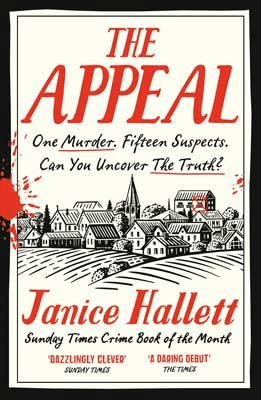
The novel’s cover (at least in the paperback edition) explicitly sets out the challenge to readers: “One murder, fifteen suspects. Can you uncover the truth?” To which the inevitable answer is no, because on the basis of what the reader is told there are multiple potential murderers (probably 15 although I didn’t count) and any one of them could be guilty because of some unrevealed information that only emerges in the closing pages. Spotting the many other crimes and misdemeanours along the way – virtually no-one is entirely well-meaning and innocent – is straightforward enough, but the final resolution, the big reveal as to ‘whodunnit’ was deeply disappointing and unconvincing, requiring as it does someone to take the blame for the crime, then quickly change their mind about doing while at the same time refusing to tell anyone who actually was the murderer. A lot of effort goes into making this plausible behaviour for the character involved, but I wasn’t convinced.

Another mystery within the novel relates to the character of Helen Hayward. We never hear from Helen directly, but we eventually learn that she was responsible for the death of her five year old child when she lived in America, long before meeting her present husband. She moved to the UK to avoid the scandal of a trial in which she was accused of infanticide. The novel becomes muddled on this point, because it suggests that Poppy’s illness is another example of Helen’s child abuse. In fact Poppy isn’t ill at all, and her ‘brain tumour’ is simply a way of scamming money from the community. Helen isn’t Poppy’s carer, and the opportunity for her to induce illness in the child would be limited. So the history of child medical abuse is simply not relevant, and the suggestion that this revelation is in some way an insight into the solution of the mystery (or this particular mystery) is misleading. The novel is full of similar false red herrings which don’t really stand up to much scrutiny. This invites a superficial reading of the text – mysteries are clearly flagged, solutions presented, but scrutiny or careful consideration best avoided. Which presents an inevitable tension with the whole premise of the novel itself in which a careful reading is encouraged to work out the ‘solution’ to the murder.

Having said that this is in other ways a clever novel. Its observations of the British class structure – “they’re an insular bunch. Repressed, judgmental—and they don’t like strangers” – is spot on, and the small-mindedness of many of them is well sketched (if this doesn’t put people off amateur dramatics nothing will). The structure of texts, Whatsapp messages and emails breaks the narrative down into very digestible chunks which keep the pages turning. There is also a contemporary feel to some of the storylines, such as those featuring Fabricated or Induced Illness Syndrome (formerly Munchausen’s Syndrome by Proxy) and the overseas charity sexual exploitation scandal. But ultimately novels like this stand or fall on their conclusion, and the fact that this was so unconvincing and arbitrary was a real disappointment given the effort taken to get us to that point. The author has another mystery novel coming out in the new year (The Mysterious Case of the Alperton Angels – “another labyrinthine, twist-laden mystery focusing on a true-crime writer investigating the historic case of a disturbing cult) which sounds like it will be more of the same. Unless another £1 bargain presents itself, I’ll pass.

The Appeal by Janice Hallett, 2021

Aside
Book review

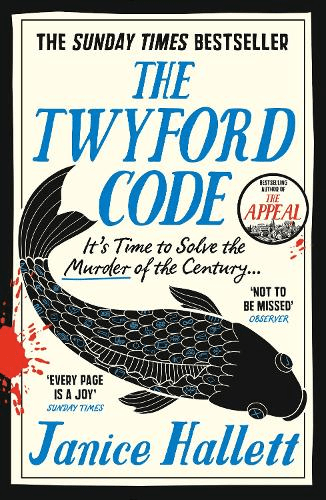
The Twyford Code is several books at once. Don’t be misled by the Osmanesque branding – this is nothing like The Thursday Murder Club, apart from coexisting in the broad category of mystery/crime. The misleading marketing continues in the novel’s blurb, which claims “It’s time to solve the murder of the century...” even though the novel isn’t about a murder. What it is about is slightly harder, I’d admit, to define.

It opens with what seems at first to be a fairly clumsy framing device – a detective inspector sends some transcribed audio-files to an academic who specialises in cryptic codes, asking for assistance in tracing the missing person who made the recordings. That’s where the first warning signal should been buzzing away – why send the transcriptions rather than the audio files themselves? And why transcribe the files using a very poor voice recognition software full of mistakes when an audio typist could have transcribed the audio accurately? Of course there are answers to both these questions that we find out at the end of the novel when the big reveal takes place, although by then we have just accepted the premise.

The transcribed recordings form the bulk of the narrative. Some are straightforward dictation, others are recordings of telephone conversations, and a few are fragmented recording of conversations while the phone is in the character’s pocket, constituting in effect ‘overheard’ conversations. This gives the novel the immediacy of a story being told in the moment, although the device doesn’t always work. There are several points when the narrative has some catching up to do. The recordings are being made by Steven Smith, who has recently been released from a long prison sentence, and are directed to his parole officer, Maxine. They are an account of his life story, focussing on an incident from his schooldays. Travelling on a bus he found a copy of a children’s book. Thinking he might be able to sell it for the price of a bag of chips he took it to his remedial English teacher, Miss Isles, (throughout the novel her name is transcribed as ‘missiles’, which at first was mildly amusing but which quickly became irritating), who is fascinated by it. Eventually she explained to Steven her belief that the author was using the bland children’s stories to communicate in code, To whom, and about what, is unclear, but in pursuit of the mystery she organised a field trip for her class to the author’s family home in Bournemouth. At some point during the trip she disappeared, leaving her class to make their own way home.

Steven has become obsessed by this buried memory, and now free to pursue his investigation he contacts the schoolmates who were with him on the trip. Alongside the story of his investigation he recounts memories of his childhood and how he drifted into a life of crime.

Twyford is a very thinly disguised version of Enid Blyton. There is some clumsy commentary on how Blyton was cancelled in the seventies and eighties, which is very much not the case and glosses over the fact that there was problematic content in her stories. It wasn’t political correctness that caused Blyton to fall out of fashion but an increasing awareness that the outdated views on gender and race in her stories was potentially harmful to kids. But she was never banned and her books remained widely available and in print.

The mystery at the core of The Twyford Code is hard to pin down – the focus of the mystery keeps shifting. It’s not clear whether Miss Isles did go missing on the day trip to Bournemouth, nor whether the Twyford books do contain acrostics and other codes pointing to the whereabouts of stolen bullion hidden during the second world war. It’s also unclear whether the narrator is being pursued by mysterious figures throughout his investigations, as he appears to be, or whether these are figures of his imagination. He is an unreliable narrator and there’s almost nothing he says that can be trusted.

The resolution to the novel is well constructed and convincing, but it is a long time coming. You can read mystery/crime novels passively, knowing that each mystery you are presented with will be explained and resolved fairly quickly, or you can more actively engaged with the text and try and work out what is going on. This novel pushes that choice upon the reader quite hard – for example we are presented with large chunks of text from the Twyford stories and asked to decode them. I have no idea whether this is a confession or not, but I tend to read these popular fiction novels for entertainment rather than mental exercises, and I don’t try to work the puzzles out. I know that the author will usually have withheld key information making the working out element almost impossible, and Hallett is no exception. As an example, we are told that acrostics can be found throughout the Twyford stories between occurrences of the word ‘cat’. This is then modified to phrases where the word ‘cat’ appears as an acrostic itself, and then further modified to phrases where the word ‘cat’ appears close together in the text. Then it is finally revealed (minor spoiler) that cat isn’t the real keyword at all, and there is another keyword which we should have been looking out for all the time. That’s just cheating isn’t it? If the intention was to invite the read to go back over these passages and work out the puzzles than that’s a hard pass from me.

There are other instances where the puzzles in the text are impossible for the reader to decrypt. A picture in the background of a photograph is believed to contain clues relating to numbers of a dartboard. Subsequently a different version of the picture is revealed showing another set of numbers. So any effort invested in trying to discern the relevance of the first group of numbers – are the map references, dates, codes to a cypher etc – is pointless. That’s my excuse for not engaging with this element of the novel – it’s a matter of personal choice and if you enjoy trying to work these puzzles out then go for it.

I appreciate the fact that the author tried something different here rather than the conventional, narrator-led body in the drawing room school of cosy crime. She also includes some commentary in education in prison, and the treatment of children with special educational needs, all of which is very commendable. I am tempted to try Hallett’s earlier novel The Appeal which has received positive reviews, and to which by all accounts this represents a slightly disappointing follow up. Without wanting to sound too condescending, if you are looking for something diverting on a long train journey, this might fit the bill, but I doubt it will linger long in the memory.

The Twyford Code, Janice Hallett, 2022

Aside