
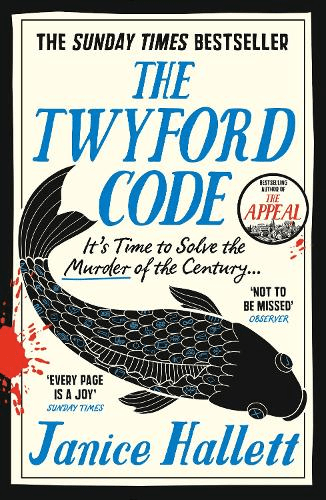
The Twyford Code is several books at once. Don’t be misled by the Osmanesque branding – this is nothing like The Thursday Murder Club, apart from coexisting in the broad category of mystery/crime. The misleading marketing continues in the novel’s blurb, which claims “It’s time to solve the murder of the century...” even though the novel isn’t about a murder. What it is about is slightly harder, I’d admit, to define.
It opens with what seems at first to be a fairly clumsy framing device – a detective inspector sends some transcribed audio-files to an academic who specialises in cryptic codes, asking for assistance in tracing the missing person who made the recordings. That’s where the first warning signal should been buzzing away – why send the transcriptions rather than the audio files themselves? And why transcribe the files using a very poor voice recognition software full of mistakes when an audio typist could have transcribed the audio accurately? Of course there are answers to both these questions that we find out at the end of the novel when the big reveal takes place, although by then we have just accepted the premise.
The transcribed recordings form the bulk of the narrative. Some are straightforward dictation, others are recordings of telephone conversations, and a few are fragmented recording of conversations while the phone is in the character’s pocket, constituting in effect ‘overheard’ conversations. This gives the novel the immediacy of a story being told in the moment, although the device doesn’t always work. There are several points when the narrative has some catching up to do. The recordings are being made by Steven Smith, who has recently been released from a long prison sentence, and are directed to his parole officer, Maxine. They are an account of his life story, focussing on an incident from his schooldays. Travelling on a bus he found a copy of a children’s book. Thinking he might be able to sell it for the price of a bag of chips he took it to his remedial English teacher, Miss Isles, (throughout the novel her name is transcribed as ‘missiles’, which at first was mildly amusing but which quickly became irritating), who is fascinated by it. Eventually she explained to Steven her belief that the author was using the bland children’s stories to communicate in code, To whom, and about what, is unclear, but in pursuit of the mystery she organised a field trip for her class to the author’s family home in Bournemouth. At some point during the trip she disappeared, leaving her class to make their own way home.
Steven has become obsessed by this buried memory, and now free to pursue his investigation he contacts the schoolmates who were with him on the trip. Alongside the story of his investigation he recounts memories of his childhood and how he drifted into a life of crime.
Twyford is a very thinly disguised version of Enid Blyton. There is some clumsy commentary on how Blyton was cancelled in the seventies and eighties, which is very much not the case and glosses over the fact that there was problematic content in her stories. It wasn’t political correctness that caused Blyton to fall out of fashion but an increasing awareness that the outdated views on gender and race in her stories was potentially harmful to kids. But she was never banned and her books remained widely available and in print.
The mystery at the core of The Twyford Code is hard to pin down – the focus of the mystery keeps shifting. It’s not clear whether Miss Isles did go missing on the day trip to Bournemouth, nor whether the Twyford books do contain acrostics and other codes pointing to the whereabouts of stolen bullion hidden during the second world war. It’s also unclear whether the narrator is being pursued by mysterious figures throughout his investigations, as he appears to be, or whether these are figures of his imagination. He is an unreliable narrator and there’s almost nothing he says that can be trusted.
The resolution to the novel is well constructed and convincing, but it is a long time coming. You can read mystery/crime novels passively, knowing that each mystery you are presented with will be explained and resolved fairly quickly, or you can more actively engaged with the text and try and work out what is going on. This novel pushes that choice upon the reader quite hard – for example we are presented with large chunks of text from the Twyford stories and asked to decode them. I have no idea whether this is a confession or not, but I tend to read these popular fiction novels for entertainment rather than mental exercises, and I don’t try to work the puzzles out. I know that the author will usually have withheld key information making the working out element almost impossible, and Hallett is no exception. As an example, we are told that acrostics can be found throughout the Twyford stories between occurrences of the word ‘cat’. This is then modified to phrases where the word ‘cat’ appears as an acrostic itself, and then further modified to phrases where the word ‘cat’ appears close together in the text. Then it is finally revealed (minor spoiler) that cat isn’t the real keyword at all, and there is another keyword which we should have been looking out for all the time. That’s just cheating isn’t it? If the intention was to invite the read to go back over these passages and work out the puzzles than that’s a hard pass from me.
There are other instances where the puzzles in the text are impossible for the reader to decrypt. A picture in the background of a photograph is believed to contain clues relating to numbers of a dartboard. Subsequently a different version of the picture is revealed showing another set of numbers. So any effort invested in trying to discern the relevance of the first group of numbers – are the map references, dates, codes to a cypher etc – is pointless. That’s my excuse for not engaging with this element of the novel – it’s a matter of personal choice and if you enjoy trying to work these puzzles out then go for it.
I appreciate the fact that the author tried something different here rather than the conventional, narrator-led body in the drawing room school of cosy crime. She also includes some commentary in education in prison, and the treatment of children with special educational needs, all of which is very commendable. I am tempted to try Hallett’s earlier novel The Appeal which has received positive reviews, and to which by all accounts this represents a slightly disappointing follow up. Without wanting to sound too condescending, if you are looking for something diverting on a long train journey, this might fit the bill, but I doubt it will linger long in the memory.
 The Reading Bug
Pingback: The Appeal by Janice Hallett, 2021 | The Reading Bug