
I am pretty ambivalent about horror as a genre, and The Haunting of Hill House has done little to change my mind about this one way or the other. While bad horror is virtually unreadable, good horror needs to tap into some primeval fear for it to make any impact at all and avoid the cardinal sin of being ridiculous. I wasn’t convinced that The Haunting managed to swerve that pitfall.
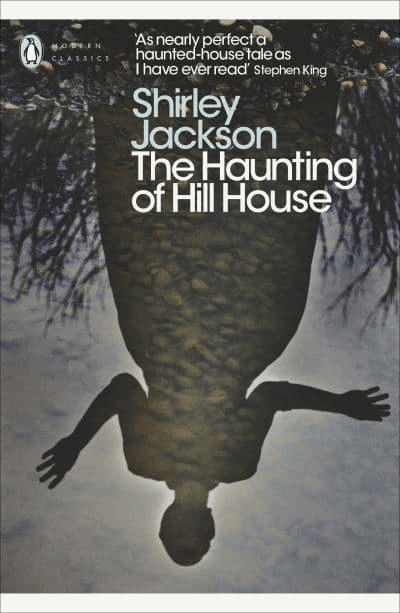
This novel is an unusual example of the genre in that is is without a monster – no aliens or creatures from the black lagoon. While other 1950’s American authors were being inspired by the Cold War, the space race and the march of technology (see for example Richard Matheson’s 1956 The Shrinking Man, or John Wyndham’s 1951 The Chrysalids) here Shirley Jackson falls back to one of horror’s earliest forms, the haunted house story.
Hill House is a mansion somewhere remote in the USA – a precise location is obviously never specified – which although relatively recently built, has acquired a reputation for being cursed or haunted:
“Hill House, not sane, stood by itself against its hills, holding darkness within; it had stood so for eighty years and might stand for eighty more. Within, walls continued upright, bricks met neatly, floors were firm, and doors were sensibly shut; silence lay steadily against the wood and stone of Hill House, and whatever walked there, walked alone.”
Jackson, or her narrator, is clear – there is something about the precise architecture of Hill House that is evil:
“No human eye can isolate the unhappy coincidence of line and place which suggests evil in the face of a house, and yet somehow a maniac juxtaposition, a badly turned angle, some chance meeting of roof and sky, turned Hill House into a place of despair, more frightening because the face of Hill House seemed awake, with a watchfulness from the blank windows and a touch of glee in the eyebrow of a cornice.”
and later
“Almost any house, caught unexpectedly or at an odd angle, can turn a deeply humorous look on a watching person; even a mischievous little chimney, or a dormer like a dimple, can catch up a beholder with a sense of fellowship; but a house arrogant and hating, never off guard, can only be evil.”
Four brave/foolhardy souls decide to stay at the house overnight to investigate the persistent reports of the place being haunted: Dr. John Montague, an paranormal investigator; Eleanor Vance, a young woman escaping her oppressive family; Theodora, an artist; and Luke Sanderson, heir to Hill House. Eleanor and Theodora have been chosen by Dr Montague, who is leading the experiment, because they have had previous encounters with the paranormal. Clearly the assumption is that they will find something strange about the house – and of course they immediately do.
Apart from Dr Montague these are not the typical cast of characters found in a haunted house story. Eleanor is timid and an extremely unlikely ghost-hunter; Theodora is, it is broadly hinted, a lesbian, and while I am not suggesting for one second that lesbians can’t hunt ghosts, it is definitely not a typical piece of casting; and Luke – well to be honest Luke is not a very well developed character at all – he is principally there to make up the numbers. Only Dr Montague conforms to his eccentric scientist trope.
The cast assembles in the way that groups of people going to haunted houses do and the scene is set for the haunting to begin, along with the obligatory creepy housekeeper. Strictly on cue the scary happenings kick-off. All of the inhabitants begin to experience ‘strange events’ while in the house and its grounds, including violently loud noises, freezing cold doorways, sinister messages being scrawled on the walls and spectral figures glimpsed out of the corner of the eye.
Is this all really happening, or are the loud noises etc being produced by the residents themselves? Alternatively, are they imagining them? Maybe even both? The narrative carefully avoids any possibility of the reader knowing what is really happening, and this undermines the attempts at realism in the story. We can’t be scared of what we know is not real after all, and the willing suspension of disbelief needs a convincing appearance of reality.
Approximately two-thirds of the way through, as the daily routine of general spookiness is beginning to settle down, the novel is given a massive injection of life by the late arrival of the magnificent Mrs. Montague and her side-kick Arthur Parker, a no-nonsense headmaster. This pair are wonderfully comedic – Mrs Montague relentlessly and unreasonably hen-pecks her husband, and Mr Parker’s attempts at being the alpha-male are farcical:
I shall make my headquarters in the small room just this side of the nursery, well within shouting distance. I shall have with me a a drawn revolver – do not take alarm, ladies, I am an excellent shot – and a flashlight, in addition to a most piercing whistle…You may all sleep quietly I assure you.
The ending is sadly predictable, but after all the range of choices available to the author of horror stories are fairly limited:
a) Ghost are real;
b) It was the spooky caretaker/groundskeeper in a mask after all (i.e. there is a logical explanation of some kind to all the apparently supernatural activity); or
c) The horror is psychological – the haunting etc is all in the mind.
H. P. Lovecraft said of horror writing that “the oldest and strongest emotion of mankind is fear, and the oldest and strongest kind of fear is fear of the unknown”. Jackson picks up on this concept here:
“Fear,” the doctor said, “is the relinquishment of logic, the willing relinquishing of reasonable patterns. We yield to it or we fight it, but we cannot meet it halfway.”
Jackson does a good job of keeping the threat imposed by Hill House largely unknown – it’s never really clear what is going on at any particular time. The confusing layout of the house, which leads to the characters getting lost all the time, makes good use of this concept. But I needed to be persuaded to willingly relinquish my grasp on reasonableness before experiencing anything like fear and I never quite succumbed.
 The Reading Bug
I have this movie. I like it, I’ve never read the book but the movie isn’t traditional neither. Thanks for sharing!
LikeLiked by 1 person