
(NB I’ve tried to avoid spoilers in this review but I am not sure I have succeeded, so if you are planning to read The Bullet that Missed and want to have a spoiler-free experience, best not to read on.)
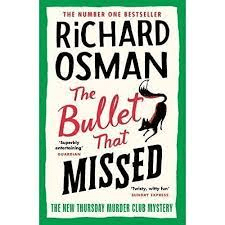
Any author setting out to construct a crime novel will need to decide fairly early on in the process the amount of peril they want to include. Are the characters going to be at serious risk of harm or death, or will they be able to slip away from danger effortlessly? Authors writing for children will usually avoid anything where their characters come to ‘real’ harm, and any deaths are usually ‘off-screen’ or reversed very quickly – I know I have said this before, but I have a theory that you can work out the age group a film is targeted out by the number of seconds between the moment a character ‘dies’ and then suddenly coming back to life. When J K Rowling kills one of her characters in front of us – Cedric Diggory of course – and he doesn’t come back to life, we know she is now writing for a new, more mature audience, even if it is the same one that initially read Philosopher’s Stone three years earlier.
Richard Osman seems to have made a different choice and gone in the opposite direction, ratcheting up the ‘cosy’ element of the Thursday Murder Club series and removing all sense of peril whatsoever. At no point are his senior citizen investigators under any more threat than the Jigsaw Club. Highly skilled assassins can be persuaded not to go through with their threats over a cup of tea, a chocolate biscuit and a nice little chat with someone telling them they really didn’t want to kill anyone, did they? A hardened gang-leader in prison for murder can be persuaded to help the gang investigate the current crime simply through being asked nicely. Another lonely gangland crime boss trades secrets for another game of snooker.
Which makes it hard to take the novel at all seriously. Osman introduces several new characters in this latest incarnation of the Thursday Murder Club, which it goes without saying will sell in its millions. There’s a Swedish crypto-billionaire money launderer who tries to do his own easily-foiled assassinations (even though he has a crew to conduct kidnappings for him). He shows Elizabeth, retired spy, around his baronial lair in Staffordshire (why Staffordshire – is it home to many Swedish crypto-currency billionaires?) and the only thing missing is a white cat being slowly stroked for the Bond villain caricature to be complete. Victor is the ubiquitous retired Russian KGB colonel who always turns up in this kind of novel and would be played by Brian Cox (the actor, not the astronomer) in the inevitable film adaptation. He is also a complete sweetie and wants to join the gang, moving into the retirement community from his lonely luxury apartment in a tower block with it’s own suspended swimming pool.
The novel’s whodunnit puzzle – the gang are investigating a mysterious death of a reporter ten years earlier – is not that interesting. The red herrings are capitalised, in bold, and underlined to remove the risk of them being missed, and the resolution is, unusually for this series, a bit messily handled. The clues include some clunky anagrams which are hard to avoid – because arch-criminals obviously disguise their bank accounts anagrammatically, don’t they?
The element of pathos in the novel, the recognition that these are the last years of the characters’ lives and that death and infirmity come for us all, remains a theme, but is kept firmly in the background. Stephen, Elizabeth’s husband, is suffering from rapidly deteriorating dementia, but remains lucid enough most of the time to be able to assist with the investigation. Overall old-age is presented as rather pleasant golden years rather than those of infirmity, poverty and loneliness.
That’s the negative aspects of the novel – the cosiness is dialled past 11 and any sense of peril is entirely absent. Joyce, Elizabeth, Ron and Ibrahim (and Victor?) are going to all live to 100 and run out of cases before they run out of time. But the 400+ pages pass by pleasantly enough nonetheless. Joyce remains the star of the show, navigating her way through the complexities of the modern world including Instagram and losing her savings by investing them in BitCoin and Etherium. Her murder mystery story, submitted to the local paper as a competition entry and included in full as a bonus item in the Waterstones edition of the novel (but I am sure available online) is hilarious and shows just how hard it is for crime-writers to avoid cliché. The humour in the novel is cleverly done. I particularly enjoyed the observation that “he eats salmon and broccoli now. He eats so much broccoli he can spell it without looking it up” given how hard it usually is to get this one right. Jokes about technology also land well – one character admits “I got so desperate I even used Bing, but the results were the same, if a bit slower.” There are plenty of quotable nuggets of wisdom scattered through the text – Victor in particular is wise in the manner of most Russian spies in this genre:
“It’s the people, in the end, isn’t it?” says Viktor. “It’s always the people. You can move halfway around the world to find your perfect life, move to Australia if you like, but it always comes down to the people you meet.”
There are enough points of entertainment to keep the pages turning and one’s interest engaged. The extra-large font the novel is printed in tells you everything you could want to know about Osman’s target readership, if that was ever in any doubt! I just wonder if perhaps Osman is losing focus and interest, and whether diminishing returns are beginning to set in? Eventually all long-running series run the risk of self-parody (a risk Osman explicitly acknowledges in the short story Joyce writes). He will need to find a new element or character in the inevitable Thursday Murder Club 4 due out this autumn this series becoming oppressively comfortable and we all doze off. This is a book to listen to while doing an uncomplicated jigsaw. There is a place in the world for that kind of book and I am sure I will read TMC4 when it comes out – but I can’t avoid thinking that Osman could do better than this.

