I am coming late to the Shapiro party, and that is only in part because I got stuck halfway through this actually very readable account of England in 1606 and the plays Shakespeare wrote in this year. (Quite rightly Shapiro cheats a little and also spends some time in 1605, looking in detail in particular at the events of the Gunpowder Plot.)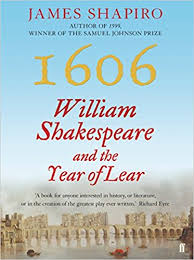
Dating Shakespeare’s plays is never easy. The exercise assumes that the plays were written at a specific time, whereas there is plenty of evidence that once written and performed the plays continued to be revised for different performances (for example a shorter version of the play might be required for a court performance). But the overwhelming consensus is that King Lear, Macbeth, and Antony and Cleopatra were written in 1606, and were first performed in that year. So Year of Lear is slightly misleading, but more concise than Year of Lear, Macbeth and so on.
I make no claims to expertise on these issues, so the extent to which Shapiro’s analysis is reliable or otherwise is beyond me. Certainly it sounds authoritative; there is also a wealth of footnotes and bibliography supporting the text. In dating Lear, Macbeth and Antony and Cleopatra to 1606, Shapiro inevitably upset the Oxfordian lobby, that remarkable group of people who are convinced that Shakespeare’s plays were written by the Earl of Oxford. In order for this group’s theories to “work” they need Lear and the others to have been written much earlier, before James 1 came to the throne in 1603. So they felt/feel compelled to attack Shapiro’s central concept – that the events of the time can be seen reflected in the plays of the time – even though Macbeth in particular seems profoundly influenced by James’s interest/obsession with witches, and the pursuit of Jesuits in England following the Gunpowder Plot.
Anyone writing about Shakespeare in the context of the times in which he lived has to exercise a lot of care. These are without question not autobiographical plays, and any attempt to link events in Shakespeare’s personal life to his plays is bound to fail. At the same time we know a lot more about the major political events that happened in England at the time Shakespeare lived, so it is only reasonable to ask to what extent these events informed his plays, both in their original conception and their subsequent evolution. It is hard to imagine that it is a coincidence that Shakespeare wrote a play – Lear – showing the dangers of a disunited kingdom while at the same time James was arguing with Parliament for union between his two thrones, England and Scotland, or that a play showing the consequences of regicide – Macbeth – should just accidentally have turned up on stage as the consequences of the attempted regicide of the Gunpowder Plotters still reverberated around the country.
While undoubtedly very scholarly, Shapiro’s book is not an academic tome. It is accessible and relatively easy to read. The chapters on the Gunpowder Plot and its aftershock are quite thrilling, if not also rather gruesome. One gets a vivid picture of Jacobean London and England, the world in which Shakespeare was living and working. Some of the content was not new to me – it must be extraordinarily hard to find new things to say about Shakespeare, rather than just presenting content in new ways. But there were certainly snippets of new insight – new to me, anyway – such as the fact that Shakespeare’s daughter was a recusant (i.e she refused Anglican communion) or that his landlady in St Olave’s parish in London almost certainly died of the plague. I had never noticed before Shapiro pointed it out that the plague, such a dominant feature of life in England at the time, never really plays anything other than a peripheral part in Shakespeare’s works.
If this is a topic that interests you, and it really should, Shapiro’s 1606 is highly recommended. He wrote a similar book on 1599, and also what looks like a pretty definitive guide to the ‘authorship’ debate, which I have to admit I have added to my Amazon wish list!

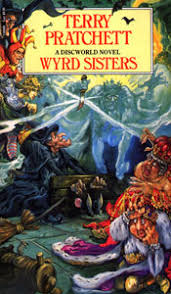 deviates somewhat from its source. (For the avoidance of any doubt, this is of course a joke – Macbeth is a source for ‘Wyrd Sisters’ in the same way that Hamlet is a source for the Lion King, i.e. barely).
 The Reading Bug