
‘Wyrd Sisters’ sees the return of Terry Pratchett’s magnificent three, Granny Weatherwax; Nanny Ogg, and Magrat Garlick, Discworld’s most chaotic coven. The opening of the novel is closely modelled on Pratchett’s source text, Macbeth: King Verence I of Lancre, a small mountainous kingdom high in the Ramtops, is murdered by his cousin, Duke Felmet, and the duke’s homicidal wife. So far so Shakespeare, but from this point the novel 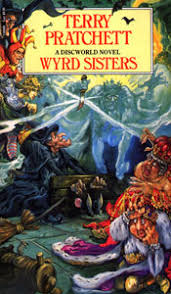 deviates somewhat from its source. (For the avoidance of any doubt, this is of course a joke – Macbeth is a source for ‘Wyrd Sisters’ in the same way that Hamlet is a source for the Lion King, i.e. barely).
The king’s son and his crown are smuggled out of the castle and handed to the witches for safekeeping. They foster the child with a troupe of travelling actors, hide the crown in plain sight in a box of props, and settle back to watch destiny take its course. Their confident expectation is that the prince, Tomjon, will grow up, defeat Duke Felmet and take his rightful place as king.
However, this is Discworld, so of course things don’t work out as easily as that. Lancre is a highly magical and very slightly sentient kingdom, and is angry about the way the new King mistreats the land. Reluctantly, the coven casts a spell over the kingdom, freezing it in time for 15 years and allowing Tomjon to grow into a young man and therefore (in theory at least) able to challenge his er…second cousin (uncle would have been better) for the throne. Tomjon is also, as it happens, a highly talented actor….
‘Wyrd Sisters’ isn’t just a Shakespeare parody, although it is an extremely clever one at that. Pratchett was obviously fascinated with the power of words, a theme employs time after time, in novels such as ‘Going Postal’. He returns to this theme when Felmet, constantly worried about the threat to his reign from the witches, decides to adopt an indirect approach. Imprisoning them doesn’t work, nor does threatening them. Realising that the way to undermine their authority and status with the people of Lancre is through ‘headology’, the duke commissions a play that will show the witches as dangerous and malevolent. A play like Macbeth for example. He sends the court Fool, who has been clumsily courting Magrat, and whose idea this originally was, to Ankh-Morpork to recruit a theatre company to write and perform the play. Inevitably the company that he employs is the one that has been fostering Tomjon all this time.
The story’s climax is reached when the theatre troupe makes its way to Lancre and perform their play. Despite many dress rehearsals and practice runs, Hwel, (Will, of course) the company’s dwarf playwright, maintains that there is something wrong with the play, something that just doesn’t feel right. The real play eventually asserts itself, and in a slightly farcical ending the witches cast a spell that causes the actors to portray the killing of the king truthfully. Felmet finally goes mad and starts to stab people with a stage dagger, before tripping and falling to his death in the Lancre Gorge. The Duchess suffers a similar grisly fate. Granny Weatherwax explains that Tomjon is the rightful heir, but he declines the throne and pursues his acting career. Granny Weatherwax pulls an admirable plan b from under her hat, claiming that the Fool is Tomjon’s half-brother. The fool is crowned King Verence II of Lancre, and it is not revealed until much later that their shared parent is the original king’s fool (i.e that the Fool has no claim to the throne at all).
I lost track of the references to various Shakespeare plays in this text. Pratchett seems to have ransacked his memory for snippets of mis-remembered quotes and thrown them in at every opportunity. It’s a fun game to spot the source but it’s not just Shakespeare – Annie Get Your Gun, Starlight Express, Phantom of the Opera, Charlie Chaplin, the Marx Brothers, and Laurel and Hardy all make fleeting appearances as Hwel struggles to shape the random ideas he keeps being struck with into plays. Macbeth remains of course the primary reference point. I also enjoyed the idea of the players building a theatre in Ankh-Morpork called ‘The Dysk’.
I have written elsewhere about the huge affection I feel for Pratchett’s principal players, and of these Granny Weatherwax and Nanny Ogg are right at the top of the list. So any novel that features them can do no wrong by me. You could if you were in a huge hurry skip ‘Equal Rites’, which with hindsight feels like a bit of a dry run for ‘Sourcery’ and ‘Wyrd Sisters’, and start straight in with either of these novels as your introduction to Discworld. But think of what you would miss!


I love the Discworld books esp the ones with the witches as main characters. For some reason my favourite is Magrat. I much prefer the witches ones to the Watch-focused ones.
LikeLiked by 1 person
No doubt I will be accused of hyperbole, but I happen to believe that Granny Weatherwax is one of the greatest characters in popular fiction. Pratchett created such extraordinary rounded and believable women characters.
LikeLike