
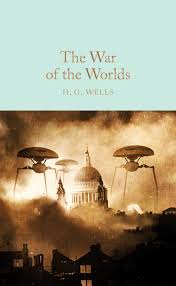
“No one would have believed in the last years of the nineteenth century that this world was being watched keenly and closely by intelligences greater than man’s and yet as mortal as his own; that as men busied themselves about their various concerns they were scrutinised and studied, perhaps almost as narrowly as a man with a microscope might scrutinise the transient creatures that swarm and multiply in a drop of water.”
I come from the generation that finds it physically impossible to read that opening paragraph without hearing Richard Burton’s magnificent voice, providing the narration for Jeff Wayne’s album.
I really enjoyed ‘War of the Worlds’. I can’t imagine you don’t know the basic premise, but just in case, here goes: aliens attack Woking, and thence Southern England. Not so much war of the worlds therefore as Martians vs the Home Counties. And of course ‘we’ win, in a way that had allowed Europeans to win so many earlier colonial wars.
‘War of the Worlds’ is however not really about Martians, but another type of alien completely – Germans. It’s an example of the invasion literature genre. In the second half of the nineteenth century, following Prussia’s overwhelming victory against France in the Franco-Prussian war of 1870-71, concerns began to grow about the possibility of a conflict between the UK and the emerging nation state of Germany. There were many reasons why this was unlikely – not least the close connections between the countries’ royal families – but the publication in 1871 of the short story ‘The Battle of Dorking‘ seemed to capture the public mood – what if the United Kingdom were to be invaded by a militarily and technologically superior force? Would we lose? What would the nation’s people do – would they fight back, or panic and flee?
Wells’s answer is unequivocal – after an initial response in which the British artillery have some limited successes against the Martian war machines, a new and sinister weapon – poison gas – annihilates all resistance, and the population panics. Wells’s description of the gas the Martians use is horribly prescient – compare his description to the account of a World War 1 gas attack survivor:
” It was heavy, this vapour, heavier than the densest smoke, so that, after the first tumultuous uprush and outflow of its impact, it sank down through the air, and poured over the ground in a manner rather liquid than gaseous, abandoning the hills and streaming into the valleys and ditches” (Wells)
“[I watched] figures running wildly in confusion over the fields. Greenish-grey clouds swept down upon them, turning yellow as they travelled over the country blasting everything they touched and shrivelling up the vegetation. . . . Then there staggered into our midst French soldiers, blinded, coughing, chests heaving, faces an ugly purple colour, lips speechless with agony, and behind them in the gas soaked trenches, we learned that they had left hundreds of dead and dying comrades.” (WW1 memoir).
Later in the novel there is a scene of a mass evacuation by sea, strangely anticipating Dunkirk:
“Close inshore was a multitude of fishing smacks – English, Scotch, French, Dutch, and Swedish, steam launches from the Thames, yachts, electric boats; and beyond were ships of large burden, a multitude of filthy colliers, trim merchantmen, cattle ships, passenger boats, petroleum tanks, ocean tramps, an old white transport, even neat white and grey liners from Southampton and Hamburg; and along the blue coast across the Blackwater my brother could make out dimly a dense swarm of boats chaffering with the people on the beach, a swarm which also extended up the Blackwater almost to Maldon” (Chapter 17, the Thunder Child).
Equally spot on is Wells’s account of how people react when the opportunity arises to make a profit out of tragedy –
“The man was running away with the rest, and selling his papers for a shilling each as he ran—a grotesque mingling of profit and panic.”
Wells even joins the dots for us by making the parallels between the Martian invasion and war with Germany explicit. When the Martians first land, and their intention is unclear, the narrator talks about the press coverage of the landing and tells us that
“Many people had heard of the cylinder of course, and talked about it in their leisure, but it certainly did not make the sensation that an ultimatum to Germany would have done“. (Chapter 8, Friday night – my emphasis). Wells also refers to the “war fever that occasionally runs through a civilised community” .
Some other minor details jumped out at me from this read, which is often the case. The unnamed narrator is really upset when his hat falls off during his initial flight from the Martians – being properly dressed was incredibly important to an English gentleman of the late nineteenth century! Ogilvy his astronomer friend has the same experience when he tries to explain that the shooting stars from Mars were more sinister than originally thought:
“He met a waggoner and tried to make him understand, but the tale he told and his appearance were so wild – his hat had fallen off in the pit – that the man simply drove on”. Martians announced by a properly dressed gentleman, that’s one thing, but Martians and no hat – what nonsense!
Wells makes the invasion very realistic. His attention to detail about the precise locations of events, the everyday life that is destroyed by the invasion, has a chilling effect that would be lost without it. For non-British reader this might sometimes seem like a long list of small English locations and landmarks, but Orson Welles captured the atmosphere of the text in his famous 1938 radio broadcast, leading to the much disputed panic in middle America.
Wells’s narrator is in a small way a philosopher, and comes to perceive the invasion as a Darwinian outcome, as natural in its way as the extinction of the dodo.
“We must remember what ruthless and utter destruction our own species has wrought, not only upon animals, such as vanished bison and the dodo, but upon its own inferior races. The Tasmanians . . . were entirely swept out of existence in a war of extermination waged by European immigrants, in the space of fifty years. Are we such apostles of mercy as to complain if the Martians warred in the same spirit?”
This a thoughtful, interesting and at times exciting novel, even if the outcome is never really in doubt. There are horrific elements as well, surprisingly explicit for a Victorian novel. If you want an introduction to Wells’s science fiction this short read is a great place to start.


I remember I enjoyed teaching this novel, back in the day, when I worked in London. There’s a lot to make students think. When you’ve done The Time Machine – as I imagine you may be about to do – may I recommend Christopher Priest’s excellent The Space Machine?
LikeLiked by 1 person
Thanks for the recommendation – haven’t heard of this one but will check it out.
LikeLike
I happened to read this recently as well. Very interesting to hear about all of the parallels with WWI! I hadn’t given that as much thought, but you’re right — some are downright uncanny.
LikeLiked by 1 person
I think a proper scholarly look at invasion literature and how it anticipated and influenced thinking about WW1 is long overdue. Maybe a retirement project!
LikeLiked by 1 person