
Following on from my post about H G Wells’ ‘War of the Worlds’, I wanted to share with you an anecdote about one of the more interesting aspects of this novel’s “afterlife” and its impact on society. You are probably familiar with the story of Orson Welles’s radio dramatization of the novel, broadcast just before Halloween in 1938, at the height of the events leading up to the Munich agreement. Such was the effectiveness of the dramatic techniques used in the broadcast, it is said, that many Americans believed their country was really under attack. 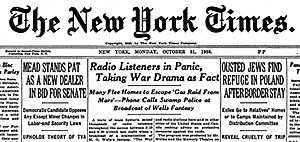
This story has been investigated over the years, and the consensus appears to be that it is an urban myth. There is very little evidence of real panic, of people genuinely believing there was an invasion underway, etc. I have no doubt that there would have been a brief flicker of doubt in many people’s minds if they tuned into the broadcast halfway and heard a reporter’s account of the Martian attack, and inevitably some of them will have phoned the police or the radio station. But I suspect few would have headed for the hills.
The press reaction was immediate, and a myth was born, one which Welles was happy to perpetuate in later life as a way of bolstering his status as a writer and performer. Within days Hitler had referenced the story in a speech using it as evidence of the West’s weakness. There is a very detailed and well researched Wikipedia article about the whole affair, which I recommend if this story interests you. There is even an audio file of the whole broadcast which you can download and try to imagine if you would have been spooked by it.
My reason for mentioning it relates to the story at the end of the article, which tells of a meeting between the author and the director in October 1940, shortly before the second anniversary of the broadcast. In the conversation, broadcast on radio, Wells expressed doubts about the extent of the panic caused by the broadcast, and asked “Are you sure there was such a panic in America or wasn’t it your Halloween fun?” Welles was at this stage happy to agree that the reaction had been over-reported, saying “I think that’s the nicest thing that a man from England could say about the men from Mars. Mr. Hitler made a good deal of sport of it, you know…. It’s supposed to show the corrupt condition and decadent state of affairs in democracy…. I think it’s very nice of Mr. Wells to say that not only I didn’t mean it, but the American people didn’t mean it.”
Welles is saying in other words that Hitler was wrong, when the time comes Americans will not blink or panic in the face of an attack, Martian or otherwise, and that they know the difference between a radio play and reality. Wells speculates that until America has to face the reality of the Second World War, as it was to do 14 months later at Pearl Harbour, Americans would not fully appreciate its horrors, and could instead continue to enjoy the make-believe thrill of radio plays and Halloween.
For me this short conversation emphasises the tragedy both men were contemplating. Over forty years earlier Wells had imagined a global conflict arising from outer space. Instead world war had erupted, not once but twice, in ever more horrific forms of conflict. In 1940 the victory Wells anticipated for his home country in his novel was far from secure.
“Until it ceases to be a game,” Welles said, a phrase that Wells repeated

