
The power to transform the human body using advances in scientific understanding. 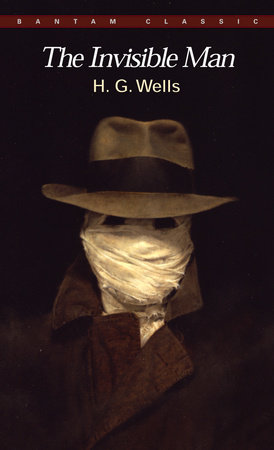 This was the theme that captured the imagination of many nineteenth century writers, including, among others, Mary Shelley in ‘Frankenstein‘, Robert Louis Stevenson in ‘Dr Jekyll and Mr Hyde‘, and H.G. Wells in ‘The Invisible Man‘. In this late Victorian novella, Wells explores the idea of what would happen if someone, somehow, managed to make themselves invisible.
Traditionally invisibility is seen as a bit of a superpower, but for Wells’ invisible man, Griffin (I doubt it is a coincidence that the eponymous protagonist is named after a mythological creature), it is a curse. Wells uses the practical challenges that his character faces rather than the empowering aspects of invisibility to make a point about the importance of man’s social existence:
“Alone– it is wonderful how little a man can do alone! To rob a little, to hurt a little, and there is the end.”
In the end Griffin does more than hurt a little, but not without consequence.
Wells gives the scientific method behind the invisibility process some care and thus credibility, even though we all know it is so much hokum. In the other novels I have mentioned the ‘science’ bits are deliberately blurred – there’s no real attempt to give the experiments to bring life to a corpse or unleash man’s animal nature anything but a veneer of credibility. But Wells doesn’t shy away from the challenges invisibility would bring, and makes a decent stab of persuading the reader that just maybe it is possible. The nineteenth century had seen so many things undreamt of at the beginning of the century come to reality and the everyday, and it was not beyond the realms of possibility that something even more unbelievable would come within man’s reach.
‘The Invisible Man‘ is surprisingly uneven in tone. The novel opens memorably and magnificently when Griffin arrives mysteriously in the village of Iping, scaring the landlady and villagers with his bandaged face and crates of experimental equipment.
“The stranger came early in February, one wintry day, through a biting wind and a driving snow, the last snowfall of the year, over the down, walking as it seemed from Bramblehurst railway station, and carrying a little black portmanteau in his thickly gloved hand. He was wrapped up from head to foot, and the brim of his soft felt hat hid every inch of his face but the shiny tip of his nose; the snow had piled itself against his shoulders and chest, and added a white crest to the burden he carried. He staggered into the Coarch and Horses, more dead than alive as it seemed, and flung his portmanteau down. “A fire,” he cried, “in the name of human charity! A room and a fire!”
This section of the novel is told from the perspective of the villagers, simple folk who are quick to suspicion but slow to understanding. The humour derives from the gap between the reader’s knowledge of the invisible man’s condition (we have the advantage of knowing the novel’s title) and their slowly dawning suspicions about the mysterious stranger. I wonder if Wells considered a different title (‘The Mysterious Stranger’ for instance) which would have allowed the reader to piece together Griffin’s secret at the same pace, or perhaps slightly quicker, than the villagers?
The second half of the novel takes a darker turn as large sections are narrated by Griffin, as he tells Kemp, a local doctor and former university acquaintance, about his experiments and the misadventures that led him to Iping. By now we the readers can see Griffin’s mind is beginning to turn – he believes “a reign of terror” is required to subdue the local populace. Any thought of remaining hidden, or sharing his knowledge with the world, is forgotten, and the inevitable end comes quickly enough. Wells leaves us with a last hint that the story is not quite complete, as he shows that Marvel, a tramp Griffin had earlier press-ganged into helping him, has kept secret Griffin’s notebooks, which contain the details of his experiments.
The Invisible Man has become an archetype of horror fiction. On the one hand this is a bit strange – Griffin is very vulnerable and has few powers, his invisibility being more of a curse – but the potential of an unseen aggressor is obviously potent. Having established his powerful scenario, Wells seems uncertain where to go with it – Griffin is weak and deluded, and captured easily after wreaking the smallest possible revenge on his tormentors. His adventures whilst invisible seem to suggest tampering with the forces of nature is a thing to undertaken with the greatest of care. This is however a very short novel, and if you want an introduction to Wells or Victorian science fiction, or simply to just tick a classic novel off your list, this is a great place to start. Another good reason to read it is to go back to the source material for all the films and adaptations that this book has inspired, which I always find instructive. This novel set me off on a bit of a Wells rediscovery process – reviews of ‘The Time Machine‘ and ‘War of the Worlds’ to follow.


I do keep meaning to go back to this. Thanks for nudging me again!
LikeLiked by 1 person
And it’s a very short novel as well!
LikeLike