
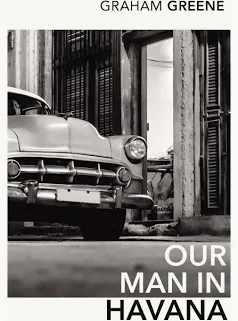
Our Man in Havana by Graham Greene, 1958
The central plot point of Graham Greene’s 1958 novel Our Man in Havana involves an unlikely spy, James Wormold, a middle-aged English vacuum salesman, making up details of secret military installations he claims are being built in the mountains outside Havana. Absurdly he sends his handlers in London detailed drawings of the rocket base using the schematics of the vacuum cleaners he sell, presciently named the Atomic Pile Suction Cleaner. What is strange is that I knew this detail before I opened the book, and it was one of the very few things I know about Greene’s work. But I found it frustrating that I can’t for the life of me remember how I knew that fact! There is a wider point here about how novels work their way into the cultural subconscious (so that, for example, Kate Bush could write a song about Wuthering Heights without ever having read the novel). I suspect the main reason this detail stuck in my head for so long (however it got there) is because of the way the novel strangely anticipated the 1962 Cuban Missile Crisis which brought the world to the brink of nuclear war.
The novel draws its humour from the gullibility of MI6. The central character, Wormold, is a vacuum cleaner salesman, selling only one company’s product (he seems to have only two different models of vacuum available). It shouldn’t matter, I know, but the idea of an Englishman selling vacuums in 1950’s Cuba just struck me as profoundly improbable. Who is buying these things? Greene himself had worked for British Intelligence during the war, and came to realise how easy it was for spies to file fictitious reports – who could check them for accuracy? This idea seems to have originated with the notorious case of Garbo, a Spanish double agent who pretended to have up to 27 agents working for him all over England, and who came to play an important role in misleading the Germans about the location of the 1944 landings. Greene wrote a first draft of the story in 1946 but it was the outbreak of the Cold War that gave the novel a new, more absurd, dimension.
The novel opens with our rather pathetic anti-hero struggling to keep his head above water, financially, mainly due to the demands of his spoilt teenage daughter. His wife has long since left him, leaving him to bring up his strictly Catholic daughter on his own. When he is clumsily approached by Hawthorne, an English spymaster, he becomes a spy himself almost accidentally. His initial doubts about the job are quickly overcome when he realises that this could be a lucrative profession if he recruits enough fictitious agents and claims enough expenses. His masterstroke comes when he concocts the idea of a secret mountain missile base using drawing of vacuum cleaner parts. Although British Intelligence is presented in this novel as incompetent and overly-trusting, it is very hard to see how else they could have dealt with the situation Wormold presents them with. They take his reports seriously – to do otherwise would have been reckless – and insist on him providing proof, suggesting different ways he can do so. They also send other agents out to Cuba to help him. That all seems fairly reasonable to me. Of course their main mistake is there inability to notice drawings of a vacuum clear when presented with them.
Up to the point at which Wormold starts his campaign of deception, the novel has been lightly comic, with Wormold being an accident-prone loser who is making things up as he goes along. He seems destined to be exposed as a fantasist at any point. But he reveals an inner strength when his improvised plans start to fall apart. Back in London, nobody knows he sells vacuum cleaners and has no reason to suspect his worrying reports. A secretary, Beatrice, and a radio assistant are sent out to join him and scale up his operation. As his lies become more outrageous Beatrice comes to suspect his elaborate fictions. She asks to speak to one of his agents, a pilot named Raúl. When a real-life pilot named Raul is killed in a ‘car accident’, but which is almost certainly an assassination, Wormold begins to panic. It is almost as if his lies are becoming reality and he sets out to save his fictional contacts, exposing himself to real danger while doing so. The reader is able to infer that his reports to London have been intercepted and decoded and his ‘operation’ is now under attack. Things get real very quickly and in the novel’s climax Wormold only narrowly escapes an attack on his own life.
An accidental spy who finds himself in the thick of an adventure, surviving encounters with assassins through dumb luck, sounds like a summary of a James Bond parody such as Johnny English or Austin Powers. Our Man in Havana was published only a few months after Dr No, the sixth in the James Bond series which started with Casino Royale in 1953 and seems to have been influenced by many of the tropes Fleming uses. I think it is best seen in this light – as a response to the portrayal of English spies as suave, sophisticated and almost unstoppable. But both Bond and Wormold get the girl in the end, and both beat the bad guys when it matters. Wormold discovers a surprising inner core when he and his family are threatened.
As I have mentioned several times before, I am not a massive fan of trigger/content warnings, but it comes as a shock when Greene uses the n-word in the novel’s opening sentence. The word is used casually by a character rather than the narrator and emphasises his background (he is a refugee from Germany). Other than the general contempt that British people casually treat all ‘foreigners’ in books from this period, the racism shown here does not reappear regularly, so if you can get past this instance you should be able to stick with the rest of the book. This is not Greene’s most sophisticated or complex novel and it is hard to warm to the principal characters, especially Wormold, but it has moments of light comedic touch, and is an interesting portrait of pre-revolutionary Cuba. Never has vacuum sales been more interesting.


Wonderful book from my favorite writer (at least one of them) and its also a great film.
LikeLiked by 1 person
Pingback: The Quiet American by Graham Greene, 1955 | The Reading Bug