
Nostromo, A Tale of the Seaboard, by Joseph Conrad, 1904
I came perilously close to abandoning Nostromo and it was only sheer bloody-mindedness that kept me going. This was a result of a combination of Conrad’s prose style and his poorly defined characters. I found the prose wooden and the characters spent far too much time pontificating about abstract concepts:
“Action is consolatory. It is the enemy of thought and the friend of flattering illusions. Only in the conduct of our action can we find the sense of mastery over the Fates”
or
“There is no peace and no rest in the development of material interests. They have their law, and their justice. But it is founded on expediency, and is inhuman; it is without rectitude, without the continuity and the force that can be found only in a moral principle.”
The novel’s cast of characters is wide, but many of them were often hard to differentiate from one another, especially given the frustrating practice of giving them multiple, interchangeable names (so for instance, the central character, Nostromo, is also known as Giovanni Battista Fidanza or Capataz de Cargadores). Conrad also adopts a narrative structure which eschews traditional chronology and tells some of the story in retrospect, some in the present. None of these techniques are objectively wrong or even particularly challenging, but Conrad’s execution of them is leaden. Although the novel is only 450 or so pages long it took me several weeks to read. You know you are struggling when you start to count the number of pages to go, and 20 pages read was a good day. To what extent this is my failure as a reader and Conrad’s as an author I cannot be sure.
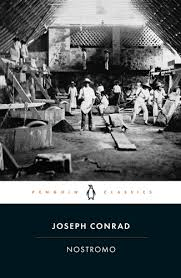
The first two hundred pages (almost half the novel) are a meandering build-up to the point in the story at which the action properly begins, revolving around the struggle over ownership and control of a silver mine in the fictional South American country of Costaguana. Costaguana is an archetypal South America banana republic, with a long history of political instability. Charles Gould owns Costaguana’s primary natural asset, a silver mine, near the port of Sulaco. Revolutionary force invade Sulaco with the aim of capturing the mine. Nostromo, the head longshoreman of the port, escapes with the mine’s recently retrieved cargo of silver. Nostromo, an Italian expatriate, is a leading figure in Sulaco, with influence among the wealthy Europeans who control much of the city, but also widespread support from the working people of the town. Accompanied by a journalist, Martin Decoud, Nostromo smuggles the silver out of Sulaco, but is only able to make it as far as a small island at the head of the harbour, where he and Decoud hide the silver. The revolutionaries and the resident townspeople all believe the silver has been lost at sea and after Nostromo swims back to shore he does nothing to make them think otherwise. He avoids capture by the revolutionaries and rides out to seek help from the Government forces.
A jump forward in time shows the reader that Nostromo’s intervention has led to the creation of the independent state of Sulaco, which is now prospering. He has kept the location of the silver a secret. His partner, Decoud, left stranded on the island with only the silver for company, eventually lost his mind and drowned himself weighed down with some of the silver ingots. Over time Nostromo slowly grows rich, ostensibly because of his successful trading, but mainly because he collects the silver a little at a time so as to not arouse suspicion. But wealth does not bring happiness. Several years pass, and the independent Government decides to construct a lighthouse on Great Isabel. Nostromo fears this will lead to the remaining silver being discovered, but there is little he can do other than keep a close eye on the construction. He recommends an old friend, the widower Giorgio Viola, as the lighthouse keeper. The novel concludes dramatically with the resolution of these plot lines, but I won’t give away the ending.
I have read that Nostromo was originally conceived as a short-story, but over time the novel expanded in scale and scope. This could have had something to do with the publication in instalments of course, but also explains its rambling unfocussed structure. Conrad apparently found writing it almost as difficult as I found reading it, saying “it is like a kind of tomb which is also hell where one must write, write, write.” Nostromo was not very popular or successful when it was first published, with many finding the plotting byzantine and over-elaborate. Online you can find many people praising the novel as the best ever written, but this is surely hyperbole. When I did eventually finish it was with more of a sense of relief than anything else.
 The Reading Bug