Book review

Herland by Charlotte Perkins Gilman, 1915

Herland is one of those novels that has been on the edges of my consciousness for a long time. I’ve known about it, known broadly what is is about, and always intended at some point to get round to it. Unlike a lot of people who take reading seriously I don’t have a literal ‘to be read’ list, but I do have a vague collection of tests that one day I intend to get round to. And for as long as I have been aware of it, Herland has been on that list. Published in 1915, when the Great War was well underway but America had yet to get involved, Herland begins as a traditional exploration/lost world novel: while on a journey of exploration in an unnamed continent, three American adventurers – Vandyck “Van” Jennings, Terry Nicholson and Jeff Margrave – hear of an isolated community that is peopled by women only, Eventually Van gets round to naming this community the rather reductive name of ‘Herland’ (we later hear that this community has been completely isolated for two thousand years, so how the tribes in the area would have heard of it is left unexplained). The explorers’ curiosity is piqued and they eventually return on a subsequent trip determined to track down this lost world. Authors such as Ryder Haggard or Conan Doyle would have lingered over the details of the
preparation for the trip, the extensive list of equipment needed, the hiring of guides, the journey inland and so on. Perkins Gilman has no interest in this element of the story, and within a few short paragraphs they are approaching Herland. Using a plane (that they have someone managed to bring with them), they surmount the impenetrable mountainous barriers around the country. We are not told where Herland is – the implication is that it is somewhere largely unexplored, and the surrounding countryside is populated by ‘savages’ but the ambiguity as to the country’s location is obviously intended to emphasise its universality. In any event, Van’s narration makes it clear that he has subsequently left Herland and returned to America, having committed to not reveal the location of the lost world.

Of course the arrival of a plane in a society isolated from the rest of the world for centuries is hardly likely to be unnoticed, and the explorers are quickly found by, initially by three young women who watch them from the treetops. Treating the women almost as prey, the men try to catch them, but they are easily outrun and then captured by a large group of women. They try to escape but are overpowered, drugged to stop them struggling, and taken to a nearby community.

From this point the body of the novel is comprised of the men’s captivity and education in the ways of Herland, which the author uses to outline the detail of the all-women society. Each man is assigned a tutor who teaches them their language while at the same time learning English. Van is a careful observer of all aspects of this new society, from the well-designed clothing they use to their agriculture and technology. But his real interest (and clearly, the main interest of the author) is in understanding how a women-only society has evolved and in what ways it is different from his own. In short, Herland is a feminist utopia. Everything is better. Conflict, inequality and criminality are things of the past, to the extent that the very concepts are no longer understood. Society has been finely tuned to allow all women to study and be creative. There are no masters and servants, bosses or slaves. No-one is overburdened with childcare or work. The traditional subservient roles of women in modern society have been forgotten – there is no-one to be subservient to. All of society’s practical problems have been mastered. By contrast the men’s accounts of their own world makes many of the practices of the outside world seem barbaric. Particular horror is shown at the very idea of abortion – a view which some modern critics have used to undermine Herland’s claim to be a feminist text, although surely the point is here about women’s loss of control of their fertility?

What is it about a women-only society that makes it so perfect? Or to put it another way, what is it about men that makes the outside world so damaged? The author suggests some answers to these questions but is surprisingly undidactic – the reader is left to join the dots themselves, even if the exercise isn’t that challenging. Free from the oppression of men and traditional female roles, women have evolved a near-perfect society. Women are respected and valued in this society, free from domestic servitude and male oppression. A key factor is their control over their fertility – the women can reproduce by parthenogenesis but choose to control their community’s population by having only one child each. Motherhood is a form of religion in this society, and children are cared for communally. No-one is worn out by having too many children or burdened by the cost of providing for large families. (This is surprisingly accurate – once women have control of their fertility, combined with lower infant mortality rates, birth rates drop dramatically.) But can this utopia survive the reintroduction of men? The author implies that this might be possible and that only some rather than all men are the problem. Of the three explorers, only one, Terry, finds the changes he faces in this society unbearable.

Over the course of the novel Van gradually finds out more information about the women’s society. He is told that a volcanic eruption 2000 years ago sealed off the only pass out of Herland, the only way of travelling to the outside world. The remaining men, mostly slaves, tried to take over but were killed by the women. Facing the end of their race a miracle occurs – one woman became pregnant without the intervention of a male partner, and went on to have five daughters, who in turn grew up to bear five daughters each. This women only society rapidly evolved strategies to survive their isolation and grew to prosper and flourish. Freed from the myriad the problems of society caused by women’s oppression the society find that many of the most deep-rooted problems such as criminality simply wither away and are forgotten.

Having had no contact with men for 2,000 years, the women have no experience or cultural memory of romantic love or sexual intercourse other than for the purposes of animal reproduction. They understand the mechanical process of mating, but the idea of sex for pleasure is unknown to them. This does not appear to be a society in which lesbian couples have formed – there is no mention or suggestion of this – and while it is never said so explicitly is is strongly suggested that all sexual urges have withered away. Therefore the men’s enthusiasm for marriage and sex (the author is not radical enough to suggest that one could happen without the other) is baffling to them. Although the men eventually form affectionate partnerships with three of the Herland ‘girls’, society appears to see this as an experiment in identifying any benefits from fatherhood rather than romances or expressions of love.

To be fair to the author, she doesn’t turn away from the question of sex, even though her freedom for discussing them directly was obviously limited. It would have been tempting I am sure to just have ignored the whole issue. She uses a wide range of creative euphemisms to discuss sex. Marriage is described by the women as “permanent mated love“. In an attempt to persuade the women to have sex with them, the men describe marital sex thus: “Why, to touch you, to be near you, to come closer and closer, to lose myself in you” and talk about “the sweet intense joy of married lovers“.

The women are puzzled by the concept of sex for pleasure rather than for procreation:

“Do you mean, she asked quite calmly, as if I was not holding her cool form hands in my hot and rather quivering ones “that with you, when people marry, they go on doing this in season and out of season, with no thought of children at all?”

Married love as an experiment in Herland is unsuccessful. After a short honeymoon period, Van’s wife Ellador withdraws from ‘married life’ and declines to have sex with him, explaining “If I thought it was really right and necessary I could perhaps bring myself to it, for your sake dear, but I do not want to, not at all. You would not have a mere submission, would you?”

Van and Jeff try to work these issues out with their wives, with Jeff seemingly accepting long-term celibacy as an option, but the more aggressive, impatient of the three, Terry, is uncompromising in his view of the submissive role of women in the bedroom and the rest of the relationship. When his partner Alima rejects his ‘advances’ he hides in her bedroom and “put into practice his pet conviction that a women loves to be mastered, and by sheer brute force, in all the pride and passion of is intense masculinity, he tried to master this woman“. In other words he tries to rape her. Van’s reaction is chilling: “In our country he would have been with quite within his rights of course….”[Crime]’s a pretty hard word for it. After all, Alima was his wife, you know.” Terry stands trial for his crime and is ordered to leave Herland. Van decides to accompany Terry but they are only allowed to leave Herland once they promise not to reveal its location. The novel ends abruptly at that point, with the subsequent adventures of Van, Terry and Ellador in the outside world told in the novel’s sequel With Her in Outland.

Following its publication Herland was almost completely forgotten and it was not until the re-printing of the author’s short-story, The Yellow Wallpaper in 1973, that readers began to rediscover Herland. For its time, Herland was extremely radical, daring to suggest that many of society’s problems originate with the subjugation of women, and even possibly that the problems originate with men alone. That may have been a step too far in a time when women still did not have the vote in the USA or the UK, but these were to happen very soon and formed part of significant changes to the role of women in society. There’s no reason to believe Herland contributed to these changes, but it is nonetheless one of the clearest descriptions of what a society without men might look like (even if it is told from the perspective of a male narrator rather than one of the society’s citizens). It is a treatise dressed up in novel form, where the story element of the text is minimal – very little happens once the men are captured, apart from a desultory escape attempt. But it has important things to say about the role of women in society and many of these messages remain starkly relevant today.

Herland by Charlotte Perkins Gilman, 1915

Aside
Book review

The Mercies, by Kiran Millwood Hargrave, 2020

The raw harshness of The Mercies is pretty unrelenting. Based on a real-life seventeenth century witch trial, Hargrave’s novel is either “an atmospheric tale of self-sufficient womanhood and sexual suspicion in a tight-knit island community” as the publisher would claim, or an extraordinarily bleak portrait of how awful life was for women and minorities in this period.

The first thread of the narrative is told by a young woman living in a small fishing community in Northern Norway, close to the Arctic Circle. It opens with a fierce storm (on Christmas Eve, just to rub it in) in which forty fishermen are drowned, watched from the cliff-tops by their womenfolk. The community – Vardo – is an island, largely isolated from the outside world. An already difficult, subsistence way of life suddenly becomes much harder. Word of the tragedy eventually reaches the outside world, but such is the state of public life in Norway in this period, the state’s reaction is to send them a priest, to make sure the women don’t get up to any inappropriate behaviour – such as going fishing to feed themselves. Women doing men’s work is seen by the Puritanism gripping the country to be ungodly, as is wearing trousers, not going to church, and just about any deviation from orthodoxy.

We are introduced to one of the complexities of social life at this time. The indigenous people – the Sami – live alongside the Christian incomers in this part of the world. There is some tension between the two communities but they have largely come to terms with one another. However, the new puritanism that has gained hold in Norway from across the sea in Scotland, where King James preaches against witchcraft, is being used to persecute the Sami and seize their property. It is clear that it is only a matter of time before any traditions relating to the Samis and their way of life become taboo.

The novel’s second narrative begins in Bergen, where a young woman, Ursa, is sold into marriage by her father. Because this is apparently common practice she accepts this servitude without protest. Her new husband immediately takes her with him on his journey to become the Commissioner of Vardo. He is on a mission to cleanse the community of heresy – in other words he is a witchfinder. Ursa’s husband rapes her nightly and of course there is no affection or connection of any kind between husband and wife. The impact of the Commissioner’s eventual arrival in Vardo is explosive and dangerous.

One of the many challenges writers must struggle with when constructing the plots of their novels is how to ensure that the ending doesn’t come as a complete out-of-the-blue surprise to the reader, but at the same time isn’t blindingly obvious. Give too many clues and the element of suspense is gone; give too few and the conclusion will feel like a deus ex machina. Sadly here the author flags the ending very early on. Without giving anything away, which is an approach the author does not adopt, the nature of the relationship between the two central characters is hinted almost immediately. The fact that the witchfinder quickly finds some witches will equally come as no surprise to any reader. One character sees the inevitable coming and flees the village – others are too stubborn to save themselves. Any element of suspense was stripped from the novel by this heavy-handed foreshadowing – it was a question of when things happened rather than whether.

There are other points of interest in the novel beyond the plot-lines and the stories of the two central characters. The evocation of a sense of place is powerful and I learnt more about seventeenth-century Norwegian fishing communities than I knew there was to be learnt. The characterisation was well done. The horrors of the treatment of women suspected of witchcraft was vividly hard to read. It all comes together into a strongly contemporary story of how women are persecuted when men feel threatened by their power. Sadly that message couldn’t be more relevant today. On that level The Mercies succeeds as a powerful reminder of the fundamental injustices women face in society. There’s no question its heart is in the right place. But I can’t say I really enjoyed reading The Mercies – I am not even sure I was supposed to.

Standard
Book review

“The presumption that what is male is universal is a direct consequence of the gender data gap. Whiteness and maleness can only go without saying because most other identities never get said at all. But male universality is also a cause of the gender data gap: because women aren’t seen and aren’t remembered, because male data makes up the majority of what we know, what is male comes to be seen as universal. It leads to the positioning of women, half the global population, as a minority. With a niche identity and subjective point of view. In such a framing, women are set up to be forgettable. Ignorable. Dispensable – from culture, from history, and from data. And so, women become invisible.”

It is difficult to read this book without succumbing to a sense of both rage and frustration. Rage at the endemic discrimination against women which seems hard baked into all areas of society, all deriving from the often-unacknowledged assumption that women are the

deviation from the male norm. And frustration at the speed of change in a society which has known about many of these issues for a long time but seems to have made little progress in addressing them.

“The result of this deeply male-dominated culture is that the male experience, the male perspective, has come to be seen as universal, while the female experience–that of half the global population, after all–is seen as, well, niche.”

The depth and range of research that went into this book is breath-taking. The author’s examples touch on almost every area of life, and consistently return to the same conclusion: women just haven’t been thought about when it comes to the design of the constructed world we live in. It is hard to pick representative examples from the book, but here goes: at Google, which likes to think of itself as a progressive company, they hadn’t realised that parking spaces for pregnant women shouldn’t be at the back of the car park until the Chief Operating Officer fell pregnant; when first launched the Apple Health app didn’t include a menstrual cycle tracker; car crash dummies are 1.7m tall, the size of the average man, leading directly to women being 47% more likely to be seriously injured if they are in a collision; the average smartphone is 5.5 inches long and is too big for most women’s hands; speech-recognition software is trained on recordings of male voices and therefore much more likely to understand men. I could go on – this is not a book short on evidence or examples.

But it doesn’t have to be like that. This is not just a collection of evidence, powerful though that would be on its own. It is a manifesto, a rallying call for change. It is not enough to just witness this inequality; we should not accept women being treated as an anomalous version of masculinity and data collection should recognise sex and always consider how men and women are impacted differently.

“Closing the gender data gap is only step one. The next, and crucial step, is for governments and organisations to actually use that data to shape policy around it. This isn’t happening.

(page 120)

I am well aware that it is going to seem churlish of me to write about one of the very few passages in this book that I disagree with, but I think the issue is sufficiently important to address. In Chapter 12 ‘A Costless Resource to Exploit‘, the author writes about the post-2010 General Election austerity policies of public sector cuts. She describes how these cuts fell on women particularly hard (although you could add people with disabilities, ethnic minorities, Scots, Welsh, Irish, Northerners and the working class to that list) and observes that by comparison “men in the richest 50% of households actually gained from tax and benefit changes since July 2015”. So, an ideologically hard-Right Government cuts benefits, attacks the poor and gives tax breaks to the middle classes – Criado Perez rightly asks “So why is the UK Government enacting policy that is so manifestly unjust?” Her answer I have to say made me splutter:

The answer is simple: they aren’t looking at the data”!!

Really? So it is not that there is a gender-gap in the data, which has been the central thesis of the book thus far, but that the Government and the thousands of civil servants that advise it have either chosen or forgotten to look at the data forecasting the impact of their cuts before implementing them. I can imagine George Osborne sitting in his office at the Evening Standard reading this chapter and saying “If only someone had told me that closing all those children’s centres, shutting down Sure Start, cutting funding to local Government, imposing the bedroom tax etc would have been damaging to working people and women in particular. If I had known that of course I wouldn’t have cut public spending and given tax breaks to the rich.”

This is important, because if we accept Criado-Perez’s idea that the problem is the data gap (which unquestionably exists in many areas) then the obvious remedy is to gather more data. That would no doubt help, but I struggle to believe that it would address the injustices in society on its own. Because there are plenty of situations where we have more than enough data, we just have politicians and people in power who choose not to use that data. Equal pay is an obvious example – we have a vast amount of data about how much people are paid, not least through the income tax system, yet the pay gap between men and women remains shamefully high. Do we need more data as to why that is, or do we just need to do something about it, and if so what? (Incidentally the Office for National Statistics has got a wonderfully detailed report on the gender pay gap on its website.)

Perhaps I am being unfair. Elsewhere the author is much more direct about the issue of whether the problem is missing data, or the willingness to use the data to confront inequality. It’s clearly both, and the motivations ascribed to the Government when imposing austerity were hyperbole.

The only other critical observation I would make is that Criado-Perez is inconsistent in her treatment of unpaid work. In Chapter 12 she points out that it is a political choice to exclude unpaid work, done largely by women, from measurements of national wealth and economic activity, usually expressed as GDP (gross domestic product). She illustrates how much GDP would increase in various countries if unpaid work was included in the measurement. But later she argues that

Increasing the amount of unpaid work women have to do (by closing children’s centres, for example) lowers their participation rate in the paid labour force. And women’s paid labour-force participation rate has a significant impact on GDP.”

Invisible Women, pages 245-6

Enabling women to undertake paid work by providing adequate childcare would only raise GDP if we exclude the economic value of unpaid work from that measurement? Otherwise women would just be swapping unpaid work in the home for paid work outside of it. The actual value generated would be neutral.

These points might seem like nit-picking, but there is a far more serious issue that goes unaddressed here. The author treats data as if it is neutral, objective, the elusive source of answers to any question if it is collected correctly or if just enough data is gathered. But it’s not. It is possible to frame or interpret data in many ways. It isn’t passive – the exact same data set can be read to mean entirely different things (we’ve all seen those drawings – is it a duck or a rabbit?). Data can be twisted to make difference seem less drastic, false correlations can be drawn, how data is collected and presented can make huge differences to what it appears to tell us, and of course numbers can be manipulated depending on the question asked. Ben Goldacre’s Bad Science has some fascinating evidence on this, showing how it is possible to manipulate the results of supposedly double-blind trials simply by how you select your participants. We have seen during the recent Covid 19 epidemic that it is possible to the collect and present data to show how successful the UK Government’s handling has been despite it being seen by the rest of the world as an unmitigated disaster. Data is political.

Criado-Perez doesn’t directly address transgenderism, but it is an underlying topic in many sections of the book. A book called Invisible Women needs a working definition of ‘women’ for starters. One of the structural responses to the public discussion of transgender issues has been the introduction of gender-neutral toilets in public spaces. Criado-Perez is not sure that this is the correct approach. Not only does it reduce the availability of toilets for women (because they need to use stalls) but:

“We have learned from so many mistakes in the past that women are at a greater risk for sexual assault and violence if they don’t have separate bathrooms” (quoting an Amnesty International official).

Page 303

And on the topic of transwomen competing in women’s sport, the author provides the following significant evidence (I have removed the half a dozen or so footnotes from this quote, which provide evidence for each of the statistics quoted, but they are there to be checked if required) :

“Upper-body mass is approximately 75% greater in men because women’s lean body mass tends to be less concentrated in their upper body, and, as a result, men’s upper body strength is on average between 40-60% higher than women’s (compared to lower-body strength which is on average only 25% higher in men). Women also have on average a 41% lower grip strength than men, and this is not a sex difference that changes with age: the typical seventy-year-old man has a stronger hand grip than the average twenty-five-year-old woman. It’s also not a sex difference that can be significantly trained away: a study which compared ‘highly trained female athletes’ to men who were ‘untrained or not specifically trained’ found that their grip strength ‘rarely’ surpassed the fiftieth percentile of male subjects. Overall, 90% of the women (this time including untrained women) in the study had a weaker grip than 95% of their male counterparts.

Food for thought.

This is not a book to be rushed, but one once read to keep on the shelf for reference. It should be compulsory reading for anyone in a position of authority whether in Government or private enterprise. It’s a landmark study that will be looked back on in decades to come, hopefully as a record of how we got things wrong in the bad old days.

Invisible Women: Data Bias in a World Designed for Men by Caroline Criado Perez, 2019

Aside
Book review

The Five – the untold lives of Jack the Ripper’s victims, by Hallie Rubenhold, 2019

The FiveThe central concept of this popular history book (by popular in this context I mean some of the claims are not as strictly evidenced as I would normally expect) is to tell the stories of the five “canonical” victims of the Ripper, the women generally accepted to be the victims of a single murderer operating in Whitechapel in 1888.

Inevitably the author cannot avoid drifting into speculation on how they came to their deaths, and it is here where the book has caused some controversy. Rubenhold disputes the widely held view that all of the victims were prostitutes. Her case seems strong here, although I haven’t read the counter-evidence which I am sure exists. She also argues powerfully that several of the women were killed while rough-sleeping; again this seems to make a lot of sense – they certainly were living a lifestyle where rough-sleeping would have been a necessity on occasion, even if the precise locations of their murders suggest unlikely places in which to bed down. 

But these issues are not the focus of the book. What the author aims to do is to tell these women’s stories – from their births to how they came to be on the street on those nights in 1888. What decisions and events led them there. If you knew nothing about these women and were to guess you would expect drink to play a part, and of course it does. Abusive relationships and personal tragedy are also involved. More widely the author is extremely strong on the social, political and economic context of the mid nineteenth century, including of course the housing and public health crises that were at the heart of these women’s tragic stories. Things were not all consistently bleak for these women – for example some of them were reasonably well educated for their class and generation. All had been in stable relationships (so far as we can tell) and had families from whom they had slowly been alienated. They were given support from employers, charities and housing associations. There was nothing inevitable about their deaths. 

In books of this kind one is always left wondering how much of the author’s reconstruction is speculation or educated guessing. A good example is the claim that Catherine Eddowes, the fourth victim, whilst selling pamphlets and so-called ‘gallows ballads’ was present at the execution of her cousin, Christopher Robinson, at Strafford in January 1866. The evidence that Catherine was present at the execution is flimsy to say the least, but here it is presented as unquestionable fact. (This is one issue were I took a quick look at some alternative sources). The other thing that is is hard to be clear on is how much of the text is the result of independent research, and how much is simply a reheating of existing knowledge about the victims. Because despite the widespread claim that this book is the first attempt to tell these women’s stories, there have been several previous such narratives, and there is arguably not much more to be found out.

Was this a genuine attempt to give a voice to these women, or yet another cynical exploitation of the frisson of excitement caused by the monstrous nature of the murders? I am happy to give the author the benefit of the doubt here. The narratives are all well-constructed, and the decision to end them at the point of the murders removes any hint of titillation. It was nice to see photographs of the victims others than on the mortuary slab. These photographs are remarkable, and if Rubenhold is the first historian to track them down (and I have no way of knowing if that is the case or not) then this in itself was a remarkable piece of historical detective work.

I think there was another way to give some value to these women’s lives, and that would have been to show how – if at all – their murders changed society. Did the way police investigate murders change? Did the way they treated vagrants and prostitutes change? Were the Whitechapel slums cleared? What, in other words, were the political and social impacts of the Ripper murders? But that’s obviously another book entirely.

Standard
Book review

The Handmaid’s Tale, by Margaret Atwood, 1985

The popularity of the television adaptation of The Handmaid’s Tale may have been what inspired Margaret Atwood to return to Gilead and the story of the eponymous handmaid Offred. (In the TV adaptation this character is called June, but so far as I can tell this name is not used in the book). It was certainly a factor in my decision to finally getting round to picking up this much-admired classic.

The Handmaid’s Tale is set the near future. A radical religious group, the “Sons of Jacob”, has captured power in the United States. The president has been assassinated, congress murdered, the constitution suspended, and the possession of jobs and separate bank accounts is forbidden to women. This is only the beginning of a dramatic overhaul of society in which all other religious groups are banned and a Talibanesque Old Testament-inspired model of society is imposed.

Declining birth rates caused by pollution and radiation mean that now only a few women are able to have children. These women are taken into slavery and forced to produce children for the ruling class of men, the “Commanders”. They are known as handmaids, a title derived from the story in Genesis of Rachel and her slave Bilhah. Women (and their children) are commonly treated as possessions in the Old Testament, and this inspires many of the new social structures and traditions in Gilead. All women have rigidly defined roles and and must follow a strict dress code: Commanders’ wives wear blue, handmaids red, and Marthas (servants) green.

The story is narrated by Offred, a 33 year old woman who records several months of her life as handmaid to a Commander and his embittered wife. As well as telling the reader about her imprisonment and the daily tortures she faces, she includes memories of her life before and during the revolution, which she describes as “The other time, the time before”. Life is brutal for almost everyone in Gilead, but the enslavement of women and the ritualised assaults for the purpose of breeding is particularly horrifying, even if Offred has slow begun to come to terms with her captivity. Her fond memories of times past provide some slight relief from the brutality of her new life.

Things improves marginally when the Commander begins to meet her secretly at night, not for sex, but to play Scrabble. This surprising development lightens the mood slightly and allows them to develop a less formal relationship. This is rule-breaking that could easily end badly for Offred, but she welcomes the hint of freedom it offers. She also agrees when the Commander’s wife, Serena, proposes that she tries to get pregnant by Nick, the family chauffeur, the implication being that the Commander may be sterile. At the same time Offred learns from her shopping partner, Ofglen, that there may be an underground resistance working to overthrow Gilead.

Offred’s narrative ends abruptly, leaving it unclear whether she has been taken into custody for her small acts of resistance, or whether she escapes Gilead. A mis-judged epilogue set in 2195 explains the events of the novel were recorded onto cassette tapes and are now considered an historic document charting the early years of the Republic of Gilead. While it appears a more equal society has now been restored, the lecturer is insensitive, treating the victims of the regime as a source for clumsy jokes. 

There are several disturbing aspects to this novel. It is utterly convincing in its demonstration how the injustices towards women in today’s society came to be the first step towards their enslavement in Gilead. Offred describes her life before the collapse of society as largely happy, but

“I never ran at night, and in the daytime only beside well-frequented roads. Women were not protected then. I remember the rules, rules that were never spelled out, but that every woman knew: don’t open your door to a stranger, even if he says he is the police. Make him slide his ID under the door. Don’t stop on the road to help a motorist pretending to be in trouble. Keep the locks on and keep going. If anyone whistles don’t turn to look. Don’t go into a laundromat, by yourself, or at night.”

In other words the seeds of Gilead and its oppression of women are inherent in today’s society. Another incident recounted in the novel emphasised this point. Offred describes a book-burning scene. But these are not nazis burning books about Marxism, but women burning hard core porn.

You see what things used to be like? That’s what they thought of women then!”

I think the author may be suggesting here that freedom of speech extends to even content we find offensive, and that once we start burning books or magazines because they are upsetting, we are on the path that lead to censorship. Atwood in other words is out to challenge the reader rather than present a scary story which we can walk away from knowing we are lucky not to live there.

There are some obvious parallels between The Handmaid’s Tale and George Orwell’s 1984. Both are set in a relatively near future in which people can remember and contrast life under the previous regime. Both envisage totalitarian control of society in which thought crime can be punished by death. Sex is strictly controlled by society and is used as an act of rebellion by the protagonists. War dominates daily life in both Gilead and Eurasia. The state spies on and tortures its opponents and punishes any deviation from the rules, and uses collective gathering, such as the daily hate or the Salvagings to keep the people in check. The novels even share the same feature of an epilogue or postscript looking back at the society from a more liberal future. The other characteristic the novels share is their approach to language. In 1984 language is under attack through the introduction of Newspeak, constantly being diminished to reduce the risk of thoughtcrime. In Gilead they take this further, so all writing and reading is forbidden to women (which is why seemingly mundane invitation to play Scrabble is so dangerous thrilling to Offred).

Doing a small amount of background reading I came across the shocking fact that this novel was short-listed but did not win the 1986 Booker prize, which was instead awarded to Kingsley Amis’s The Old Devils. Time has not been kind to that decision. I know hindsight is a wonderful thing but the judges of that award must look back with some shame. Instead of the Booker the Handmaid’s Tale won the inaugural Arthur C Clarke award in 1987, even though the novel is clearly not science fiction. My other brief attempt at research also threw up (choice of words intentional) this classic example of missing the point. Writing in the Spectator, the writer Allison Pearson claimed

“I only wish that Atwood would tell her fans that she is not writing, primarily at least, about the way that Trump’s America could go in the future, but about how things are right now for females in repressive Islamic societies. We are so blessed compared to them. To don a red dress and white bonnet, to pretend their suffering is ours, to talk of tyranny, is the most appalling moral vanity.”

Yes and no. Surely Atwood is writing about how women are treated in patriarchal society, not just one country or set of social conditions. She is unlikely to have been writing about Trump’s presidency in 1985 anyway! It’s easy to scan round the world, find a society you don’t like (the Spectator isn’t a fan of Islam) and identify ways in which women in that society are treated similar to those in Gilead. You can if you wish do the same for women in America denied the right to have an abortion. It’s not a competition – which society is the most repressive towards women – the problem is that they all are. And they all use the same reasons – that women are not safe when they are free. I think this slowly dawns on Pearson, because she ends on this peroration

Imagine a country where women have no jobs, no rights and are valued only for their reproductive success. Imagine a country where girls aren’t taught to read in case they get ideas. Imagine a country where boys eat lunch while girls have to wait. Imagine women having to cover themselves head to toe in case men get ideas. Sadly, we don’t have to imagine. There are millions of handmaids. The nightmare of Gilead is right here.

Her dislike of Islam overrides her need for consistency, because women wear head to toe clothing in many societies including the UK, women earn less than men, women face everyday sexism in the workplace, and the example of boys eating their lunch first is drawn for a reference earlier in the article to a school in the UK.

I am glad Atwood has returned to Gilead in The Testaments, which I look forward to reading. The Chaucerian echo in this novel’s title always suggested there were more tales to be told.


Standard
Book review, Discworld, Equal rites, fantasy, science fiction', Terry Pratchett

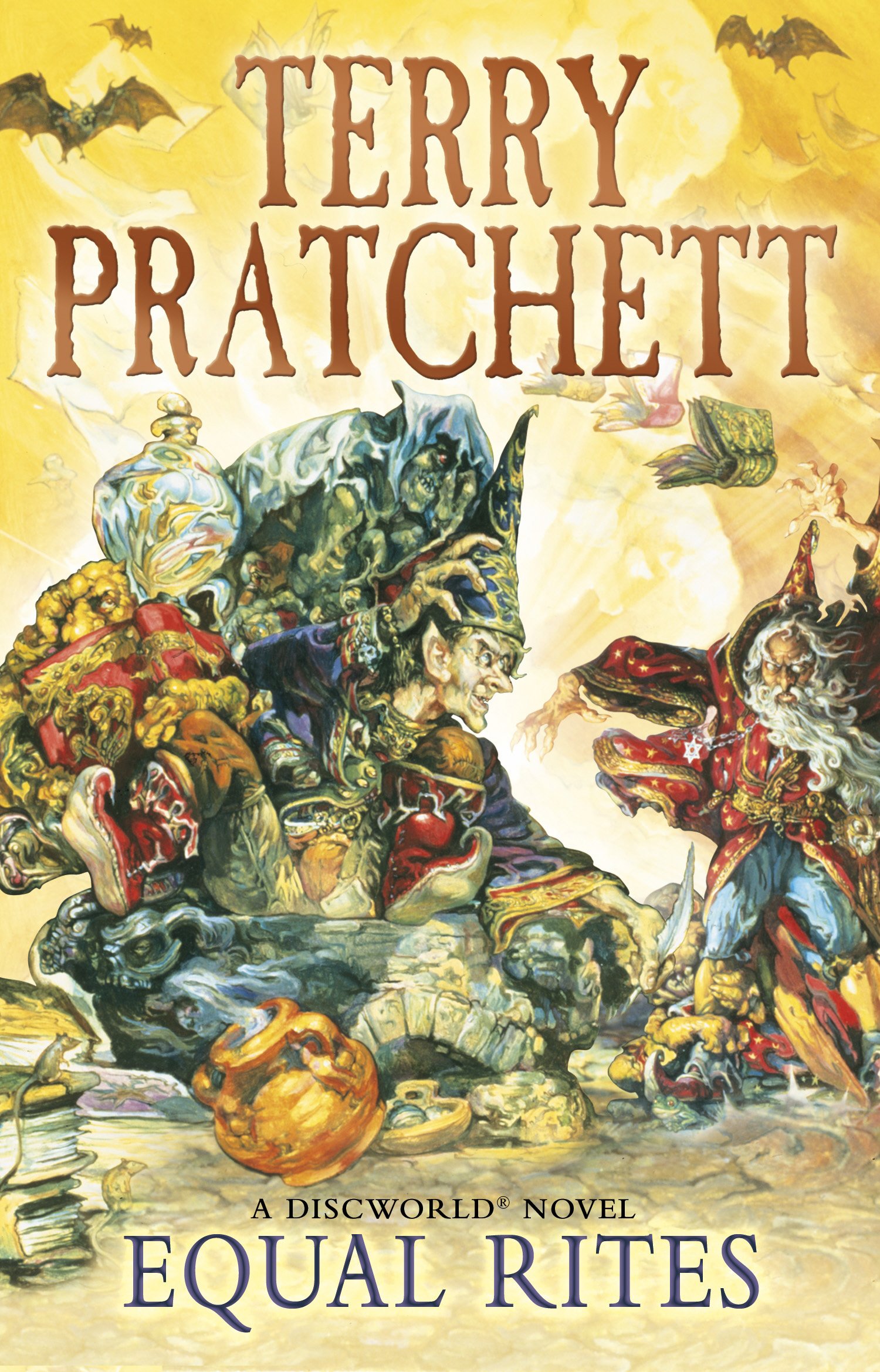
Equal Rites, (Discworld 3) by Terry Pratchett, 1987

Equal Rites’ is the third novel in the Discworld series. This is the novel where Pratchett really hits his stride. ‘The Colour of Magic’ and ‘The Light Fantastic’ are good, of course, but by comparison they felt a little childish when I was rereading them recently (see the reviews earlier in July). Some of the jokes in particular are quite crude, and the plotting is simplistic if not awkward – magic is used as the ultimate get out of jail card. Pratchett dips his toe in the waters of social issues, but quickly reverts to the frothy irreverent humour that is the trademark of these books.

Equal rites.jpg

‘Equal Rites’ is different in kind. It introduces the extraordinary, imperious Granny Weatherwax -‘I’m not a lady, I’m a witch’. This is going to sound like hyperbole, but if Terry Pratchett had not written about any other character his place in the pantheon of great writers would have been secured by his portrait of Granny Weatherwax. She is funny and kind and clever and wise and respected and seems almost a real person.

Granny Weatherwax was a witch. That was quite acceptable in the Ramtops, and no one had a bad word to say about witches. At least, not if he wanted to wake up in the morning the same shape as he went to bed.”

I also love her stubbornness:

She was also, by the standards of other people, lost. She would not see it like that. She knew where she was, it was just that everywhere else didn’t.”

Pratchett’s theory of magic – that a large part of it is in the head of the person on whom the magic is being performed – ‘headology’ – is cleverer than any system of runes mana or potions you find in other fantasy series.

“I saved a man’s life once,” said Granny. “Special medicine, twice a day. Boiled water with a bit of berry juice in it. Told him I’d bought it from the dwarves. That’s the biggest part of doct’rin, really. Most people’ll get over most things if they put their minds to it, you just have to give them an interest.”

The central question posed in ‘Equal Rites’ is why can’t a woman be a wizard? Eskarina Smith is accidentally given a wizard’s staff, and despite all efforts to the contrary is destined to be a powerful magical person – be that a witch, wizard, warlock, sourcerer, thaumaturge or otherwise. She is apprenticed to Granny Weatherwax, who soon realises the girl’s potential, and they set off on a classic road trip to try to gain access to Discworld’s only college for wizards, the Unseen University. Her application to join the university is dismissed out of hand, and a passionate battle for equal rights ensues, with only one winner ever being likely.

Given that female wizards are unheard of in Discworld, Granny has to get a bit creative, so Esk enters the university as a servant. She is reunited there with Simon, an apprentice encountered earlier on the route to Ankh-Morpork. Simon is, like Esk, a naturally talented wizard, but he loses control of his magic and accidentally opens a rift to the Dungeon Dimensions. As you can probably guess this is not a good thing. With the help of Granny Weatherwax, Archchancellor Cutangle, and Esk’s staff, Simon and Esk manage to defeat the demons and escape back to Discworld.

The ending of the novel is one of its weaker features – there is never any real sense of peril or doubt that Esk and Simon will escape unharmed from the Dungeon Dimensions – but who reads Pratchett novels for their plot? it was great to read what is in effect Granny’s origin story. I am really enjoying my rediscovery of early Discworld, watching it emerge and expand before my eyes. The next novel in the series, Mort, takes us to Death’s own domain – I can’t wait!

Standard