Book review

The Testaments, by Margaret Atwood, 2019

This review is going to get me into trouble, at home if nowhere else. Because The Testaments was such a disappointment! While living up to the standards of her earlier works was always going to be difficult, some elements of the novel were reminiscent of fan-fic – based in the world so chillingly described in The Handmaid’s Tale, but unevenly written with poorly conceived characters and an implausible plot.

Of course I could self-censor, write about the things in the novel that I did like – Gilead is no less a scary dystopia than it was before, and of course Atwood hasn’t become a bad writer overnight – but what would be the point of that? If this blog has any purpose at all it is to act as a place where I record my authentic impressions of what I read, not what I am supposed to think. Having said that, I also owe any author, let alone one of such distinguished status as Margaret Atwood, the effort of trying to recognise the strengths in their work. So let’s start there.

Atwood’s political analysis of the oppression of women hasn’t fundamentally changed from Handmaid’s, but it remains as sharp as ever. For example, where she identifies what made women particularly vulnerable when Gilead first took over:

“All that was necessary was a law degree and a uterus: a lethal combination.”

Young women growing up in Gilead are brain-washed into thinking their bodies are the source of all sin:

“We were precious flowers that had to be kept safely inside glass houses, or else we would be ambushed and our petals would be torn off and our treasure would be stolen and we would be ripped apart and trampled by the ravenous men who might lurk around any corner, out there in the wide sharp-edged sin-ridden world.”

What has changed from Handmaid’s is that Atwood identifies the role of women as instruments of their own oppression. Some women are zealots who seem to genuinely believe men are the stronger sex who have the right to control women’s bodies; others simply do what they have to do to survive. As Aunt Lydia tells us:

Two roads diverged in a yellow wood, and I took the one most travelled by. It was littered with corpses, as such roads are. But as you will have noticed, my own corpse is not among them.”

The threats to women’s autonomy remain as significant as they were when Handmaid’s was written – but arguably that just makes the original novel all the more pertinent rather than requiring a sequel. Atwood’s reasons for writing this follow-up may well be as much to do with the success of the television adaptation as a burning desire to explore further the complexities of Gilead. I can’t blame her for that, and to be fair she doesn’t just write Handmaid’s Tale 2.

The original novel has an ambiguous ending. We know, due to the appendix, that Gilead doesn’t survive, but we don’t know how the regime ends, and we know nothing about the fate of the central character, Offred. We don’t even know her real name. Atwood has returned to Gilead to answer some of these questions. The novel uses the always popular multi-narrator approach, threading the testimonies of three key women. We hear more from Aunt Lydia about the circumstances in which Gilead and its institutions were founded, how it survived despite conflict on all its borders, and how eventually it fell. I haven’t worked out a clear timeline for the events of the novel, but the whole period seems little more than a few decades from creation to fall.

We also learn about life outside Gilead, in Canada and elsewhere, and the efforts of Mayday, an underground organisation, to rescue women from Gilead. Their work is consciously modelled on the Underground Railroad.
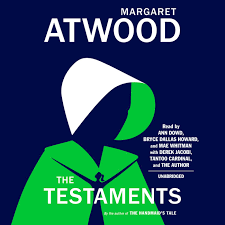
The Testaments by Margaret Atwood | Penguin Random House Audio

As well as Aunt Lydia’s narrative the novel interweaves testimonies – testaments – by two teenage girls, Agnes, the adopted daughter of Commander Kyle and his wife Tabitha, and Daisy, growing up in Toronto with her adoptive parents, Neil and Melanie, who run a second-hand clothes store. The three narrators alternate in short chapters which gave considerable pace to the narrative. It was obvious early on that the secrets about Daisy and Agnes’s parentage would be revealed, and how the threads of the narrative would eventually join.

Aunt Lydia is the dominant character in the novel – shrewd, knowledgeable, and a survivor. She is not above suspicion, but is able to manipulate (a little too easily) the characters around her to protect herself, while all the time working to undermine Gilead. The teenage girls show two completely different views of Gilead – Agnes has been born and raised in the country and has adopted its worldview unquestioningly. She has been taught that women must cover up to avoid inflaming male passions, and that reading is a source of sin. Her body is dangerous and she must be married at an early age to fulfil her purpose of having children. She is profoundly religious and keeps her faith even when her belief in the ideals of Gilead are shaken. Daisy on the other hand, having been raised in Canada, is an atheist and is opposed to everything Gilead stands for. She happily volunteers to go undercover into Gilead to recover some damning information about the regime, despite the obvious dangers.

Despite its status as a feminist novel of ideas, The Testaments works most effectively as an action novel. The climax of the narrative features a breathless escape from Gilead, with speedboats and helicopters thrown in for good measure, secret information hidden in a micro-dot (how very 1970’s!) hidden under one of the girl’s skin, disguised by a GOD/LOVE tattoo.

Atwood’s skill as a writer is without question, but her ability to craft a phrase stands out:

“The truth can cause a lot of trouble for those who are not supposed to know it.”
“how easily a hand becomes a fist.”
“No one wants to die…but some people don’t want to live in any of the ways that are allowed.”

That skill falters slightly when she writes as a teenage girl, where an element of inauthenticity appears. Would a teenage girl, even when writing in later life, write “Nobody is any authority on the fucks other people give“? Much quoted (in reviews) phrases such as “You don’t believe the sky is falling until a chunk of it falls on you” or “As they say, history does not repeat itself, but it rhymes” sound quite impressive on a first reading but I am not sure they actually mean anything.

So what’s the problem with The Testaments? I’ve touched on some of the issues above. But my main concern was with the action elements of the novel. Perhaps they would work better on television, but on the page they came across as a parody of a spy novel. What is more they didn’t really make any sense. I found Daisy’s decision to return to Gilead disguised as a Pearl Girl (a missionary) completely unconvincing, and Commander Judd’s decision to keep quiet about her return was baffling. Of all the people you would send back to Gilead to recover some vital intelligence, Daisy would be the very last choice. And once her return to Gilead was known why the Commander would keep it quiet and allow her to escape back to Canada I have no idea.

Other elements such as the casually announced death of one of the minor characters suggested a rush to end the novel and tie up loose ends without thinking through the detail. There were other signs of this, such as how trainee aunts, totally illiterate when they arrive at Ardua Hall in their mid teens, are fluent readers in a few months despite starting with modestly coloured-in Dick and Jane books.

Despite all this I enjoyed reading this novel. I recognise I should probably consider it on its own merits rather than as the sequel to an iconic classic. It’s ironic that this won the Booker rather than the original, which is probably the judges’ way of correcting history. I am pretty sure that Handmaid’s will be read in decades if not centuries to come as an important statement of protest at society’s treatment of women, while The Testaments will be remembered as a less interesting addendum.

Standard
Book review

The Handmaid’s Tale, by Margaret Atwood, 1985

The popularity of the television adaptation of The Handmaid’s Tale may have been what inspired Margaret Atwood to return to Gilead and the story of the eponymous handmaid Offred. (In the TV adaptation this character is called June, but so far as I can tell this name is not used in the book). It was certainly a factor in my decision to finally getting round to picking up this much-admired classic.

The Handmaid’s Tale is set the near future. A radical religious group, the “Sons of Jacob”, has captured power in the United States. The president has been assassinated, congress murdered, the constitution suspended, and the possession of jobs and separate bank accounts is forbidden to women. This is only the beginning of a dramatic overhaul of society in which all other religious groups are banned and a Talibanesque Old Testament-inspired model of society is imposed.

Declining birth rates caused by pollution and radiation mean that now only a few women are able to have children. These women are taken into slavery and forced to produce children for the ruling class of men, the “Commanders”. They are known as handmaids, a title derived from the story in Genesis of Rachel and her slave Bilhah. Women (and their children) are commonly treated as possessions in the Old Testament, and this inspires many of the new social structures and traditions in Gilead. All women have rigidly defined roles and and must follow a strict dress code: Commanders’ wives wear blue, handmaids red, and Marthas (servants) green.

The story is narrated by Offred, a 33 year old woman who records several months of her life as handmaid to a Commander and his embittered wife. As well as telling the reader about her imprisonment and the daily tortures she faces, she includes memories of her life before and during the revolution, which she describes as “The other time, the time before”. Life is brutal for almost everyone in Gilead, but the enslavement of women and the ritualised assaults for the purpose of breeding is particularly horrifying, even if Offred has slow begun to come to terms with her captivity. Her fond memories of times past provide some slight relief from the brutality of her new life.

Things improves marginally when the Commander begins to meet her secretly at night, not for sex, but to play Scrabble. This surprising development lightens the mood slightly and allows them to develop a less formal relationship. This is rule-breaking that could easily end badly for Offred, but she welcomes the hint of freedom it offers. She also agrees when the Commander’s wife, Serena, proposes that she tries to get pregnant by Nick, the family chauffeur, the implication being that the Commander may be sterile. At the same time Offred learns from her shopping partner, Ofglen, that there may be an underground resistance working to overthrow Gilead.

Offred’s narrative ends abruptly, leaving it unclear whether she has been taken into custody for her small acts of resistance, or whether she escapes Gilead. A mis-judged epilogue set in 2195 explains the events of the novel were recorded onto cassette tapes and are now considered an historic document charting the early years of the Republic of Gilead. While it appears a more equal society has now been restored, the lecturer is insensitive, treating the victims of the regime as a source for clumsy jokes. 

There are several disturbing aspects to this novel. It is utterly convincing in its demonstration how the injustices towards women in today’s society came to be the first step towards their enslavement in Gilead. Offred describes her life before the collapse of society as largely happy, but

“I never ran at night, and in the daytime only beside well-frequented roads. Women were not protected then. I remember the rules, rules that were never spelled out, but that every woman knew: don’t open your door to a stranger, even if he says he is the police. Make him slide his ID under the door. Don’t stop on the road to help a motorist pretending to be in trouble. Keep the locks on and keep going. If anyone whistles don’t turn to look. Don’t go into a laundromat, by yourself, or at night.”

In other words the seeds of Gilead and its oppression of women are inherent in today’s society. Another incident recounted in the novel emphasised this point. Offred describes a book-burning scene. But these are not nazis burning books about Marxism, but women burning hard core porn.

You see what things used to be like? That’s what they thought of women then!”

I think the author may be suggesting here that freedom of speech extends to even content we find offensive, and that once we start burning books or magazines because they are upsetting, we are on the path that lead to censorship. Atwood in other words is out to challenge the reader rather than present a scary story which we can walk away from knowing we are lucky not to live there.

There are some obvious parallels between The Handmaid’s Tale and George Orwell’s 1984. Both are set in a relatively near future in which people can remember and contrast life under the previous regime. Both envisage totalitarian control of society in which thought crime can be punished by death. Sex is strictly controlled by society and is used as an act of rebellion by the protagonists. War dominates daily life in both Gilead and Eurasia. The state spies on and tortures its opponents and punishes any deviation from the rules, and uses collective gathering, such as the daily hate or the Salvagings to keep the people in check. The novels even share the same feature of an epilogue or postscript looking back at the society from a more liberal future. The other characteristic the novels share is their approach to language. In 1984 language is under attack through the introduction of Newspeak, constantly being diminished to reduce the risk of thoughtcrime. In Gilead they take this further, so all writing and reading is forbidden to women (which is why seemingly mundane invitation to play Scrabble is so dangerous thrilling to Offred).

Doing a small amount of background reading I came across the shocking fact that this novel was short-listed but did not win the 1986 Booker prize, which was instead awarded to Kingsley Amis’s The Old Devils. Time has not been kind to that decision. I know hindsight is a wonderful thing but the judges of that award must look back with some shame. Instead of the Booker the Handmaid’s Tale won the inaugural Arthur C Clarke award in 1987, even though the novel is clearly not science fiction. My other brief attempt at research also threw up (choice of words intentional) this classic example of missing the point. Writing in the Spectator, the writer Allison Pearson claimed

“I only wish that Atwood would tell her fans that she is not writing, primarily at least, about the way that Trump’s America could go in the future, but about how things are right now for females in repressive Islamic societies. We are so blessed compared to them. To don a red dress and white bonnet, to pretend their suffering is ours, to talk of tyranny, is the most appalling moral vanity.”

Yes and no. Surely Atwood is writing about how women are treated in patriarchal society, not just one country or set of social conditions. She is unlikely to have been writing about Trump’s presidency in 1985 anyway! It’s easy to scan round the world, find a society you don’t like (the Spectator isn’t a fan of Islam) and identify ways in which women in that society are treated similar to those in Gilead. You can if you wish do the same for women in America denied the right to have an abortion. It’s not a competition – which society is the most repressive towards women – the problem is that they all are. And they all use the same reasons – that women are not safe when they are free. I think this slowly dawns on Pearson, because she ends on this peroration

Imagine a country where women have no jobs, no rights and are valued only for their reproductive success. Imagine a country where girls aren’t taught to read in case they get ideas. Imagine a country where boys eat lunch while girls have to wait. Imagine women having to cover themselves head to toe in case men get ideas. Sadly, we don’t have to imagine. There are millions of handmaids. The nightmare of Gilead is right here.

Her dislike of Islam overrides her need for consistency, because women wear head to toe clothing in many societies including the UK, women earn less than men, women face everyday sexism in the workplace, and the example of boys eating their lunch first is drawn for a reference earlier in the article to a school in the UK.

I am glad Atwood has returned to Gilead in The Testaments, which I look forward to reading. The Chaucerian echo in this novel’s title always suggested there were more tales to be told.


Standard