
Bliss by Peter Carey, 1981
Initially I thought Bliss, Carey’s first novel, might be interesting in the way authors’ early work often is, giving an insight into the author they are going to become. Northanger Abbey for example is in some ways quite an unremarkable novel, but it does show glimpses of the writer who was going to go on and give us Pride and Prejudice. Would it still be in print if it was the only novel written by Austen? Possibly not (although comments in defence of NA are more than welcome!)
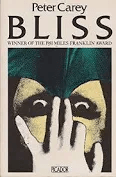
But Bliss is much more than just an early novel of an author showing promise. It is a mature, complex work – had I not know it was Carey’s first I would never have been able to tell. There are characteristics of his work in terms of complexity and also thematically, but few signs of immaturity or anything else to show this is a first novel.
All the reviews of Bliss I have been able to find on the internet agree on one thing – this is a darkly comic novel. While that’s a fair observation it is a lot more than that. The novel’s central character is Harry Joy, an Australian advertising executive. At the start of the novel, Harry suffers a near-fatal heart attack and for a few minutes he is technically dead. When revived he becomes convinced that he is still dead and is now in Hell. The world he once knew— his wife Bettina, his children, and his job in the advertising industry— now feels hellish and grotesque. He is convinced that his family and friends are devils acting as part of his torture. This delusion is aggravated when he simultaneously discovers his wife is having an affair with his business partner and his teenage children are having incestuous, exploitative sex. How can that world not be hell? Seen through this new lens Harry re-evaluates his life. He decides to walk away, seeking the ‘bliss’ of the novel’s title with Honey Barbara, a free-spirited hippie and environmentalist who lives in an off the grid community.
Bliss is a not particularly subtle satire of consumer society; at one point Harry agonises over whether to work with petroleum companies knowing their products are harmful – they eventually are revealed to have given his wife cancer. Harry only comes to life when he walks away and moves to the hippie commune. Bliss is both tragic and redemptive. Harry’s quest for spiritual rebirth brings him a form of peace but he loses his family in the process. Can genuine happiness – “bliss”— only be achieved by rejecting the trappings of modern life?
When Bliss was first published, it was hailed as a major breakthrough in Australian fiction. It won the Miles Franklin Award and was adapted into a film and even an opera. It is one of the strongest first novel’s I have read in quite some time and a clear indication of the author’s abilities, a promise fulfilled in novel’s such as the Booker Prize winning The True History of the Kelly Gang.

