
The Dumb Waiter, by Harold Pinter, 1957/1960
I think I am going to try and read, and review, more plays this year, even though I remain steadfast in my view that plays are for watching not reading. Sure you can read them, but in doing so you could easily miss much of the nuance and subtlety of a play that would be brought out in performance.
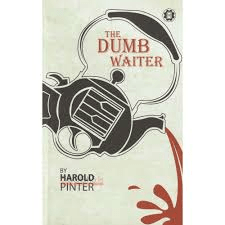
Just to explain the dates above, the internet tells me that The Dumb Waiter was written in 1957 but not performed until 1960. Either way that makes it one of Pinter’s earliest works. It is a short one-act play in which two men, Ben and Gus, wait in a basement. Ben, apparently the senior member of the two, reads a newspaper, while Gus fusses around nervously. Tea is mentioned but never quite made. As their conversation progresses it emerges that they are hit-men, waiting for an assignment and instructions on who to kill. Their conversation is dominated by mundane, everyday nonsense such as the difference between the phrase ‘light the kettle’ and ‘put on the kettle’. There is almost a vaudeville, back and forth element to their conversation, but at the same time there is a sinister undertone.
Pinter’s stage directions are very detailed and one of the reasons for this emerges when the men realise that at the back of the room is a dumbwaiter, a small lift for carrying food between floors. The waiter starts to deliver a series of food orders, as if to a restaurant kitchen – at first for plain café food – soup of the day, liver and onions, jam tart – and then for more complex orders – macaroni pastistsio, ormitha macaroundada, and scampi. Ben and Gus are dumbfounded by this turn of events, but are so used to doing what they are told that they send up what food they have – milk, biscuits, crisps and chocolate – in a pathetic attempt to comply. . In production I can imagine that this part of the play would be essentially comic, but on the page the tragic element also comes across – they are unable to understand what is happening to them, but still try to do their best. Next to the dumb waiter is a speaking tube which they try to use to communicate with whoever is sending down the orders, but to no avail.
In a break from the dumb waiter’s interruptions, the men start to rehearse the impending assassination, which complies with a strict sequences of events. In doing so they casually but shockingly reveal that their last ‘job’ was to kill a girl.
The impact of Beckett’s Waiting for Godot on this early work by Pinter is immediately obvious – two anonymous characters waiting in a remote location for something to happen, passing time with inane chat that reveals their concerns about their purpose in life. There is no conventional narrative or storyline (although in Pinter’s play there is a dramatic denouement) and absurd and unexplained events challenge the characters’ ideas. Long periods of silence allow space for the claustrophobic tension of the setting to develop. The Dumb Waiter is often produced alongside another of his one-act plays, but I can’t help wonder whether a contrasting text – something by Joe Orton for example – might work as effectively? If you want to read more British post-war plays then The Dumb Waiter is an excellent starting point. Pinter was a key figure in post-war British drama and went on to be awarded the Nobel Prize for literature in 2005, being cited for work that “”uncovers the precipice under everyday prattle and forces entry into oppression’s closed rooms”.

