
No-one writes to the Colonel, by Gabriel Garcia Marquez, 1958
No One Writes to the Colonel is a long short story or short novella, coming in at under 70 pages. Famously Marquez said that he had to write One Hundred Years of Solitude so that people would read No One Writes to the Colonel. Which is really a throwing down of the gauntlet, challenging any reader who admires his longer form work to love this short story.
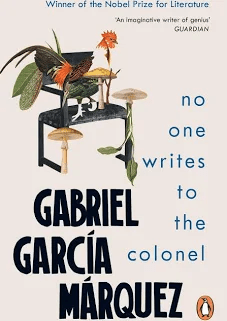
An unnamed retired Colonel, a veteran of earlier Colombian wars, lives in poverty with his wife and his rooster. The rooster has been bred to fight on cock-fights, and could potentially be worth a lot of money, either in prize money or sold on to other trainers. The rooster previously belonged to the colonel and his wife’s son, who has been killed in the political violence gripping the country.
For fifteen years the Colonel been waiting for the Government pension he was promised (or perhaps more accurately he believes he was promised, because his lawyer seems to be very unsure of his eligibility). Every week he meets the mailboat and each week he is sent home empty handed, because no-one writes to the Colonel. His wife has asthma, making their daily lives all the more difficult and miserable. The story opens with the colonel preparing to go to the funeral of a town musician. The reader is told that this death is significant because he was the first to die from natural causes in many years. Initially it is unclear why natural causes deaths should be so unusual, but it soon becomes apparent that most other deaths have been as a result of political violence. Their small village is under martial law – there is a nightly curfew at 11, and the funeral procession is forbidden from passing in front of the police station.
The centre of the story is dominated by the decision as to whether or not to sell their prize rooster. Potentially it could be very lucrative once the cock-fighting season starts in the new year, but they have to find a way to get through the winter first and without jobs or the long-awaited pension, they fear they may starve before that happens. So they are forced to consider selling the rooster for well below its actual value just to survive. There is also the complication that the rooster itself eats a lot of corn, taking food out of their mouths. The Colonel’s wife sometimes has to boil stones to try to convince their neighbours that they have something to eat. So this is not a community where the old and hungry feel able to ask for help from others – whether or not that help would be offered.
Despite the eternal non-appearance of his pension, the Colonel still lives in hope, hope that one day a letter will arrive, one day his rooster will win. The story ends on a defiant upbeat note. Having decided to keep the rooster until the cock-fighting season starts, he is berated by his wife who asks
“And meanwhile what do we eat?”.
“It had taken the Colonel seventy-five years – the seventy-five years of his life, minute by minute – to reach this moment. He felt pure, explicit, invincible at the moment when he replied:
‘Shit.'”

