
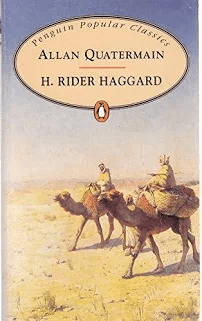
Allan Quatermain, by H. Rider Haggard, 1897
“I have just buried my boy, my poor handsome boy of whom I was so proud, and my heart is broken. It is very hard having only one son to lose him thus, but God’s will be done. Who am I that I should complain? The great wheel of Fate rolls on like a Juggernaut, and crushes us all in turn, some soon, some late—it does not matter when, in the end, it crushes us all
Allan Quatermain is the sequel to King Solomon’s Mines and the second novel in a series of adventures for the eponymous hero (although chronologically it is the last in the series). It sees our hero reunited with Captain Good and Sir Henry Curtis, his original travelling companions in adventure in KSM. The novel opens on the shockingly downbeat note above – Quatermain’s son Harry has just died of smallpox, contracted in a hospital where he was working as a doctor. Quatermain is understandably devastated and decides to abandon the sedentary life of a country gentleman and return to where his heart lies, Africa, in search of one last great adventure. Good and Sir Henry decide on the spot to join him, and no sooner said than done, the gang is back together again, on their way to lands unknown.
One of the many conventions of the adventure novel of the late nineteenth and early twentieth century (and still seen in films today) was that however large the continent being explored, the adventurers always almost immediately bump into someone they know. Here Quatermain and party meet Zulu chief Umslopogaas on their arrival in Africa and persuade him and his small group of soldiers to join them. Umslopogaas is an interesting portrait, the very definition of the ‘noble warrior’ trope that recurs throughout this genre. Although he is defined by racist ideas about the savagery of African tribesmen, it is not an unsympathetic portrait – in fact Umslopogaas is a hero and role model, loyal to Quatermain and fearless in battle.
Thus assembled the explorers set out from the coast of east Africa into the unknown. They have heard of a lost race of white- or light-skinned people who they decide to track down. Again Rider Haggard is relying safely on another trope of the genre, the ‘lost race’ story where explorers journey into isolated, uncharted territory and discover an undiscovered or hidden civilisation. The rumours of the lost race are always borne by someone who escapes from the lost world and survives an exhausting journey, only to expire almost as soon as his story is told. Thus:
“I was sitting on the veranda, when a poor, miserable, starved-looking man came limping up and squatted down before me. I asked him where he came from and what he wanted, and thereon he plunged into a long rambling narrative about how he belonged to a tribe far in the north, and how his tribe was destroyed by another tribe, and he with a few other survivors driven still further north past a lake named Laga. Thence, it appears, he made his way to another lake that lay up in the mountains, ‘a lake without a bottom’ he called it, and here his wife and brother died of an infectious sickness—probably smallpox—whereon the people drove him out of their villages into the wilderness, where he wandered miserably over mountains for ten days, after which he got into dense thorn forest, and was one day found there by some white men who were hunting, and who took him to a place where all the people were white and lived in stone houses…. he seems, according to his account, to have gone through sufferings and hardships innumerable, and to have lived for weeks on roots and berries, and such things as he could catch and kill. But somehow he did live, and at last by slow degrees made his way south and reached this place.”
As soon as his story is told his end is nigh:
“I told him to return on the morrow, bidding one of my headmen look after him for the night. The headman took him away, but the poor man had the itch so badly that the headman’s wife would not have him in the hut for fear of catching it, so he was given a blanket and told to sleep outside. As it happened, we had a lion hanging about here just then, and most unhappily he winded this unfortunate wanderer, and, springing on him, bit his head almost off without the people in the hut knowing anything about it, and there was an end of him and his story about the white people”.
But first they have to travel through Maasai territory. Following a violent quarrel with their bearers, the group find that are being tracked by a Maasai war party intent on punishing them. They seek sanctuary at the home of a Scottish missionary, Mr. Mackenzie, who has established a very civilised home in the deep jungle. As well as building a heavily fortified and extensive mission house, Mackenzie has tamed the jungle and established a small oasis of ‘civilisation’. It is described as being like a Garden of Eden, full of plants imported from the UK:
“We been walking up the slope of the hill, the lower portion of which was fenced off, sometimes with quince fences and sometimes with rough stone walls, into Kaffir gardens, just now full of crops of mealies, pumpkins, potatoes, etc. In the corners of these gardens were groups of neat mushroom-shaped huts, occupied by Mr Mackenzie’s mission natives, whose women and children came pouring out to meet us as we walked. Through the centre of the gardens ran the roadway up which we were walking. It was bordered on each side by a line of orange trees, which, although they had only been planted ten years, had in the lovely climate of the uplands below Mt Kenia, the base of which is about 5,000 feet above the coastline level, already grown to imposing proportions, and were positively laden with golden fruit…. What a garden it was! I have always loved a good garden, and I could have thrown up my hands for joy when I saw Mr Mackenzie’s. First there were rows upon rows of standard European fruit-trees, all grafted; for on top of this hill the climate was so temperate that nearly all the English vegetables, trees, and flowers flourished luxuriantly, even including several varieties of the apple, which, generally, runs to wood in a warm climate and obstinately refuses to fruit. Then there were strawberries and tomatoes (such tomatoes!), and melons and cucumbers, and, indeed, every sort of vegetable and fruit…. I do not think I ever saw such roses, gardenias, or camellias”.
The not-so-subtle message here is that Imperialism can tame and bring order to the wildest of environments. This little England is threatened when Mr. Mackenzie’s daughter is kidnapped by the Maasai war party who demand the life of one of the Britons as ransom. Instead they counterattack, and using their rifles and guns are able to defeat the much larger group, slaughtering every one of them and feeding them to the crocodiles. That’s the sentence for threatening a white woman. Mackenzie’s cook, Alphonse, a cowardly French cook, joins the party at this point, and for the rest of the novel fulfils a straightforward comedic role of the ‘funny foreigner’.
Following this short break they push on into the interior. Another trope is quickly upon them. The race of white-skinned people they are searching for live in an area of Africa isolated by mountains and other impenetrable geographical features, as is almost always the case. Compare for example the Lost World which is cut off from the outside world by virtue of being on a volcanic plateau, Shangri-La in a hidden Himalayan valley or Herland on another of those isolated and unscalable plateaus that litter the African landscape.
The party accidentally find their way into this region by canoeing along an underground river, through which they find the lost world of Zu-Vendis. Zu-Vendis is ruled by two queens, sisters Nyleptha and Sorais. While this society is an absolute monarchy, the peace is kept by a precarious alliance between the powerful priesthood and another group of wealthy feudal lords. The novel reaches its climax when both sisters fall in love with Curtis, and his choice of one over the other triggers a bloody civil war.
Allan Quatermain is a guilty pleasure, an unashamed adventure novel. If at times it seems a bit ‘by the numbers’ with a lot of predictable elements, this in part is because the author originally established many of the tropes he uses. I am sure that other, earlier authors wrote about lost tribes, noble savages and so on, but Rider Haggard is the founding father of the genre. He is unapologetically imperialist – or at least Quatermain is. He boasts about the vast amount of elephants he has shot without a hint of regret or remorse. To the Englishmen in this novel black lives, with a few exceptions, are disposable. All of the Wakwafi soldiers who sign on to join the party with Umslopogaas are killed off during the journey, but none are named nor mourned and their deaths are passed over casually. Even the portrait of Alphonse, intended as comical, is at this distance racist. So this is a period piece that has not aged well and I have no doubt I would never have read it if it wasn’t part of a second-hand bookshop bargain haul. But at the same time I don’t regret doing so either. In part this is because books of this genre were part of the standard reading material (of boys in particular) when I was growing up, and nostalgia is a powerful force, but also gaining a better understanding of how the world was seen by many Europeans in the late nineteenth century is a useful means to appreciate the nature of imperialism. It’s still escapism of course – while Quatermain and friends were exploring a fictional Africa of maybe a hundred years earlier, the reality of imperialism was being exposed in novels such as Conrad’s Heart of Darkness. The contrast is stark.

