Book review

The trouble began long before June 9, 1976, when I became aware of it, but June 9 is the day I remember. It was my twenty-sixth birthday. It was also the day I met Rufus – the day he called me to him for the first time.

Dana and Kevin have just moved into their new apartment in Los Angeles, California. Out of nowhere, Dana starts to feel dizzy and faint, and before she knows it…

“The house, the books, everything vanished. Suddenly I was outdoors kneeling on the ground beneath trees. I was in a green place. I was at the edge of a woods. Before me a was a wide tranquil river, and near the middle of that river was a child, splashing, screaming….Drowning!”
Dana has been transported to somewhere where she is needed, where she can save the life of the drowning child, whose name we later find out is Rufus. But the boy’s parents are not grateful – far from it, they seem to think Dana is responsible for his accident – the father aims a shotgun at her and angrily confronts her. She fears for her life, and in that moment she is transported back to her apartment, where a puzzled Kevin tells her that only moments have passed.

At first the reader thinks they are in a simple time travel novel, where the principal character is summoned into another time and place to intervene in the life of someone with whom they have some kind of connection. Yes and no, because in a moment of dreadful realisation Dana finds out something terrible about the challenge fate has presented her with – the time she is travelling back to is the 1820’s, in the South of the United States of America, and Dana is black. The young boy whose life she is fated to save – she is summoned from the present every time his life is at risk – is the son of a slave-owner. He lives on a plantation. Worse, Dana has no control over when she is summoned nor when she is returned. She works out that she will return to her own time – where time passes at a completely different rate from that in the 1820’s, so several months can pass in the past but only hours in the present – when her own life is threatened. She cannot choose when to return, and putting her own life deliberately at risk seems far too dangerous.

The only positive side to this appalling situation is that, unlike the form of time travel in the Time Traveller’s Wife (for example) she is able to take objects with her into the past, anything she happens to be touching at the time she is summoned, including her partner Kevin. She quickly assembles a small bag of useful items, including a knife and some painkillers, knowing she could be whisked back to the nineteenth century at any time. I would have been tempted to take a gun, preferably a rifle, but I am probably taking the time travel conventions a little too literally! On her subsequent journey to the 1820’s Kevin goes or is taken with her, and after she saves the young man’s life once again, the plantation owner assumes Dana is Kevin’s slave. Dana, recognising names from the family tree in her bible, quickly works out that Rufus is one of her distant relatives, and that she needs to keep him alive long enough for him to father one of her ancestors. But Rufus is white, and she is not, horrifyingly suggesting that the ancestor she is waiting to arrive is the product of an abusive relationship between slave-owner and enslaved.

Novels that attempt to portray the horrors of slavery are faced with an immediate challenge – how to convey the many terrible things that happened – the brutality of every day life, the appalling treatment of the enslaved, the families torn apart by slave-owners simply for monetary gain – without looking away or in any way softening the edges of the realities of the form of chattel slavery of this period, but at the same time not making the novel impossible to read, capturing the reality of what living through this period must really have been like. To take someone from the 1970’s and transplant them into this environment is a brilliant way of making the reader imagine what being in this time must have been like – these are no longer long-dead people who it is easy to think of as statistics, but real, living family members and friends.

Butler takes one step further than just presenting afresh the trauma of slavery, by asking the question – how does one accommodate oneself to living in that situation, living as an enslaved person? Dana is trapped in the nineteenth century for long periods, too far away from the Northern states where slavery was no longer practised or widespread (slavery in the Northern states of the USA ended gradually over several decades; Vermont banned slavery in 1777 and Massachusetts in 1783; other Northern states passed gradual emancipation laws that freed existing slaves slowly, meaning complete freedom for all enslaved people in the North took until the early-to-mid 1800s – and even then ‘runaways’ were subject to the punitive conditions of the Fugitive Slaves Act). Dana is forced to come to terms with the conditions and compromises of her enslavement. Her partner Kevin is trapped in this time period for several years when she is returned to the twentieth century unexpectedly and this experience changes him as well (Dana perceives) even though he commits himself to helping runaway and escaped slaves.

Quite early on Rufus learns of Dana’s origins – he can hardly find a natural explanation for her appearing out of thin air every time his life is at risk – and has to accept the undeniable supernatural element of her existence. Dana slowly comes to an understanding with Rufus – he depends on her to save his life, therefore he must treat her with respect and care for her, protecting her from the unstable temper of his father. But time and again Rufus’s contempt for black people resurfaces – he never gets out of the habit of using the n-word for example, even though he knows he needs Dana to save his regularly threatened life (Rufus is very accident-prone!).

Kindred has an incredibly strong narrative structure. The reader (or this one at least) cares for and wants to find out what happens to Dana, Kevin and even Rufus. I understand why the author included a prologue which effectively spoils the ending of the novel for the reader – we know some important details about the outcome of the novel through this short opening chapter – but personally I don’t think it added anything and removed much of the suspense from the novel’s ending and I would have not used it had I been the author. But even though this is a very strong story, that’s not the primary reason for this being such a ‘must read’ – that derives from its unblinking portrait of the horrors of American chattel slavery.
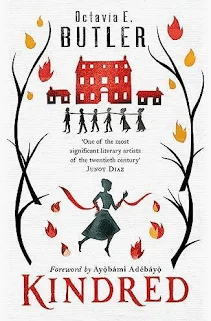
Kindred by Octavia Butler, 1979

Aside
Book review

Parable of the Talents is a strange combination of disparate elements that never quite come together. There’s the standard economic collapse/breakdown in social order dystopia theme, which in many ways is the core of the novel. This ground was quite well covered in the first novel in the series, Parable of the Sower. The future is bleak, particularly for the poor, for women and people of colour. More than bleak, it’s nightmarish. There’s also an extended commentary – a parable if you will – on religious extremism in the USA. Despite the violence and anarchy America is still able to hold a presidential election, which sees the arrival of the demi-Trump, President Jarret. The temptation to draw comparisons between any fictional ‘bad’ President and Trump is hard to resist – Sinclair Lewis’s It Cant Happen Here for example, or Philip Roth’s The Plot Against America, but here the similarities are overwhelming, even down to the choice of slogan, Make America Great Again. Did Trump or his followers actually read this novel and think ‘that looks great, let’s do that!’? The playbook they use is also very similar – use extremist elements as the stormtroopers of the movement, easy to disown if things go wrong, but pretty useful if some heads need smashing. And the appeal to the working man looks the same: “Even some of the less religious ones support him. They say the country needs a strong hand to bring back order, good jobs, honest cops and free schools’.

The science fiction element of the novel – Butler is best known as a sci-fi writer – is tacked on uncomfortably to the main narrative, and never really integrated, despite the author’s best efforts to bring the elements together. This is a thankless task, because when society is breaking down probably the last thing people are interested in is an attempt to colonise space.

Parable of the Talents is principally narrated by Lauren Oya Olamina, who we met in Parable of the Sower. Each chapter is prefaced by comments written much later by her daughter Larkin, which reveal much of the eventual outcome of Lauren’s story and serve to remove some of the tension from the narrative. Lauren’s husband Bankole also narrates briefly. The novel ostensibly consists of present tense diary entries written by Lauren and recovered (somehow) many years later, on which Larkin provides commentary. When the novel opens five years have passed since the founding of Acorn, the community set up to provide shelter for the group Lauren was travelling with. Acorn has become an Earthseed community, which is based on the non-theistic ideas developed in the previous novel, that God is Change and that humanity’s destiny is to live on other planets. These are dangerous ideas when Christian fundamentalist is on the rise in the form of “Christian America” led by President Andrew Steele Jarret. Slavery has been reintroduced with “shock collars” being used to control the enslaved. 

When Acorn was first established the core members of the group expressed doubt that it would survive in such harsh times. Their doubts are proven correct when the community is attacked by Jarrett’s ‘Crusaders’ and turned into a prison, and the community’s children are taken away for adoption in ‘good’ Christian families. The parallels between this society and the slavery of eighteenth and nineteenth century America is unavoidable. Read as an account of the horrors of slavery with all manner of degradation forced upon the slaves is the most difficult part of the novel, and while we know from Larkin’s comments that Lauren and her group eventually escape their enslavement, there is no conventional happy ending on the horizon.

Is the novel a parable, and if so of what? I find that difficult to answer. The parable of the talents, in which servants are given money (talents) by their master, and achieve very different things with what they are given, is an interesting companion story to the parable of the sower. The moral of the (biblical) story is I believe that we are given the same opportunities in life, and it is up to us to make the most of them. Which is palpably not what happens in this novel, where people are oppressed and suffer despite their very best efforts to carve safe spaces out for themselves. So I found the ‘message’ if there is one, confusing.

On the other hand it is obviously a lot clearer that Butler had little good to say about fundamentalist Christianity, which is a source of evil in the novel. Lauren’s continuing attempts to found her own religion, Earthseed, is ostensibly the novel’s most positive thread, but I found the verses used to introduce Earthseed theology at the opening of each chapter tedious and intrusive. Are we supposed to identify with Lauren’s ideas? Without doubt she suffers for them, but there is another way of looking at the novel, a perspective hinted at by Lauren’s brother Marc, who joins Jarret’s Christian America church. It could be argued that Lauren is as much a monster as Jarrett. She is intolerant of dissent and is entirely comfortable with killing her guards when the opportunity presents itself. All of them. One has his throat bitten out. She pursues her vision of Earthseed with the same fervour as Jarrett proselytises fundamentalist Christianity. It’s not a competition to be the more terrible, and Lauren suffers through most of the novel, but it’s also not as simple as good versus evil. Giving Marc chapters to narrate from a totally different perspective helps emphasise this point.

The novel closes on a positive note, with society returned to normal, Earthseed flourishing, and the first tentative steps being made towards fulfilling mankind’s destiny of interstellar travel. How the world went from barbarism to advanced technology in a few decades isn’t the most convincing aspect of the novel, but it does set up a sequel, which Butler was sadly never to write.

This is not a novel for the younger reader. I have a pretty strong stomach for scenes of violence etc, but even I found points where I had to remind myself that it was only a book and that the extreme violence being inflicted upon the characters wasn’t real. There’s so much suffering inflicted on women and children, relentlessly with no promise of escape or redemption. If you can get through that, and the dull poetry about Earthseed, there is still plenty to be derived from this very different novel.

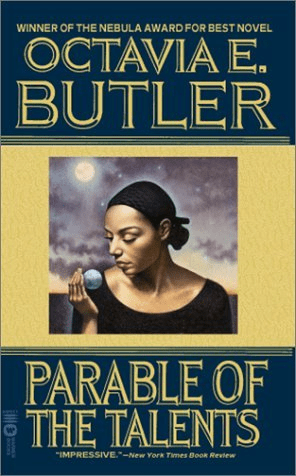
Parable of the Talents by Octavia Butler, 1998

Aside
Book review

Most dystopian fiction is set after the collapse of civilisation. In some instances it is set a long time in the future, where science has helped rebuild society (see Brave New World, for example). Other works imagine a society where social order has broken down and a new world has yet to emerge. Often the collapse of society is envisaged as happening very quickly – a virus breaks out and before you know it people are killing one another over fresh water and food. John Christopher’s 1950’s novel The Death of Grass is an early example of this genre. But occasionally novelists conclude that the disintegration of society is going to take a little bit longer. Parable of the Sower is one such novel.

Parable of the Sower is told by Lauren Olamina, a fifteen-year-old girl living in the greater Los Angeles area in 2024. (Incidentally that’s a similar time gap – just over thirty years between the date of the novel’s publication and its setting – that Orwell used in 1984 – 1949-1984. This gives the novel a sense of immediacy and recognition that a setting centuries in the future would lose.) Lauren’s father is a pastor and is one of the few remaining people in their society with a paid job – he teaches at a nearby college. Her family live in a walled community and the residents go outside its walls only rarely. Outside public order is breaking down, fuelled by poverty, an indifferent privatised police force, ecological collapse and widespread drug abuse, in particular ‘pyro’, which turns users into pyromaniacs. Lauren concludes that the regular attacks on her community will get worse – while they are armed and willing to defend themselves, the desperation and recklessness of those outside the walls means that sooner or later their community will fall. Lauren studies the skills needed to survive in the outside and prepares resources to take with her. She develops a plan to go north where there are jobs and better social conditions, but doesn’t have time to put this plan in place before the inevitable happens and their compound is destroyed.

A further complication is that Lauren has a condition called hyperempathy, caused by a drug her mother took when she was carrying her. She feels other people’s pain (and pleasure) as if it is her own. She keeps this condition as secret as possible, knowing that it will be seen as a weakness and exploited by others, She keeps a journal – this novel – in which she slowly develops the basis of a new religion she calls ‘Earthseed’. Earthseed is a variation of eastern mysticism that is predicated upon the idea that God is Change. What makes it different from other ‘mother nature’ forms of religion is the idea that the eventual future of humans is to explore the stars. This seems a quite redundant idea given the challenges people face in the present and while the last remaining space exploration programmes are being cancelled by the newly elected President. At least for now the country has a elections and a President.

The torture and murder of Lauren’s brother Keith is a clear warning sign that the end is imminent. Keith had run away from home and joined a gang, but this is a wildly dangerous life and he obviously ran out of luck at some point. Months later Lauren’s father goes missing, another unavoidable sign, but still the community trusts that its walls and guns will protect them. It’s no surprise when the narrative jumps forward to the point when the pyro-addicts attack and almost everyone is killed. Lauren escapes with Harry and Zahra, two community members who she didn’t know very well before but who now become her sole surviving ‘family’. They decide to trek north to find work and safety – although while travelling they are extremely vulnerable to marauders and pyromaniacs, they have a handgun and enough money to survive. On the road others join their group, finding strength in numbers. Lauren tells the group about her nascent new religion and her plans to start a community. They head for a property owned by one of their group and despite several attacks by addicts and the many dangers of the road, they finally reach their new home, which they call Acorn. The novel ends at this point, with key members of the group concluding that they have only a slim chance that their new community will survive.

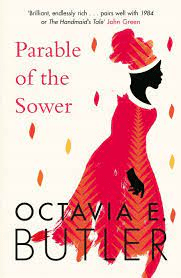
At some points Parable felt in ‘Young Adult’ territory, particularly the empathetic teenage narrator and the vague eco-religious themes. But the violence (including rape and cannibalism) is pretty graphic, and there’s not much in the novel’s marketing to suggest that it was specifically aimed at a young adult audience. (Having said that the front cover’s quote from John Green (obviously a very popular young adult author) recommending that the novel “pairs well with 1984 or the Handmaid’s Tale” feels like a strong hint to readers looking for companion texts to these standard A level novels.) This is probably a case of the publishers covering all possible market bases.

Butler was primarily a science fiction author, but this isn’t really a science fiction novel, despite the setting. It’s an eminently recognisable portrait of the USA facing ecological and social collapse, with a number of interesting ideas in play. Lauren is the sower in this novel and the parable label encourages the reader to interpret the novel metaphorically – despite the hyper-realism of some scenes. The parable of the sower from which the novel draws its title always interested me, because it is often misunderstood. If you are not familiar with the parable itself the Wikipedia article on it is here. It appears in three of the four gospels and includes a careful explanation from Christ – god’s message is the seed, and we are the ground upon which it falls. Whether the seed prospers or not depends on us. So little possibility of ambiguity? And yet the parable is often understood to be a message of acceptance – whether we prosper or wither away is a matter of chance, depending on whether we (the seed) land on rich or barren soil. You can see why people would be encouraged to read the parable that way – accept your fate in life, the rich man in his castle, the poor man at his gate etc.

Parable is an entertaining, highly readable version of the very familiar end of the world story. Lauren is an erudite guide to events even if she sometimes makes silly mistakes. Not having a designated meet-up point if everything goes wrong once is daft, but to do it twice is unforgiveable. She convictions about Earthseed are something we just have to accept rather that it being an logical conclusion drawn from her observations about the world. The final third of the novel is rushed – people join the group quickly and there’s little time to introduce them before the next gunfight. Late in the novel Lauren also finds out that her condition is not as rare as she thought it was – it is hinted that it is being deliberately spread to make modern slavery more easily reintroduced. The author doesn’t do much with the concept of hyperempathy – it’s just a condition Lauren has to put up with. There are other interesting ideas within the narrative – corporate takeovers of coastal communities for instance – which also peter out. But despite these qualifications I enjoyed the novel enough to immediately order the sequel as soon as I finished, which is a pretty good sign!

Parable of the Sower by Octavia Butler, 1993

Aside