
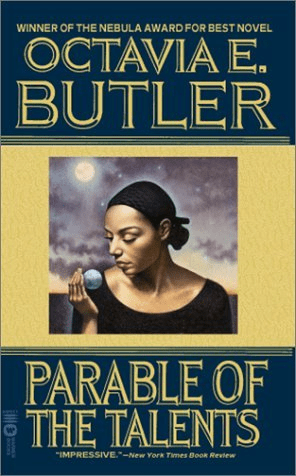
Parable of the Talents is a strange combination of disparate elements that never quite come together. There’s the standard economic collapse/breakdown in social order dystopia theme, which in many ways is the core of the novel. This ground was quite well covered in the first novel in the series, Parable of the Sower. The future is bleak, particularly for the poor, for women and people of colour. More than bleak, it’s nightmarish. There’s also an extended commentary – a parable if you will – on religious extremism in the USA. Despite the violence and anarchy America is still able to hold a presidential election, which sees the arrival of the demi-Trump, President Jarret. The temptation to draw comparisons between any fictional ‘bad’ President and Trump is hard to resist – Sinclair Lewis’s It Cant Happen Here for example, or Philip Roth’s The Plot Against America, but here the similarities are overwhelming, even down to the choice of slogan, Make America Great Again. Did Trump or his followers actually read this novel and think ‘that looks great, let’s do that!’? The playbook they use is also very similar – use extremist elements as the stormtroopers of the movement, easy to disown if things go wrong, but pretty useful if some heads need smashing. And the appeal to the working man looks the same: “Even some of the less religious ones support him. They say the country needs a strong hand to bring back order, good jobs, honest cops and free schools’.
The science fiction element of the novel – Butler is best known as a sci-fi writer – is tacked on uncomfortably to the main narrative, and never really integrated, despite the author’s best efforts to bring the elements together. This is a thankless task, because when society is breaking down probably the last thing people are interested in is an attempt to colonise space.
Parable of the Talents is principally narrated by Lauren Oya Olamina, who we met in Parable of the Sower. Each chapter is prefaced by comments written much later by her daughter Larkin, which reveal much of the eventual outcome of Lauren’s story and serve to remove some of the tension from the narrative. Lauren’s husband Bankole also narrates briefly. The novel ostensibly consists of present tense diary entries written by Lauren and recovered (somehow) many years later, on which Larkin provides commentary. When the novel opens five years have passed since the founding of Acorn, the community set up to provide shelter for the group Lauren was travelling with. Acorn has become an Earthseed community, which is based on the non-theistic ideas developed in the previous novel, that God is Change and that humanity’s destiny is to live on other planets. These are dangerous ideas when Christian fundamentalist is on the rise in the form of “Christian America” led by President Andrew Steele Jarret. Slavery has been reintroduced with “shock collars” being used to control the enslaved.
When Acorn was first established the core members of the group expressed doubt that it would survive in such harsh times. Their doubts are proven correct when the community is attacked by Jarrett’s ‘Crusaders’ and turned into a prison, and the community’s children are taken away for adoption in ‘good’ Christian families. The parallels between this society and the slavery of eighteenth and nineteenth century America is unavoidable. Read as an account of the horrors of slavery with all manner of degradation forced upon the slaves is the most difficult part of the novel, and while we know from Larkin’s comments that Lauren and her group eventually escape their enslavement, there is no conventional happy ending on the horizon.
Is the novel a parable, and if so of what? I find that difficult to answer. The parable of the talents, in which servants are given money (talents) by their master, and achieve very different things with what they are given, is an interesting companion story to the parable of the sower. The moral of the (biblical) story is I believe that we are given the same opportunities in life, and it is up to us to make the most of them. Which is palpably not what happens in this novel, where people are oppressed and suffer despite their very best efforts to carve safe spaces out for themselves. So I found the ‘message’ if there is one, confusing.
On the other hand it is obviously a lot clearer that Butler had little good to say about fundamentalist Christianity, which is a source of evil in the novel. Lauren’s continuing attempts to found her own religion, Earthseed, is ostensibly the novel’s most positive thread, but I found the verses used to introduce Earthseed theology at the opening of each chapter tedious and intrusive. Are we supposed to identify with Lauren’s ideas? Without doubt she suffers for them, but there is another way of looking at the novel, a perspective hinted at by Lauren’s brother Marc, who joins Jarret’s Christian America church. It could be argued that Lauren is as much a monster as Jarrett. She is intolerant of dissent and is entirely comfortable with killing her guards when the opportunity presents itself. All of them. One has his throat bitten out. She pursues her vision of Earthseed with the same fervour as Jarrett proselytises fundamentalist Christianity. It’s not a competition to be the more terrible, and Lauren suffers through most of the novel, but it’s also not as simple as good versus evil. Giving Marc chapters to narrate from a totally different perspective helps emphasise this point.
The novel closes on a positive note, with society returned to normal, Earthseed flourishing, and the first tentative steps being made towards fulfilling mankind’s destiny of interstellar travel. How the world went from barbarism to advanced technology in a few decades isn’t the most convincing aspect of the novel, but it does set up a sequel, which Butler was sadly never to write.
This is not a novel for the younger reader. I have a pretty strong stomach for scenes of violence etc, but even I found points where I had to remind myself that it was only a book and that the extreme violence being inflicted upon the characters wasn’t real. There’s so much suffering inflicted on women and children, relentlessly with no promise of escape or redemption. If you can get through that, and the dull poetry about Earthseed, there is still plenty to be derived from this very different novel.
 The Reading Bug