
Most dystopian fiction is set after the collapse of civilisation. In some instances it is set a long time in the future, where science has helped rebuild society (see Brave New World, for example). Other works imagine a society where social order has broken down and a new world has yet to emerge. Often the collapse of society is envisaged as happening very quickly – a virus breaks out and before you know it people are killing one another over fresh water and food. John Christopher’s 1950’s novel The Death of Grass is an early example of this genre. But occasionally novelists conclude that the disintegration of society is going to take a little bit longer. Parable of the Sower is one such novel.
Parable of the Sower is told by Lauren Olamina, a fifteen-year-old girl living in the greater Los Angeles area in 2024. (Incidentally that’s a similar time gap – just over thirty years between the date of the novel’s publication and its setting – that Orwell used in 1984 – 1949-1984. This gives the novel a sense of immediacy and recognition that a setting centuries in the future would lose.) Lauren’s father is a pastor and is one of the few remaining people in their society with a paid job – he teaches at a nearby college. Her family live in a walled community and the residents go outside its walls only rarely. Outside public order is breaking down, fuelled by poverty, an indifferent privatised police force, ecological collapse and widespread drug abuse, in particular ‘pyro’, which turns users into pyromaniacs. Lauren concludes that the regular attacks on her community will get worse – while they are armed and willing to defend themselves, the desperation and recklessness of those outside the walls means that sooner or later their community will fall. Lauren studies the skills needed to survive in the outside and prepares resources to take with her. She develops a plan to go north where there are jobs and better social conditions, but doesn’t have time to put this plan in place before the inevitable happens and their compound is destroyed.
A further complication is that Lauren has a condition called hyperempathy, caused by a drug her mother took when she was carrying her. She feels other people’s pain (and pleasure) as if it is her own. She keeps this condition as secret as possible, knowing that it will be seen as a weakness and exploited by others, She keeps a journal – this novel – in which she slowly develops the basis of a new religion she calls ‘Earthseed’. Earthseed is a variation of eastern mysticism that is predicated upon the idea that God is Change. What makes it different from other ‘mother nature’ forms of religion is the idea that the eventual future of humans is to explore the stars. This seems a quite redundant idea given the challenges people face in the present and while the last remaining space exploration programmes are being cancelled by the newly elected President. At least for now the country has a elections and a President.
The torture and murder of Lauren’s brother Keith is a clear warning sign that the end is imminent. Keith had run away from home and joined a gang, but this is a wildly dangerous life and he obviously ran out of luck at some point. Months later Lauren’s father goes missing, another unavoidable sign, but still the community trusts that its walls and guns will protect them. It’s no surprise when the narrative jumps forward to the point when the pyro-addicts attack and almost everyone is killed. Lauren escapes with Harry and Zahra, two community members who she didn’t know very well before but who now become her sole surviving ‘family’. They decide to trek north to find work and safety – although while travelling they are extremely vulnerable to marauders and pyromaniacs, they have a handgun and enough money to survive. On the road others join their group, finding strength in numbers. Lauren tells the group about her nascent new religion and her plans to start a community. They head for a property owned by one of their group and despite several attacks by addicts and the many dangers of the road, they finally reach their new home, which they call Acorn. The novel ends at this point, with key members of the group concluding that they have only a slim chance that their new community will survive.
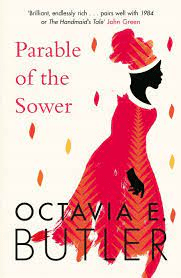
At some points Parable felt in ‘Young Adult’ territory, particularly the empathetic teenage narrator and the vague eco-religious themes. But the violence (including rape and cannibalism) is pretty graphic, and there’s not much in the novel’s marketing to suggest that it was specifically aimed at a young adult audience. (Having said that the front cover’s quote from John Green (obviously a very popular young adult author) recommending that the novel “pairs well with 1984 or the Handmaid’s Tale” feels like a strong hint to readers looking for companion texts to these standard A level novels.) This is probably a case of the publishers covering all possible market bases.
Butler was primarily a science fiction author, but this isn’t really a science fiction novel, despite the setting. It’s an eminently recognisable portrait of the USA facing ecological and social collapse, with a number of interesting ideas in play. Lauren is the sower in this novel and the parable label encourages the reader to interpret the novel metaphorically – despite the hyper-realism of some scenes. The parable of the sower from which the novel draws its title always interested me, because it is often misunderstood. If you are not familiar with the parable itself the Wikipedia article on it is here. It appears in three of the four gospels and includes a careful explanation from Christ – god’s message is the seed, and we are the ground upon which it falls. Whether the seed prospers or not depends on us. So little possibility of ambiguity? And yet the parable is often understood to be a message of acceptance – whether we prosper or wither away is a matter of chance, depending on whether we (the seed) land on rich or barren soil. You can see why people would be encouraged to read the parable that way – accept your fate in life, the rich man in his castle, the poor man at his gate etc.
Parable is an entertaining, highly readable version of the very familiar end of the world story. Lauren is an erudite guide to events even if she sometimes makes silly mistakes. Not having a designated meet-up point if everything goes wrong once is daft, but to do it twice is unforgiveable. She convictions about Earthseed are something we just have to accept rather that it being an logical conclusion drawn from her observations about the world. The final third of the novel is rushed – people join the group quickly and there’s little time to introduce them before the next gunfight. Late in the novel Lauren also finds out that her condition is not as rare as she thought it was – it is hinted that it is being deliberately spread to make modern slavery more easily reintroduced. The author doesn’t do much with the concept of hyperempathy – it’s just a condition Lauren has to put up with. There are other interesting ideas within the narrative – corporate takeovers of coastal communities for instance – which also peter out. But despite these qualifications I enjoyed the novel enough to immediately order the sequel as soon as I finished, which is a pretty good sign!

