
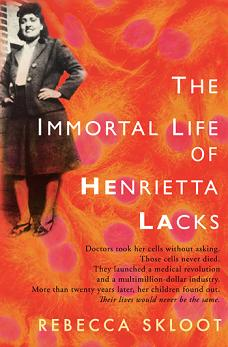
The Immortal Life of Henrietta Lacks by Rebecca Skloot, 2010
The premise of this book is that the extraordinary story of Henrietta Lacks – and more specifically, her cells which (for reasons I am still not clear about) continued to multiply after they were removed from her body, shortly before her death from cancer in 1951 – needs to be told. In other words, that this is the most
comprehensive account of Henrietta’s life, death, and subsequent ‘life’. But you don’t have to read very far into “The Immortal Life” to establish clearly that is an overstatement – in fact one of the complaints of Henrietta’s surviving family is that they are constantly being badgered for interviews by journalists and scientists. Skloot’s account may well be the most comprehensive but it is not a revelation of a lost story. Since 1996 the main School of Medicine in Atlanta has held an annual Women’s Health Conference in recognition of Henrietta and “the valuable contribution made by African Americans to medical research and clinical practice”. In 1996 the mayor of Atlanta declared a ‘Henrietta Lacks Day’. In 1997 U.S. Congressman Robert Ehrlich presented a congressional resolution recognizing Lacks and her contributions to medical science and research. Also in 1996 the BBC made a documentary about Henrietta’s story, ‘The Way of all Flesh’. Skloot writes that the documentary team “covered the Lacks family story in more detail than anyone ever had, filling dozens of hours of interviews”. In other words, hers is a very well known and comprehensively researched story and the suggestion that this account is anything other than a detailed retelling – albeit with some new elements relating to Henrietta’s family – is misleading. Which is a pity because this is a perfectly worthwhile retelling, as far as it goes, just not anything revolutionarily new. To be fair I have to accept that I can’t pin down a quote where this claim is made explicitly, but it is strongly implied throughout the text, as well as the presentation and marketing of the book.
Henrietta’s story is definitely worth retelling. She came from a literally dirt-poor African American family only two generations away from slavery. Brought up by her grandmother and married at 14 to a cousin, she grew up in an America where African Americans had few civil rights. She was only 31 years when she died in 1951 in a “coloured ward” in hospital in Baltimore. She left behind a husband and five children – and a slice of her tissue, cut from the cancer that went on to kill her. These cells duplicated and kept on duplicating despite being outside a host living organism. Scientists had known this was technically possible, and I am not sure if Henrietta’s cells were the first ever kept alive in this way, but they were undoubtedly the most prolific. The cells went on to be used across the world in numerous different laboratories and environments, including being sent into space. Their origins were largely forgotten. An industry developed around the production of these cells and it seems as if the question of compensating Henrietta’s family and heirs for her extraordinary, if entirely accidental contribution to medical research simply didn’t occur to anyone.
Henrietta’s family are as much a part of this story as her own short life. Her deaf daughter, Elsie, was committed to an institution despite there being any evidence of mental illness. The hospital she was committed to sounds an incredibly grim place. Henrietta’s other children grew up without much in the way of parenting and suffered horrible abuse from family members. Skloot invites us to pity this resilient family, suggesting that they struggled to understand the difference between their mother’s death and the survival of her cells – “Nobody round here ever understood how she dead and that thing still living. That’s where the mystery’s at” – which feels… improbable. Henrietta’s youngest son Joe served time for homicide and remains a menacing presence in this narrative, but the central role is taken by Deborah, Henrietta’s daughter, whose obsession with her mother’s legacy comes to dominate the final chapters of the book. Whether that would have been the case without Skloot’s intervention is unclear, but it’s no surprise that in the television film adaptation of this book it was this role that was taken by Oprah Winfrey rather than Henrietta herself. Skloot even goes so far as to suggest that Deborah believed her mother had been cloned and that she was suffering the pains of all the diseases that her cells had helped to cure, and links these delusions to the more understandable suspicions of African Americans of the medical establishment. Central to this belief was growing awareness of the brutal Tuskegee project in which black men were allowed to die from syphilis so that the progress of the disease could be studied. While the extent to which the medical establishment could abuse African American people is hard to over-state, the idea that Henrietta’s family thought she might still be suffering through her surviving cells feels far-fetched.
There are three main components to this book – Henrietta’s story, the discussion of the various medical ethics issues suggested by what was done to her, and the account of the writing of the book itself. The ethical issues chapters are some of the weaker elements of the book. At points Skloot conflates serious ethical scandals (such as the Tuskagee experiments mentioned earlier) with the taking of tissue samples without informed consent. It is hardly surprising that the paper trail for Henrietta’s consent (if any) to the procedures she underwent is impossible to trace and I struggle the idea that it is a scandal that someone didn’t obtain her informed consent to the tests that were done on her tissue samples and their eventual commercial exploration. She was in intense pain and dying of cancer – the last thing she would have needed is someone trying to explain what they were planning to do with her tissue after its removal. Such consent is not required even to this day, and the case for it being so is very weak.
It is the third element of the narrative, the diary-like description of the creation of the book itself, that comes to dominate the narrative, providing an element of drama, specifically whether Deborah will withdraw her support for the project. Henrietta’s story ends chapters earlier. The space Skloot devotes to her travels and time with Deborah feels self-indulgently ‘meta’ – a book about the writing of a book – and doesn’t contain anything of substance. I felt that at over 350 pages the book could easily have been 100 pages shorter without losing any of its impact. Arguably in the end the author eventually becomes the story herself, which is rarely a good thing, not least in a popular science book. Despite all these reservations, Henrietta’s story is worth retelling and stands on its own as a fascinating combination of science and ethics set against a backdrop of racism and the experience of black people in the period immediately before the civil rights movement.

