
Dr Fischer of Geneva, or The Bomb Party, by Graham Greene, 1980
Graham Greene was arguably the senior British novelist of the post-war period. He was nominated for the Nobel Prize for Literature and probably would have won it if not for the objections of a couple of key Swedish judges. But since his death in April 1991 his reputation has faded and faded quite quickly. According to an essay in Prospect magazine this is because ” the world has moved on to another century and other fashions”. Adaptations of his work, such as Neil Jordan’s film of The End of the Affair (1999) and Phillip Noyce’s The Quiet American (2002) only served to emphasis the outdated nature and period settings of his novels rather than keep him in the public eye. I’d struggle to find any concrete evidence for this fading popularity, but my feeling is that his work is read very little nowadays. He certainly is conspicuously missing from many of the ‘100 best novels written in the 20th Century’ lists that pop up from time to time.
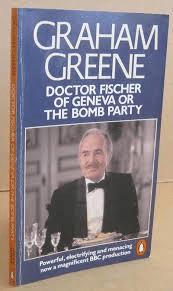
So, as always, the question has to be asked, why did I read Dr Fischer of Geneva? The BBC made a television movie of the book in 1984, with Alan Bates, James Mason (in his final screen performance) and Greta Scacchi in the leading roles and with Barry Humphries rather hilariously miscast as the alcoholic womanising film star Richard Deane. The edition I read had a still from this adaptation on the front cover and the impression was inescapably that I was looking at a late version of one of Roald Dahl’s corny ‘Tales of the Unexpected’. (For people of my generation that reference will immediately summon up a lot of memories and meaning – for others please refer to the internet!) Perhaps it was that association, combined with the promising brevity of the novella, that encouraged me to read this text to while away the time on a short journey.
The novella is narrated by Alfred Jones, a translator for a Swiss chocolate company. A note of inauthenticity is immediately introduced – did even the largest chocolate companies have their own in-house translators? It does seem something of a luxury. Jones lost his left hand while working as a fireman during the Blitz and is a widower in his fifties. In Geneva Jones meets the much younger Anna-Luise Fischer, the estranged daughter of the eponymous Dr Fischer and quickly experiences a mutual if unlikely attraction. Her father, Dr Fischer, has become rich after inventing a perfumed toothpaste. He is now known for his notorious dinner parties which attract the rich and famous. Alfred and Anna-Luise are married after a very short courtship and the problem of how to tell her father is one they eventually have to confront.
Jones finally plucks up the courage to go and see Fischer to tell him about the marriage, but Fischer is indifferent to the news. However, he later invites Jones to one of his slightly sinister and infamous dinner parties. Anna-Luise begs him not to go – the suggestion is that the parties will in some way corrupt him – but she relents, and out of curiosity Jones goes to one of the parties. At the party, Fischer sets out the ‘rules’: if a dinner guest does as she or he is instructed they will receives a valuable present at the end of the meal. This is simply a way for Fischer to humiliate his guests. Desperate for their reward they go only with the rules, pretending to find the experience amusing. Jones of course refuses to take part.
This would have been the last of their relationship with Dr Fischer and his ludicrous parties, but Anna-Luise is tragically killed in a skiing accident. Jones is devastated and considers suicide. He tells Fischer about his daughter’s death, but he needs unconcerned. When unexpectedly another party invitation arrives from Dr Fischer he decides to attend to vent his anger at his father-in-law’s indifference to his wife’s death by attending the dinner party and telling him precisely what he thinks of him and his ‘friends’.
This is of course the “Bomb Party” of the novel’s alternative title. Dr. Fischer explains the rules – he has hidden cheques for two million francs apiece within five crackers. Inside the sixth is a small bomb likely to kill whoever opens it. The guests are expected to chose a cracker and open it. A form of Russian roulette in other words. Most of the guests accept the challenge, partly suspecting that Dr Fischer would not really kill one of his guests. Jones, still feeling suicidally reckless, opens several of the crackers. I won’t spoil the ending for you but it was neither surprising nor satisfying.
Greene is quite clumsily discoursing on wealth and morality, but I am not convinced he had anything particularly interesting to say. Fischer is a monster who uses his wealth to abuse his ‘friends’, and they are sufficiently avaricious to allow him to treat them like that. Rich people aren’t very kind to one another. Who would have known? By contrast the romance at the heart of the novel is sweet albeit brief. Jones’s first person narration warns the reader early on that it is not going to last, so Anna-Luise’s death does not come as a shock. But we lose the more interesting character – Jones never really emerges as a convincing persona: having lost his hand in the war he has no expectation of a romance in later life, let alone with someone as exuberant as Anna-Luise. After her death he reverts to existing rather than living.
This was a late Greene novella, not much more than an extended short story. It passed away a short journey, but I doubt it will linger long in the memory, nor encourage me to continue trying with Greene.
 The Reading Bug