
Did I mention that Terry Pratchett was, amongst many other things, a brave writer? In his novels he tackles some of the most difficult subjects, and the fantasy settings can only provide so much “it’s only a story about vampires and trolls” cover. In Monstrous Regiment he addresses some seriously weighty issues – war, the status of women in the military and wider society, and fundamentalist religion.
For much of the time he is on a tightrope, balanced finely between being preachy while also avoiding being insensitive – these are not laughing matters. Amazingly he pulls it off – there’s never a point in this novel where I felt spoken down to or where the material wasn’t treated with the respect it deserved, while all the time making a series of serious points about the issues discussed. It’s mature writing of the highest order, Pratchett at the peak of his powers.
Which begs the question – what’s the novel about? Monstrous Regiment is set in Borogravia, a deeply traditional country not far from Uberwald, and therefore a long way from anywhere else. Its people are followers of Nuggan, a weirdly strict deity who rules through his representative on earth, or in the part of it that is Borogravia, the Duchess, the country’s monarch, who is almost certainly long-dead. There is strong middle-European feel to this country, not least to its constant border disputes with its neighbours over who owes a particular field or tree.
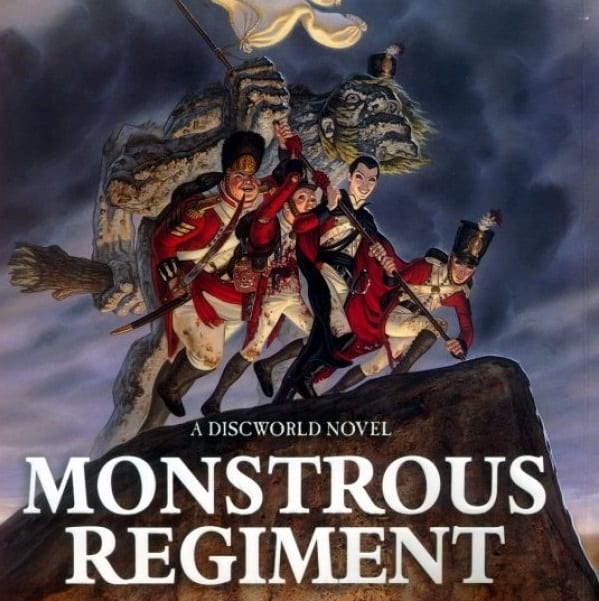
The current war with Zlobenia is going badly for Borogravia, and we join the novel with recruiters scouring the countryside for anyone who can hold a gun. The narrator follows Polly Perks, who joins up to try and find her missing in action brother Paul. (This is not just sisterly love – if Paul cannot be traced the family pub will pass to her drunken cousin when her father dies. It is one thing to recognise the unfairness to women of inheritance law, and another to include such reference in a fantasy novel). Joining a long tradition of women in the military, Polly disguises herself as a man. Much fun is had with her attempts to adopt a male swagger, to occupy space, and to fart and belch convincingly. Other recruits sign up – Maladict, a vampire, a troll called Carborundum, an Igor, and Tonker, Shufti, Wazzer and Lofty. Without wanting to spoil the reveal, this unlikely bunch of recruits are not what you might expect of a group of young men and persons joining the army.
They set off for the front, led by Sergeant Jackrum, a corpulent and highly experienced recruiting officer and their commanding officer, Lieutenant Blouse. Their first encounter with an arrogant troupe of Zlobenian cavalry is surprisingly successful. even more so when their unlikely victory is reported on by war correspondent William de Worde, he of The Truth. They quickly become popular figures of interest followed back home, and elsewhere by Commander Vimes, sent from Ankh-Morpork to try to broker a peace and protect Ankh-Morpork interests. Vimes sees that a straightforward Zlobenian victory will lead to an imbalance of power in the area, so he wonders whether the small band of plucky recruits working their way to the war might prove more useful than just cannon fodder. Sergeant Angua keeps track of the recruits as they make their way to the front, occasionally providing help, such as an unexpected package of coffee when Maladict, a black ribboner, (a vampire who has foresworn blood) begins to suffer withdrawal symptoms. On their journey the links between the unlikely recruits grow stronger, and their various backstories and secrets slowly emerge.
When they reach the front the recruits realise that the war is at a stalemate – Borogravian troops are pinned down and unable to break out of a small area of land; Zlobenian and alliance troops holding the area’s principal fortress but are unable to press their advantage. Control of the castle is key, and in a highly risky plan (which is therefore guaranteed success) they decide to infiltrate the Keep disguised (of course) as washerwomen, free the prisoners, and end the war.
I can’t tell you much more without revealing some important plot points, and for once I don’t intend to do so. As always with Pratchett the plot is really secondary to the character development anyway, and the outcome is not really that much of a surprise.
This is one of my favourite later Discworld novels – it’s set in largely new territory with only a brief appearance of regular characters, but remains unquestionably Discworld in feel throughout. The sensitivity with which the material and issues are handled is impressive, and although the jokes as always are pretty basic, the central characters are fully rounded and utterly believable. There are no bad starting places in the series, but if you have preconceptions about fantasy novels as being full of dwarves and dragons, there are worse places to put you straight than this.
P.S. I am sure you will have spotted it, but just in case, the title is an ironic reference to this 16th century misogynist pamphlet against women in positions of authority.
P.P.S. Towards the end of the novel, Pratchett uses the haunting refrain “the world turned upside down” several times. You might recognise this phrase from the musical ‘Hamilton‘. But Wikipedia tells me that the phrase derives from a pamphlet published in the 1640s “as a protest against the policies of Parliament relating to the celebration of Christmas” and has an even earlier origin in Scripture:
“These that have turned the world upside down are come hither also; Whom Jason hath received: and these all do contrary to the decrees of Caesar, saying that there is another king, one Jesus‘.” Acts 17:5-7
The Hamilton reference derives from a legend that the British army marched to this tune when they surrendered after the Siege of Yorktown. The British army would apparently have played an American or French tune in tribute to the victors, but General Washington refused them the honours of war and insisted that they play “a British or German march.” Like most good stories of this kind it is probably apocryphal – it first appears in the historical record a century after the surrender!
 The Reading Bug
I’m currently reading Monstrous Regiment and it’s just brilliant. There’s such a wonderful dialogue about very real issues told with the customary (and faultless) wit of Pratchett! 😀
LikeLiked by 1 person
100%
LikeLiked by 1 person