Paradise has a gripping opening:
They shoot the white girl first, but the rest they can take their time. No need to hurry out here.
The rest of this complex, challenging novel is all about unpicking this first sentence – what has driven these men to attack these women?
They are 17 miles from a town which has 90 miles between it and any other. Hiding places will be plentiful in the convent, but there is time, and the day has just begun. They are nine. Over twice the number of the women, they are obliged to stampede or kill, and they have the paraphernalia for either requirement–rope, a palm leaf cross, handcuffs, mace, and sunglasses, along with clean, handsome guns.”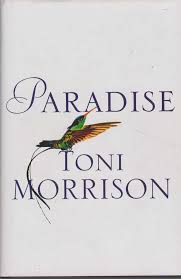
Readers of Morrison’s previous novels might be expecting the “they” in this opening paragraph to be white racists attacking a black community, perhaps in the civil rights period if not earlier. Any expectations of this kind are quickly confounded. It soon becomes clear that this is an exclusively black community brutally cleansing itself of the inhabitants of a troublesome women’s communal shelter.
Ruby, a town of some 360 souls, was founded as a refuge for its inhabitants, in recognition that black communities were always going to face racism from white neighbours and authorities. This retreat into isolation and seclusion followed a brief period after the civil war when some black community leaders rose to positions of prominence, only to be stripped of those roles as part of the removal of civil rights that in turn took many decades to restore. Ruby is a successor community to the earlier Haven, also a black-only town, intended (as the name implies) to create a place free from racism and prejudice. As part of the building of the community the founding fathers constructed a communal oven of brick and iron. This oven carries a heavy symbolic burden representing everything the people of Ruby have achieved. The name of the new town, originally “New Haven” derives from that of a young woman who died when she was refused medical attention because of her race. The town has no jail or cemetery because, it is claimed, it has never needed either, although this is what is known surely as tempting fate?
Anxiety about Ruby’s future comes to crystallise in concerns about the nearby “convent”, a refuge for women with nowhere else to go, a mirror image of the town. The building sense of crisis comes to be crystallised around plans to change the slogan on the Oven: though it now says only “… the Furrow of his Brow”, the town elders claim it used to say “Beware” at the beginning, whereas the younger generation wishes to make it “Be the Furrow of his Brow”. In parallel to learning the history of Ruby we learn the back-stories of the inhabitants of the ‘convent’, a mansion ominously designed like the cartridge of a gun. The description ‘convent’ is colloquial but incorrect – the house was originally a boarding school for native American girls until it closed and became the refuge of today. (In writing this post I am struggling with tense – “is” or “was” – this is at least in part because the narrative is so fluid in terms of time, jumping freely from decade to decade.) The tipping point in the troubled relationship between the town and the convent comes when some men in the town are scandalized when the Convent women make a rowdy appearance at a wedding between members of two of Ruby’s founding families.
This is a classically “difficult” novel. There is little exposition – a sequence of point-of-view narrators tell their stories, explaining little and only slowly coming to the point at which their lives bring them to Ruby. Some things are never explained – for instance one character, Mavis, flees an abusive husband and family following the death by suffocation of her young twins. These deaths are almost too horrific for her to consider face-on, so we only get brief snippets of information about how they came to die or be killed, and about her culpability or otherwise for their deaths. The memories and reminiscences of the multiple narrators range freely over time, and it can often be hard to tell when and where the events being described happened. It’s a little like looking at a jigsaw before the pieces are assembled. If you read a traditional review of this novel it will normally try to pieces these pieces together for you, or at least join up the edges, and lay them before you in a sequential narrative – this happens, then this happens, etc. But reading the novel is obviously a very different experience – we find things out, if ever, when the author tells us, and it can be many pages between a scene or situation being described and us finding out what may have happened. This complexity is further compounded by the scale and ambition of the novel. There are dozens of characters involved in the narrative, and I defy any reader on a first reading to keep track of who they are and the complex web of family relationships between them. I can only assume that the author knew we would be unable to retain all this information on a first read. So is the experience of reading this novel intended to be muddled and unclear, or are we being invited to return for further readings?
I have written about complexity in novels many times before, such as here, and I should be clear and re-emphasise that complexity isn’t inherently either good or bad. I have tried to read books where the complexity was such I gave up, but that was my failure rather than that of the author. Complex books can be rewarding in ways that straightforward narratives are not, however frustrating they can be at the time. Which is a way of avoiding the question of whether the complex nature of Paradise makes it a rewarding read or not. Initially I couldn’t make my mind up, so I read some reviews.
The New York Times was pretty savage:
“Paradise” is everything that “Beloved” was not: it’s a heavy-handed, schematic piece of writing, thoroughly lacking in the novelistic magic Ms. Morrison has wielded so effortlessly in the past. It’s a contrived, formulaic book that mechanically pits men against women, old against young, the past against the present.
Zoe Heller in the London Review of Books was less strident but still had serious reservations:
At some point, all Morrison’s major novels seem to lose patience with the finicky business of recording moral blur, choosing to swerve off into the realm of moral fable and preacherly uplift. Often, as in Paradise, the change is marked by an onset of gloopily ‘miraculous’ events.
Adam Mars Jones in the Guardian agreed with the LRB’s concerns about the mysticism in the novel
If Morrison had resisted the temptation to bring in possession, ghosts and amateur miracles, Paradise might have attained the status of masterpiece. As it is, reading the book is too often like standing next to someone with a pair of powerful binoculars trained on a distant view. From her impassioned commentary on what is going on you long to share her vision, but when she passes the binoculars across, the focus wheel is missing or jammed.
This is a novel that confounds readers’ expectations. It is not an easy read, and I am not yet convinced that the complexity works in the way it does in, for example, the work of William Faulkner, of which I kept getting strong echoes throughout the novel. I can certainly understand the reservations of the reviewers quoted here, that frustration with a novel that never fully comes into focus.
It would be wrong of me to close this post without paying tribute to the author who died last month aged 88. Her life was one of remarkable achievement, culminating in the Nobel Prize in Literature in 1993. In 2012 she was also awarded the Presidential Medal of Freedom, and in 2016 she received the PEN/Saul Bellow Award for Achievement in American Fiction. She was unquestionably a giant of American literature, and through her work provided a way for America to come to terms, at least in a small way, with its past.
 ails of the story emerge in the gaps between what the narrator tells us, and what we can perceive is actually happening. Here Ishiguro pushes the flawed narrator concept even further – Stevens’s memories are carefully layered to reveal a portrait of a man profoundly reserved and out of touch with his feelings, who comes to fear that he has wasted his life, and worse still will waste what remains to him. Several memories are revisited more than once in the course of the novel, with Stevens’s revisions and corrections revealing each time further insights into his decisions and thought processes.