
The Remains of the Day is a subtle, detailed portrait of a life of self-control, restraint and sacrifice. It is narrated by Mr Stevens, an ageing butler, who in 1956 takes a road trip to the West Country, to visit a former colleague, Mrs Dean, formerly Miss Kenton. In the course of his largely uneventful trip he reminisces freely about his long career of service. It has been a prestigious career at the height of his profession, or at least so he claims, but there has been a price to pay for this commitment to the demands of his role.
We are used to flawed narrators in modern literature, in which the det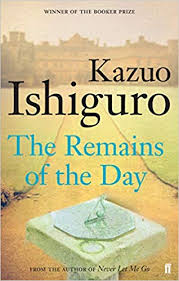 ails of the story emerge in the gaps between what the narrator tells us, and what we can perceive is actually happening. Here Ishiguro pushes the flawed narrator concept even further – Stevens’s memories are carefully layered to reveal a portrait of a man profoundly reserved and out of touch with his feelings, who comes to fear that he has wasted his life, and worse still will waste what remains to him. Several memories are revisited more than once in the course of the novel, with Stevens’s revisions and corrections revealing each time further insights into his decisions and thought processes.
The ostensible purpose of his road trip emerges over the course of the novel. Initially we are told that Stevens is planning to ask Miss Kenton to return to Darlington Hall, the scene of his long years of service to Lord Darlington, and more recently to an American employer, Mr Farraday. Darlington Hall was once a large prestigious establishment, but is now sadly reduced with large areas of the hall closed up, and only a skeleton staff. Stevens has received a letter from Miss Kenton which he chooses to interpret as indicating that she wants to return to her post as housekeeper. At this time we know little about their relationship, and Stevens only gives us unreliable glimpses of the past, but he slowly builds a picture of a warm friendship which could easily have become something more. Later he confesses that he may have read too much into her letter, and that his visit has more a more personal agenda. He mentions several other former acquaintances that he has lost touch with over the course of the years, and it becomes apparent that this trip is, for Stevens, (although he would never admit it) a last attempt to rekindle an old flame and recapture some of the former glories of his past. Stevens is an expert at self deception, and his explanations for his conduct – for example when he pretends to the villagers he meets when his car breaks down that he is a gentleman, rather than a servant – are always plausible but ultimately unconvincing.
In parallel with this personal account of his life, Stevens reveals the story of his former employer, Lord Darlington. Lord Darlington, it slowly becomes apparent, was a Nazi-sympathiser and supporter of appeasement, and after the outbreak of the second world war was publicly disgraced. Stevens avoids admitting that he was butler to Lord Darlington in the post-war present, even though privately in the confines of his personal narrative he defends his former employer as having been well-intentioned if ultimately misled by those he trusted. In one scene he recounts the story of his being asked by Lord Darlington to fire two servants because they are Jewish. He does so despite the passionate protests of Miss Kenton, taking the approach that it is not his role to question his employer’s decision.
The pace of the novel and the lack of incident in the present have led to some reviewers expressing frustration with this novel. Stevens’s buttoned-up, restrained personality, and his habit of expressing himself with precise, non-committal language that never expresses his true feelings. When his father dies for example, we can only tell he is upset because someone notices he is crying, something he would never admit to doing himself.
Certainly there are no car-crashes, chases or fist-fights in ‘The Remains of the Day’. If you are looking for dramatic incident, look elsewhere. This is a novel of subtle details, precisely chosen words, and delicate portraits. The reader needs to invest in the narrative – if they do so the rewards are worth it.
Did you enjoy ‘Remains’? Did you prefer the film, which was undoubtedly brilliant, but arguably placed too much emphasis on the romantic aspects of the novel? Or was the lack of incident a problem for you? Would really like to know what you thought.


Thanks for reminding me how much I enjoyed this book! There is something achingly sad in all that Stevens refuses to admit to himself.
LikeLiked by 1 person
Looking forward to reading more Ishiguro. Any recommendations?
LikeLike
It’s the only one I ever read actually.
LikeLiked by 1 person
This is a fantastic book. One of my favorites. I read it fairly recently, within the last couple of years. I had no idea there was a movie or how it stands up compared to the novel. In the novel, Ishiguro creates a narrator who comes across as an authentic person. If you loved this book, you must read An Artist of the Floating World. The twists are more twisty and the outcomes graver than in this book. Both are masterpieces of the written word. And if you like both of these, try reading After the Banquet by Yukio Mishima, which I feel has a similar atmosphere of tone, even though it’s about a woman who runs a business and not the reflections of retired men.
LikeLiked by 1 person
The movie was nominated for 8 Oscars, but I don’t think it won any. many thanks for the recommendations.
LikeLike