Book review

Girl, Woman, Other by Bernadine Evaristo, 2019

When is a novel not a novel? When it is, as here, a collection of loosely related narratives, or a “collage of well-composed individual stories” as one reviewer described it, without much in the way of plot. Is the distinction an important one? I think so, but let’s come back to that question.

Girl, Woman, Other tells the stories of the lives of the novel’s 12 principal characters. Most the large cast of characters are black and mixed race women, and of course their stories focus on this aspect of their lived experience. The book is divided into four chapters each telling the stories of three women who are connected to one another in some way. Although each story is a separate and often compelling narrative in its own right, they slowly interweave to create the overall narrative. The novel’s focal point to which it returns from time to time is the opening night of a ground-breaking new play, The Last Amazon of Dahomey. The implicit point is that all of the women portrayed in the novel are one way or another Amazons themselves, warrior women who have had to fight for everything they have achieved.

While GWO has been widely lauded, and of course won the 2019 Booker prize (jointly with Margaret Atwood’s sequel to The Handmaid’s Tale, The Testaments), the author’s choice to not use capitals and full stops to signal the start and end of sentences has upset some readers disproportionately. A good example is this passionate post from the Orangutan Librarian. For me, this wasn’t really an issue. Rules are there to be broken by writers and I found I quickly adjusted to the convention the author used to signal a new sentence, namely a line break. To an extent this made the choice to abandon full stops etc fairly pointless (sorry). I assume the author was aiming for a free-flowing representation of the characters’ internal monologues, something akin to stream of consciousness. Because my mind reconstructed the sentence structure fairly easily, and after while without noticing, this effect was largely lost.

It is hard to write this without sounding spiteful, but my main concern with GWO was not the choices around punctuation, but the quality of the writing. As an experiment I opened my copy of the text at random half a dozen times, and noted the following:

“he sold the farm for a song” (178)

“the two love-birds sat holding hands on the sofa” 269

“over time Shirley became an experienced schoolteacher who remained committed to giving the kids a fighting chance” (sorry forgot to note page number!)

“Mummy went through the roof, literally exploded like a rocket” 205

“it’s way too early for the youngsters to begin their death-defying leaps and twists without helmets or knee-pads” (23)

“apparently Tyrone, Section Manager of Electronics and Appliances, has a thing for her” (213)

(Incidentally, I can’t resist pointing out that the author’s rejection of capitals doesn’t extend as far as names and job titles!)

The weight of cliché here is, for me, problematic. Of course it is difficult to represent people’s internal monologues without using cliché if that’s how you think they would express their thoughts. But do people really think in clichés? In any event most writers would try and find a way around that issue rather than just weighing down the narrative with an accumulation of stale expressions.

The text only really takes off and becomes lyrical and expressive when political views are being discussed. Some reviewers have found this aspect of the novel didactic. I didn’t see it that way – each character represented is shown as having their own prejudices and biases, and there is no single perspective that is endorsed as being definitive, simply that we all carry our own burden of experiences and ideas, which change over time. That’s not to say the novel is entirely neutral, respectful of all views. Right wing readers will struggle with the representation of the progressive portrayal of oppression in all its forms that the women in the novel experience. The discussion of white privilege between the students in the novel is entertaining as well as being informative:

People won’t see you as just another woman any more, but as a white woman who hangs with brownies, and you’ll lose a bit of your privilege, you should still check it, though, have you heard the expression, check your privilege, babe?
Courtney replied that seeing as Yazz is the daughter of a professor and a very well-known theatre director, she’s hardly underprivileged herself, whereas she, Courtney, comes from a really poor community where it’s normal to be working in a factory at sixteen and have your first child as a single mother at seventeen, and that her father’s farm is effectively owned by the bank
Yes but I’m black, Courts, which makes me more oppressed than anyone who isn’t, except Waris who is the most oppressed of all of them (although don’t tell her that)
In five categories, black, Muslim, female, poor, hijab bed
She’s the only one Yazz can’t tell to check her privilege
Courtney replied that Roxane Gay warned against the idea of playing ‘privilege Olympics’ and wrote in Bad Feminist that privilege is relative and contextual, and I agree, Yazz, I mean, where does it all end? Is Obama less privileged than a white hillbilly growing up in a trailer park with a junkie single mother and a jailbird father? Is a severely disabled person more privileged than a Syrian asylum-seeker who’s been tortured? Roxane argues that we have to find a new discourse for discussing inequality

While many characters are well rounded in all their flawed humanity, others are more lightly sketched and less convincing. One example is Roland, Yazz’s father, who at one point describes his partner’s disturbing way of rejecting homophobia:

“Sylvester shouting Take that, Maggie T! at the point of ejaculation was quite off-putting” (407)

Did anyone ever call Mrs Thatcher “Maggie T”? Surely it was either Maggie or Mrs T? This lack of authenticity in a novel grounded in attempts to accurately reflect the experience of black and mixed race women growing up and growing old in the UK was disappointing but probably the exception, although this lack of authenticity is echoed elsewhere by some of the exchanges on race and feminism:

“We should celebrate with that many more women are reconfiguring feminism and that grassroots activism is spreading like wildfire and millions of women are waking up to the possibility of taking ownership of our world as fully-entitled human being how can we argue with that?” (said after two bottles of red wine and 4 lines of coke!) or elsewhere “Her mother was unthinkingly repeating patterns of oppression based on gender”

To return to the question I posed at the start of this post, is the novel taken as a whole greater than its constituent parts? I can certainly see each portrait as a separate sketch being published in serial form in a magazine without any loss of impact. (And to be clear, I mean no disrespect by this. Dickens published his novels in serial form in magazines, and he was a fairly good writer!). Part of the problem is a failure or inability to draw the stories together – the links between them are fragile, and the attempt to introduce a surprise ending falls flat given how clearly it has been telegraphed earlier in the novel (one mixed-race character is adopted as a baby and doesn’t know anything about her birth parents; another has her mixed-race baby removed from her by her parents and placed for adoption – who could guess how this development would be resolved? One review described this approach as:

“too many delicious starters without a truly satisfying main course.

Which I think is about right.

Standard
Book review

The Power, by Naomi Alderman, 2016

Many of the great dystopian novels have at their centre what amounts to a thought experiment – a ‘What If….?’ What if women were enslaved and used to breed children? What if totalitarianism ruled our lives? What if our obsession with technology distorts society to remove all meaningful human relationships? And so on. Alderman’s master-stroke in ‘The Power‘ is to imagine a new and compelling ‘What If?’ – what would happen if women had the ability to generate electric shocks from their bodies? What if they literally had ‘the power’? What would that do to gender relationships in society? Would women be free from sexism, oppression, sexual violence and so on? Ultimately, would the world be a better place?

Alderman uses a rather clumsy framing device to provide a structure to the narrative. The novel is book-ended with correspondence between a male historian turned author and a female editor. He seeks her comments on and support for his novel, ‘The Power’. He is attempting to find a wider audience for his archaeological findings by turning them into a novel, recreating the world he has discovered . She patronises him, finding the scenes of female on male sexual violence and the idea of male soldiers “sexy”. She suggests the novel is published under a male pseudonym, in an ironic inversion of a practice in publishing that still survives to this day. Their letters are written several thousand years after the central events of the novel. The historian’s theory, given imaginative form in the novel, is that women have not always had ‘the power’, and in earlier pre-power societies men were the dominant sex. He describes the period when women’s electrical abilities first emerged, and the events leading up to the global war which followed.

This framing technique is not new of course – Margaret Atwood (who mentored Alderman during the writing of this novel) does something similar at the end of the Handmaid’s Tale, as does Orwell at the end of 1984, but the impact of the device in both is different, distancing the reader from the grim dystopias, and offering hope that the world has changed. In The Power, Alderman both opens and closes the novel with the correspondence, so we are aware while reading the novel that things don’t end well – chapters headings even have a grim countdown to the apocalypse to emphasise the point. Between chapters are illustrations of archaeological finds. The historian ‘author’ speculates on their purpose, often wildly inaccurately. Alderman has some fun here – for example she talks about the mysterious meaning of the ‘bitten fruit logo’, although this ignorance of twenty-first century technology is not really consistent with the story within the story, in which email and smart-phones are fully understood.

The central narrative is told through the intersecting stories four main characters: Roxy, the daughter of a British drug baron; Margot, mayor of an unnamed city in the United States; Allie, a teenage girl in an abusive foster home in Alabama; and Tunde, a young male Nigerian journalist. Tunde stumbles into journalism driven by a need to understand ‘the power’, and through his efforts the reader sees the its impact on countries around the world. In some countries, such as Saudi Arabia, the changes are literally revolutionary. Allie is at the heart of the development of a new religion focussed on women and their new powers, reinterpreting Christian theology with a fresh emphasis on the role of women. Margot’s story shows the impact of the power on politics and the military-industrial complex – the military possibilities of the power are quickly identified. Finally Roxy’s story shows how organized crime reacts to the opportunities of the changes within society. These disparate narratives converge, improbably, on the newly declared central European nation of Bessapara, which becomes the focus for their stories and the stage on which a new world order begins to emerge.

At first, the power liberates women. No longer frightened of the men in their lives, they begin to take control. The reversal of roles happens quickly – stripped of their power to physically dominate women, men become subservient. This is shown in some obvious ways – there is a scene when women soldiers rape some young men – but also in subtler ways, such as the male newsreader who claims not to understand the political stories he is covering, and is relieved to turn to lighter news or the traffic reports.

The central concept of ‘The Power‘ is remarkably effective. It is thought-provoking and challenging. It locates the oppression of women in their physical weakness relative to men, and asks what would happen if that situation were to be reversed? Whether women’s oppression is solely down to this issue or is rooted in other causes is probably beyond the scope of this review, but what is interesting to me is that Alderman argues quite explicitly that once women have the upper hand, they behave just as badly and oppressively as men. They abuse their physical superiority to strip men of their human rights, to demean them, to torture, humiliate and assault them. Women are not the gentle sex here, they are just weaker, and as soon as that changes they exact revenge. As a mediation on the relationships between the sexes and their capacity to change, this is therefore ultimately a pessimistic book. It argues that human power is not located in the rules by which we agree to conduct civil society, but in our brute strength and ability to harm one another:

“It follows that there are two ways for the nature and use of human power to change. One is that an order might issue from the palace, a command unto the people saying “It is thus.” But the other, the more certain, the more inevitable, is that those thousand thousand points of light should each send a new message. When the people change, the palace cannot hold.”

Furthermore that physical power cannot be trusted in the hands of either sex. Women’s liberation in these circumstances becomes impossible. Their oppression is caused by their physical weakness relative to men (the author suggests) and there is no mysterious electrical power that is going to spontaneously emerge and liberate them – but even if there were, that freedom would be at the expense of men, civil society, and peace.

The contrast with ‘The Handmaid’s Tale‘ is stark. We believe that Atwood’s world is possible, not least because it is drawn from the real-life oppression of women. Women can be freed from Gilead not through any superhuman or supernatural external forces, but through their own actions (and those of their allies). Atwood’s novel is therefore at the same time both more chilling and more optimistic about the future of our species.

I am left wondering, worrying – have I misunderstood the allegory of ‘The Power‘? Does a novel that ostensibly seeks to imagine a world in which women do not have to fear men really end up by concluding that such a world is impossible, unattainable? In a way I hope so.

Standard
Book review

A Room of One’s Own is Virginia Woolf’s celebrated essay on the position of women in society. In this important landmark text in feminist writing, Woolf confronts the central challenges facing women in Britain in the 1920’s, barely a decade after they were first legally entitled to vote in general elections. While ostensibly about the problems of being a woman writer, the essay has much broader themes. Its central thesis (if it can be said to have one – it is quite discursive) is that “England is under the rule of a patriarchy.” The book’s title derives from Woolf’s argument that to address this oppression

a woman must have money and a room of her own if she is to write fiction”.

Woolf adopts a number of personas to narrate the text, referring to herself in the third person as Mary BetonMary Seton, Mary Carmichael “or by any name you please“. These names are not adopted by chance of course – whether Woolf’s audience would have been aware of their historical significance is possibly irrelevant – the use of the forename Mary to represent an everywoman figure has its own resonance. The style of the narrative has been described as stream of consciousness. There are elements similar to this but it is not quite right. Although it has an informal format far from the traditional structure of a lecture or speech and it does wander to a degree, the narrative thread remains clear.

Categorising this book is not easy. I can’t think of any obvious equals to it in modern literature. It’s certainly a lot more than a lecture or an essay – the imaginative reconstruction of the narrator’s time spent preparing for the lecture reads almost like a novel (and the book is sometimes described as such) in the intensity of its descriptive writing:

I found my way back to my house by the river. Lamps were being lit and an indescribable change had come over London since the morning hour. It was as if the great machine after labouring all day had made with our help a few yards of something very exciting and beautiful – a fiery fabric flashing with red eyes, a tawny monster roaring with hot breath. Even the wind seemed flung like a flag as it lashed the houses and rattled the hoardings.

While the book’s title offers a simple solution to the question Woolf poses – that in order to be able to express themselves freely as authors (and by implication in all other fields) all women need is financial independence – the narrative recognises that the issue is more complex than this solution suggests. Woolf recognises for example that many of the great nineteenth century women novelists had neither rooms of their own nor financial independence. She pays tribute to these women who were able to write magnificent novels despite the constraints of society, who wrote without neither a room of their own nor £500 a year.

Woolf also recognises the importance of women being free in other ways, including to make their own choices in terms of their partners. Describing the work of a fictional woman author Woolf teasingly tells her readers/audience

“Then may I tell you that the very next words I read were these – ‘Chloe liked Olivia …’ Do not start. Do not blush. Let us admit in the privacy of our own society that these things sometimes happen. Sometimes women do like women.”

Here Woolf explicitly refers to  the recent obscenity trial of Radclyffe Hall’s The Well of Loneliness. Before she can discuss the ‘like’ Chloe has for Olivia she rhetorically checks whether Sir Chartres Biron, the magistrate in charge of Hall’s trial, is not listening. Such a check would be meaningless unless there is more to the ‘liking’ than just friendship.

The text’s most resonant chapter reflects on what might have been had Elizabethan women had the opportunity to write as freely as men. Woolf brings to life Judith, Shakespeare’s sister, who is denied an education, banned from the stage, and dies ignominiously without ever having the chance to write freely. What plays or poems are lost to the world by the absence of a room of her own where Judith could write? Sometimes it is just as important to ask the right questions as it is to offer answers, and here Woolf reminds us powerfully of all we have squandered by not allowing writers to write, musicians to play, artists to paint, whether because of their gender, class, disability or ethnicity. 

For this thought alone A Room is an important text. It doesn’t proffer any constructive solutions to the problems it raises: women are unable to express themselves freely because they do not have the independent space or funds to do so. Therefore we should….? We are not told. It sometimes feels as if the core text of the lecture has at a later point been padded to bring the book to a length suitable for publication. Woolf writes from a position of privilege, a position she freely acknowledges. My instinct is that the original lectures, stripped of a lot of the asides, anecdotes and off-the-point observations might have been more impactful that the longer, published text.


A Room of One’s Own, by Virginia Woolf, 1928

Aside
Book review

BloodyChamber.jpg

The first edition of The Bloody Chamber, published by Gollancz

Angela Carter’s The Bloody Chamber is her breakthrough 1979 collection of short stories in which several well-known fairytales are updated and given a modern twist. Several of the stories had previously been published elsewhere – only two were original to this collection. At the time of publication there was some debate about whether Carter had imposed a feminist interpretation on these stories; some forty years on that debate seems a bit irrelevant – the ten very varied stories can stand in their own right without the imposition of such limiting categorisation.

The first and longest of the tales is The Bloody Chamber, which is loosely based on the traditional story of Bluebeard. A teenage girl marries a wealthy French Marquis for his money. He seduces her with ostentatious gifts including

a choker of rubies, two inches wide, like an extraordinarily precious slit throat

and whisks her off to his mysterious castle. Left on her own she explores the library, quickly discovering his disturbing collection of pornography. This is a warning of what is to follow. After their first night together he is called away to business in New York, leaving her again alone in the castle. Before leaving he gives her the keys to the castle and tells her she can go anywhere except to one forbidden room, the bloody chamber of the book’s title. Guess what she does? She of course breaks her promise and promptly goes to his secret room, where she discovers the murdered bodies of his earlier wives, all gruesomely presented as trophies. But the latest wife, our narrator, is not going to go without a fight. Bluebeard has met his match. This story hints at the close relationship (for some) between violence and sex, without perhaps ever going the full Fifty Shades, observing

“There is a striking resemblance between the act of love and the ministrations of a torturer.”

The Courtship of Mr Lyon faithfully follows the traditional narrative of the Beauty and the Beast story. The only concession to modernity is that Beauty’s father seeks assistance at the Beast’s chateau after having car trouble rather than merely getting lost in the woods. But this conformity with the original story is presented as a contrast with the next iteration of the tale, The Tiger’s Bride. Here a woman is lost to the Beast (in the shape of a tiger) in the form of a gambling debt. In an ending to which Shrek owes a debt, instead of true love transforming the beast into a man, it is the heroine who transforms into a tiger.

The next story, Puss-in-Boots, is a comic interlude in the increasingly dark stories. Puss, a sardonic narrator of the story, helps his young dissolute companion seduce a young woman kept in a tower by a her miserly, older husband.

In The Erl-King a young woman is seduced by the sinister Erl-King, who plans to imprison her by turning her into a bird. She avoids this fate by strangling him with his own hair. If one were looking for feminist reworking of folklore outside the principal story this would be a good place to start – the Erl-King is a sexual predator and his intended victim a strong woman who sees past his sexuality and is happy to use violence to protect herself.

The Snow Child is the shortest and for me the most disturbing story in the collection. It is also the most heavily symbolic and allegorical. A Count and Countess ride out in deepest winter. The Count wishes for a child “as white as snow”. A young woman magically appears at the side of the road; she picks a rose, is pricked by a thorn and dies. Perhaps she is killed by the magic of the jealous countess?  

The Lady of the House of Love is a retelling of the vampire myth. A soldier, travelling by cycle through Romania, is lured to a mansion where a beautiful vampire tries to seduce him. His virginity somehow protects him from her, and he escapes only to have to face the greater horror of World War I.

The final three stories are variants on the Little Red Riding Hood story. In The Werewolf A girl is attacked by a wolf on the way to see her grandmother. She cuts its paw off, but when she reaches her grandmother’s house it is revealed that the grandmother was the werewolf. She is stoned to death by the villagers, who were are told are always quick to dispose of older women suspected of witchcraft in this manner. The Red character is here an unreliable narrator, and the suspicion lingers that she has attacked her grandmother in order to secure her cottage for herself. The next version of this story is The Company of Wolves which of course was turned into a feature film directed by Neil Jordan. This is a complex narrative with a number of stories within the story.  A witch turns a wedding congregation into wolves. A young couple are about to have sex on their wedding night, but the husband goes outside, never to return. She eventually remarries and has children, only for her first husband to finally reappear in wolf form. In the final story within the story yet another version of Red this time the wolf masquerades as the hunter before eating the grandmother. Red refuses to be scared by the wolf, and seduces him.

“See! Sweet and sound she sleeps in granny’s bed, between the paws of the tender wolf.”

In the collection’s final story, Wolf-Alice, Red is now a feral child raised by wolves. She lives with a vampiric Duke. When the duke is shot and wounded by the inevitable angry villagers, Alice saves him by tenderly licking the blood and dirt from his face.

In The Bloody Chamber Carter breaks multiple genre boundaries. On their own the stories are carefully crafted little gems, but the cumulative impact is unsettling and powerful.


The Bloody Chamber, by Angela Carter, 1979

Aside
100 Best Novels Guardian list, 20th century Literature, Book review

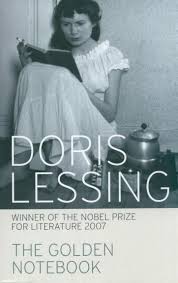
The Golden Notebook, by Doris Lessing, 1962

The Golden Notebook is a complex narrative. The writer, Anna Wulf, uses four notebooks to record different aspects of her life, and at the end of the novel attempts to unite them in a fifth, gold-coloured, notebook. The novel waves together several parallel narratives, and at times it can be hard to work out whether we are reading Anna’s personal account of her life, or her fictionalised version. In addition to the ‘realistic’ narrative of Anna’s life – Free Women— the four notebooks – black for her adventures in Africa before World War 2,  red for her time as a on/off member of the British Communist Party, yellow for a fictionalised account of her relationships, which sometimes run ahead of the real life telling of her story, and at others behind, and blue for her personal journal of memories and dreams.TGN

The non-linear narrative Lessing uses was ground breaking for its time – there is little in the way of conventional story telling. When the novel was first published the focus in many critical responses was on Lessing’s frankness in sexual matters, and what were seen at the time as her feminist characters. 50 years and more on, the presentation of sexual relationships in the novel seems dated – perhaps inevitably. As a feminist character Anna in particular is utterly defined by her relationships with men – and while she is sexually liberated, her emphasis on being sexually available to men who pay her very little regard shows her vulnerability. In the final section of the novel, the apparently unifying golden notebook, where the tale of her relationship with Saul Green is fictionalised, virtually every encounter with Green, however strained or disagreeable, almost always ends with the throwaway line “and then we made love”.

In a Guardian piece written to mark the fiftieth anniversary of the novel’s publication, Margaret Drabble put this point more clearly:

“As a feminist and a free woman, living a life of what was then striking promiscuity, her protagonist Anna Wulf displays some curiously traditional female behaviour, which is even more puzzling on rereading. On one page she can declare, shockingly but truthfully, that “every woman believes in her heart that if a man does not satisfy her she has a right to go to another. That is her first and strongest thought, regardless of how she might soften it later out of pity or expediency.” But this same woman (albeit writing in a different notebook, about a later period in her life) is discovered preparing a meal for the man she loves and knows she is about to lose. Much care is lavished on this memorable set piece describing a breaded veal escalope with mushroom in sour cream, a dish that the defaulting man never turns up to eat. Throughout the novel it is the women who do all the cooking and make all the cups of tea, even for men to whom they owe less than nothing. …. And yet it seemed liberating at the time.”

The novel has a number of other dominant themes: the Cold War and the decline of the British Communist Party, the end of Empire, and not least the personal breakdown of the central character. Often the novel seemed increasingly self-referential – so for example the novel’s opening lines are “The two women were alone in the London flat”; much later, to help relieve her writer’s block, Anna is given an opening line for her novel, which of course is “The two women…” etc. Novels which have as their central character novelists are always going to go down this road.

To be frank I found ‘The Golden Notebook’ very hard work. It is very long, very repetitive (to read about a dull relationship is one thing – to read about it twice, once in the central character’s diarised version, and then again in her fictionalised, slightly changed but essentially the same, version – is quite another. I doubt I would have troubled to finish were it not for a reluctance to admit doing so in this blog, which I think says it all. Lessing was awarded the Nobel Prize for literature in 2007, 45 years after ‘The Golden Notebook’ was published – 45 years in which Lessing published a great deal, but was never to repeat the critical or commercial success of her earlier work. It looks a little like a lifetime achievement award, which is understandable, but doesn’t make this novel any easier to read.


Standard